

Over the years on our production floor, we have seen hundreds of installation reports come back from European job sites — and the pattern is always the same EN standards 1. The most expensive failures never happen because the aluminum was bad. They happen because something went wrong before the first post was even set. A rushed site survey, a missing footing detail, or a single overlooked local code requirement 2 can turn a beautiful pergola into a costly rework project.
You can avoid most aluminum pergola installation problems by verifying custom measurements before production, inspecting all components upon delivery, confirming motor and load-bearing compliance with local safety standards, and following professional 3D installation guides to prevent onsite assembly errors.
This guide breaks down the four critical stages where things typically go wrong — and what you can do at each stage to keep your project on track. Whether you are a contractor, distributor, or purchasing manager sourcing pergolas for your clients, these steps will save you time, money, and headaches.
How do I ensure my custom measurements and technical drawings are accurate before production?
We process over a thousand custom orders each year at our facility, and the single biggest cause of delays is not production speed — it is measurement errors that arrive with the initial order. A wrong dimension by even 10 mm can mean profiles that do not fit, posts that are too short, or louver panels that gap at the edges.
To ensure accurate measurements, always conduct an onsite survey with a laser measure, confirm all dimensions against a scaled technical drawing, and request a factory review of your drawings before production begins. Double-check wall attachment points and ground levels separately.
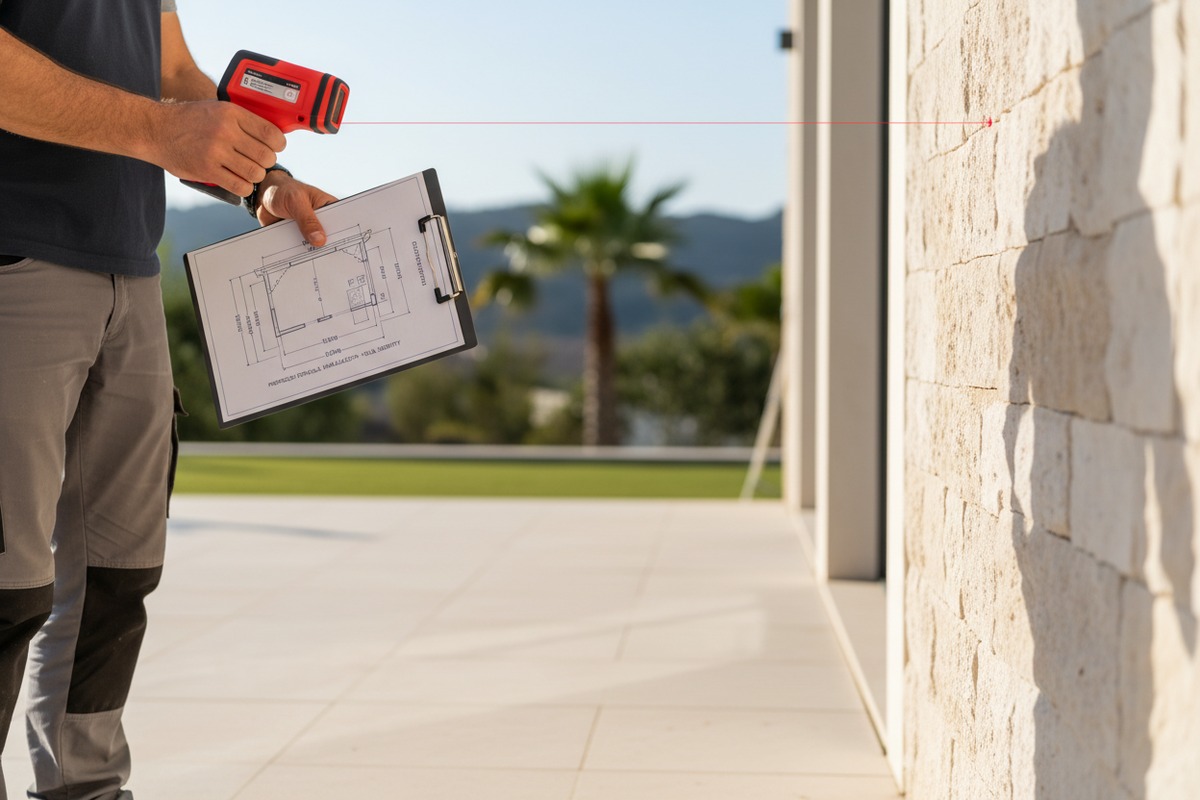
Why Measurement Errors Are So Costly
When a custom aluminum pergola 3 is cut and welded to spec, there is no easy fix if the numbers are wrong. Unlike wood, you cannot trim aluminum profiles onsite without specialized tools and a risk of damaging the powder-coated finish 4. A single wrong measurement can mean remaking entire beams or rafters, which adds weeks of lead time and significant shipping costs — especially for international orders heading to Europe.
Our engineering team reviews every drawing before it enters the CNC queue. But we can only catch errors if the drawing reflects the real site. That is why we always recommend a two-step verification: first, the onsite team measures and documents; second, a different person checks those numbers against the drawing before submission.
Key Dimensions to Verify
Not all measurements carry equal risk. Some are more likely to cause problems than others.
| Dimension | Warum es wichtig ist | Common Mistake |
|---|---|---|
| Overall width and depth | Determines beam and rafter lengths | Measuring to the wrong reference point (e.g., wall face vs. wall center) |
| Post height | Affects roof pitch, drainage, and clearance | Forgetting to account for finished floor level or footing height |
| Wall attachment height | Critical for attached pergolas | Ignoring soffit, gutter, or fascia obstructions |
| Ground slope | Impacts post lengths and leveling | Assuming the ground is flat without checking with a level |
| Diagonal measurement | Confirms the layout is square | Skipping this step entirely |
Practical Tips for Submitting Drawings
Use a simple checklist before you send your technical drawing to the factory. Include all four post locations with heights measured from the finished floor. Mark any obstructions within 300 mm of the pergola footprint — downpipes, electrical boxes, window frames. Note the RAL-Farbcode 5 clearly. And always specify whether dimensions are inside-to-inside or outside-to-outside. Ambiguity here is where most misunderstandings begin.
If you are ordering a motorized louvered pergola, you also need to specify the motor side, drainage direction, and cable exit points. These details affect the internal channel layout of the profiles, and they cannot be changed after production.
We have found that sending a short video walkthrough of the installation site — even shot on a phone — reduces drawing errors by a significant margin. It gives our design team context that a flat drawing simply cannot provide.
What steps should I take to prevent missing components or damaged profiles during shipping?
From our warehouse in China to a job site in Italy or Germany, a pergola kit can travel for 30 to 45 days by sea. That is a long journey with multiple handling points — and every transfer is a chance for damage or loss. We have invested heavily in packaging systems precisely because we know what happens when a single connector or non-standard screw is missing on arrival.
To prevent missing or damaged components, request a factory packing list with photos, insist on reinforced packaging for long-distance shipping, conduct a full inventory check immediately upon delivery, and confirm that replacement part logistics are agreed upon before the order ships.
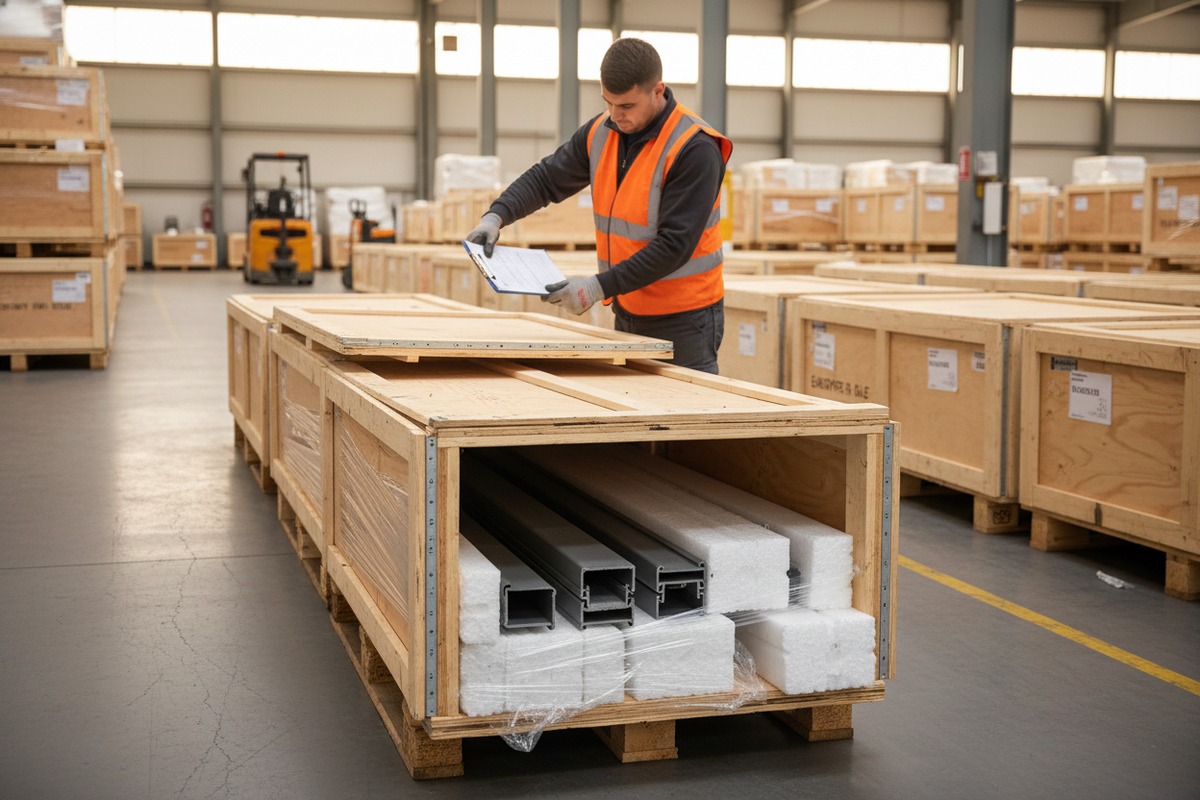
The Real Cost of a Missing Part
For a domestic order, a missing bolt might mean a trip to the hardware store. For an international B2B order, a missing non-standard connector or a scratched main beam can halt an entire installation. The contractor's crew sits idle. The client's project timeline slips. And sourcing a replacement from China can take weeks by air freight — at a cost that far exceeds the part's value.
This is why we pack every kit with a detailed component list, photograph each layer of the packing before the crate is sealed, and include a small bag of spare fasteners and connectors. But the receiving party also plays a critical role.
Inspection Checklist Upon Delivery
When your shipment arrives, do not sign off on the delivery until you have at least checked for visible external damage. Then, within 48 hours, do a full inventory. Here is a practical checklist:
| Step | Action | What to Look For |
|---|---|---|
| 1 | Inspect outer packaging | Dents, tears, water stains, crushed corners |
| 2 | Open and photograph each layer | Document condition before moving parts |
| 3 | Match parts to packing list | Count every profile, bracket, screw bag, and motor unit |
| 4 | Check profile surfaces | Scratches, dents, powder coat chips |
| 5 | Verify motor and electronics | Correct voltage, certification labels present, no visible damage |
| 6 | Test-fit critical connections | Dry-assemble one joint to check tolerances |
Packaging Standards That Matter
Not all packaging is equal. For aluminum profiles, the key risks are bending, surface scratching, and corner damage. Good packaging uses EPE foam wraps around each profile, separating layers with cardboard dividers. Corner protectors should be rigid, not just folded cardboard. Crates for sea freight should be fumigation-treated and structurally braced for stacking.
We also label every crate with a numbering system that matches the installation sequence. This may sound like a small detail, but on a busy job site with multiple deliveries, knowing which crate to open first saves real time.
Agree on Replacement Logistics Before You Order
The smartest thing a purchasing manager can do is negotiate the replacement part process before the first order ships. Ask your supplier: How quickly can you ship a replacement part by air? Do you stock standard connectors and fasteners? Will you cover the cost of replacement for factory-side errors? Having this agreement in writing prevents finger-pointing later and gives your installation team confidence that problems can be resolved fast.
How can I verify that the motor and structural load-bearing capacity meet my local safety standards?
When our team develops a new motorized pergola model, one of the first questions we address is: will this pass inspection in the markets where our clients sell? In Europe, the answer depends on CE-Kennzeichnung 6, specific EN standards for wind and snow loads, and electrical safety directives. Getting this wrong does not just mean a failed inspection — it can mean legal liability if something goes wrong.
To verify motor and structural compliance, request CE certificates and test reports from your supplier, cross-check the pergola's rated wind and snow load against your local building code requirements, and ensure all electrical components carry the correct certifications for your specific market.
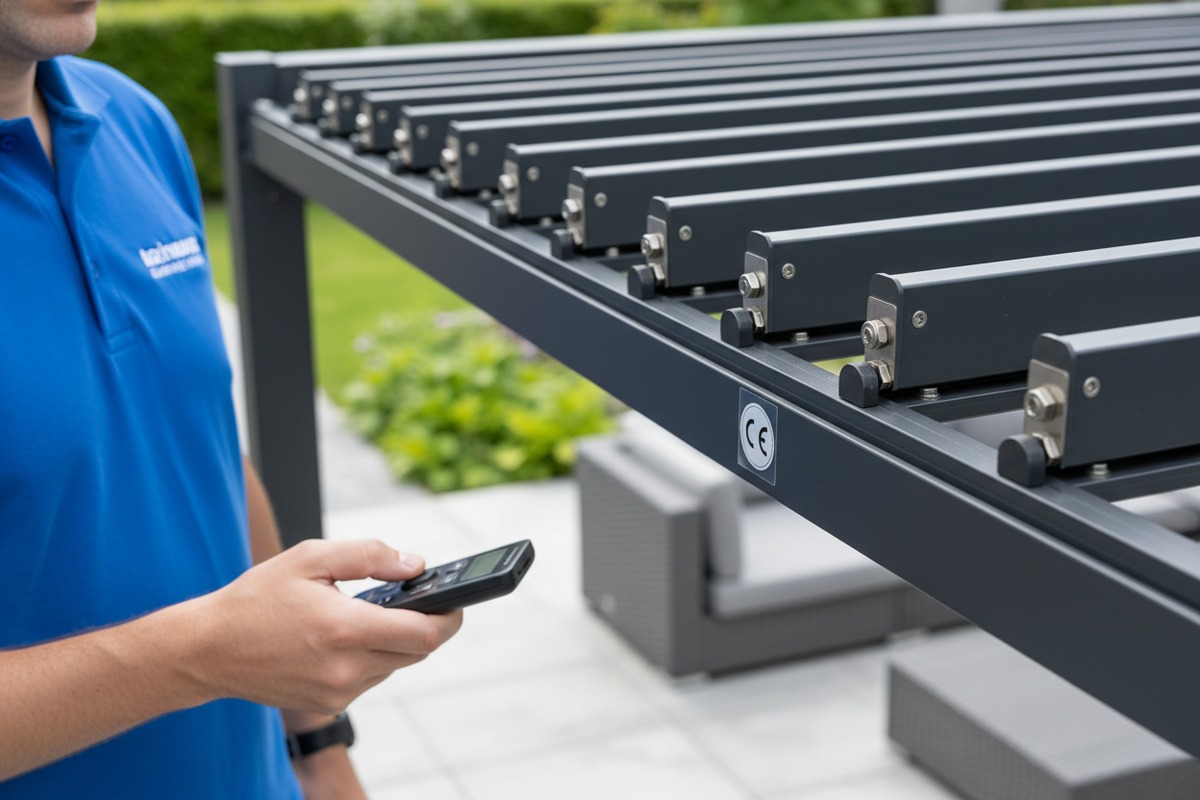
Understanding Load Ratings
Every pergola has a structural limit — the maximum wind speed and snow load it can safely handle. These are not marketing numbers. They should be backed by engineering calculations or physical testing. When you source a pergola for a project in northern Italy versus coastal Spain, the requirements are very different.
Our standard louvered pergola models are engineered to handle wind loads up to Class 6 in the Beaufort scale 7 and snow loads appropriate for most central European climates. But for exposed coastal sites or alpine regions, reinforced columns, additional cross-bracing, or thicker wall profiles may be necessary. Always ask your supplier for the specific engineering data — not just a brochure claim.
Motor and Electrical Compliance
Motorized louver systems add a layer of complexity. The motor, control unit, rain sensor, and any integrated LED lighting must all comply with the electrical safety standards of the destination country. For Europe, this means CE marking under the Low Voltage Directive 8 and the Machinery Directive where applicable.
| Component | Key Standard (EU) | What to Check |
|---|---|---|
| Louver motor | CE, EN 60335 | Rated voltage matches local supply; IP rating suitable for outdoor use |
| Control unit | CE, EMC Directive | No electromagnetic interference with nearby devices |
| Rain sensor | CE | Reliable trigger in light and heavy rain |
| LED lighting | CE, EN 60598 | IP65 or higher for outdoor exposure |
| Wiring and connectors | CE, Low Voltage Directive | Proper insulation rating; UV-resistant cable sheathing |
How to Request the Right Documentation
Do not accept a generic "CE certificate" without checking what it actually covers. A valid Declaration of Conformity 9 should reference the specific product model, the applicable EU directives, the harmonized standards used, and the name of the responsible party. If your supplier cannot provide this, that is a red flag.
We provide full documentation packages with every motorized system we ship — including the Declaration of Conformity, motor spec sheets, wiring diagrams, and recommended installation clearances for electrical connections. For contractors and distributors, having this paperwork ready means smoother inspections and faster project sign-off.
Structural Anchoring and Local Codes
Beyond the pergola itself, the anchoring method must match the site conditions and local building codes. A pergola bolted to a thin concrete slab with undersized anchors may look fine on day one, but it becomes a safety hazard in the first serious windstorm. Always consult local building requirements for footing depth, anchor bolt specifications, and setback distances from property lines. If the pergola is attached to a building wall, the wall's structural capacity must also be verified.
Where can I access professional 3D installation videos and manuals to avoid onsite errors?
One lesson we learned early in our export business is that even the best-engineered pergola will fail if the installation team cannot understand the assembly instructions. A paper manual with tiny diagrams and poorly translated text is not enough — especially when your installers are working under time pressure and may not speak the same language as the manual's author.
You can access professional 3D installation videos and manuals by requesting them directly from your pergola supplier before ordering, verifying they cover your specific model and configuration, and ensuring they include step-by-step visual sequences that do not rely heavily on written language.
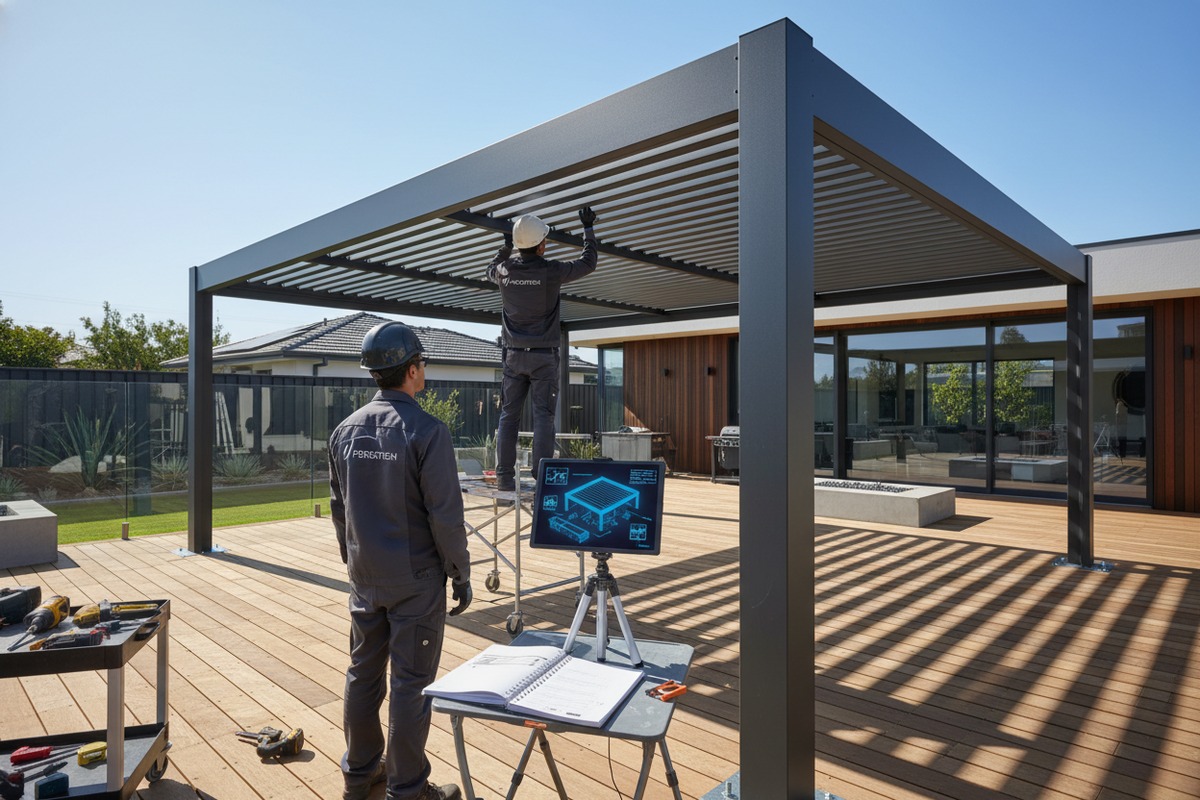
Why 3D Videos Outperform Paper Manuals
A flat diagram shows you what the finished joint should look like. A 3D video shows you how to get there — the angle of approach, the order of operations, the moment when you need a second pair of hands. For complex assemblies like motorized louvered pergolas with integrated drainage channels, this difference is critical.
Our production team creates model-specific 3D animation videos for every major product line. These videos walk the installer through each phase: foundation preparation, post erection, beam connection, louver panel installation, motor mounting, wiring routing, and final adjustment. Each step is numbered and shown from multiple angles.
What Good Installation Documentation Includes
Not all manuals are created equal. Here is what to look for when evaluating a supplier's installation support:
- A parts identification guide with photographs, not just part numbers
- Step-by-step assembly sequence with numbered stages
- Torque specifications for critical fasteners
- Wiring diagrams for motorized and lighting components
- Drainage slope and channel connection details
- Troubleshooting section for common fit issues
- QR codes linking to the corresponding video segment
Reducing Onsite Errors Through Pre-Installation Training
For distributors and contractors managing multiple installation crews, we recommend a pre-installation briefing using the 3D video before anyone arrives on site. This takes about 30 minutes and dramatically reduces the number of questions, mistakes, and callbacks.
Common onsite errors that good documentation prevents include installing louver panels in the wrong direction (which reverses the drainage slope), over-tightening connection bolts (which cracks the powder coat or strips threads), mounting the motor on the wrong side (which blocks access for maintenance), and forgetting to leave expansion gaps for thermal movement.
Thermal Expansion — A Detail Most Installers Miss
Aluminum expands and contracts with temperature changes. In southern European climates, a 4-meter beam can shift by several millimeters between summer and winter. If connections are too rigid or clearances too tight, this movement causes creaking, binding louvers, or even cracked joints over time. Good installation manuals specify the required expansion gaps for each connection type. This is a detail that separates a professional installation from one that develops problems within the first year.
We also offer remote technical support during installation for our distribution partners. If a crew encounters a problem onsite, they can share photos or video with our engineering team and receive guidance within hours, accounting for time zone differences. This kind of support is part of what makes a supplier relationship work over the long term.
Schlussfolgerung
Most aluminum pergola problems are preventable. Verify measurements before production, inspect every component on delivery, confirm safety compliance for your market, and use professional installation guides. A little discipline at each stage protects your project, your timeline, and your reputation.
Fußnoten
1. Official site of European Standardization Organizations (CEN-CENELEC) for EN standards. ︎
2. Explains building codes and regulations relevant to outdoor structures like pergolas. ︎
3. Provides general information about pergolas, including aluminum as a material. ︎
4. Replaced HTTP 403 with an authoritative Wikipedia article explaining powder coating. ︎
5. Official website for the RAL color system, widely used for coatings. ︎
6. Official European Commission page explaining CE marking requirements and significance. ︎
7. Provides an official explanation of the Beaufort wind scale for estimating wind speeds. ︎
8. Replaced HTTP 404 with an authoritative Wikipedia article on the Low Voltage Directive, as the official EU link remains broken. ︎
9. Replaced HTTP 404 with an authoritative Wikipedia article explaining the EU Declaration of Conformity within the context of CE marking, as the official EU link remains broken. ︎
10. Wikipedia article explaining thermal expansion, including specific data for aluminum. ︎