
Every year, our production floor in China welcomes dozens of international buyers who want to see where their Aluminium-Pergolen 1 are actually made before signing a contract.
Planning a China factory visit for aluminum pergola sourcing requires a structured approach: prepare detailed product specifications and a quality checklist, shortlist verified manufacturers, coordinate travel logistics, and conduct systematic on-site audits of materials, production processes, packaging, and engineering capabilities to mitigate sourcing risks.
This guide breaks down each stage of the factory visit process. Whether you are a distributor, contractor, or hospitality buyer, the steps below will help you evaluate suppliers with confidence and avoid costly mistakes.
How do I prepare my checklist before visiting an aluminum pergola factory in China?
We have hosted buyers from over 20 countries at our facility, and the ones who arrive with a clear checklist always get better results and waste less time on the production floor.
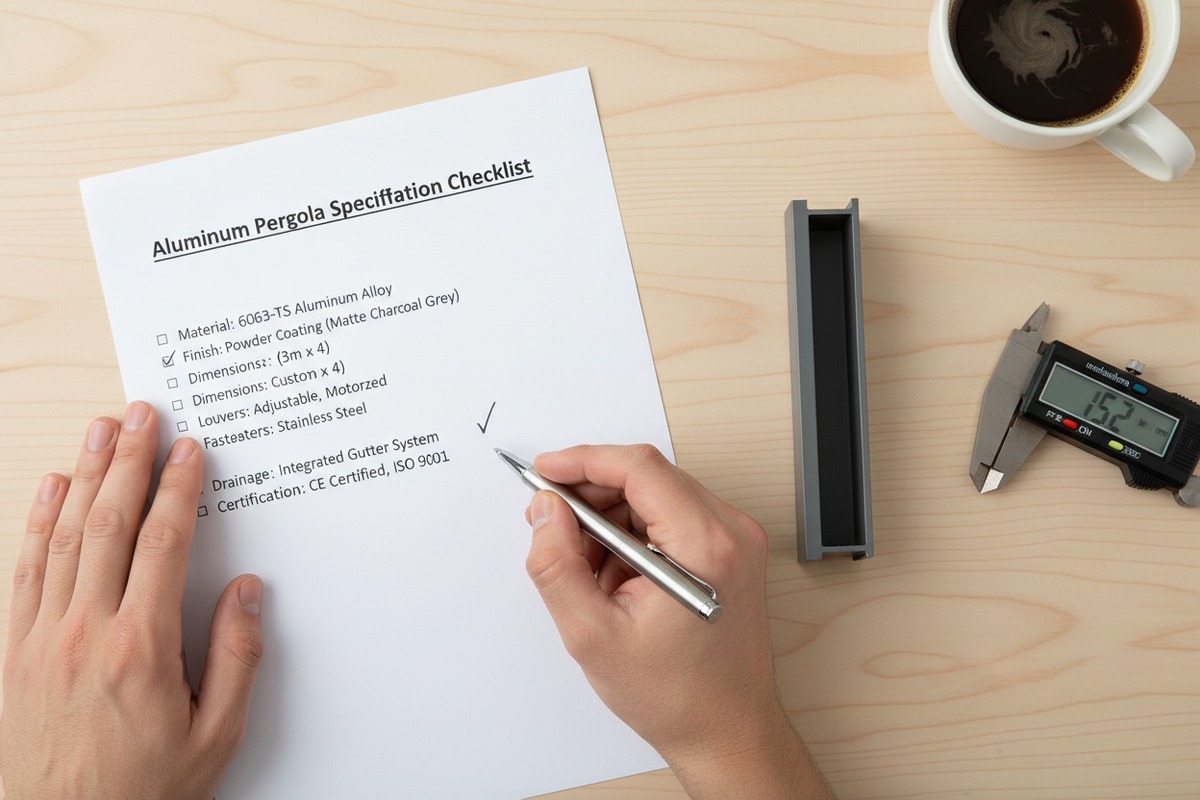
Before visiting, prepare a checklist that covers your target product specifications (aluminum grade, wall thickness, coating type, dimensions), annual order volume, required certifications (ISO, CE), packaging standards, delivery timeline, and a list of critical questions about the factory's quality control, customization process, and export experience.
Define Your Product Requirements First
Start with the basics. Write down every technical detail your project demands. This includes the aluminum alloy grade 2 (6063-T5 is common for pergola extrusions), wall thickness (typically 2–4 mm for structural posts), surface finish (powder coating 3, anodizing, or PVDF), color (specific RAL codes), and overall dimensions. If you need a louvered roof system, retractable canopy, or integrated zip blinds, note those too. The more specific your requirements, the easier it is to evaluate whether a factory can deliver.
Pre-Qualify Suppliers Before You Travel
Do not fly to China to visit ten factories. Narrow your list to three or four. Request business licenses, export certificates, ISO 9001 documentation 4, and recent production photos from each candidate. Ask for a process flow diagram. If a supplier cannot provide one, they may be a trading company, not a real manufacturer. We always encourage buyers to request a short video call before booking flights. This saves thousands of dollars in wasted travel.
Build Your Audit Checklist
Your checklist should include at least these categories:
| Checklist Category | Key Items to Verify |
|---|---|
| Company Credentials | Business license, export rights, ISO 9001, CE certificates |
| Product Specifications | Aluminum grade, wall thickness, coating type, RAL color accuracy |
| Production Capacity | Annual output, current order load, lead times |
| Quality Control | Incoming material inspection, in-process QC, final inspection |
| Customization Ability | OEM/ODM experience, 3D modeling, DFM feedback |
| Packaging & Logistics | Protective packaging methods, container loading plan, missing parts history |
| References | Export markets served, client testimonials, sample projects |
Protect Your Designs
If you are bringing proprietary designs, sign an NDA before the visit. Send it digitally and get it countersigned. This step is simple but often overlooked. Without it, your custom louver profile or unique post design could end up in a competitor's catalog.
Coordinate Logistics Early
Book your trip at least two to three weeks in advance. Confirm factory addresses in both English and Chinese. Hire a technical interpreter if your Mandarin is limited. Schedule visits during active production hours—not weekends—so you can observe real workflows. A typical five-day sourcing trip costs between $2,000 and $4,000, including flights, accommodation, interpreter, and ground transport.
What key quality indicators should I look for during my on-site pergola inspection?
When buyers walk through our workshops, we point them to specific quality checkpoints that separate a reliable pergola from a risky one—details that photos and catalogs simply cannot reveal.
During your on-site inspection, focus on aluminum wall thickness consistency, welding seam quality, powder coating uniformity and adhesion, joint tightness, hardware grade, load-bearing test documentation, and the factory's incoming material inspection and in-process quality control systems to ensure structural integrity and long-term durability.
Check Raw Material Storage and Incoming Inspection
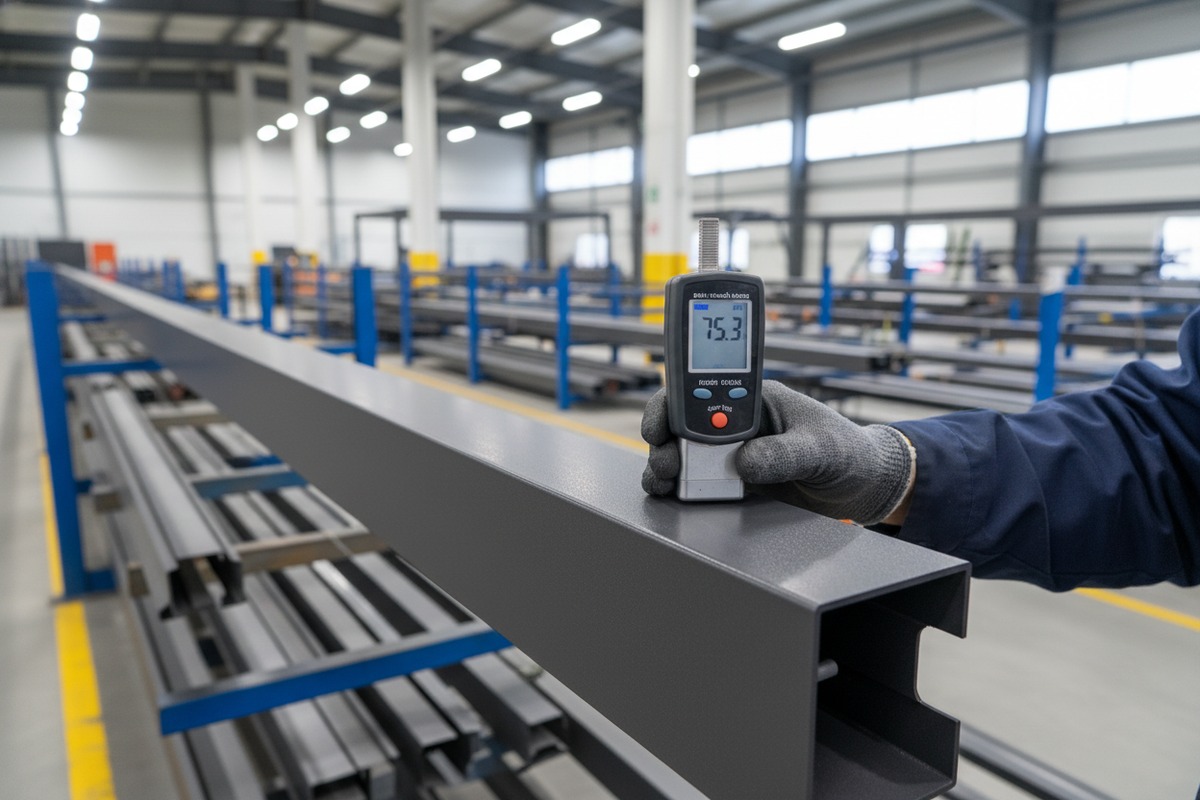
Walk into the raw material warehouse first. Look at how aluminum extrusions are stored. They should be separated by grade and batch number, stacked on racks—not piled on a dirty floor. Ask to see the incoming inspection records. A good factory tests each batch of aluminum for alloy composition and wall thickness before it enters production. If there are no records, that is a red flag.
Inspect Welding and Joint Quality
Welding is where structural integrity is won or lost. Look closely at welding seams on pergola posts, beams, and brackets. Good welds are smooth, consistent, and free of porosity or cracks. Ask the factory what welding method they use (TIG welding 5 is preferred for aluminum pergolas). Check whether they grind and polish welds before coating. Poor weld cleanup leads to coating defects and corrosion down the line.
Evaluate Coating Application
Powder coating is the most common finish for aluminum pergolas. During your visit, ask to see the coating line. Key things to check:
| Coating Quality Indicator | What to Look For |
|---|---|
| Pre-treatment | Chromate or chrome-free conversion coating before powder application |
| Coating Thickness | 60–120 microns (measured with a digital thickness gauge) |
| Adhesion Test | Cross-hatch adhesion test results (ASTM D3359 6 Grade 4B or higher) |
| Color Consistency | No visible color variation between batches; RAL color matching records |
| Surface Finish | No orange peel, drips, bare spots, or contamination |
| Salt Spray Test | Minimum 1,000 hours for coastal or high-humidity environments |
If the factory cannot show you salt spray test reports or adhesion test records, proceed with caution.
Observe In-Process Quality Control
Watch the production floor carefully. Are workers using measurement tools at each station? Are there visual inspection checkpoints between cutting, welding, coating, and assembly? A disciplined factory will have QC stations with documented pass/fail criteria. Ask about their rework rate. In our experience, a rework rate below 2% indicates strong process control.
Review Load-Bearing Documentation
For any pergola destined for outdoor use, wind and snow load 7 ratings matter. Ask to see structural calculation reports and third-party test results (SGS-certified load testing is a solid benchmark). If the factory claims their pergola handles 150 kg/m² snow load, they should have documentation to prove it.
How can I evaluate a manufacturer's OEM customization and technical design skills in person?
Our engineering team handles hundreds of custom pergola projects each year, and we have learned that the best way for a buyer to judge customization capability is to sit with the engineers—not just the sales team.
Evaluate OEM customization skills by requesting design-for-manufacturability feedback on your drawings, reviewing the factory's 3D modeling and prototyping process, examining past custom projects with similar complexity, and testing whether engineers can discuss tolerance trade-offs, material optimizations, and alternative roof system designs confidently.
Meet the Engineering Team Directly
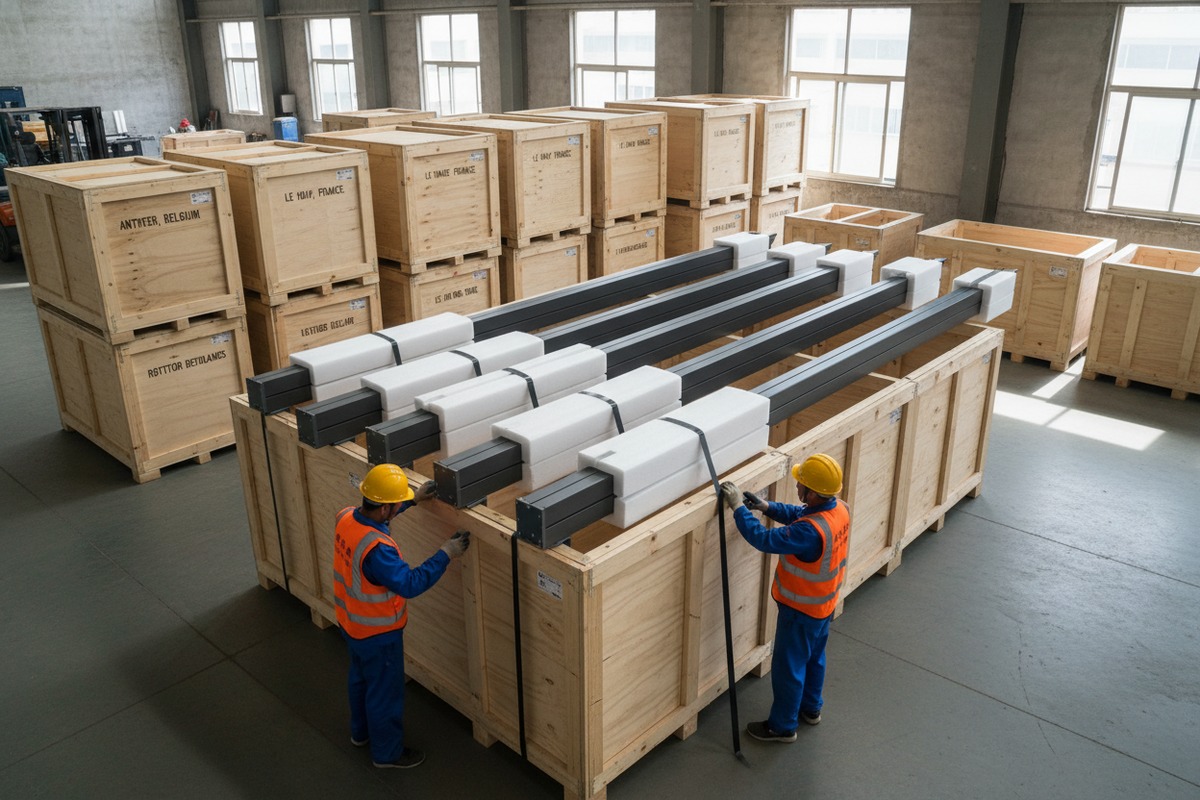
Insist on meeting the design and engineering staff during your visit. If the factory only presents sales representatives and avoids bringing engineers into the room, that is a warning sign. A strong manufacturer will have engineers who can review your drawings on the spot, suggest material substitutions for cost savings, and explain how they handle non-standard dimensions. At our facility, we make it a point to have our lead engineer present during every buyer meeting.
Request DFM Feedback on Your Designs
Hand over your 3D drawings or technical specifications and ask for design-for-manufacturability feedback 8 within 24 to 48 hours. A capable factory will identify potential production issues—tight tolerances that increase cost, joint configurations that weaken under load, or coating specifications that conflict with the chosen alloy. If the factory simply says "no problem" to everything without questions, they may lack the expertise to catch errors before production.
Review Past Custom Projects
Ask to see a portfolio of past OEM/ODM projects. Pay attention to complexity. Can they show louvered pergolas with motorized roof systems? Have they produced custom RAL color matches? Do they have experience with integrated zip blinds or LED lighting channels? A factory that has only made standard fixed-roof pergolas may struggle with your retractable louver design.
Evaluate Prototyping and Sample Capabilities
For high-value projects—especially in hospitality—request a prototype or partial mock-up before full production. This step verifies finish quality, joint precision, and mechanical function (like louver rotation). Ask how long prototyping takes and what it costs. A well-equipped factory can turn around a sample in two to three weeks.
| Customization Capability | Signs of Strength | Signs of Weakness |
|---|---|---|
| 3D Modeling | In-house BIM/CAD team; files delivered in 48 hours | Outsourced design; slow turnaround |
| DFM Feedback | Proactive suggestions on material and tolerance | "No problem" response to all specifications |
| Prototype Testing | Humidity chamber and UV exposure testing available | No testing facilities; samples are visual only |
| Past OEM Projects | Diverse portfolio with complex roof systems | Only standard fixed-roof designs |
| Engineering Communication | Engineers attend meetings; discuss trade-offs | Sales team only; technical questions deflected |
Test Their Problem-Solving Ability
Pose a hypothetical scenario. For example: "What happens if my client changes the pergola width from 4 meters to 4.5 meters after production starts?" A mature factory will explain the impact on beam thickness, the need for structural recalculation, the timeline delay, and the cost adjustment. A weak factory will simply agree or give vague answers.
What should I verify regarding packaging and logistics to ensure my pergola shipment stays safe?
We learned the hard way—early in our export journey—that a perfectly manufactured pergola means nothing if it arrives at the client's warehouse with scratched profiles and missing hardware.
Verify that the factory uses protective foam wrapping for each aluminum profile, sturdy carton or wooden crate packaging, clearly labeled component bags with hardware counts, waterproof outer packaging, a detailed packing list matching the bill of materials, container loading plans, and pre-shipment loading supervision to prevent transit damage and missing parts.
Why Packaging Deserves a Dedicated Inspection
Packaging failures are the number one source of post-shipment complaints in aluminum pergola trade. Aluminum profiles scratch easily. Long beams bend during container loading if not properly supported. Small connectors and screws disappear into large boxes. A single missing non-standard bracket can delay an entire installation project for weeks while a replacement ships internationally. That is why we now dedicate a full QC station just to packaging verification before any container is sealed.
Inspect the Packaging Materials and Methods
During your factory visit, walk through the packing area. Look for these specific practices:
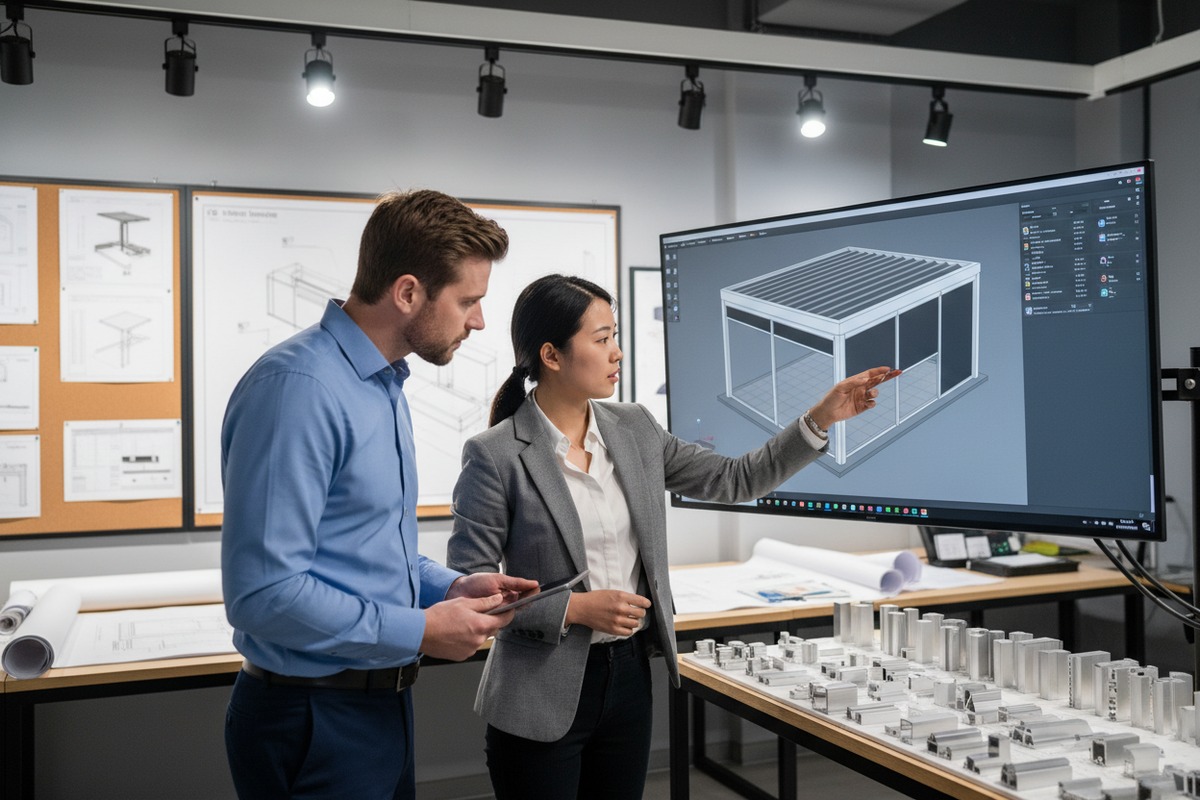
- Individual profile wrapping: Each aluminum extrusion should be wrapped in protective film or foam sleeves to prevent surface contact damage.
- Edge protection: Corner protectors on all beam ends and post ends.
- Hardware bagging: Every set of screws, bolts, brackets, and connectors should be bagged separately and labeled with part numbers and quantities.
- Carton or crate quality: Outer packaging should be double-wall corrugated carton or wooden crates for heavy components. Single-wall cartons are not sufficient for sea freight.
- Waterproofing: Shrink wrap or waterproof liners inside cartons to protect against container condensation during ocean transit.
Review the Packing List and Bill of Materials
Ask the factory to show you a sample packing list from a recent shipment. It should match the bill of materials 9 exactly. Every component, down to the last washer, should be listed with quantity, part number, and carton assignment. Cross-check one or two cartons against the packing list during your visit. If the numbers do not match, the factory's packing process needs improvement.
Evaluate the Container Loading Plan
A good factory prepares a container loading diagram before shipment. This diagram shows exactly how cartons and crates are positioned inside the container. It accounts for weight distribution, stacking limits, and bracing to prevent shifting during transit. Ask to see one. If the factory does not use loading plans, your shipment is at higher risk of damage.
Ask About Pre-Shipment Inspection
Clarify who conducts the final pre-shipment inspection (PSI). Will the factory do it internally? Will you hire a third-party inspector? At our facility, we offer buyers the option to have their own QC agent present during container loading. This extra step costs a few hundred dollars but can save tens of thousands in damage claims.
Discuss Logistics Routing and Lead Times
Finally, confirm the shipping timeline and routing. Standard production lead time for custom aluminum pergolas is eight to twelve weeks. Ask whether the factory has relationships with freight forwarders experienced in oversized outdoor structure shipments. Some factories now offer tariff-optimized routing through specific ports that can reduce duty costs by up to 33%. Ask about these options. Also confirm whether the factory provides installation manuals, assembly videos, and technical support for on-site teams.
| Logistics Item | What to Verify |
|---|---|
| Profile Protection | Foam wrapping, PE film, corner protectors on all pieces |
| Hardware Completeness | Labeled bags with part numbers; count matches BOM |
| Outer Packaging | Double-wall cartons or wooden crates; waterproof liners |
| Loading Plan | Container diagram with weight distribution and bracing |
| Pre-Shipment Inspection | Internal QC or third-party inspector present at loading |
| Shipping Timeline | 8–12 weeks production; confirmed vessel booking |
| Installation Support | Multilingual manuals, 3D assembly videos, tech support contact |
Schlussfolgerung
A well-planned factory visit is not a luxury—it is essential risk management that protects your investment, your timeline, and your brand reputation in the aluminum pergola market.
Fußnoten
1. Replaced with a comprehensive guide on aluminum pergolas. ︎
2. Replaced with a selection guide to aluminum grades and properties from the original domain. ︎
3. Explains what powder coating is, its history, and application process. ︎
4. Provides an overview of ISO 9001, its importance, and requirements. ︎
5. Replaced with an authoritative explanation of TIG welding from a reputable manufacturer. ︎
6. Provides details on the ASTM D3359 standard for assessing coating adhesion. ︎
7. Explains the importance of wind and snow load calculations in structural design. ︎
8. Defines Design for Manufacturability (DFM) and its principles for optimizing production. ︎
9. Explains what a Bill of Materials (BOM) is and its role in manufacturing. ︎