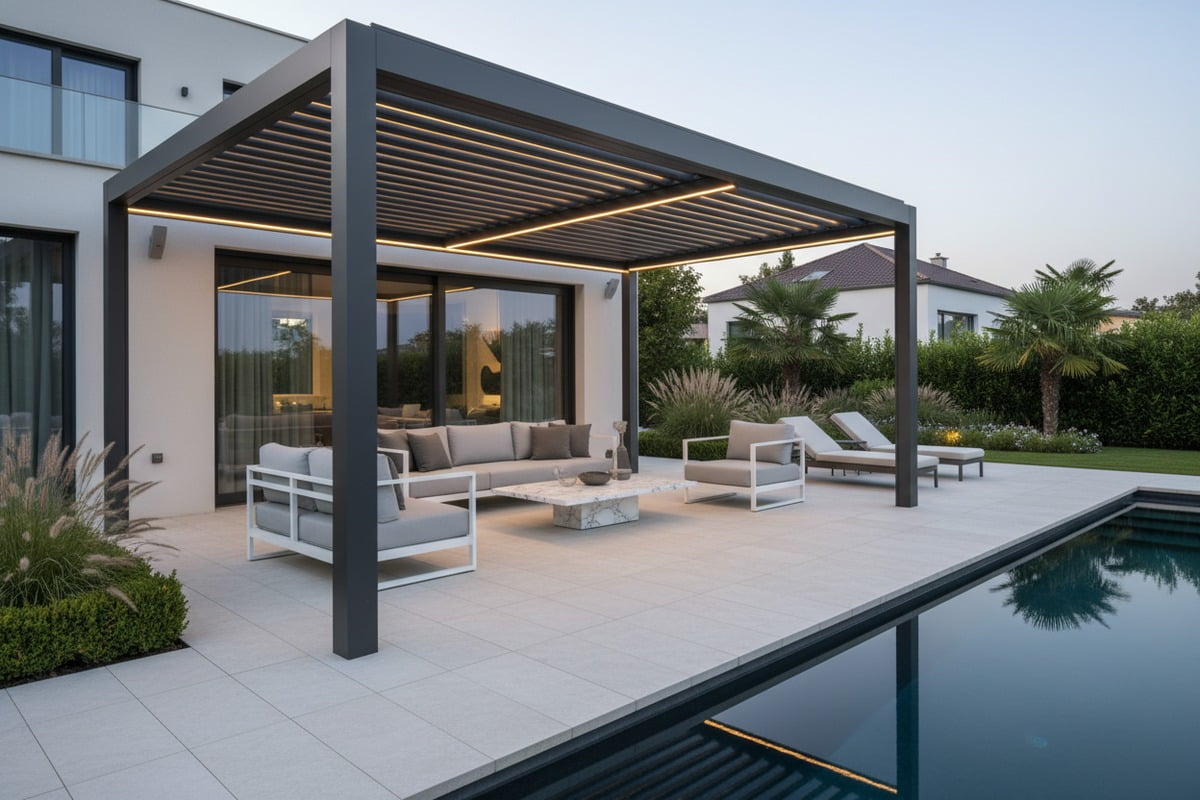
After 25 years on the production line, our team has seen pergola trends come and go — but one question keeps coming back from every buyer we work with.
Customers consistently pay more for aluminum pergola upgrades that solve daily comfort problems, extend usable seasons, and make the structure feel like a permanent outdoor room. Motorized louvers, integrated drainage, retractable screens, LED lighting, and reinforced profiles drive the highest willingness to pay, while purely cosmetic add-ons rank lower unless bundled with functional features.
This article breaks down exactly which upgrades change buyer behavior enough to justify a higher price — and which ones just look good on paper Motorized louvers 1. Whether you sell to homeowners, contractors, or hospitality projects, the framework below will help you choose where to invest.
How can I tell if motorized zip blinds and smart sensors are worth the added cost for my clients?
Every season, our export team fields the same debate from European distributors: should they stock motorized zip blinds and sensor packages, or keep things simple and manual retractable screens 2?
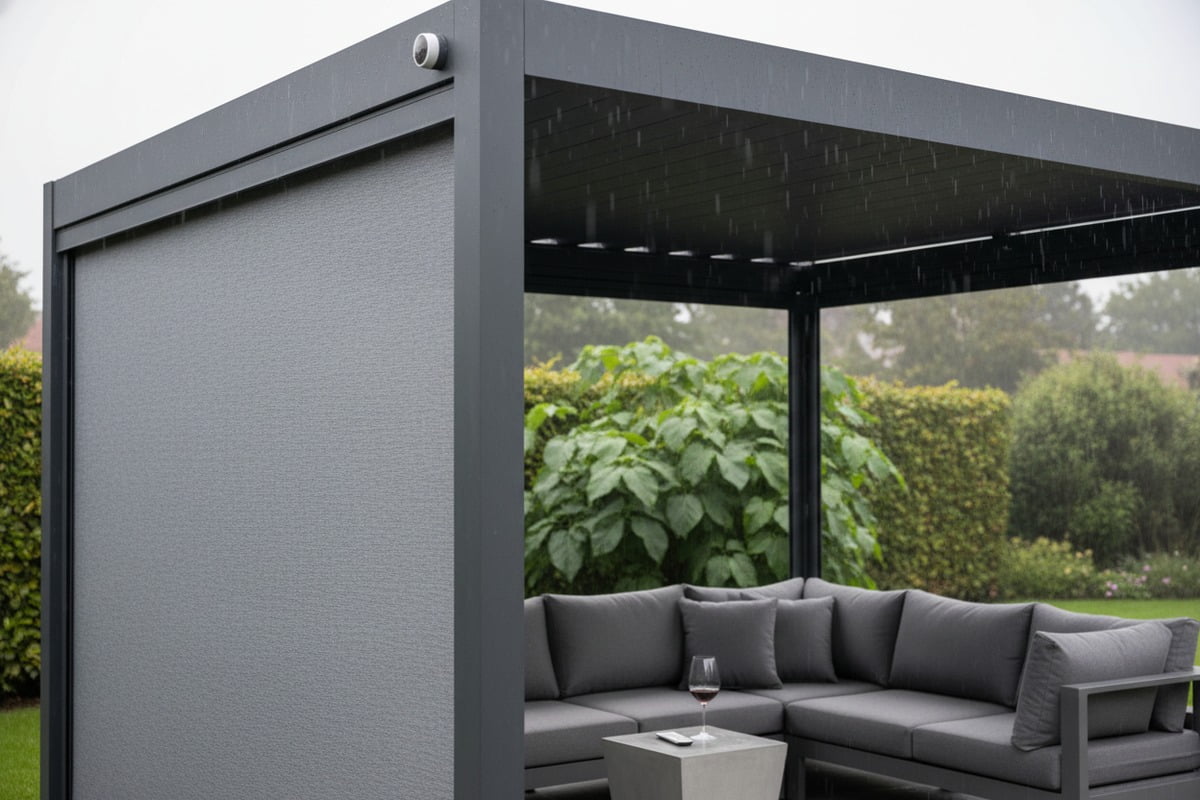
Motorized zip blinds and smart sensors are worth the added cost when your clients prioritize convenience, weather automation, and year-round outdoor living. Rain and wind sensors that auto-close louvers or retract screens reduce manual effort, protect furniture, and elevate the pergola from a shade cover to a true outdoor room.
Why Motorization Changes Buyer Behavior
The core reason motorized zip blinds sell well is simple: they remove friction wind and snow resistance 3. A homeowner who has to manually crank down screens on a windy evening will eventually stop using them. But a system that closes automatically when rain sensors detect moisture? That gets used every single day.
From our production data, roughly 60% of our European orders now include at least one motorized component — up from about 30% five years ago. The shift is not driven by luxury alone. It is driven by practicality. Contractors tell us that motorized systems reduce callback complaints because end users understand how to operate them instantly with a remote or app.
Smart Sensors: Gimmick or Game-Changer?
There is a real split in the market here. Budget buyers often see sensors as unnecessary. Mid-market and luxury buyers see them as essential. The key difference is use case. A hotel terrace in southern Italy that seats 40 diners cannot afford to have a staff member manually adjusting louvers every time the wind picks up. A sensor that triggers automatic closure at a preset wind speed solves a real operational problem.
Here is how the cost-benefit comparison typically breaks down:
| Feature | Added Cost Range | Primary Benefit | Best Buyer Segment |
|---|---|---|---|
| Manual zip blinds | Base price | Privacy, wind block | Budget buyers |
| Motorized zip blinds | +15–25% over manual | Convenience, daily usability | Mid-market and above |
| Rain sensor (auto-close) | +€80–€200 per unit | Furniture protection, hands-free | All segments with rain exposure |
| Wind sensor (auto-retract) | +€80–€200 per unit | Safety, prevents screen damage | Coastal and high-wind regions |
| App/voice control integration | +€150–€400 per system | Smart-home compatibility | Luxury and tech-forward buyers |
When to Skip the Upgrade
Not every project needs full automation. A small residential pergola in a sheltered courtyard may only need manual screens. The honest answer is: sell sensors where the environment demands them. Coastal areas, regions with sudden rain, and commercial hospitality projects almost always justify the cost. Quiet suburban patios with mild weather? The ROI is harder to prove.
Our engineering team always recommends pre-wiring the frame for motorization even if the buyer starts with manual screens. The cost of running wiring channels during manufacturing is minimal — around €30–€50 per unit — but retrofitting later can cost the installer five to ten times that amount.
Will my customers pay more for reinforced aluminum profiles that offer better wind and snow resistance?
When we run stress tests on our extrusion lines, the difference between a standard profile and a reinforced one is visible to the naked eye. But the real question is whether your end customer can see — and value — that difference too.
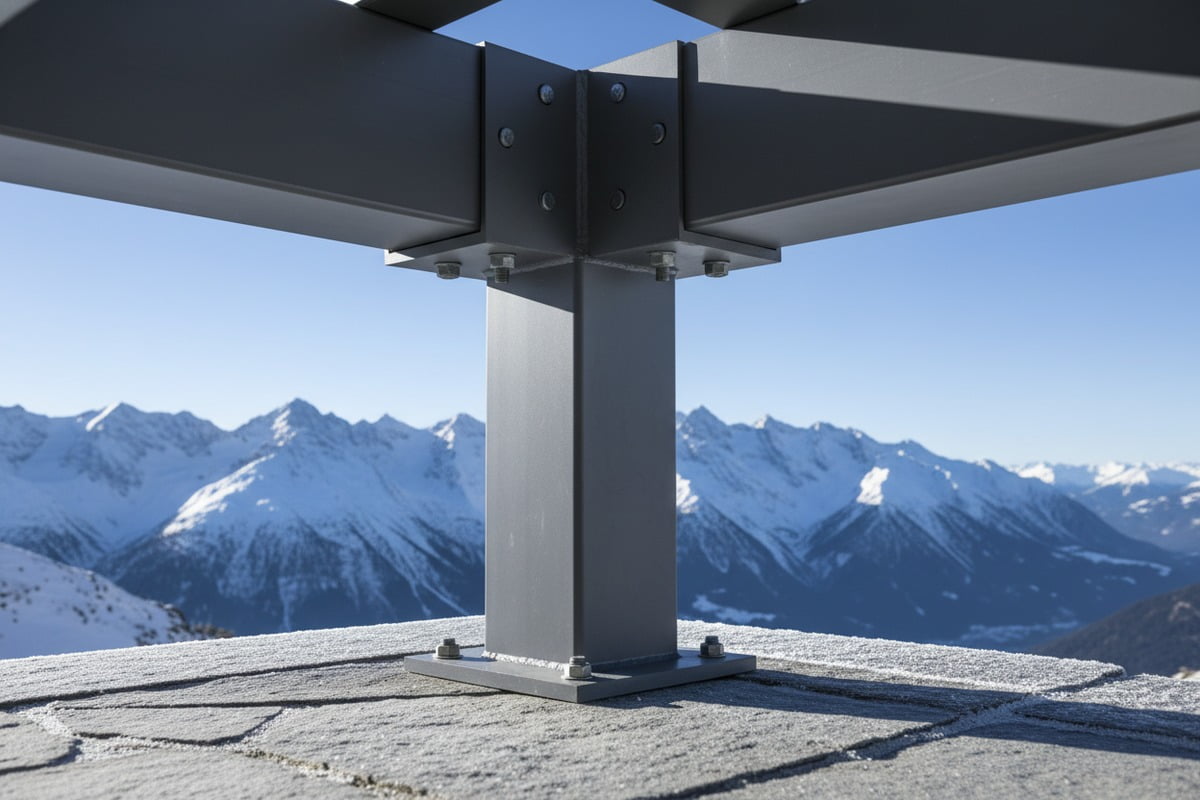
Yes, customers will pay more for reinforced aluminum profiles when they understand the wind and snow load ratings. Buyers in regions with heavy snowfall, coastal winds, or strict building codes consistently choose thicker walls and reinforced connections because structural failure carries far greater cost than the upgrade itself.
The Education Gap
The biggest challenge with selling structural upgrades is that most end users do not understand load ratings. They see a number like "120 km/h wind resistance" and have no context for what that means in real life. Contractors and distributors who educate their buyers — using simple comparisons or local weather data — convert far more structural upgrades.
We have found that a short one-page spec sheet comparing standard versus reinforced profiles, with a local weather reference, increases upgrade adoption by a significant margin among our distribution partners.
Standard vs. Reinforced: What Changes?
| Specification | Standard Profile | Reinforced Profile |
|---|---|---|
| Wall thickness | 1.5–2.0 mm | 2.5–3.0 mm |
| Wind load rating | Up to 90 km/h | Up to 130 km/h+ |
| Snow load rating | Up to 50 kg/m² | Up to 150 kg/m² |
| Post cross-section | 100 x 100 mm | 120 x 120 mm or 150 x 150 mm |
| Price premium | Base | +20–35% |
| Typical buyer | Sheltered patios, mild climates | Exposed locations, commercial, code-strict regions |
Who Pays — and Who Doesn't
Budget buyers in mild Mediterranean climates often skip reinforcement. They may never face a snow load above 30 kg/m², and their wind exposure is limited. That is a rational decision.
But contractors working on hospitality projects — hotels, restaurants, resort terraces — almost always specify the reinforced tier. The liability risk of a collapsed pergola on a commercial property is enormous. A 20–35% price increase on the frame is trivial compared to the legal and reputational cost of a structural failure.
Building Code Compliance
In many European markets, outdoor structures above a certain size require engineering certification 5. Building Code Compliance 6 Reinforced profiles make it easier to meet local codes without custom engineering. Our team pre-calculates load data for standard reinforced configurations, which saves our partners the cost and time of hiring a local structural engineer for every project.
The bottom line: structural upgrades are a hard sell on emotion alone, but they are an easy sell when framed around risk avoidance and code compliance. The best distributors we work with position reinforcement as insurance, not luxury.
Which custom RAL colors and integrated LED lighting options will help me stand out in the high-end market?
Our powder coating line runs over 200 RAL colors 7 a year, and the patterns in what sells — and what sits in inventory — tell a clear story about what the premium market actually wants.
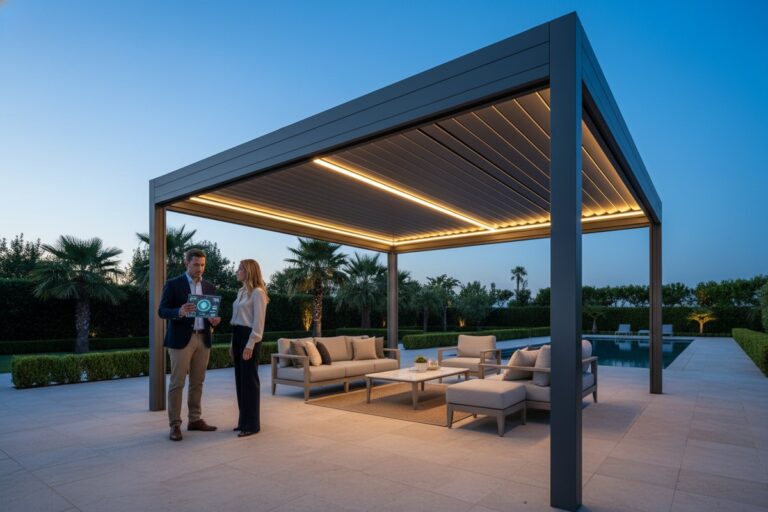
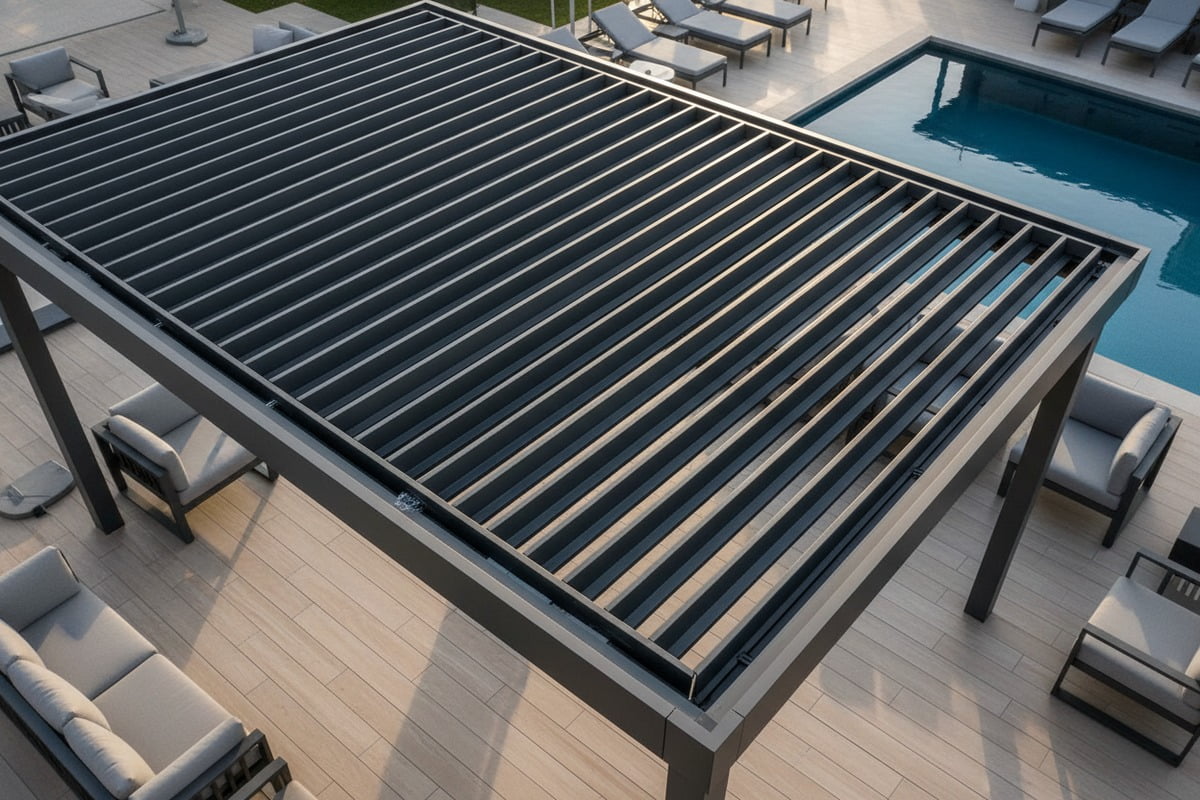
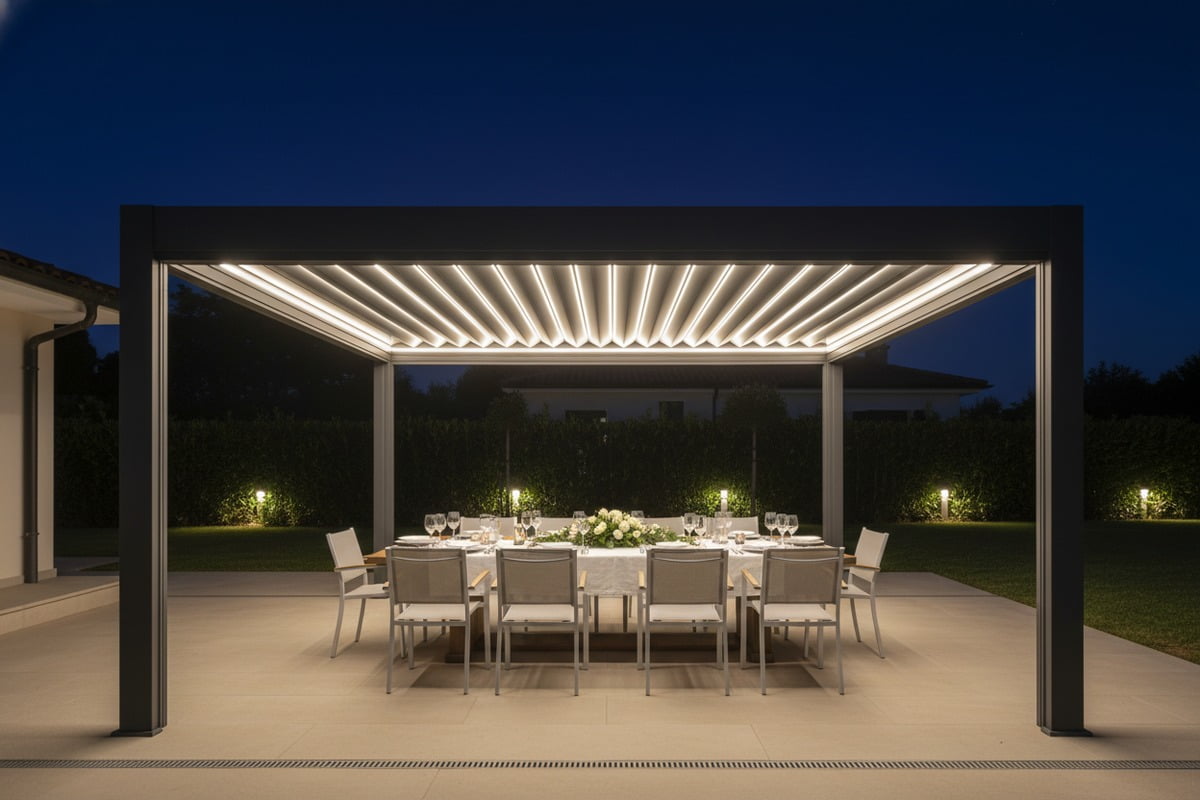
In the high-end market, matte RAL 7016 anthracite grey, RAL 9005 jet black, and woodgrain-effect finishes dominate demand, while integrated warm-white dimmable LED strip lighting under louvers creates the strongest evening ambiance. Offering these options as standard differentiates your brand from competitors selling only basic white or silver frames.
The Colors That Actually Sell
Aesthetic upgrades are often underestimated in B2B conversations. Distributors focus on specs and price. But our order data consistently shows that color and finish drive the emotional purchase decision at the end-user level. When a homeowner sees a pergola that matches their home exterior perfectly, price objections drop.
Here are the top-selling finishes across our European export markets:
| RAL Color / Finish | Market Popularity | Best Application | Price Premium |
|---|---|---|---|
| RAL 7016 Anthracite Grey (matte) | Very high | Modern architecture, dark exteriors | Base or +5% |
| RAL 9005 Jet Black (matte) | High | Contemporary, minimalist homes | Base or +5% |
| RAL 9010 Pure White (matte) | Moderate | Mediterranean, coastal homes | Base |
| RAL 8014 / Woodgrain effect | Growing fast | Traditional homes, rural settings | +10–20% |
| RAL 7006 Beige Grey | Moderate | Southern European markets | +5% |
| Custom RAL (any code) | Niche | Architect-specified projects | +15–25% |
The woodgrain-effect finishes 8 deserve special attention. They use sublimation or film-transfer technology to replicate a natural wood appearance on aluminum. The result looks remarkably realistic, and it eliminates the maintenance headaches of real wood — no rotting, no repainting, no termite risk. For buyers who want warmth without the upkeep, this finish is a strong closer.
LED Lighting: The Easiest Upsell
Lighting is probably the single most cost-effective upgrade in terms of perceived value versus actual cost. A strip of warm-white LEDs recessed under the louver edges can cost as little as €100–€200 in materials at the production stage. But it transforms the pergola into an evening entertainment space, which is a lifestyle upgrade that buyers feel immediately.
What Type of Lighting Works Best?
From the feedback our partners share, here is what we see:
- Warm white (2700K–3000K) dimmable strips are the safest default. They create a soft, inviting glow that works for dining, relaxing, and entertaining.
- RGB color-changing strips appeal to a younger, tech-forward demographic but are often seen as gimmicky by traditional luxury buyers.
- Perimeter downlights are clean and architectural but provide less ambiance than under-louver strips.
- App-controlled dimming is a moderate-cost add-on that pairs well with smart-home integration.
The best strategy we have seen from our distribution partners is to include warm-white dimmable LEDs as a standard feature in their mid-range and premium product lines, then offer RGB or advanced controls as optional upgrades. This way, every pergola they sell looks finished and premium out of the box.
Concealed Wiring Matters
One detail that separates a high-end installation from a budget one is wiring visibility. Our frames are designed with internal cable channels so that LED wiring, motor cables, and sensor connections are completely hidden. Exposed cables running along posts or beams immediately cheapen the look, regardless of how premium the color or lighting is. This is a manufacturing-stage decision, not something that can be easily fixed on-site.
How do I evaluate if pre-drilled components and 3D installation guides will actually save my business money?
One recurring pain point we hear from our partners in Italy, Germany, and the Netherlands is not about the pergola itself — it is about what happens after the container arrives. Installation errors, missing parts, and confused crews eat into margins fast.
Pre-drilled components and 3D installation guides save real money by cutting on-site labor time by 30–50%, reducing costly installation errors, and virtually eliminating callback visits for misaligned parts. The upfront investment in precision manufacturing and professional documentation pays back within the first two to three projects for most contractors and distributors.
The True Cost of Poor Installation Support
When a crew spends an extra half-day on-site because bolt holes do not align or a manual is unclear, the cost is not just labor. It is also the opportunity cost of that crew not being on the next job. For contractors running tight schedules, every hour of wasted installation time has a multiplier effect.
Our after-sales data from the past three years shows a clear pattern: partners who use our pre-drilled, pre-labeled component kits with 3D video guides report roughly 40% fewer support tickets and almost zero requests for replacement parts due to drilling errors.
What Pre-Drilled Really Means
Pre-drilling is not just about making holes in aluminum. It is about precision at the factory level. Every hole is CNC-machined to exact tolerances, with countersinks for flush bolt heads, thread-tapped where needed, and matched to a numbered labeling system. Each component arrives with a sticker code that corresponds to a step in the installation guide.
This means the installer does not need to measure, mark, or drill on-site. They unpack, match codes, and assemble. The difference is dramatic — especially for crews who are installing a model for the first time.
3D Guides vs. Traditional Paper Manuals
Traditional paper manuals with 2D diagrams still dominate the industry. But they cause problems. Isometric drawings are hard to interpret. Steps get skipped. Fastener types get confused.
Our 3D installation guides — available as both video walkthroughs and interactive PDF files — show every step from the installer's perspective. They rotate the model, zoom into connections, and highlight which fastener goes where. We also provide multilingual voiceover options for key European markets.
Measuring the Savings
Here is a simplified cost comparison based on feedback from three of our distribution partners:
| Cost Factor | Without Pre-Drill + 3D Guide | With Pre-Drill + 3D Guide |
|---|---|---|
| Average installation time (2-person crew) | 12–16 hours | 6–10 hours |
| On-site drilling errors per 10 installs | 3–5 incidents | 0–1 incidents |
| Callback visits per 10 installs | 2–4 visits | 0–1 visits |
| Replacement parts requested per 10 installs | 2–3 requests | 0–1 requests |
| Estimated labor cost savings per install | — | €200–€500 |
Over a season of 30–50 installations, those savings compound into thousands of euros — far exceeding any marginal cost increase for pre-drilled components 10 and professional documentation.
The Hidden Benefit: Fewer Negative Reviews
For distributors selling to end users who self-install, clear 3D guides reduce frustration and negative online reviews. A homeowner who struggles with assembly for two weekends is far more likely to leave a bad review than one who finishes in a single day. This affects long-term brand reputation and repeat business in ways that are hard to quantify but very real.
Our recommendation to every new partner is straightforward: invest in the pre-drilled kit and full 3D guide package from the first order. The per-unit cost is marginal. The downstream savings — in labor, support, returns, and reputation — are substantial.
Schlussfolgerung
Customers pay the most for pergola upgrades that solve everyday problems, expand usable seasons, and make outdoor spaces feel permanent. Focus your investment on functional value first — the aesthetics will follow.
Fußnoten
1. Authoritative source on motorized louvered pergolas and their features. ︎
2. Leading manufacturer providing information on retractable screen solutions for outdoor living. ︎
3. FEMA document detailing wind resistant provisions in the International Building Code. ︎
4. Comprehensive guide explaining types, benefits, and industry use of smart building sensors. ︎
5. Replaced HTTP 404 with an authoritative source (NSPE) explaining professional engineering licensure. ︎
6. Explains code considerations for various outdoor building elements and compliance. ︎
7. Wikipedia provides a clear and concise explanation of the RAL color standard system. ︎
8. Details the process and advantages of applying wood grain finishes to aluminum. ︎
9. Replaced HTTP 404 with an authoritative government source (Department of Energy) explaining LED lighting. ︎
10. Discusses the manufacturing and benefits of precise CNC drilled parts. ︎