
Every week, our sales team receives emails from European partners describing issues their end clients face—scratched profiles, missing screws, motors without CE marks.
European wholesalers can drive aluminum pergola improvements by collecting structured field data, presenting quantified feedback on quality, packaging, and design trends, and building collaborative partnerships with suppliers through regular meetings, shared platforms, and clear technical specifications.
Below, we break down four critical areas where your feedback can reshape how manufacturers like us develop better products for the European market.
How do I communicate my need for higher wind load ratings and CE-certified motors to my manufacturer?
When our engineering team redesigns a pergola frame, we rely heavily on what wholesalers tell us about local building codes and site conditions across Europe CE marking for motors 1.
Communicate your wind load and certification needs by providing specific regional building codes, required test standards (like EN 1991-1-4 for wind), target wind speed classes, and a list of mandatory certifications such as CE marking for motors, ensuring your supplier has clear technical benchmarks to meet.

Why Vague Requests Fail
Many wholesalers simply say "we need stronger pergolas." That is not enough. Our engineers need numbers. Tell us the exact wind zone classification for your region EN 1991-1-4 for wind 2. In France, zones range from 1 to 4. In Germany, wind zones go up to 4 as well but with different reference speeds. Without these numbers, we cannot calculate the correct wall thickness or connection points QR codes printed on packaging 3.
What to Include in Your Technical Brief
| Information Needed | Example | Why It Matters |
|---|---|---|
| Wind zone classification | France Zone 3 (26 m/s) | Determines structural calculation |
| Snow load requirement | 1.5 kN/m² for Alpine regions | Affects beam cross-section |
| Motor certification | CE + TÜV preferred | Legal requirement for EU market |
| Specific EN standards | EN 13561 for awnings | Ensures compliance |
| Installation height | 3.0m clearance | Changes wind exposure factor |
How to Present This to Your Supplier
Create a one-page spec sheet. List your country, region, required certifications, and performance standards. Attach relevant excerpts from local building codes. Our R&D team can then run FEA simulations 4 and propose solutions within days.
For motors specifically, request the CE Declaration of Conformity document 5. Ask for the motor brand name, IP rating (IP44 minimum for outdoor use), and whether it includes thermal protection. At our facility, we stock Somfy and compatible motors that already carry CE marks, but some budget alternatives do not.
Regional Variations Matter
| Region | Typical Wind Requirement | Snow Load | Key Certification |
|---|---|---|---|
| Northern France | 28 m/s | 0.45 kN/m² | CE, NF |
| Southern Germany | 25 m/s | 1.0 kN/m² | CE, DIN |
| Coastal Netherlands | 30 m/s | 0.7 kN/m² | CE |
| Alpine Austria | 24 m/s | 2.0 kN/m² | CE, ÖNORM |
When you share this level of detail, we can engineer pergolas that pass local inspections the first time.
What specific packaging improvements should I request to prevent aluminum profile scratches during sea freight?
Our logistics team has learned painful lessons from claims—one scratched batch can cost thousands in replacement parts and weeks of delay for a European wholesaler waiting on stock.
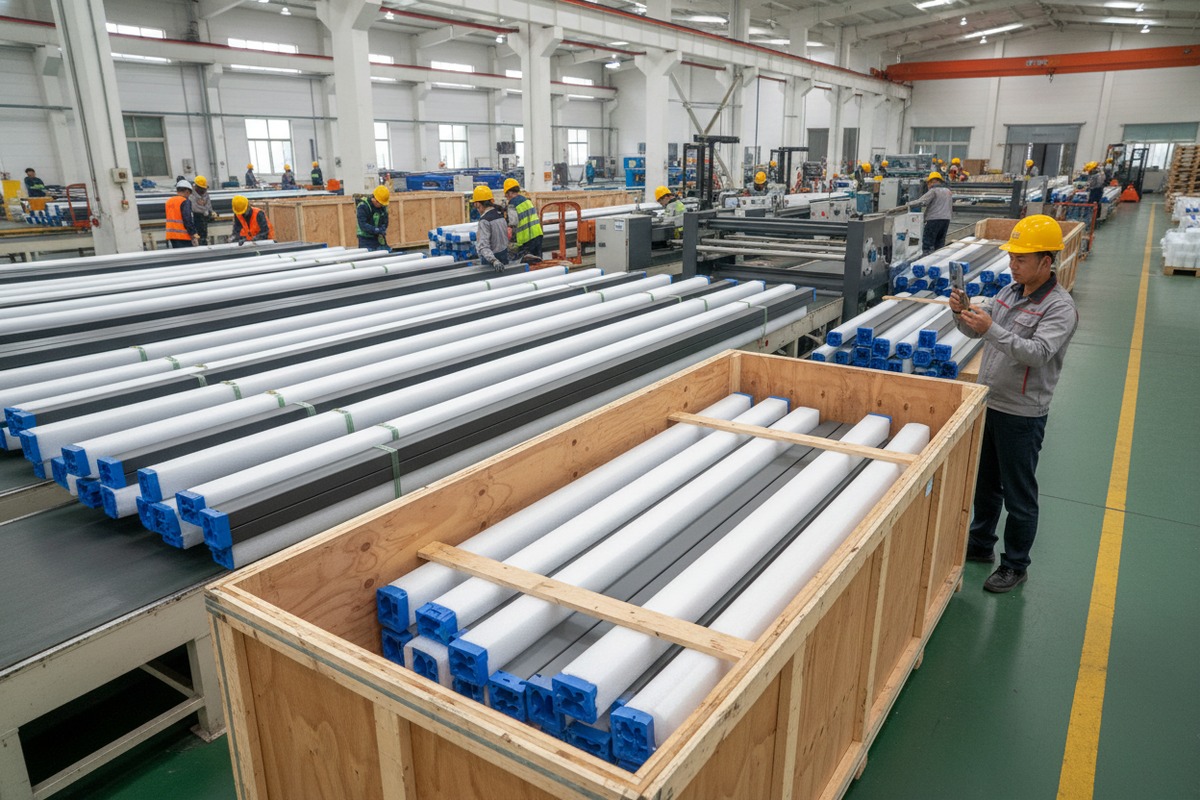
Request EPE foam wrapping on each profile, corner protectors on all exposed edges, vertical stacking with separators, shrink-wrapped bundles inside plywood crates, and a detailed packing list with photos taken before container loading to ensure accountability and damage prevention during 30-day sea voyages.
The Real Cost of Scratches
A single scratch on a powder-coated beam means the entire piece must be replaced or refinished locally. Local refinishing rarely matches the original RAL color 6 perfectly. Your client notices. Your reputation suffers.
Packaging Specification Table
| Component | Protection Method | Material |
|---|---|---|
| Main beams (6m) | Full EPE foam sleeve 7 + cardboard corners | 10mm EPE foam |
| Louver blades | Individual PE film wrap, stacked with foam dividers | PE film + 5mm foam |
| Corner posts | Bubble wrap + cardboard tube | Double-layer bubble |
| Hardware box | Sealed bag per unit, labeled | Zip-lock PE bags |
| Motor units | Foam-lined individual box | Molded foam insert |
What to Specify in Your Packaging Agreement
First, request pre-loading photos. We now send our European partners a photo set showing each pallet before it enters the container. This creates accountability.
Second, specify container loading orientation. Beams should never lay flat on container floors without pallet support. Vibration during transit causes micro-abrasions when profiles contact each other directly.
Third, demand moisture control. A 30-day sea voyage crosses multiple climate zones. Silica gel packets inside crates prevent condensation that causes water stains on anodized surfaces.
Fourth, ask for test shipment evaluation. Before your first bulk order, request one sample crate shipped via the same route. Inspect it on arrival. Document every issue with photos and send them back with specific requests.
Labeling and Traceability
Every bundle should have a sticker showing: order number, SKU, quantity, and installation position (e.g., "Left Post A1"). This prevents installers from opening every package searching for one part.
How can I work with my supplier to develop better 3D installation videos that reduce my clients' assembly errors?
Our after-sales data shows that 40% of support tickets from European partners relate to installation confusion—wrong sequence, missing steps, or misidentified parts.
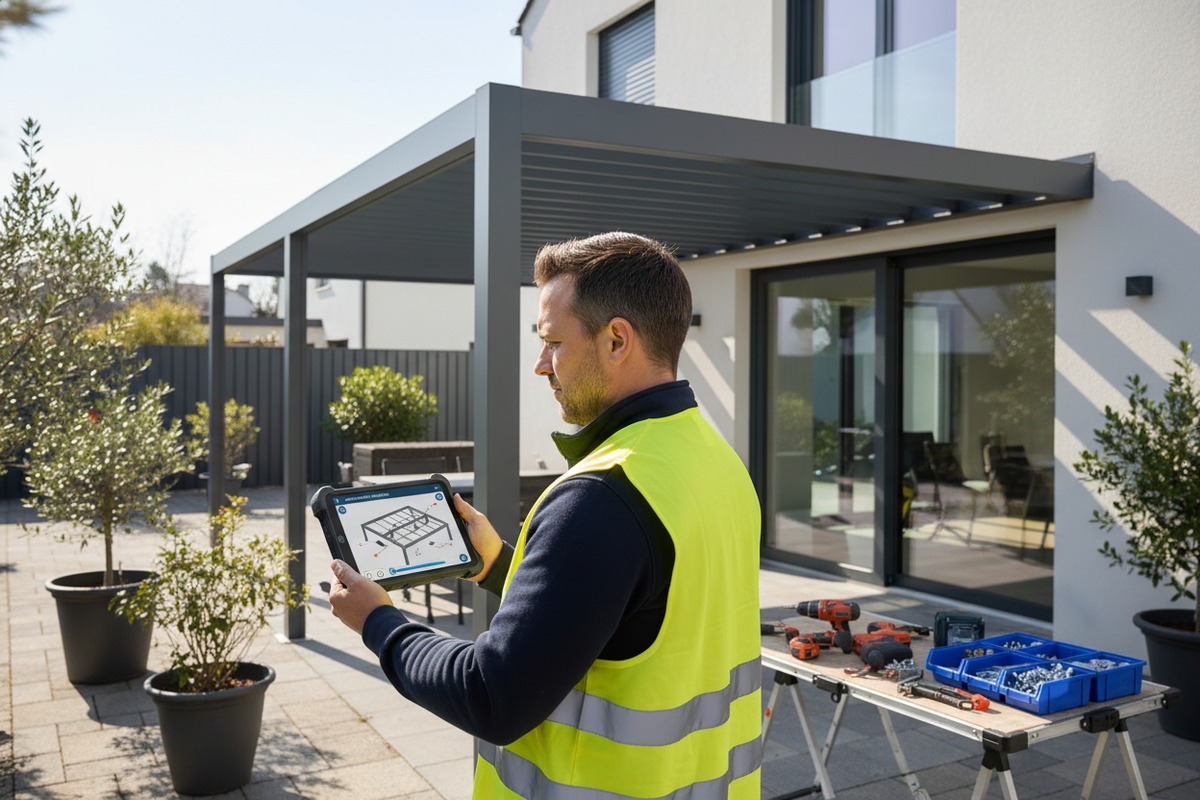
Collaborate with your supplier by providing real job-site photos of common errors, requesting step-by-step 3D animated videos with multilingual subtitles, approving scripts before production, and insisting on QR codes printed on packaging that link directly to model-specific video guides.
Why PDF Manuals Are Not Enough
A flat 2D drawing cannot show how a bracket clips onto a beam from below. Installers on ladders cannot hold paper manuals. They need a phone-friendly video they can pause and replay.
What Makes a Good Installation Video
The best videos we have produced follow this structure:
- Tool list and safety warnings (30 seconds)
- Foundation preparation (2 minutes)
- Post assembly and leveling (3 minutes)
- Beam connection sequence (4 minutes)
- Louver blade installation (5 minutes)
- Motor and wiring (3 minutes)
- Final adjustment and testing (2 minutes)
Your Role in Video Development
You know your installers better than we do. Send us:
- Photos of actual mistakes your installers make
- A list of the most confusing steps
- Preferred languages for subtitles
- Your branding requirements (logo, colors)
We then produce the 3D animation and send you a draft for review. This co-creation process ensures accuracy.
Video Distribution Strategy
| Distribution Method | Advantage | Implementation |
|---|---|---|
| QR code on packaging | Instant access on-site | Printed sticker per SKU |
| YouTube unlisted link | Easy sharing | Emailed with order confirmation |
| WhatsApp/WeChat file | Offline viewing | Sent before shipment arrives |
| Website embed | SEO benefit for wholesaler | Hosted on your domain |
Measuring Success
After implementing 3D videos for one Italian partner, their installation-related support tickets dropped by 55% within three months. Track your own metrics: fewer callbacks, fewer missing-part claims, faster project completion.
How do I provide feedback on local European design trends to ensure my OEM pergola sizes and colors stay competitive?
Our design team updates RAL color offerings and standard sizes every year, but without direct market intelligence from partners like you, we risk producing what sold last year instead of what sells next year.
Provide design trend feedback by sharing competitor product photos, bestselling RAL colors with sales volume data, popular local sizes with dimensions, architectural trend reports from regional trade shows, and seasonal demand patterns so your OEM supplier can update molds, finishes, and stock profiles accordingly.
Color Trends Shift Faster Than You Think
Three years ago, RAL 7016 (anthracite grey) dominated 70% of European orders. Today, we see growing demand for RAL 9005 (jet black), RAL 7021 (black grey), and even RAL 1015 (light ivory) in Mediterranean markets. If you do not tell us, we keep stocking 7016.
How to Structure Your Design Feedback
Send us a simple quarterly update:
- Top 3 selling colors with percentage breakdown
- Most requested sizes (width × depth × height)
- Features competitors offer that you cannot currently source from us
- Photos from local showrooms or trade fairs
- End-client rejection reasons ("too industrial," "too bulky," etc.)
Regional Size Preferences
European gardens and terraces vary significantly by country. The standard 3m × 4m pergola suits many markets, but not all.
| Market | Popular Size (W × D) | Ceiling Height | Notes |
|---|---|---|---|
| Netherlands | 3.5m × 5m | 2.5m | Larger terraces, lower rooflines |
| Italy | 3m × 4m | 3.0m | Classic proportions, tall ceilings |
| UK | 3m × 3.6m | 2.7m | Smaller gardens, compact fit |
| France | 4m × 6m | 3.0m | Hospitality sector drives larger sizes |
| Germany | 3m × 4.5m | 2.8m | Precision dimensions for tight spaces |
Beyond Colors and Sizes
Design feedback should also cover:
- Integrated LED lighting preferences (warm white vs. RGB)
- Gutter visibility (hidden gutters now expected in premium segment)
- Post profile shape (square vs. slim rectangular)
- Screen integration (zip blinds built into frame vs. add-on)
When you give us this data with numbers attached, we prioritize tooling investments correctly. One German partner told us that 30% of their lost quotes were due to us not offering a 150mm slim post. We developed it within 60 days. Their close rate improved immediately.
Conclusion
Your feedback is the bridge between what the market needs and what the factory produces. Share specific data, build structured communication habits, and treat your supplier as a development partner—not just a vendor.
Footnotes
1. Official EU information on CE marking, its purpose, and requirements for products. ↩︎
2. Official Eurocode standard for wind actions on structures, detailing calculation procedures. ↩︎
3. Discusses the benefits and use cases of QR codes on product packaging for customer engagement. ↩︎
4. Explains Finite Element Analysis (FEA) as a method for predicting product behavior under forces. ↩︎
5. Official EU guide on the mandatory legal document declaring product compliance with EU requirements. ↩︎
6. Official website for RAL colors, a globally recognized standard for defining colors in various industries. ↩︎
7. Provides information on Expanded Polyethylene (EPE) foam, its properties, and uses in packaging. ↩︎