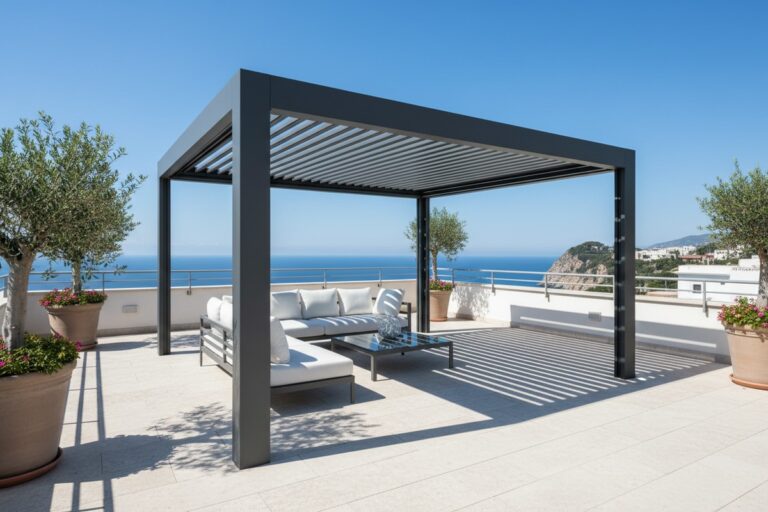

Every year, our quality control team reviews hundreds of material test reports before a single aluminum profile enters our production line UV resistance (ASTM G154 or G155) 1. Yet most buyers never ask to see one — until a pergola fails in its first winter storm and the finger-pointing begins.
You should request material test reports (MTRs) covering aluminum alloy grade and temper, wall thickness verification, powder coating salt spray and UV resistance certifications (AAMA 2604/2605), motor electrical safety certificates (CE/TÜV), and independently verified wind and snow load test reports to ensure structural safety, weather durability, and regulatory compliance.
Below, we break down each critical report category so you know exactly what to ask your supplier — and how to read what they send back Low Voltage Directive (2014/35/EU) 2. Whether you are a distributor in Italy or a contractor in Germany, these documents protect your projects and your reputation.
How do I confirm the aluminum alloy grade and wall thickness meet my structural safety standards?
We have seen it happen more times than we would like: a buyer receives a container of pergola kits, only to discover the aluminum feels flimsy and dents under thumb pressure EMC Directive (2014/30/EU) 3. The root cause is almost always an unverified alloy grade or dangerously thin wall profiles. aluminum alloy grade 4
Request a mill test certificate (MTC) specifying the alloy designation (e.g., 6063-T6), chemical composition percentages, mechanical properties including tensile and yield strength, and measured wall thickness for every extrusion lot. This single document is your first line of defense against substandard aluminum.

Why the Alloy Grade Matters
Not all aluminum is equal. The 6XXX series — specifically 6063-T5, 6063-T6 5, and 6061-T6 — dominates commercial pergola manufacturing for good reason. These alloys contain magnesium and silicon in precise ratios that deliver excellent extrudability, strong corrosion resistance, and reliable mechanical strength EN 1991 (Eurocode) 6. When our engineers design a new pergola profile, they specify 6063-T6 because it balances formability with a tensile strength of approximately 35 ksi. That number is not arbitrary. It means the aluminum can handle real-world snow loads and wind forces without permanent deformation.
Cheaper imports sometimes use 1XXX-series aluminum, which is 99% pure aluminum. It resists corrosion well, but its tensile strength is roughly half that of 6063-T6. For a decorative trim, that might be acceptable. For a load-bearing post holding up a louvered roof in a snowstorm, it is not.
How to Read the Chemical Composition Report
Your supplier's MTC should list the percentage of each alloying element. For 6063-T6, look for magnesium between 0.45% and 0.90% and silicon between 0.20% and 0.60%. If these numbers fall outside the range defined by ASTM B221 7 or EN 755, the alloy may be mislabeled or improperly processed. Improper composition increases the risk of stress corrosion cracking — a silent failure mode that can appear years after installation.
Wall Thickness: The Hidden Cost-Cutting Trick
Wall thickness is where the biggest quality gap exists between premium and budget pergolas. A commercial-grade 10×12 pergola using proper 6063-T6 profiles can weigh around 1,800 pounds. A thin-wall import of the same footprint may weigh only 250 to 450 pounds. That weight difference translates directly into structural capacity.
On our production line, we measure wall thickness at multiple points along each extrusion batch using calibrated micrometers. The MTC should confirm minimum wall thickness values — typically 3.0 mm or more for main structural posts and beams in commercial applications.
| Specification | 6063-T6 (Commercial Grade) | 6063-T5 (Standard) | 1XXX Series (Budget) |
|---|---|---|---|
| Tensile Strength (ksi) | ~35 | ~27 | ~13–18 |
| Yield Strength (ksi) | ~31 | ~21 | ~5–15 |
| Typical Wall Thickness | 3.0–4.0 mm | 2.0–3.0 mm | 1.2–2.0 mm |
| Coastal Suitability | Excellent | Good | Poor for structural |
| Approx. Weight (10×12 pergola) | 800–1,800 lbs | 400–700 lbs | 250–450 lbs |
Red Flags to Watch For
If a supplier cannot provide lot-traceable MTCs within 48 hours, that is a warning sign. Also watch for reports that lack a third-party lab stamp, missing temper designations, or mechanical test values that suspiciously match the minimum specification exactly. Real production data shows natural variation. Perfectly round numbers suggest the report may be fabricated.
Which powder coating and salt spray test reports will guarantee my pergola's long-term weather resistance?
One of the most frustrating calls we receive is from a distributor whose end client sends photos of a pergola with peeling, chalking, or faded coating after just two or three years. The damage is done — not only to the finish, but to the distributor's brand.
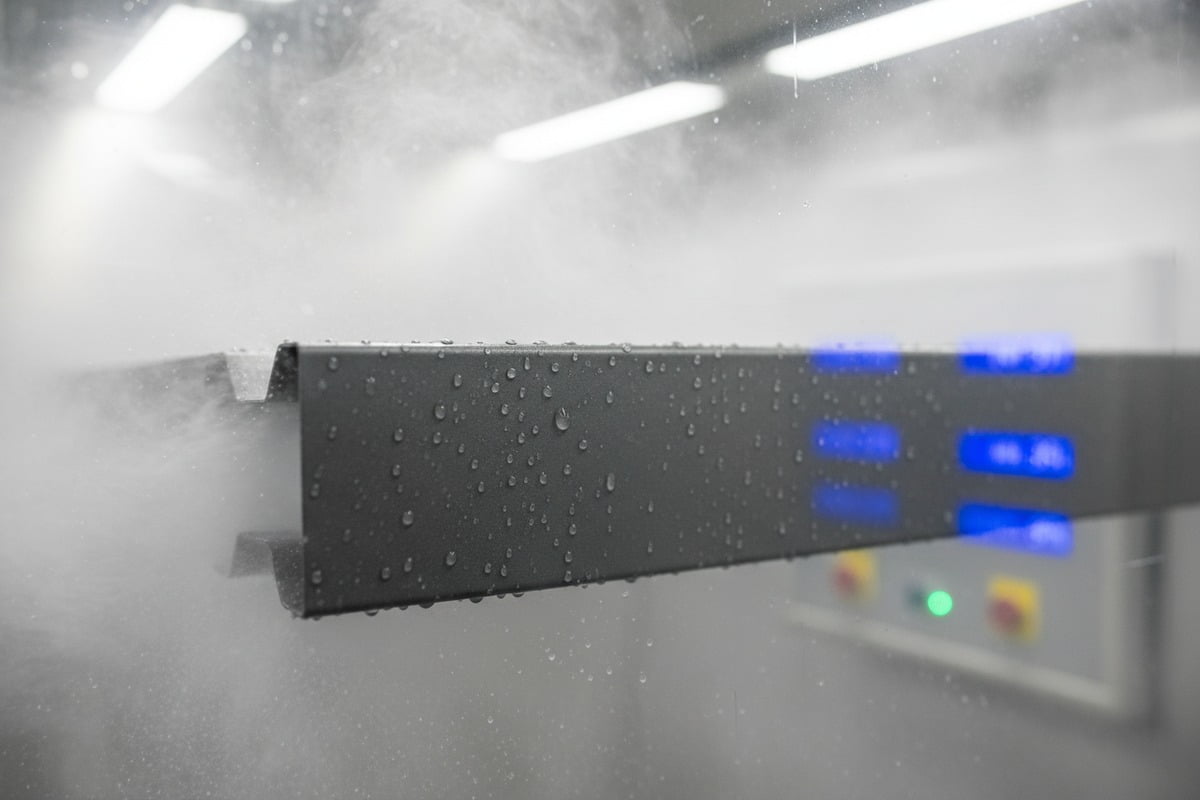
Request powder coating test reports certified to AAMA 2604 or AAMA 2605 standards, along with independent salt spray test results showing a minimum of 1,000 hours resistance (3,000+ hours for coastal projects). These reports confirm UV stability, adhesion, color retention, and corrosion protection over decades of outdoor exposure.
Understanding AAMA Coating Standards
The American Architectural Manufacturers Association (AAMA) defines three tiers of powder and liquid coating performance. AAMA 2604 or AAMA 2605 standards 8 For pergolas, only two matter:
- AAMA 2604: Requires coatings to withstand 10 years of South Florida exposure testing. Suitable for most inland and suburban installations.
- AAMA 2605: The gold standard. Requires 20+ years of South Florida exposure. This is what we recommend and apply for coastal, high-UV, and high-humidity projects.
When we source powder coatings for our production, every batch comes with a certificate of analysis. We then run internal adhesion cross-hatch tests and conduct periodic third-party salt spray validation. You should ask for both the coating manufacturer's data sheet and the pergola manufacturer's own test results.
Salt Spray Testing Explained
Salt spray testing (ASTM B117) 9 places coated samples in a chamber with a constant 5% salt fog at 35°C. The duration before visible corrosion, blistering, or coating failure is measured. Here is what the numbers mean in practice:
| Salt Spray Hours | Typical Application | Expected Outdoor Life |
|---|---|---|
| 500 hours | Light residential, dry climates | 5–10 years |
| 1,000 hours | Standard residential and commercial | 15–20 years |
| 3,000+ hours | Coastal, marine, tropical | 25–30+ years |
Our standard production line uses coatings that achieve 1,500 hours minimum. For European coastal projects — the Mediterranean, the Atlantic coast, Scandinavia — we recommend and supply coatings validated at 3,000 hours or more.
Beyond Salt Spray: Additional Coating Tests You Should Request
Salt spray alone does not tell the full story. Ask for these additional reports:
- UV resistance (ASTM G154 or G155): Confirms the coating will not fade or chalk under years of sun exposure. AAMA 2605 mandates less than 5 Delta E color change after extended weathering.
- Adhesion testing (ASTM D3359): Cross-hatch tests confirm the coating bonds permanently to the aluminum substrate. A score of 4B or 5B is expected.
- Humidity resistance (ASTM D2247): Tests whether moisture infiltration causes blistering or delamination over long cycles.
- Pencil hardness (ASTM D3363): Measures surface hardness. A minimum of 2H pencil hardness indicates the coating resists scratching and physical wear.
VOC and Environmental Compliance
For European distribution, check that the coating process meets REACH and RoHS requirements. Powder coating is inherently low-VOC compared to liquid paint, but the pigments and additives still must comply with EU regulations. Ask for a VOC emissions report and a REACH declaration of compliance. These documents are increasingly required by sustainability-conscious buyers and specifiers.
What electrical safety certifications must I see to ensure the motors are compliant for European distribution?
When our team ships motorized louvered pergolas to Europe, the motors and control systems face some of the strictest safety regulations in the world. Ignoring these requirements does not just risk a failed customs inspection — it opens the door to serious legal liability if something goes wrong on-site.
For European distribution, demand CE marking declarations of conformity, proof of compliance with the Low Voltage Directive (2014/35/EU) and EMC Directive (2014/30/EU), and ideally TÜV or equivalent third-party test reports for every motorized component including tubular motors, control boxes, and remote receivers.
CE Marking Is Not Optional
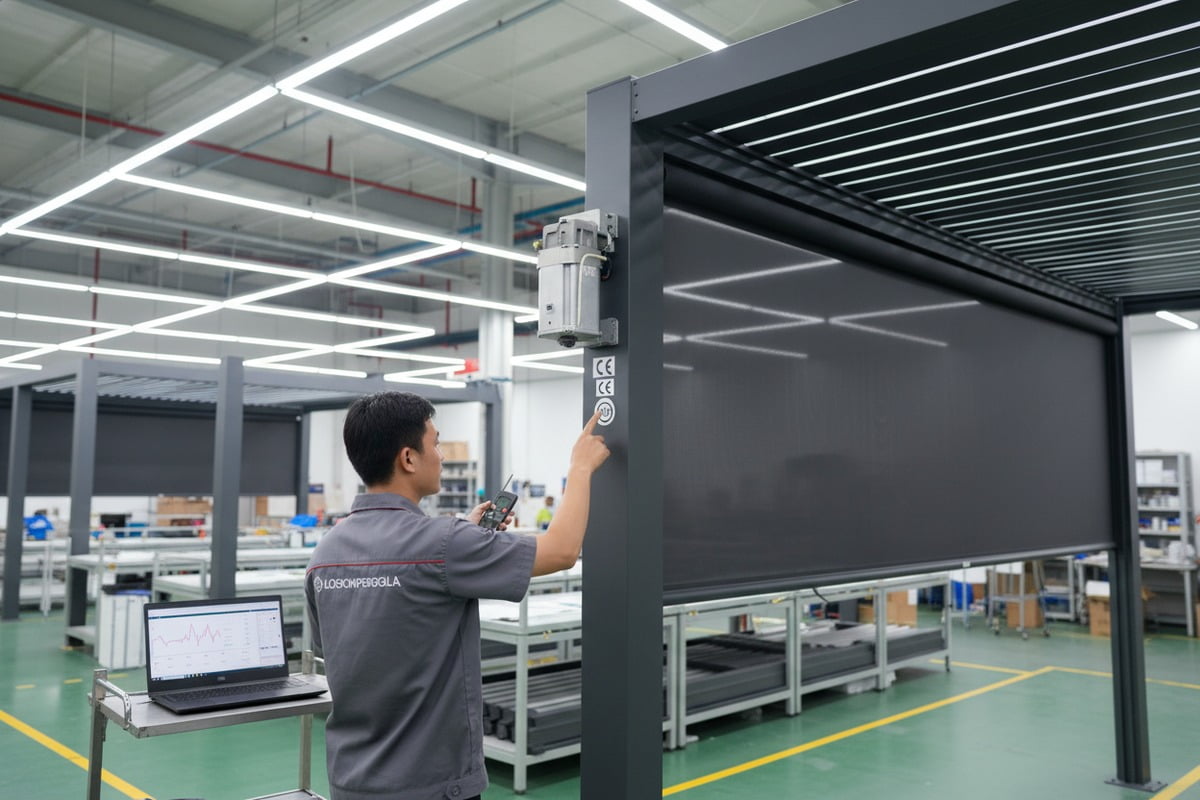
CE marking is a legal requirement for selling motorized products in the European Economic Area. CE marking declarations of conformity 10 It is not a quality mark — it is a declaration that the product meets all applicable EU directives. For a motorized pergola, the relevant directives typically include:
- Low Voltage Directive (LVD) 2014/35/EU: Covers safety of electrical equipment operating between 50 and 1,000V AC.
- Electromagnetic Compatibility (EMC) Directive 2014/30/EU: Ensures the motor does not emit excessive electromagnetic interference and is immune to external interference.
- Machinery Directive 2006/42/EC: May apply if the louvered system includes automated moving parts with pinch or crush hazards.
- Radio Equipment Directive (RED) 2014/53/EU: Applies if the pergola uses wireless remote controls or Bluetooth/Wi-Fi connectivity.
What Documents to Request
A CE marking label on the motor housing is not enough. You need the paperwork behind it. Specifically:
- Declaration of Conformity (DoC): A signed document from the manufacturer listing the applicable directives, harmonized standards (e.g., EN 60335-1 for household appliances safety), and the responsible person in the EU.
- Third-party test reports: From accredited labs such as TÜV, SGS, or Intertek. These reports detail the specific tests performed — insulation resistance, leakage current, temperature rise, endurance cycling, and more.
- IP rating certificate: Pergola motors are exposed to rain. An IP44 rating is the minimum; IP65 is preferable for exposed installations. The IP test report should come from an independent lab.
| Certification | What It Covers | Why You Need It |
|---|---|---|
| CE (LVD + EMC) | Electrical safety and electromagnetic compatibility | Legal market access in EU/EEA |
| TÜV / SGS / Intertek report | Independent verification of safety claims | Liability protection and buyer confidence |
| IP44 / IP65 rating | Ingress protection against water and dust | Motor longevity in outdoor weather |
| RED compliance | Wireless remote and connectivity modules | Required for any RF-enabled controls |
| RoHS Declaration | Restriction of hazardous substances | EU environmental compliance |
The Risk of Non-Compliant Motors
We have heard stories from European distributors who imported pergolas with uncertified motors to save a few euros per unit. One distributor in Southern Europe faced a product recall after a motor overheated and damaged a client's deck. The insurance claim was denied because the motor lacked proper CE documentation. The total loss — including legal fees, replacement costs, and reputational damage — exceeded €200,000.
On our end, we only source motors from certified manufacturers and keep copies of all test reports in our compliance archive. When we ship to Europe, every packing list includes a link to the digital DoC and test report package. If your current supplier cannot do this, ask why.
Smart Home Integration and Future-Proofing
As motorized pergolas increasingly integrate with smart home systems — via apps, voice assistants, and weather sensors — the regulatory landscape is expanding. Products with Wi-Fi or Zigbee modules must comply with the Radio Equipment Directive and applicable cybersecurity standards. Request documentation that covers not just the motor, but the entire electronic ecosystem shipped with the pergola.
Can I request a wind resistance and snow load test report to prevent project liability issues?
After a severe winter storm two years ago, one of our contractor clients in Northern Europe called to say that a competitor's pergola had collapsed under snow at a hotel project across the street — while ours held firm. The difference was not luck. It was engineering documentation.
Yes, you can and should request third-party wind resistance and snow load test reports. These documents, typically based on EN 1991 (Eurocode) or local building codes, certify the maximum wind speed and snow weight the pergola can safely withstand, directly protecting you from structural failure claims and project liability.
Why These Reports Matter for Liability
In most European countries, any structure attached to or adjacent to a building must meet local structural codes. If a pergola collapses and injures someone or damages property, the installer and distributor can both be held liable. Your best defense is a documented chain of compliance — from the manufacturer's engineering calculations to third-party load testing.
Without these reports, you are asking your clients to trust marketing claims. And when insurance adjusters investigate a failure, "the supplier told me it was strong" is not a valid defense.
What the Test Reports Should Include
A proper wind and snow load test report will contain:
- Reference standard: EN 1991-1-3 (snow loads) and EN 1991-1-4 (wind actions) for Europe. Some markets also accept ASCE 7 (American) or AS/NZS 1170 (Australian).
- Design load values: Expressed in kN/m² for snow and km/h or m/s for wind speed.
- Safety factors: The report should specify whether the values are ultimate limit state (ULS) or serviceability limit state (SLS). ULS values include built-in safety margins.
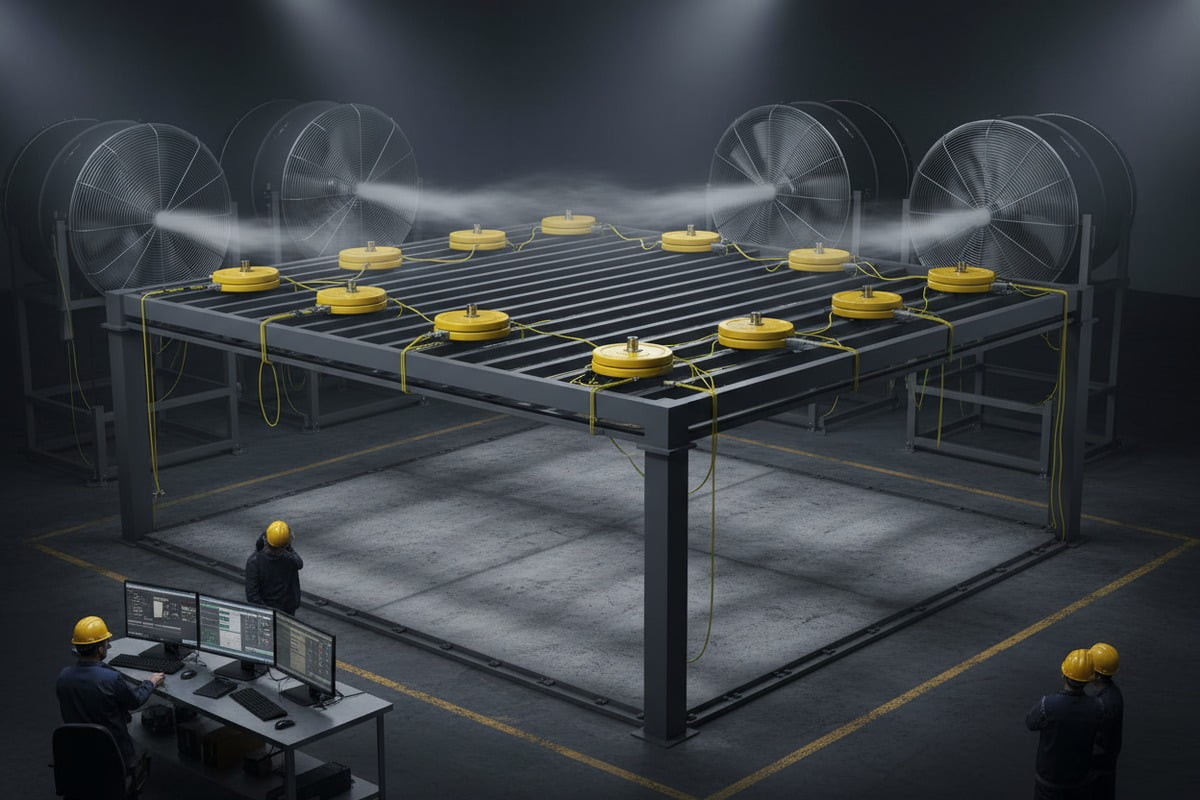
- Test methodology: Whether the values come from finite element analysis (FEA), physical destructive testing, or both. Physical testing is more credible.
- Specific configuration tested: The span, post height, louver angle, and connection type matter. A report for a 3×3 meter pergola does not apply to a 4×6 meter unit.
Engineering Calculations vs. Physical Testing
Our engineering department runs FEA simulations on every new pergola model during the design phase. These simulations model stress distribution across posts, beams, and louver blades under various load combinations. However, we also commission physical load tests at independent laboratories for our standard product range. Physical testing applies real forces to real structures and measures actual deflection and failure points.
The combination of FEA and physical testing provides the most complete picture. If your supplier only offers FEA calculations without physical validation, you are relying on assumptions about material quality and connection integrity that may not hold true in production.
ICC-ES and Other Structural Certifications
For markets that require building code compliance, ICC Evaluation Service (ICC-ES) reports are the gold standard. An ICC-ES report means an independent body has reviewed the engineering, inspected the manufacturing facility, and confirmed that the product meets specific building code requirements. While ICC-ES is primarily a North American system, its reports carry weight globally and signal a serious commitment to structural integrity.
In Europe, look for structural assessments aligned with Eurocode or local national annexes. Some manufacturers also provide ETA (European Technical Assessment) documents for their pergola systems.
Practical Load Values to Look For
For most Central and Northern European installations, you want a pergola that can handle at least 0.75 kN/m² snow load and withstand wind speeds of 100–120 km/h. Coastal and alpine regions demand higher values. Always match the report values to the specific climate zone of your project.
Ask your supplier to provide a load capacity matrix showing which pergola sizes and configurations meet which load ratings. This helps you and your clients select the right product for each project without over-engineering or under-specifying.
Conclusion
Material test reports are not bureaucratic extras — they are the documents that separate a reliable pergola from a liability waiting to happen. Request alloy MTCs, coating certifications, motor compliance documents, and structural load reports before placing your order, and you protect every project you deliver.
Footnotes
- Explains ASTM G154 and G155 standards for UV resistance testing. ↩︎
- Official European Commission page for the Low Voltage Directive. ↩︎
- Official European Commission page for the EMC Directive. ↩︎
- Authoritative overview of aluminum alloy grades and their properties. ↩︎
- Wikipedia provides a concise summary of 6063-T6 properties and uses. ↩︎
- Overview of Eurocodes, including EN 1991, from European Standards. ↩︎
- Direct link to the ASTM International standard for aluminum extrusions. ↩︎
- Industry leader's explanation of AAMA 2604 and 2605 coating specifications. ↩︎
- This is the official ASTM International page for the B117 standard, offering the most authoritative information on salt spray (fog) apparatus operation. ↩︎
- Definitive guide on EU Declaration of Conformity for CE marking. ↩︎