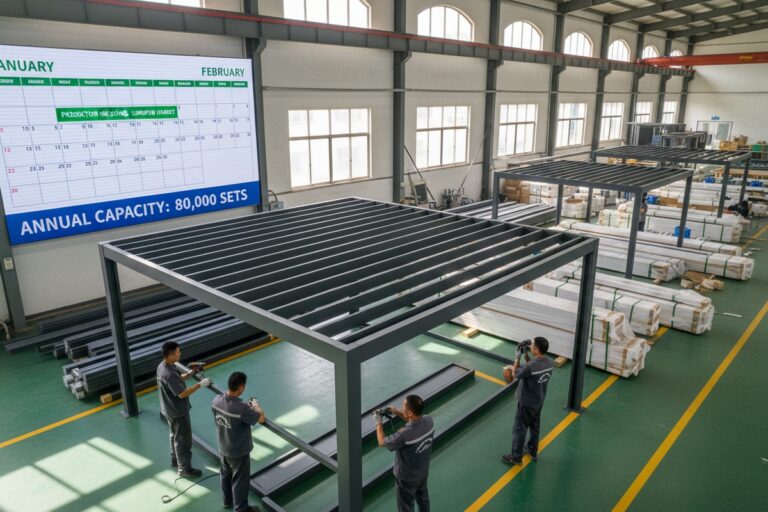

On our production floor, vague pergola briefs turn into redraws, delays, and avoidable site problems before the first frame leaves the factory.
To request a strong technical proposal, define the pergola type, mounting method, dimensions, loads, materials, drawings, certifications, and installation scope in one RFQ, then require clear structural data, 3D visuals, and document-backed quality guarantees before you compare prices.
That approach cuts confusion for both buyer and supplier.
How do I specify the mounting requirements for ground, wall, and freestanding pergolas in my technical request?
In our export projects, unclear mounting details often trigger redraws, weak anchors, and costly site fixes once installers open the crates.
To specify mounting requirements, state whether the pergola is ground-mounted, wall-mounted, or freestanding, then define the base condition, anchor method, substrate strength, drainage slope, clearances, and who supplies footings, sealants, flashing, and installation hardware.
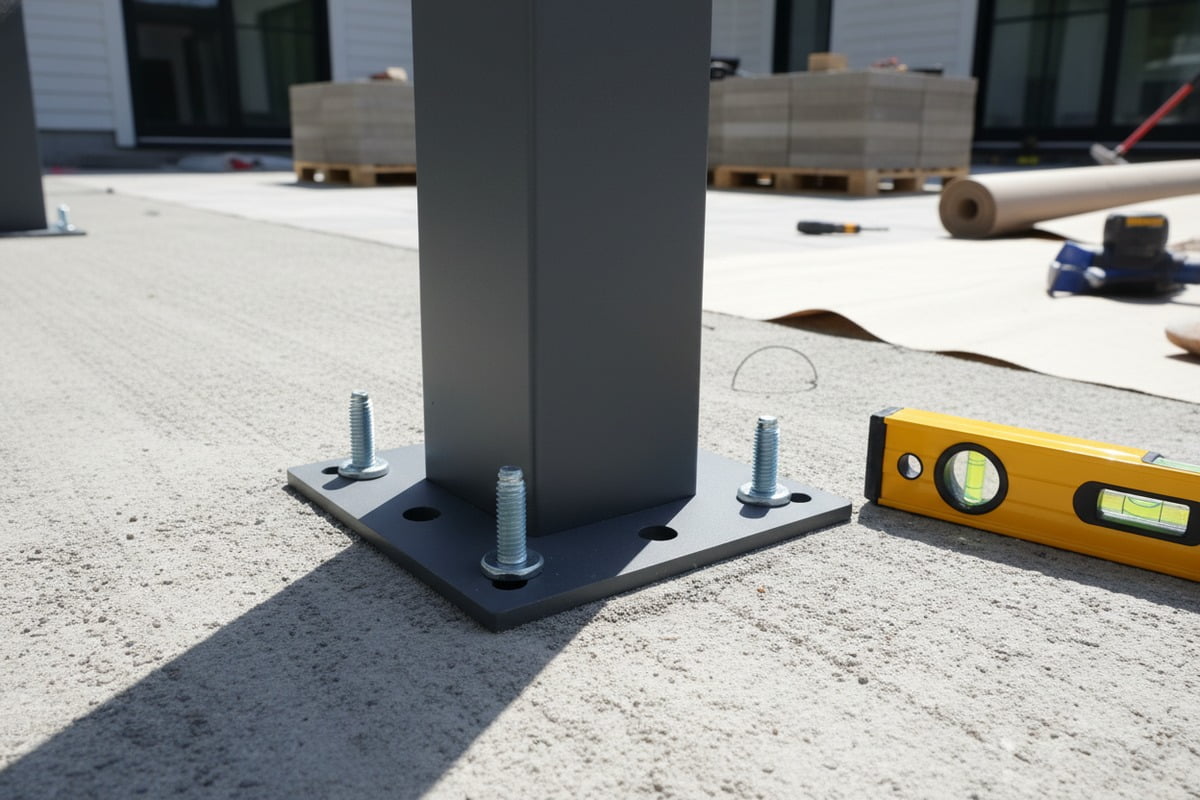
A good RFQ starts with the support condition, not the roof style. Many buyers spend pages on color, motor options, and side screens, but only one short line on how the pergola will stand. That is where problems begin. In our factory, the drawing team cannot finalize post plates, anchor holes, or beam connections until we know what the structure will sit on or attach to.
Describe the real site, not the ideal site
Ground-mounted pergolas usually need concrete footings 1 or an engineered slab. Wall-mounted pergolas need more than a wall location. They need the wall build-up. A structural concrete wall 2 is different from brick veneer, insulated facade, or light-gauge framing. Freestanding pergolas also need care. Many buyers use the word freestanding to mean independent from a house wall, but that does not mean loose placement without anchoring. In most permanent projects, freestanding units still need anchoring to concrete, steel, or other approved bases.
| Pergola type | What you should provide in the RFQ | What the proposal should return |
|---|---|---|
| Ground-mounted | Finished size, footing preference, soil notes, slab or footing dimensions, drainage slope, paving build-up | Base plate size, anchor type, footing recommendation, post layout, setting tolerances |
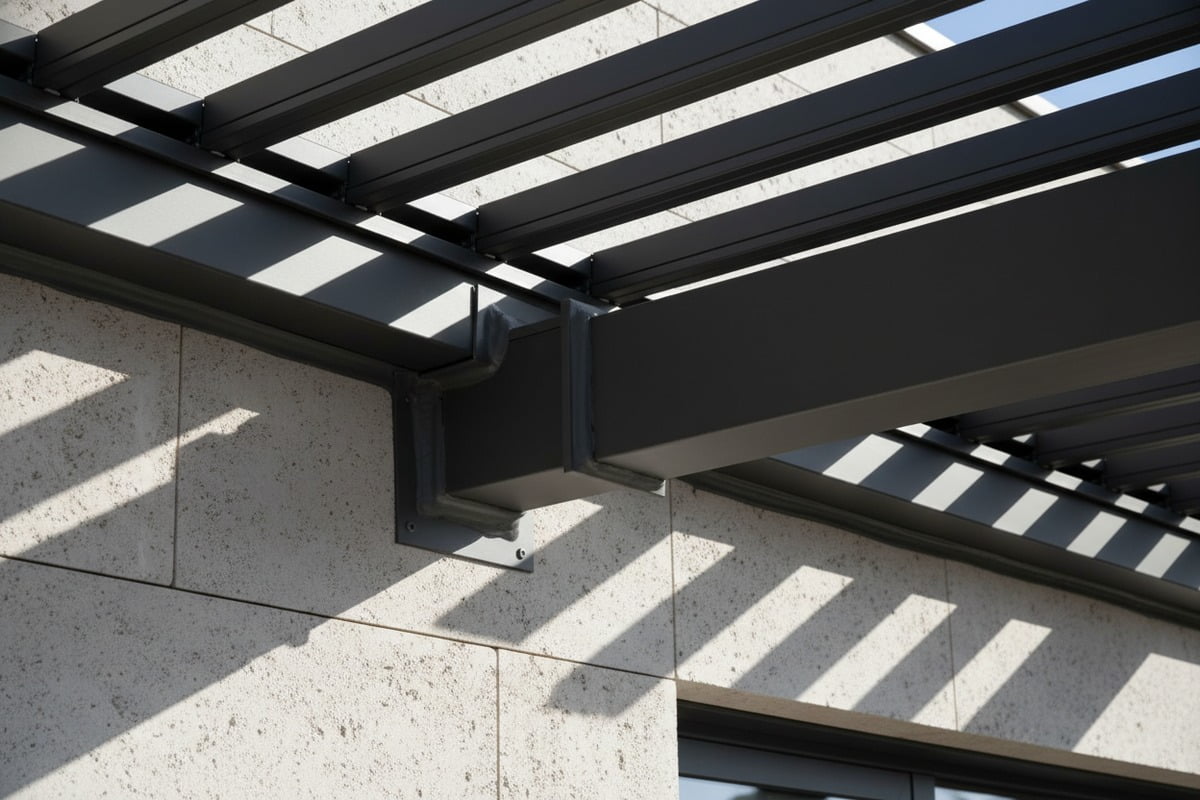
| Wall-mounted | Wall material, insulation thickness, cladding type, structural backing, flashing limits, roof eave conflicts | Wall bracket details, fastener type, waterproofing notes, minimum pull-out requirement, connection drawings |
| Freestanding | Base surface, need for portability or permanence, wind exposure, clearance around posts, nearby obstructions | Anchoring method, ballast or footing requirement, uplift control, plan view with post centers |
Ask for the surfaces under the finish
One common mistake is treating pavers as structure. Pavers are a finish layer. They are not usually the anchoring base. If the pergola will sit on pavers, your RFQ should say what is under them. Is it reinforced concrete? Compacted gravel? A suspended deck? The supplier should not guess.
The same logic applies to wall-mounted systems. Exterior finish does not equal structural support. Stone cladding, EIFS, and decorative panels often need stand-off brackets or waterproof detailing. If you skip that information, the quote may look cheap at first and become expensive later through site welding, chemical anchors 3, or flashing revisions.
Put responsibility in writing
A technical proposal should also define scope boundaries. Who pours the footings? Who checks the wall strength? Who supplies chemical anchors? Who seals penetrations? Who is responsible for site measurement tolerances? These are small questions on paper and big disputes on site.
| Missing input | What usually goes wrong | Typical cost impact |
|---|---|---|
| No slab or footing details | Wrong anchors or plate redesign | Delays, extra steel, rework labor |
| No wall substrate data | Unsafe fixing or site improvisation | Waterproofing risk and warranty disputes |
| No drainage slope shown | Posts land at different heights | Extra shims, cutting, visual defects |
| No installation scope split | Supplier and installer blame each other | Payment holdback and project delay |
When I help buyers prepare OEM or ODM files, I push for one simple rule: every mounting point should be visible in words and in drawings. That means plan view, elevation, and connection detail. It also means naming the hardware standard, hole spacing, embedment depth, and any sealant or flashing requirement. The more exact your mounting request is, the more comparable your proposals become.
What load-bearing and wind resistance data should I look for in my aluminum pergola proposal?
Our engineers see the same mistake often: buyers request style and price first, then ask about wind later, when the post size is already wrong.
In your proposal, ask for design wind speed, exposure category, allowable span, post size, snow or live load, drainage capacity, and stamped structural calculations where required, because thickness alone does not prove a pergola will stay stable in real weather.
Structural performance should be one of the first comparison points, not the last. A pergola may look solid in a rendering and still be weak in uplift, beam deflection, or roof drainage. In our R&D work, we often see buyers focus on aluminum thickness alone. Thickness matters, but it is only one part of the system. Alloy grade 4, profile shape, span length, connection design, anchor capacity, and site wind exposure all matter too.
Ask for the design basis, not just the result
A proposal should state what loads the pergola was designed for and under which assumptions. Wind speed without exposure category 5 is incomplete. Snow load without the unit is not useful. Span without deflection control tells you little about stiffness. If the quote only says "wind resistant" or "heavy duty," that is marketing language, not engineering language.
| Data point to request | Why it matters | Red flag in a proposal |
|---|---|---|
| Design wind speed 6 and unit | Shows the weather basis for the structure | No speed stated, or speed stated without unit |
| Exposure category or site condition | Open coastal sites behave differently from sheltered urban sites | No mention of exposure or terrain |
| Snow load or live load | Important for cold climates and louver roofs | Supplier says "not needed" without knowing project location |
| Maximum span and post spacing | Controls deflection and visual stability | Large span claims with no section drawing |
| Structural calculations 7 | Lets you verify load path and member adequacy | Only a brochure, no calculations |
| Anchor reaction or base load | Critical for foundation design | Structure looks strong but no footing loads are given |
Compare complete systems, not single numbers
One supplier may quote thicker posts, while another uses a better profile shape with stronger internal geometry. One may use 6063-T6 alloy. Another may use a softer temper. One may include hidden steel reinforcement at critical joints. Another may not. The fair way to compare is to request section drawings, alloy grade, wall thickness range, span tables, and connection details together.
It also helps to ask how the louver roof behaves in weather. Motorized louvers need drainage logic. Where does water go when the blades are closed? What is the gutter capacity in heavy rain? At what wind speed should louvers be opened or locked? Smart sensors are useful, but only when the proposal tells you what the sensor does and what its operating limits are.
Require project-specific proof when the site is demanding
If your project is in a coastal zone, on a rooftop, near open farmland, or in a snow region, generic catalog data is not enough. Ask for project-specific calculations prepared to local code requirements. In some markets, you may also need a licensed engineer's stamp. That detail should be written into the RFQ early, because it affects lead time and cost.
I also suggest asking for allowable tolerances. A pergola can technically pass a load check and still feel flimsy if beam deflection is too high. Good proposals explain both safety and serviceability. That makes it easier to judge long-term quality instead of only first cost.
Can I request a detailed 3D rendering and installation guide as part of my custom OEM/ODM proposal?
On projects with custom sizes, a vague drawing today can become a missing bracket or reversed motor tomorrow.
Yes. You should ask for a 3D rendering, shop drawings, exploded parts views, wiring layout, packing list, and step-by-step installation guide, because custom OEM/ODM pergolas often fail on site from unclear interfaces, mislabeled parts, and missing sequence details rather than bad materials.
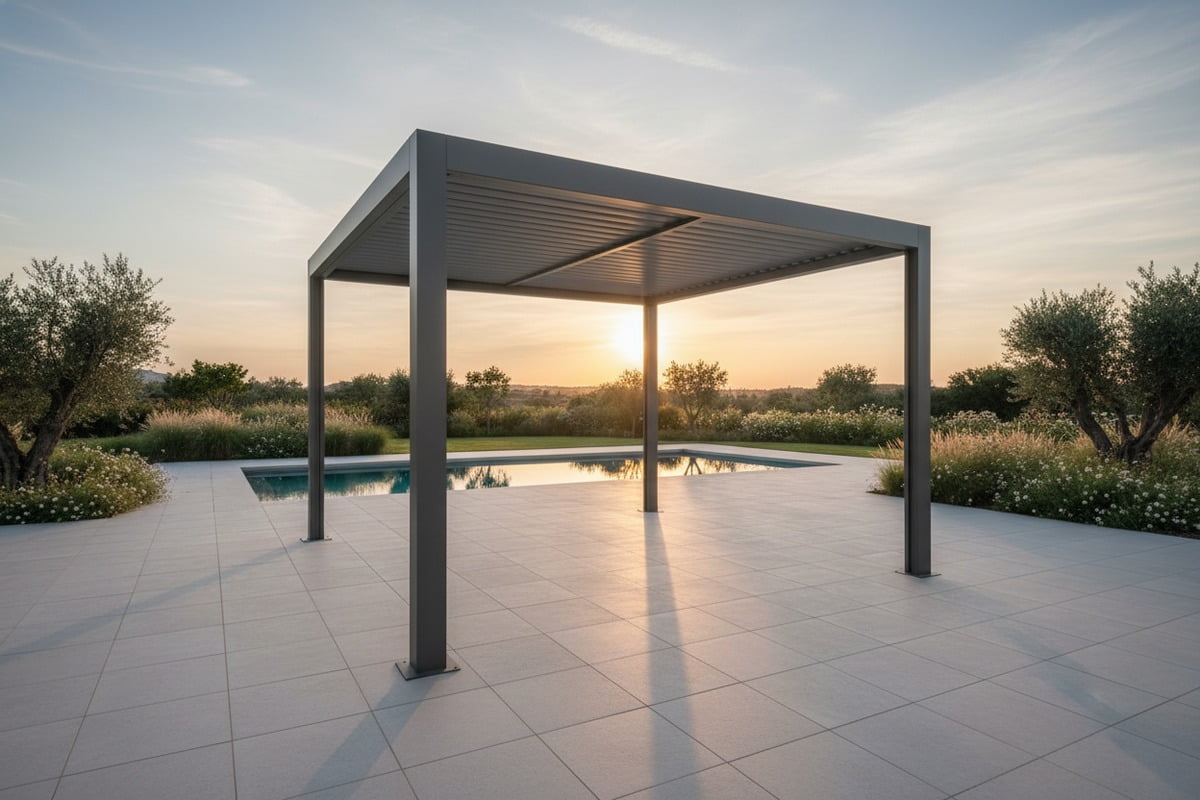
You should absolutely request these items, and not as optional extras. In B2B export work, installation errors often cost more than small design changes. A clean 3D model helps everyone see the same product. The purchasing manager sees scope. The installer sees sequence. The end client sees appearance. The factory sees which parts must be unique and which parts can stay standard.
A 3D rendering is a technical tool, not just a sales image
Many buyers think a rendering is only for presentation. In practice, it also prevents mismatched expectations. A dark charcoal matte louvered pergola may look simple, but the rendering can reveal hidden downpipes, side screen boxes, lighting grooves, post setbacks, and wall bracket locations. That is useful before production starts.
The rendering should match the technical drawings. If the rendering shows privacy screens, heaters, or curved trim, those items should appear in the bill of materials and the wiring plan too. When they do not match, site confusion starts.
| Deliverable | What it should show | Why it matters |
|---|---|---|
| 3D rendering | Final look, color, roof style, accessories, post layout | Aligns buyer, client, and factory expectations |
| Shop drawings | Plan, elevation, section, critical dimensions | Supports approval and site coordination |
| Exploded view | Part relationships and assembly logic | Reduces installation mistakes |
| Wiring diagram | Motor, LED, sensor, switch, controller routing | Prevents electrical conflicts |
| Packing list | Carton numbers, part codes, quantities | Helps check shortages before installation |
| Installation guide | Sequence, tools, torque notes, safety checks | Saves labor time and avoids rework |
The installation guide must cover sequence, not just parts
A weak manual shows parts and leaves the crew to guess the order. A strong manual shows the sequence from layout to final commissioning. It should explain how to check diagonals, when to tighten bolts fully, how to align louvers, how to connect drainage channels, and how to test motors and sensors.
For export orders, I also like to include part labels that match both the drawing and the cartons. This is simple, but it solves many headaches. Missing one non-standard connector can stop a whole job. A good proposal should explain how spare parts, extra fasteners, and replacement procedures are handled.
Ask for media that the site team can really use
A PDF alone may not be enough. For a custom pergola, ask whether the supplier can provide a short installation video, multilingual manual, or QR-linked assembly file. That matters when crews change, time zones slow after-sales support, or the project is installed by a local contractor who did not join the original technical review.
When our team handles ODM projects for European buyers, the best results come from one approved pack: rendering, full drawing set, parts coding, packing logic, and installation sequence. It does not just help installation. It also reduces claims, payment delays, and arguments about missing scope.
How do I ensure my proposal includes the necessary CE certifications and material quality guarantees for my project?
Our EU orders taught us that a clean quote means little if the motor papers, coating records, and alloy proof arrive late or not at all.
Ask for CE Declaration of Conformity for motors, controllers, LED drivers, sensors, and powered accessories sold into Europe. For the structure, request alloy certificates, coating test reports, warranty terms, and corrosion data.
This topic deserves careful wording because many buyers use CE as a shortcut for total quality. It is not. CE can be essential, especially for electrical and motorized parts entering the European market, but CE does not replace structural verification, alloy traceability, or finish durability proof. A strong proposal separates compliance documents from broader quality guarantees.
Separate compliance from quality proof
For motorized louvered pergolas, ask which components carry CE-related documentation and under which applicable directives or standards the supplier is declaring conformity. That usually means the motor, control system, remote receiver, LED driver, wind or rain sensor, and other powered accessories. Ask for the Declaration of Conformity and the model numbers tied to it. A generic CE logo on a brochure is not enough.
For the aluminum structure itself, ask for different proof. You want the alloy grade, temper, wall thickness range, and mill certificate or material certificate 8. If the pergola will be near the sea or in harsh sun, also ask for powder coating details 9, pre-treatment process, coating thickness range, and corrosion or weathering test information.
| Document or guarantee | What it confirms | What to check |
|---|---|---|
| CE Declaration of Conformity 10 | Compliance claim for applicable powered components | Exact model numbers, issuer name, date, product scope |
| Motor and controller datasheet | Electrical rating and operating limits | Voltage, IP rating, duty cycle, compatibility |
| Aluminum material certificate | Alloy and temper consistency | 6063-T5, 6063-T6, or specified equivalent |
| Coating report | Finish durability and process control | Powder brand, pre-treatment, thickness, salt spray or weathering data |
| Warranty statement | Supplier commitment after delivery | Duration, exclusions, labor coverage, coastal conditions |
| Inspection report | Shipment quality before packing | Profile finish, dimensions, accessory completeness |
Request traceability, not just promises
A useful proposal links documents to the real order. That means the motor document matches the motor in the BOM. The coating report matches the finish specified for the project, whether it is charcoal gray matte, white, or woodgrain. The material certificate matches the profile batch or production run. Without traceability, documents lose value.
This is also where packaging and after-sales support matter. Quality is not only about the profile. It is also about how the supplier protects long aluminum lengths during sea freight, how cartons are labeled, and how quickly missing parts are replaced. For many B2B buyers, these details decide whether a project stays profitable.
Put the guarantee language into the quotation file
Do not leave warranty and quality terms for later email threads. Ask for them inside the proposal or as formal annexes. The proposal should state the structure warranty, coating warranty, electrical component warranty, response time for after-sales claims, and who pays for replacement parts or freight under confirmed defects.
I also recommend asking one practical question: what test or inspection happens before shipment? A supplier that can show pre-shipment checks, dimension verification, finish inspection, and accessory counting usually manages risk better than a supplier that only sends polished renderings. In real projects, document discipline often predicts product discipline.
Conclusion
A reliable pergola proposal is more than a price sheet. It should lock down mounting, loads, drawings, compliance, and after-sales terms before production begins.
Notes de bas de page
1. Explains the purpose, types, and construction of concrete footings in foundations. ︎
2. Defines structural walls and their role in supporting building loads. ︎
3. Explains what chemical anchors are, their installation, and advantages in construction. ︎
4. Provides an authoritative definition of alloy steel, including its types, properties, and alloying elements, which directly relates to alloy grades. ︎
5. Details wind exposure categories (B, C, D) and their impact on structural design. ︎
6. Explains how design wind load is determined, including basic wind speed as a factor. ︎
7. Explains what structural calculations are, their importance, and what they include in construction projects. ︎
8. Defines material certification, its types, and significance in ensuring quality and compliance in supply chains. ︎
9. Explains powder coating specification standards (Class A, B, C) for aesthetic and functional requirements. ︎
10. Official European Union portal defining and explaining the EU declaration of conformity. ︎