

Every year, our production floor processes over 80,000 sets of aluminum pergolas, and the single most common question from European buyers landing at our facility is about raw material sourcing ASI Chain of Custody certification 1. The worry is real. You are investing thousands of euros in outdoor structures that must survive coastal winds, heavy snow loads, and years of UV exposure. If a supplier quietly swaps primary aluminum 2 for low-grade recycled scrap, your pergola could warp, corrode, or fail under load—and your brand reputation pays the price.
To verify whether an aluminum pergola supplier uses primary or recycled aluminum, request Material Data Sheets and Certificates of Analysis showing chemical composition, ask for ASI Chain of Custody certification, conduct physical inspections of extrusion surface quality, and audit the supplier's raw material procurement records directly at their facility.
This guide breaks down exactly how to inspect, certify, test, and audit your supplier's aluminum sourcing electrolysis smelting 3. Whether you are a contractor, distributor, or hotel procurement manager, the steps below give you a clear verification roadmap. Let's start with what your own eyes and hands can tell you.
How can I tell if my pergola profiles are made from primary or recycled aluminum during a physical inspection?
When our quality control team receives a new batch of 6063-T5 4 billets, the very first checks happen before any extrusion begins. Physical inspection is your first line of defense, and it costs nothing but time and attention.
During a physical inspection, examine the extrusion surface for pitting, inclusions, or color inconsistencies. Primary aluminum profiles typically show smoother, more uniform surfaces. Recycled aluminum with poor impurity control may reveal micro-pitting, rough grain texture, and uneven powder coating adhesion across the profile.

What to Look for on the Surface
The surface finish of an extruded aluminum profile tells a story. Primary aluminum, refined through the Bayer process 5 and electrolysis smelting, has very few trace contaminants. This means when it is extruded through a die, the resulting profile is smooth and consistent. Recycled aluminum 6 that has been poorly sorted may contain traces of iron, copper, zinc, or silicon beyond the alloy specification. These contaminants create tiny surface defects.
Run your fingertip along the inner channel of a pergola post or beam. A high-quality extrusion feels uniform. If you detect small bumps, rough patches, or visible streaks, that is a red flag. Also look at the powder coating. Impurities in the base metal reduce coating adhesion. If you see micro-bubbling or uneven texture in the finish, the substrate may be inconsistent.
Wall Thickness Check
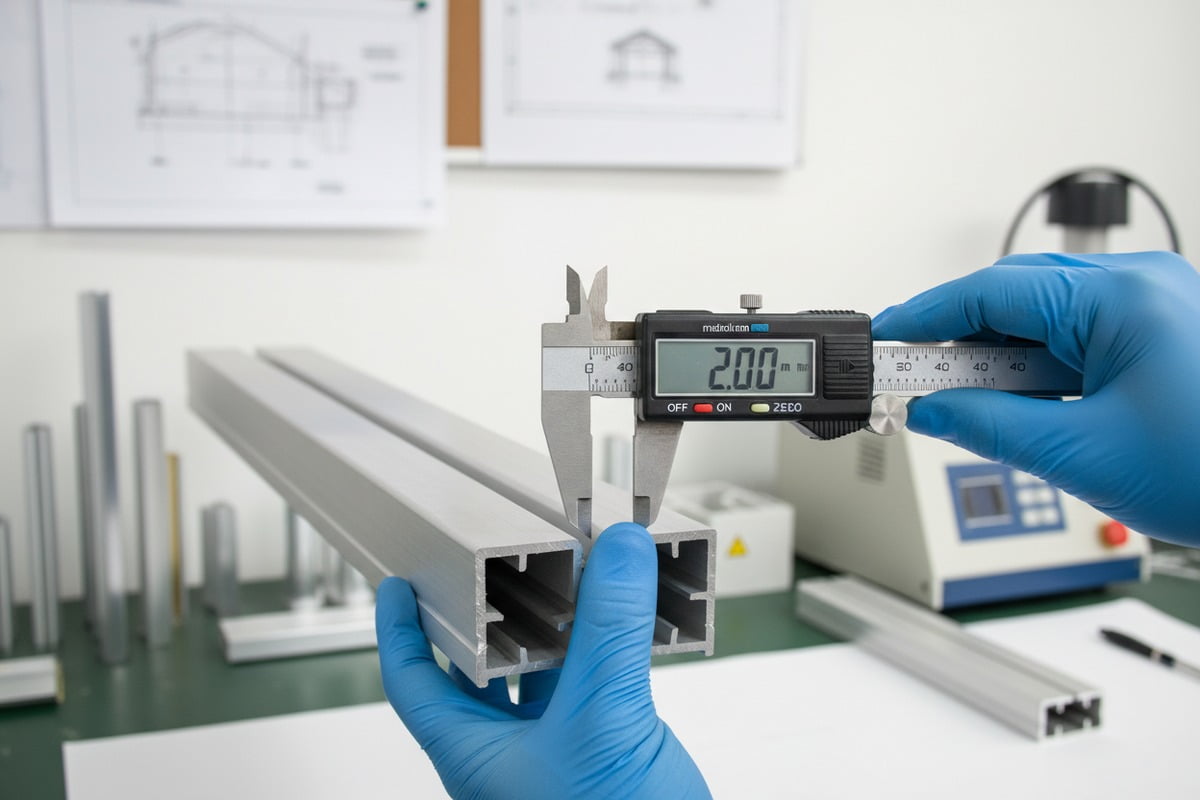
Grab a digital caliper. Measure the wall thickness at multiple points along the same profile. Our standard structural posts use a minimum of 2.0 mm wall thickness for load-bearing members. Suppliers who cut corners often reduce wall thickness and use cheaper recycled billets simultaneously. Both shortcuts compound the structural risk.
| Inspection Point | Primary Aluminum Indicator | Recycled Aluminum Risk Indicator |
|---|---|---|
| Surface smoothness | Uniform, mirror-capable after anodizing | Micro-pitting, rough grain, streaks |
| Powder coating adhesion | Even coverage, no bubbling | Uneven texture, peeling at edges |
| Wall thickness consistency | ±0.1 mm tolerance across profile | Variation >0.2 mm at different points |
| Color uniformity (raw) | Consistent silver tone | Slight discoloration or dark spots |
| Extrusion straightness | Straight within 0.5 mm per meter | Slight bowing or warping |
The Weight Test
Weigh a known-length section of profile. Compare it against the theoretical weight calculated from the alloy density (2.69 g/cm³ for 6063) and the profile's cross-sectional area. If the actual weight is significantly lower than expected, the wall thickness is likely thinner than specified. This is a simple but powerful check.
Cross-Section Examination
Cut a short sample from a profile end. Look at the cross-section under good light or a magnifying glass. Primary aluminum alloys show a fine, even grain structure. Poorly processed recycled aluminum may show coarser grains or visible inclusions. If your supplier resists providing cut samples, that itself is a warning sign.
Physical inspection alone cannot give you a definitive answer about primary versus recycled content. But it filters out the worst offenders quickly. Combine it with the certification steps below for a complete picture.
What material certifications should I request from my supplier to verify the aluminum grade?
Our export team sends material documentation to European clients before the first container even ships. This is standard practice for any reputable supplier. If your current supplier hesitates when you ask for paperwork, that tells you everything.
Request a Certificate of Analysis (CoA) for each aluminum billet batch, a Material Data Sheet (MDS) with full chemical composition, mill test certificates from the smelter, and ASI Performance Standard or Chain of Custody certification. These documents collectively prove alloy grade, composition, and sourcing transparency.

The Essential Document Stack
There are several documents you should ask for. Each serves a different purpose. Together, they create a complete verification trail.
Certificate of Analysis (CoA): This comes from the aluminum smelter or billet supplier. It lists the exact chemical composition of each batch—percentages of silicon, iron, copper, manganese, magnesium, chromium, zinc, titanium, and other elements. For 6063-T5 aluminum 7, which is the most common pergola alloy, the CoA should show magnesium at 0.45–0.9% and silicon at 0.2–0.6%. If iron content is unusually high (above 0.35%), that often signals poorly sorted recycled feedstock.
Mill Test Certificate (MTC): This verifies mechanical properties—tensile strength 8, yield strength, elongation, and hardness. For 6063-T5, expect a minimum tensile strength of 150 MPa and yield strength of 110 MPa. These numbers matter for structural performance.
Material Data Sheet (MDS): A broader document covering alloy designation, temper, applicable standards (EN 755, ASTM B221), and sometimes production origin.
Certification Bodies That Matter
| Certification | What It Verifies | Why It Matters for Pergolas |
|---|---|---|
| ASI Performance Standard | Responsible production practices at smelter level | Confirms environmental and quality governance |
| ASI Chain of Custody | Material traceability from mine or scrap source to product | Proves the aluminum in your pergola is what the supplier claims |
| ISO 9001 9 | Quality management system | Ensures consistent manufacturing processes |
| ISO 14001 | Environmental management system | Validates sustainability claims about recycled content |
| CE Marking (for EU) | Product compliance with EU directives | Required for structural products sold in Europe |
| EN 1090 | Execution of aluminum structures | Confirms structural fabrication competence |
How to Read a CoA Like a Pro
Focus on three things. First, check the alloy designation matches what was quoted—6063, 6061, or 6005A are common for pergolas. Second, scan the trace element percentages. Primary aluminum CoAs typically show very low and consistent trace elements. Recycled batches with mixed scrap inputs may show higher or more variable iron, copper, or zinc levels. Third, confirm the batch number on the CoA matches the batch number stamped or labeled on the actual billets or profiles you receive.
Red Flags in Documentation
Watch out for CoAs that look generic—no batch number, no date, no smelter name. Some suppliers photocopy a single old CoA and reuse it for every shipment. Ask for batch-specific documents. If the supplier says the smelter will not provide them, that is not true. Reputable smelters issue CoAs for every production run.
Also verify that the testing lab is accredited. Third-party lab results carry more weight than in-house tests. If you want extra assurance, you can send a profile sample to an independent metallurgical lab in your own country for composition analysis via optical emission spectrometry. The cost is typically €100–€300 per sample, and the peace of mind is worth it.
Will using recycled aluminum compromise the wind and snow load capacity of my outdoor project?
This question comes up in nearly every technical call with our European contractors. They are designing pergolas for alpine resorts or Mediterranean coastlines, and structural failure is not an option. The answer depends entirely on how the recycled aluminum is processed and controlled.
Recycled aluminum does not inherently compromise wind and snow load capacity if the alloy composition meets the same specification as primary aluminum (e.g., 6063-T5). The risk arises when recycled feedstock is poorly sorted, leading to out-of-spec impurities that reduce tensile strength, hardness, and corrosion resistance of the final extrusion.
The Science Behind the Concern
Aluminum is aluminum at the atomic level. Whether it came from bauxite ore yesterday or a recycled window frame from 20 years ago, a pure aluminum atom is identical. The issue is never the aluminum itself. The issue is what else is in the mix.
Primary aluminum from electrolysis is 99.7%+ pure. The alloy maker then adds precise amounts of magnesium and silicon to create 6063. The result is predictable and consistent. Recycled aluminum starts as scrap—old cans, car parts, building facades, industrial offcuts. Each piece carries its own alloy history. If the sorting process is sloppy, the remelted batch ends up with uncontrolled levels of iron, copper, or zinc. These contaminants change the mechanical behavior of the final alloy.
What the Numbers Say
| Property | 6063-T5 Specification | Well-Controlled Recycled 6063-T5 | Poorly-Controlled Recycled |
|---|---|---|---|
| Tensile Strength | ≥150 MPa | 150–185 MPa | May drop below 140 MPa |
| Yield Strength | ≥110 MPa | 110–145 MPa | May drop below 100 MPa |
| Elongation | ≥8% | 8–12% | May become brittle (<6%) |
| Hardness (Brinell) | ≥60 HB | 60–75 HB | Variable, potentially <55 HB |
| Corrosion Resistance | Excellent | Good to Excellent | Reduced if iron content high |
When the recycled material meets spec, it performs identically to primary. The problem is that you cannot see the difference from the outside. Only testing and documentation reveal the truth.
How This Affects Your Pergola Design
A pergola designed for a 1.2 kN/m² snow load and 100 km/h wind resistance relies on specific material properties in its engineering calculations. If the actual aluminum is weaker than assumed, the safety factor shrinks. The pergola may survive normal conditions but fail during an extreme weather event—exactly when you need it most.
Our engineering team designs every pergola with a safety factor that accounts for material variability. But that factor assumes the aluminum meets the stated specification. If a supplier quietly uses substandard recycled material, the real safety factor is unknown.
Post-Industrial vs. Post-Consumer Recycled
Not all recycled aluminum is equal. Post-industrial recycled aluminum—scrap generated during manufacturing, such as extrusion offcuts and stamping waste—is usually from a single known alloy. It is clean, consistent, and easy to control. Post-consumer recycled aluminum—old products collected from the waste stream—is mixed and harder to sort. For structural pergola applications, post-industrial recycled content is far safer than post-consumer if the supplier uses recycled feedstock.
The bottom line: recycled aluminum can be perfectly fine for pergolas. But only if the supplier rigorously tests and controls its composition. Demand the CoA for every batch. If the numbers match the alloy spec, the structure will perform as designed.
How do I audit a supplier's raw material supply chain to ensure they aren't cutting corners?
When our clients visit our Hainan facility, we walk them through the entire chain—from billet storage to extrusion, heat treatment, powder coating, and final assembly. We do this because transparency builds trust, and trust builds long-term partnerships. Here is how you can conduct a similar audit with any supplier.
To audit a supplier's raw material supply chain, visit their facility to inspect billet storage and labeling, review purchasing records linking billet batches to specific smelters, verify incoming material inspection reports with spectrographic analysis results, and cross-reference batch numbers on profiles with corresponding Certificates of Analysis from the smelter.
Step 1: Start with Purchasing Records
Ask to see the supplier's purchase orders for aluminum billets over the past 6–12 months. A legitimate supplier buys from one or two known smelters or authorized distributors. The purchase orders should show the alloy grade, quantity, price, smelter name, and delivery date. If the supplier buys from dozens of unnamed traders, the material source is untraceable.
Step 2: Inspect Incoming Material Controls
Every professional aluminum extruder should have an incoming inspection process. At minimum, this includes:
- Visual inspection of billet surface condition
- Verification of batch labels against purchase orders
- Spectrographic analysis (optical emission spectrometry) to confirm chemical composition
Ask to see the spectrometer. Ask for recent test reports. A supplier that does not own or regularly use a spectrometer is not verifying what they receive. They are trusting their supplier blindly—and so are you.
Step 3: Trace Batch Numbers Through Production
Pick a finished pergola profile from the warehouse. Ask the supplier to trace it back to the original billet batch. A well-organized factory maintains production records that link each extrusion run to a specific billet batch number. That batch number connects to a CoA from the smelter. If the supplier cannot make this connection, their traceability is broken.
Step 4: Evaluate the Supplier's Quality System
| Audit Checkpoint | What to Verify | Red Flag |
|---|---|---|
| Billet storage area | Billets labeled with alloy, batch, smelter | Unlabeled billets mixed together |
| Spectrometer availability | Calibrated and used regularly | No spectrometer on site |
| Incoming inspection logs | Records for every received batch | Missing or incomplete logs |
| Production traceability | Profile linked to billet batch and CoA | No batch tracking system |
| Supplier qualification list | Approved smelter/distributor list on file | No formal supplier approval process |
| Powder coating pre-treatment | Chromate-free conversion coating documented | No documentation of pre-treatment chemistry |
Step 5: Ask the Uncomfortable Questions
Good auditors ask direct questions. Here are the ones that matter:
- What percentage of your billets come from primary versus recycled sources?
- Who are your billet suppliers? Can I contact them directly?
- Do you accept billets from brokers or only from smelters and authorized distributors?
- How do you handle a billet batch that fails incoming spectrometric analysis?
- Can you show me a rejected batch report from the last year?
A supplier who has never rejected a batch either has impossibly perfect suppliers or is not actually testing. The latter is far more common.
Step 6: Consider Third-Party Audits
If you cannot visit the factory yourself, hire a third-party inspection company. Companies like SGS, TÜV, and Bureau Veritas offer factory audit services in China. They will check raw material controls, production processes, and quality records on your behalf. The cost is typically €500–€1,500 per audit, depending on scope. For a large contract, this is a small insurance premium.
The Long-Term Approach
One audit is a snapshot. Build ongoing verification into your supply agreement. Require batch-specific CoAs with every shipment. Include a clause allowing random third-party testing of delivered profiles at the supplier's cost if results fail to match documentation. This keeps the supplier accountable not just during the audit but on every single order.
Our approach at Lonson Pergola is to maintain full traceability as a default, not as a special request. We believe every buyer deserves to know exactly what is in their product. If your supplier treats transparency as a burden rather than a standard, it may be time to find a new partner.
Conclusion
Verifying your aluminum pergola supplier's material sourcing is not optional—it is essential for structural safety, durability, and your brand's reputation. Combine physical inspection, proper certifications, performance data analysis, and supply chain audits to protect every project you deliver.
Footnotes
1. Explains the purpose and requirements of the ASI Chain of Custody Standard. ↩︎
2. Replaced with a working URL from the original authoritative source, The Aluminum Association, specifically about primary production. ↩︎
3. Explains the Hall-Héroult process for producing primary aluminum from alumina. ↩︎
4. Provides an overview of the 6063 aluminum alloy and its T5 temper. ↩︎
5. Describes the industrial method for refining bauxite into alumina. ↩︎
6. Replaced with a comprehensive and authoritative Wikipedia article on aluminum recycling. ↩︎
7. Replaced with a specific section of the authoritative Wikipedia article on 6063 aluminum alloy, detailing the T5 temper. ↩︎
8. Replaced with an authoritative definition of tensile strength from Britannica. ↩︎
9. Provides the official definition and requirements of the ISO 9001 quality management standard. ↩︎
10. Defines a Certificate of Analysis and explains its importance in quality assurance. ↩︎