
Every year, our shipping team reviews damage claims from overseas clients. The pattern is always the same — scratched powder coatings 1, bent profiles, missing bolts. Most of these problems trace back to one overlooked conversation: packaging.
To minimize shipping damage when sourcing aluminum pergolas from China, you must negotiate packaging as a separate contract line item. Specify protective materials, demand detailed component checklists, choose the right crate type for your product tier, and verify container loading methods through pre-shipment inspections and photo documentation before the vessel sails.
This guide breaks down exactly what to discuss with your Chinese supplier at every stage. Each section covers a specific packaging concern — from surface protection 2 to container bracing — so you can protect your investment before it leaves the factory floor.
What specific packaging materials should I demand to prevent my aluminum profiles from scratching during sea freight?
We have seen too many containers arrive in Europe with cosmetic damage 3 that turns a profitable order into a costly nightmare. Scratched powder-coated finishes are the number one complaint we hear from distributors.
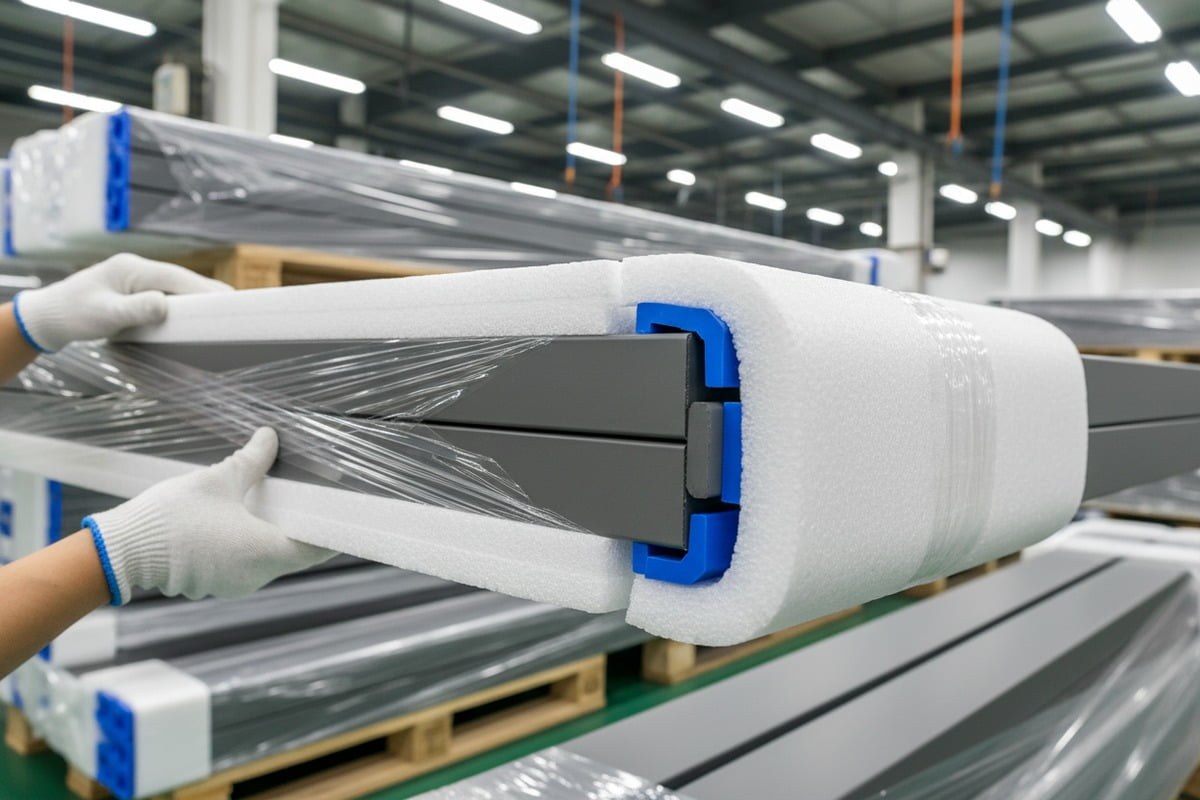
Demand EPE foam wrapping (minimum 5 mm thick), polyethylene interleaving sheets between profiles, plastic corner protectors on all edges, and shrink wrap over each bundle. These four materials together prevent 90% of surface scratches during the vibration and shifting of a 30-day sea voyage.
Why Powder-Coated Aluminum Is So Vulnerable
Powder coating gives aluminum pergolas their premium matte charcoal grey or custom RAL finish. But the coating is only 60–80 microns thick. That is thinner than a sheet of paper. Metal-to-metal contact 4 during transit grinds through the coating in seconds. Salt air accelerates corrosion 5 on exposed spots. A single scratch on a visible beam can force you to reject or discount the entire unit.
The Four Essential Protective Layers
Think of packaging as layers. Each layer handles a different threat.
| Layer | Material | Scopo | Minimum Spec |
|---|---|---|---|
| Layer 1 (Direct contact) | Polyethylene (PE) interleaving film | Prevents metal-to-metal scratching | 0.05 mm thick, full coverage |
| Layer 2 (Cushioning) | EPE foam sheet or tube | Absorbs vibration and minor impacts | 5 mm thick minimum |
| Layer 3 (Edge protection) | Plastic or cardboard corner protectors | Shields corners and ends from dents | L-shaped, covering at least 50 mm on each side |
| Layer 4 (Outer wrap) | Stretch shrink wrap | Holds everything together, keeps moisture out | 2–3 full wraps per bundle |
Don't Forget the Inner Separators
Long aluminum profiles — like the 4-meter beams on our louvered pergola series — need inner separators inside the carton or crate. Without them, profiles slide and rub against each other. We use corrugated cardboard dividers cut to the exact cross-section of the profile. This keeps each piece locked in place. If your supplier does not mention inner separators, ask for them. They cost almost nothing but prevent the most common damage type.
Moisture Barriers for Sea Freight
Humidity inside a shipping container 6 can swing wildly. Condensation forms on cold metal surfaces. This is called "container rain." Over 30 days at sea, it causes water stains and white oxidation spots on aluminum. Ask your supplier to include silica gel desiccant packets 7 inside each carton — at least 100 grams per cubic meter. For high-end projects, request VCI (Vapor Corrosion Inhibitor) bags 8 around hardware kits. These are inexpensive safeguards that protect your goods from invisible moisture damage.
A Quick Cost Comparison
Many buyers hesitate on premium packaging. Here is the reality.
| Packaging Level | Cost per Set (Approx.) | Damage Rate on Sea Freight | Claim Cost per Damaged Set |
|---|---|---|---|
| Basic (single carton, no foam) | $15–$25 | 30–50% | $200–$500 |
| Standard (foam + corner protectors + shrink wrap) | $35–$55 | 5–10% | $200–$500 |
| Premium (all layers + desiccant + VCI + wooden crate) | $60–$100 | Under 2% | $200–$500 |
The math is clear. Spending an extra $40 per set on packaging can save you hundreds in replacement parts, re-finishing, and lost customer trust.
How can I ensure my supplier includes a detailed component checklist to avoid missing hardware in my shipment?
One of the costliest mistakes in our industry has nothing to do with quality. It is a missing bag of M8 bolts discovered 8,000 kilometers from the factory. Replacing a single non-standard connector internationally can cost more than the pergola itself.
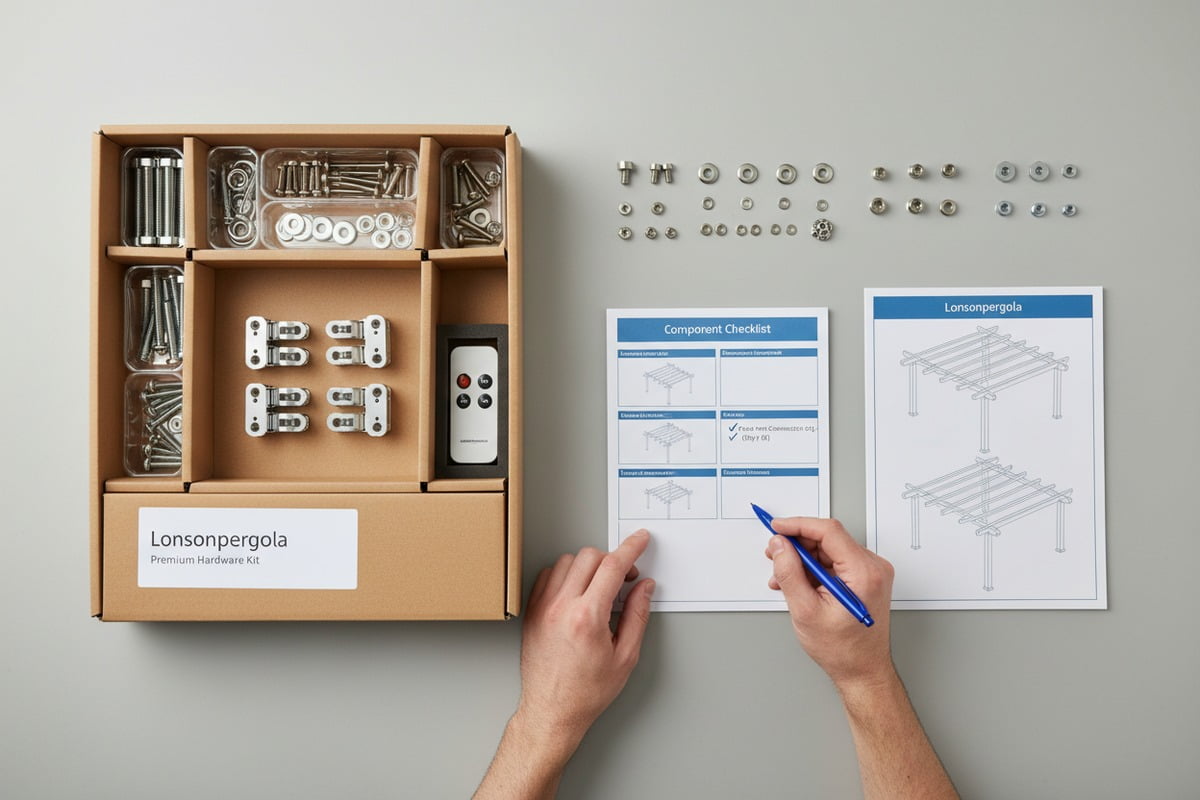
Require your supplier to provide a printed, photo-illustrated packing list inside every carton, plus a master Bill of Materials (BOM) for each pergola set. Cross-check this list during a pre-shipment inspection, and insist on barcoded or numbered hardware bags that match the installation manual step by step.
Why Missing Parts Are So Common
An aluminum pergola with louvered roof, retractable screens, and integrated LED lighting can have over 200 individual components. Bolts, nuts, washers, screen tracks, motor brackets, cable clips, drain fittings — each one matters. On our production lines, we pack hardware in a separate station from the main profiles. If communication between stations breaks down, a bag gets missed. Multiply that across a 40-foot container with 50 pergola sets, and the odds of at least one error climb fast.
The Bill of Materials (BOM) Approach
A BOM is your single source of truth. It lists every component by part number, description, quantity, and weight. Before production starts, ask your supplier to send you the BOM for approval. Then require that the same BOM be printed and placed inside each carton.
Here is a simplified example of what a BOM section should look like:
| Part Number | Description | Quantity per Set | Bag Label | Weight (g) |
|---|---|---|---|---|
| LP-4030-B01 | Main beam, 4 m | 2 | Box 1 of 5 | 8,400 |
| LP-4030-P01 | Corner post, 2.5 m | 4 | Box 2 of 5 | 12,600 |
| LP-4030-H01 | M8 × 30 hex bolt, stainless | 48 | Hardware Bag A | 580 |
| LP-4030-H02 | M6 × 20 self-tapping screw | 96 | Hardware Bag B | 320 |
| LP-4030-H03 | Post base plate with anchors | 4 | Hardware Bag C | 1,800 |
| LP-4030-S01 | Zip screen, 3 m × 2.5 m | 2 | Box 3 of 5 | 6,200 |
| LP-4030-E01 | Motor unit with CE cert | 1 | Box 4 of 5 | 3,500 |
Numbered Hardware Bags
We started numbering our hardware bags to match installation steps two years ago. Bag A goes with Step 1–5. Bag B goes with Step 6–12. This simple change cut our client installation complaints by over 60%. When you discuss packaging, ask if your supplier can do the same. If they cannot, at minimum require that each hardware bag is clearly labeled with its contents and quantity.
Pre-Shipment Inspection Is Non-Negotiable
Never skip this step. Hire a società di ispezione di terze parti 9 — or send your own QC person — to physically open random cartons and count components against the BOM. Check at least 10–20% of the shipment. Document everything with photos. Our team takes a photo of every opened hardware bag laid out next to the checklist. This takes about 15 minutes per set and prevents weeks of delay at the jobsite.
Digital Documentation
Ask your supplier for a digital copy of the packing list in Excel or PDF format, sent by email before the container ships. This lets your warehouse team prepare for receiving. They can spot missing items on paper before even opening the container doors.
Should I request reinforced wooden crates or honeycomb boxes for my high-end pergola projects?
When we ship our premium louvered pergolas — the ones with integrated motorized screens and LED systems — the conversation about crating always comes up. The stakes are higher. The margin for damage is zero.
For high-end aluminum pergola projects, reinforced wooden crates with internal foam lining offer the best protection, especially for motorized and electronic components. Honeycomb cardboard boxes are a lighter, cost-effective alternative for standard profiles, but they lack the impact resistance needed for luxury orders with fragile smart features.
Understanding Your Two Main Options
Wooden crates and honeycomb boxes each have clear strengths. The right choice depends on your product tier, shipping route, and budget.
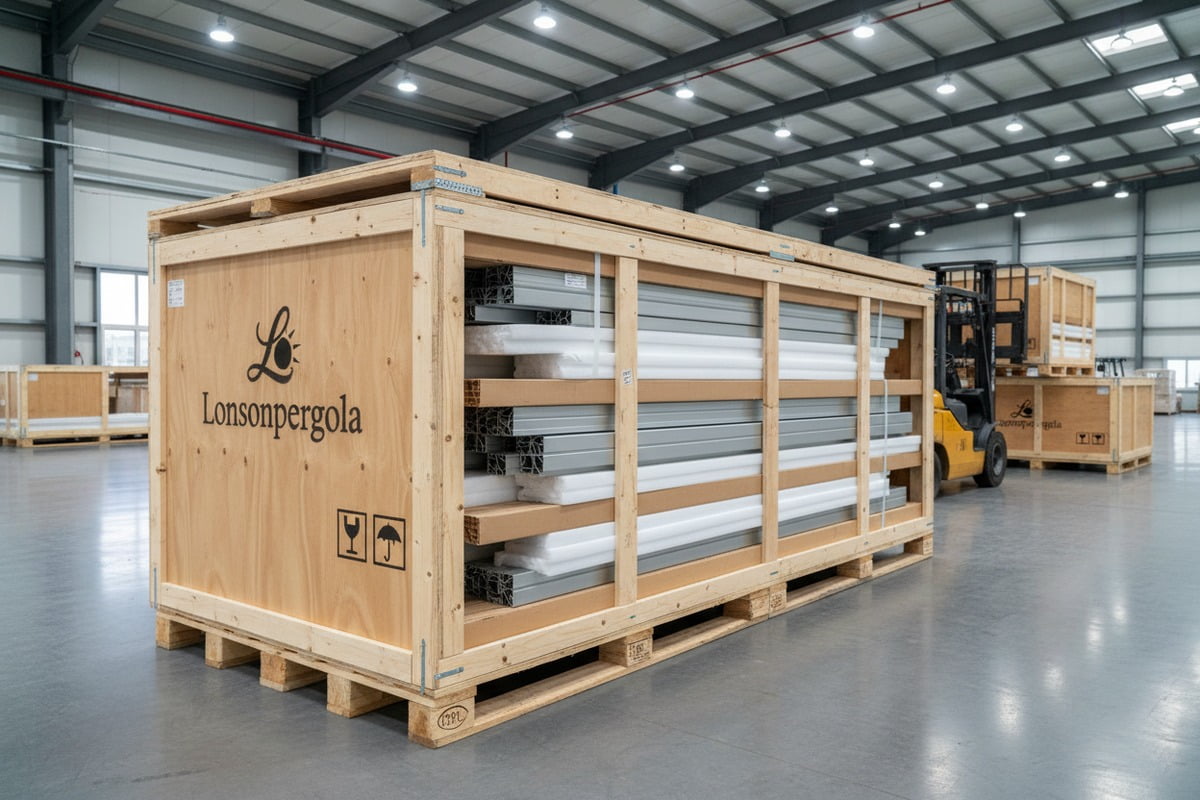
Reinforced Wooden Crates are made from heat-treated (ISPM-15 compliant) plywood or solid wood. They handle stacking pressure up to 2,000 kg. They resist puncture. They protect contents from forklift mishandling. For pergola sets that include motors, control boxes, or glass elements, wooden crates are the safest choice.
Honeycomb Cardboard Boxes use a layered honeycomb core that is surprisingly strong for its weight. They pass most drop tests for items under 50 kg per box. They are lighter, cheaper, and easier to recycle. For standard aluminum profiles without electronics, they work well — especially when combined with proper inner foam and corner protection.
When to Use Each Option
| Factor | Reinforced Wooden Crate | Honeycomb Cardboard Box |
|---|---|---|
| Best for | Motorized pergolas, smart features, glass panels | Standard aluminum profiles, hardware kits |
| Impact resistance | Excellent — withstands forklift drops | Good — handles normal handling |
| Stacking strength | Up to 2,000 kg | Up to 500 kg |
| Moisture resistance | High (with liner) | Moderate (needs extra barrier) |
| Weight | Heavy — adds to freight cost | Light — saves on shipping |
| Cost per unit | $50–$120 | $15–$40 |
| Recyclability | Reusable, but ISPM-15 treatment required | Fully recyclable, FSC-certified options available |
| Customs compliance | Must have ISPM-15 stamp for wood treatment | No wood treatment issues |
The Hospitality Project Benchmark
A client of ours shipping 30 premium louvered pergolas to a resort in Dubai initially opted for heavy-duty cartons to save cost. Four sets arrived with dented motor housings and cracked LED diffuser covers. The rework and air-freight replacement cost exceeded $20,000. On the reorder, they switched to wooden crates with custom-cut foam inserts for each motor and control unit. Zero damage. The extra $2,400 in crating costs saved them ten times that amount.
Sustainability Considerations
More European buyers now ask about eco-friendly packaging. Honeycomb cardboard is the clear winner here. It is made from recycled paper, and it is fully recyclable at destination. Some of our clients request FSC-certified materials. We can source these through our packaging partners in Guangdong. Wooden crates can be reused, but they require fumigation stamps and sometimes face stricter import regulations. If sustainability is part of your brand promise, factor this into your packaging discussion.
Hybrid Approach
You do not have to choose one or the other for the entire order. We often use wooden crates for the motor boxes and electronic components, and honeycomb cartons for the aluminum profiles and hardware kits. This hybrid method balances cost, weight, and protection. Discuss this option with your supplier early — it requires a slightly different packing plan but delivers the best of both worlds.
How do I verify that my supplier's loading and bracing methods will keep my cargo stable inside the container?
The best packaging in the world means nothing if it slides across the container floor during a storm in the South China Sea. Our logistics coordinator once told me that poor loading causes more damage than poor packaging. That stuck with me.
Request a detailed container loading plan before shipment, including a diagram showing box placement, bracing materials (wooden chocks, airbags, and ratchet straps), and weight distribution. Then require time-stamped photos and video of the actual loading process as proof that the plan was followed.
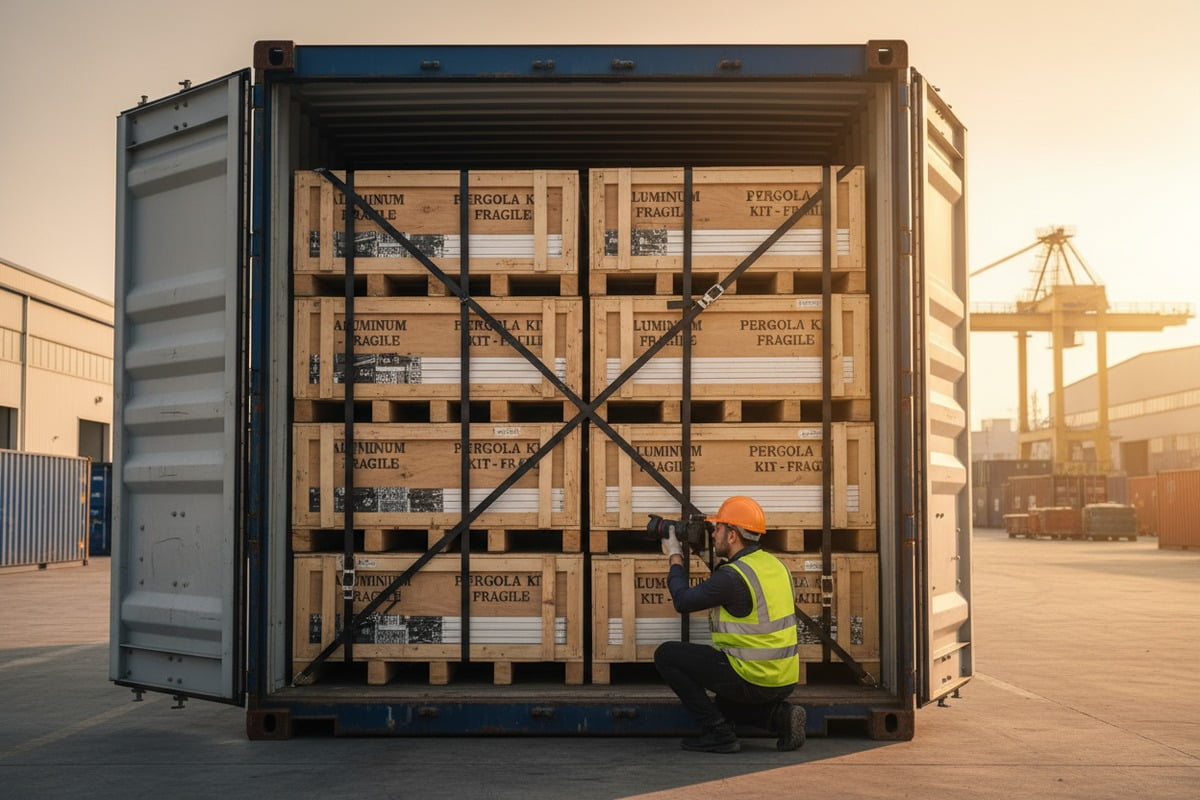
Why Loading Matters as Much as Packaging
A 40-foot container travels through rough seas, sharp turns at port, and jolting crane lifts. The forces inside can exceed 2G during heavy weather. Without proper bracing, pallets topple. Crates slam into each other. Straps snap. Your perfectly packed pergola profiles end up in a pile of bent aluminum and shattered motor housings. The carrier's insurance may not cover damage caused by inadequate loading — that responsibility usually falls on the shipper.
The Container Loading Plan
Before your container is loaded, your supplier should provide a written loading plan. This plan includes:
- Floor layout — where each pallet or crate sits inside the container
- Stacking order — heavy items on the bottom, light items on top
- Bracing points — where airbags, wooden chocks, or straps are placed
- Weight distribution — balanced left-to-right and front-to-back to prevent tipping
At our factory, we create this plan using basic CAD software. It takes less than an hour and prevents disasters. If your supplier cannot provide one, that is a red flag.
Essential Bracing Materials
| Bracing Material | Function | Placement |
|---|---|---|
| Dunnage airbags | Fill gaps between pallets, prevent lateral movement | Between pallet rows and against container walls |
| Ratchet straps | Secure tall or heavy crates to container lashing rings | Over the top of crates, hooked to floor rings |
| Wooden chocks/wedges | Block pallets from sliding on the container floor | At the base of each pallet, nailed to plywood floor |
| Plywood sheets | Create stable stacking platforms between layers | Between stacked rows of cartons |
| Anti-slip mats | Increase friction between pallet and container floor | Under every pallet base |
Photo and Video Documentation
This is where trust meets verification. Ask your supplier to take the following documentation during loading:
- Photos of empty container — confirming it is clean, dry, and damage-free
- Photos of each pallet before loading — showing packaging integrity
- Photos during loading — showing placement matches the plan
- Photos of bracing installed — airbags inflated, straps tightened
- Photo of container doors before sealing — final view of the loaded container
- Container seal number photo — matching your shipping documents
We send all of this to our clients within 24 hours of loading. It takes our team about 30 minutes to document. If your supplier resists this request, consider it a warning sign.
Third-Party Loading Supervision
For orders above $50,000, consider hiring a third-party inspector to supervise the loading. Companies like SGS, Bureau Veritas, or local QC firms in China offer container loading supervision as a standard service. The cost is typically $250–$400 per container. Compared to the value of your cargo — and the cost of a damage claim — this is a minor investment with major peace of mind.
What to Include in Your Contract
Add a loading and packaging clause to your purchase agreement. State the required bracing materials, photo documentation, and penalties for non-compliance. For example: "Supplier shall provide dunnage airbags and ratchet straps for all containers. Supplier shall provide photographic evidence of loading within 24 hours. Failure to comply shall result in a 5% deduction from the final invoice." Clear language protects both parties and sets expectations from day one.
IoT Sensors — The New Frontier
Some of our forward-thinking clients now place small IoT sensors inside containers. These battery-powered devices track temperature, humidity, tilt angle, and shock events in real time. If the container experiences a severe impact or tilt beyond a set threshold, the sensor sends an alert. When the container arrives, you download the data log and know exactly what happened during transit. This evidence is invaluable for insurance claims. The cost per sensor is around $30–$80, and they are reusable. We recommend this to any buyer shipping high-value motorized pergola systems.
Conclusione
Packaging is not an afterthought — it is the final quality gate before your aluminum pergolas cross the ocean. Discuss materials, checklists, crate types, and loading methods early. Put everything in your contract. Verify with inspections and photos. Your project margins depend on it.
Note a piè di pagina
1. Explains the process, properties, and uses of powder coating. ︎
2. Discusses various types of protective packaging for surface protection. ︎
3. Defines cosmetic damage in shipping and its impact on products. ︎
4. Explains fretting corrosion, a type of damage caused by metal-to-metal contact. ︎
5. Provides a general overview of corrosion and its causes. ︎
6. Explains what a shipping container is and its role in global trade. ︎
7. Explains the function of silica gel desiccants for moisture control in packaging. ︎
8. Describes how VCI bags prevent corrosion on metal parts during shipping. ︎
9. Explains the role of third-party inspections in quality control. ︎
10. Defines what a Bill of Materials is and its importance in manufacturing. ︎