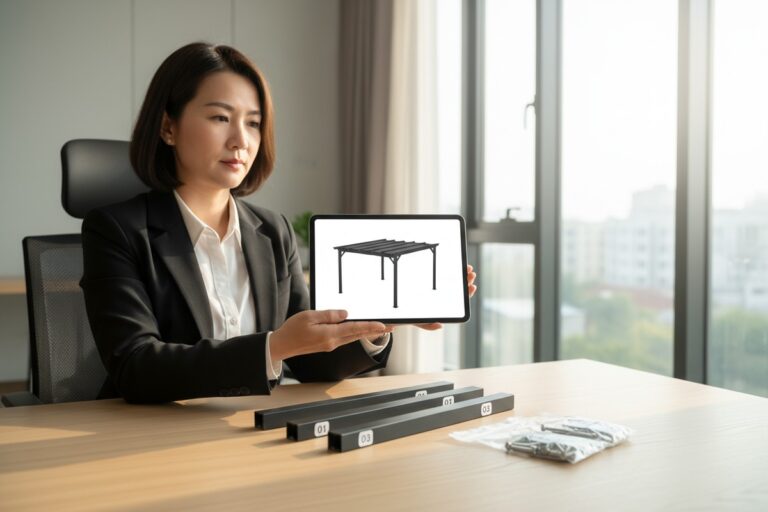
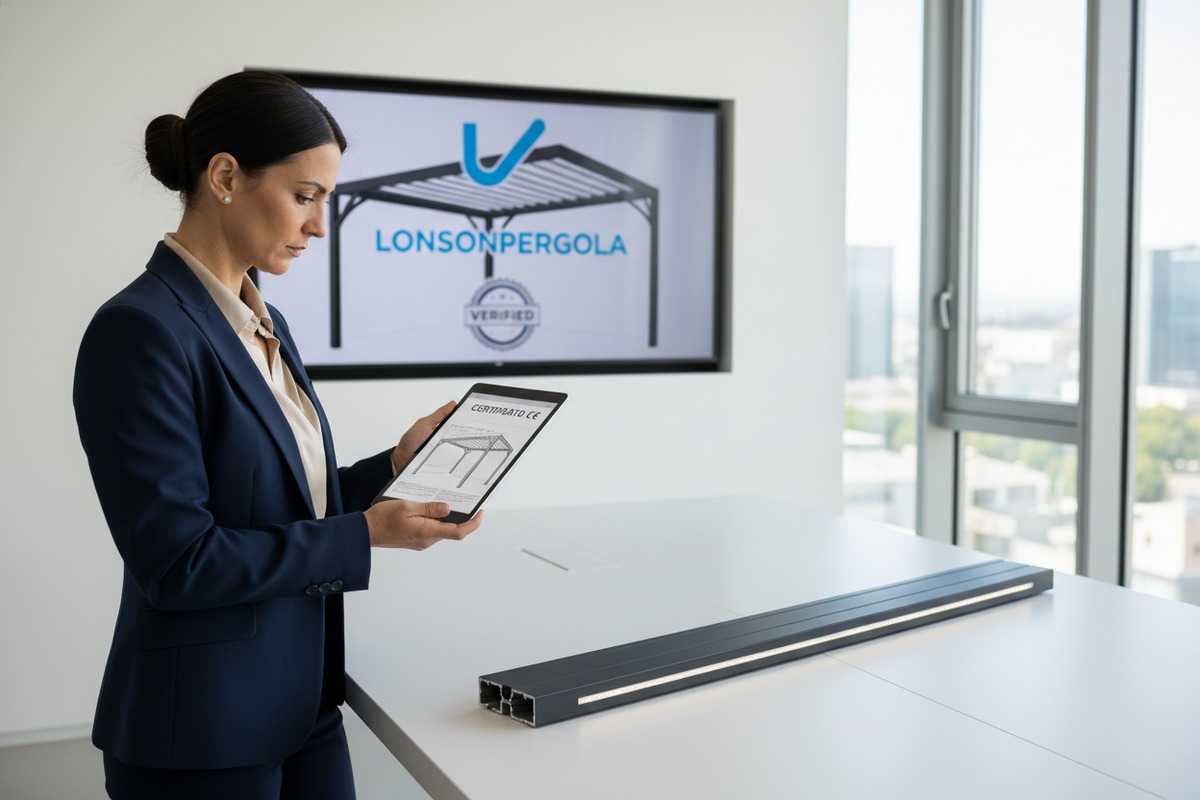
Every year, we see European importers face costly customs seizures because their pergola electrical components fail LVD checks at the border.
To ensure China-sourced aluminum pergola electrical components meet European LVD (2014/35/EU), importers must verify supplier CE certificates through third-party labs, demand component-level test reports for motors and LEDs, specify reputable brands, and embed strict compliance clauses in sourcing contracts to avoid border rejections and legal liability.
This guide walks you through each step. We will cover certificate verification, required safety tests, trusted component brands, and contract language that protects your business LVD (2014/35/EU) 1. Let us start with the most common trap: fake or misleading CE certificates.
How can I verify that the CE and LVD certificates provided by my Chinese pergola supplier are authentic?
When our export team prepares documentation for European buyers, we know how carefully purchasing managers scrutinize every certificate — and rightly so, since forgery is common dielectric strength testing 2.
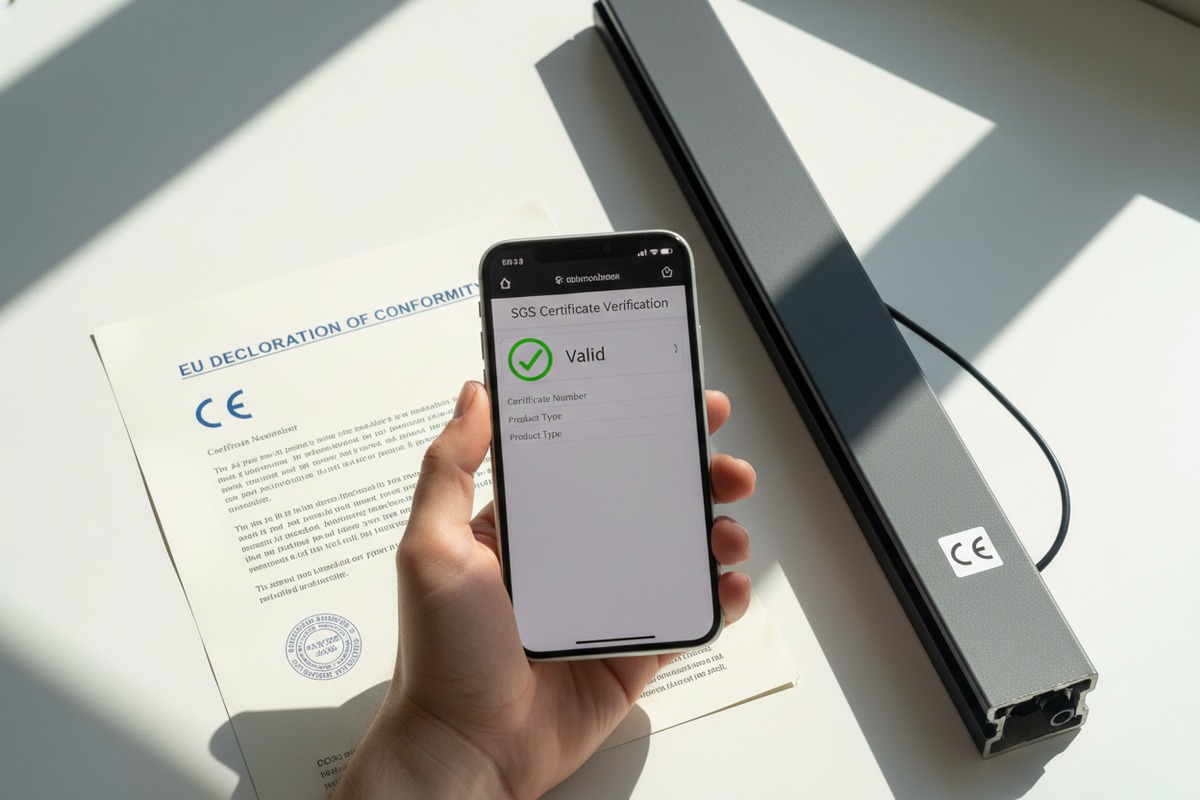
Verify CE and LVD certificates by cross-checking the certificate number directly with the issuing Notified Body or testing lab (e.g., TÜV, SGS), confirming the product scope matches your pergola model, and requesting the full EU Declaration of Conformity along with the underlying technical file.
Why Fake Certificates Are So Common
The CE mark is self-declared. This means any manufacturer can print it on a product without external approval Somfy motors 3. While LVD does not legally require third-party testing, most reputable suppliers use accredited labs anyway. The problem? Some factories purchase generic certificates from brokers. These papers look real but cover a different product or a different factory entirely. We have seen cases where a supplier's "CE certificate" was actually issued for a small household fan — not a motorized pergola system.
Step-by-Step Verification Process
Follow these steps before you place any order:
- Ask for the full EU Declaration of Conformity (DoC). This is the legal document, not the certificate. It must name the manufacturer, product description, relevant directives (LVD 2014/35/EU), and harmonized standards 4 applied (e.g., EN 60335-1).
- Check the Notified Body number. If a Notified Body 5 is referenced, look it up on the EU NANDO database (ec.europa.eu/growth/tools-databases/nando). Confirm the body is authorized for LVD.
- Contact the testing lab directly. Send the certificate number to the lab (SGS, TÜV Rheinland, Intertek) and ask them to confirm it is genuine and active.
- Match the product scope. The certificate must cover your exact product type — not just "aluminum pergola" in general, but the specific electrical configuration including motor type, LED driver, and control system.
- Request the technical file. This includes circuit diagrams, risk assessments, and test reports. A supplier who refuses to share this file is a red flag.
Red Flags to Watch For
| Red Flag | What It Means | What to Do |
|---|---|---|
| Certificate has no Notified Body number | Self-declared only; may lack any real testing | Request third-party test reports separately |
| Product description is vague (e.g., "outdoor structure") | Certificate may not cover electrical components | Demand component-specific scope |
| Certificate issued by unknown lab | May be a certificate mill | Verify lab accreditation on NANDO or ILAC |
| Supplier refuses to share technical file | Likely no real compliance documentation exists | Walk away or insist before ordering |
| Certificate date predates product launch | Recycled from an older, different product | Ask for updated testing on your model |
The Importer's Legal Responsibility
Here is the critical point many buyers miss. Under EU law, the importer — not the Chinese factory — is legally responsible for placing a compliant product on the European market. If Italian customs stops your container and the CE documentation is invalid, you face the fines, the recall costs, and the reputational damage. Our advice to every client: budget for an independent verification step. It costs a fraction of what a failed shipment costs.
What specific electrical safety tests should I demand from my manufacturer to ensure my pergolas are safe for the European market?
On our production line, every motorized pergola goes through a defined testing sequence before shipping — but we have learned that not all factories share this discipline, and importers must know exactly what to ask for.
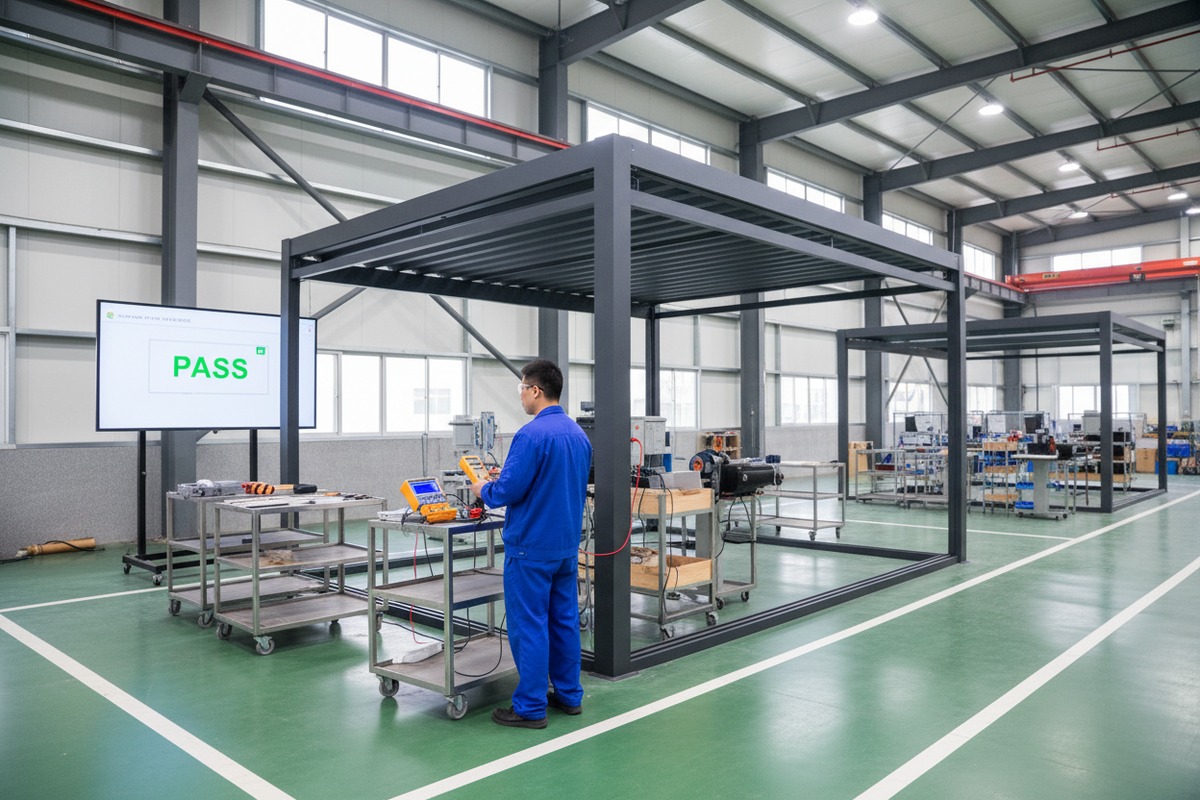
Demand dielectric strength (hi-pot) testing, insulation resistance testing, earth continuity testing, IP rating verification for outdoor enclosures, and accelerated environmental stress tests including UV exposure, salt spray, and temperature cycling — all documented per EN 60335-1 and relevant EN 60598 standards for luminaires.
Core LVD Safety Tests for Pergola Components
LVD compliance revolves around protecting users from electrical shock, fire, and mechanical hazards caused by electrical equipment. For an aluminum pergola with motorized louvers and integrated LED lighting, you need tests that address both the individual components and the assembled system.
Test-by-Test Breakdown
| Test | Standard Reference | Scopo | Applies To |
|---|---|---|---|
| Dielectric Strength (Hi-Pot) | EN 60335-1 Clause 13 | Verifies insulation can withstand voltage surges without breakdown | Motors, LED drivers, control boxes |
| Insulation Resistance | EN 60335-1 Clause 13 | Measures resistance between live parts and accessible metal surfaces | Full pergola assembly |
| Earth Continuity | EN 60335-1 Clause 27 | Confirms protective earth connection is reliable | Aluminum frame, motor housing |
| IP Rating 6 (Ingress Protection) | EN 60529 | Confirms enclosures resist water and dust ingress | Junction boxes, LED housings, motor casings |
| Temperature Rise | EN 60335-1 Clause 11 | Ensures components do not overheat during normal operation | Motors, transformers, LED drivers |
| Abnormal Operation | EN 60335-1 Clause 19 | Tests behavior under fault conditions (e.g., locked rotor) | Louver motors |
| UV Resistance | ISO 4892-2 | Validates cable and housing materials resist UV degradation | Outdoor wiring, plastic enclosures |
| Salt Spray | ISO 9227 | Simulates coastal environment corrosion | Connectors, junction boxes, fasteners |
| Temperature Cycling | IEC 60068-2-14 | Simulates extreme seasonal temperature swings | All outdoor electrical components |
Why Environmental Stress Tests Matter for Pergolas
Standard LVD tests were designed for indoor household appliances. A pergola sits outdoors year-round. In southern Europe, surface temperatures can exceed 70°C in summer. In northern Europe, frost cycles crack inferior plastic housings. Salt air along Mediterranean coastlines corrodes exposed metal contacts within months.
We learned this lesson directly when a batch of junction boxes passed all standard lab tests but failed in a coastal Italian installation after one winter. The gaskets degraded from UV exposure, water entered, and the LED driver shorted. Since then, we require accelerated aging tests on every outdoor-rated component before it leaves our factory.
Beyond LVD: Additional Directives to Consider
LVD is not the only directive that applies. If your pergola has a remote control or smart connectivity, the EMC Directive (2014/30/EU) 7 and the Radio Equipment Directive (2014/53/EU) also apply. RoHS (2011/65/EU) 8 restricts hazardous substances in electrical components. And if the system connects to Wi-Fi or Bluetooth, the upcoming Cyber Resilience Act may add further requirements. Ask your supplier for a compliance matrix covering all applicable directives — not just LVD.
Practical Tip: Request a Pre-Shipment Inspection
Even with valid test reports, production quality can drift. We recommend that European importers hire a third-party inspection agency (e.g., Bureau Veritas, SGS) to perform a pre-shipment electrical spot check. This includes a quick hi-pot test and earth continuity check on randomly selected units from the production batch. It adds minimal cost but catches problems before they reach European customs.
Which high-quality motor and LED brands do top Chinese factories use to guarantee LVD compliance for my project?
In our 25 years of manufacturing aluminum pergolas, we have tested dozens of motor and LED brands — and the difference between a cheap generic motor and a proven brand shows up not in the first month, but after the first European winter.
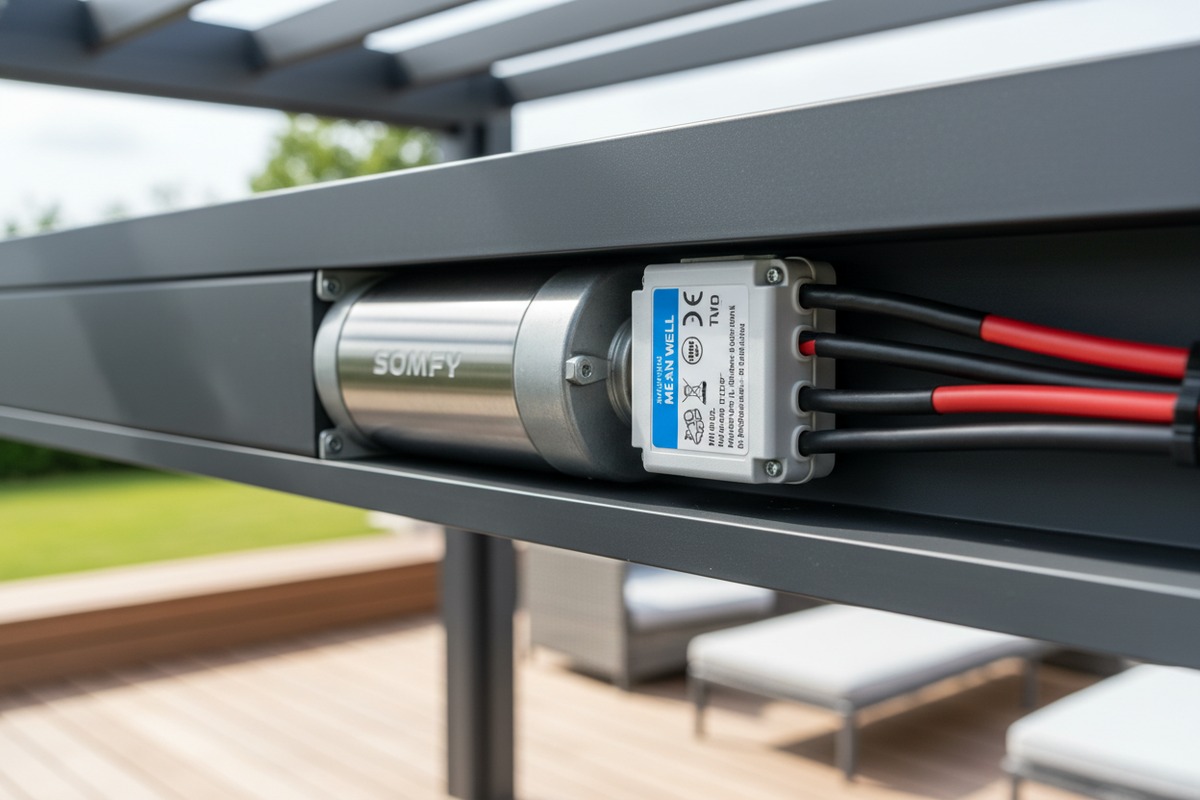
Top Chinese pergola factories use Somfy or Nice motors for louver systems, Meanwell or Philips LED drivers, and Osram or Cree LED chips. These brands carry existing CE and LVD certifications, dramatically reducing compliance risk and ensuring long-term reliability in European outdoor environments.
Why Brand Selection Is a Compliance Shortcut
When a pergola factory uses a Somfy motor, that motor already carries its own CE marking and Declaration of Conformity under LVD. This means the component has been independently tested and certified. It simplifies your technical file significantly. Compare this to a no-name motor from an unknown factory in Zhejiang — you would need to conduct full LVD testing yourself, or trust a paper trail that may not hold up under scrutiny.
Recommended Component Brands
| Componente | Recommended Brands | Why They Matter |
|---|---|---|
| Louver Motor | Somfy, Nice, Elero | Pre-certified CE/LVD; proven outdoor durability; widely recognized by EU authorities |
| LED Driver | Meanwell, Philips Xitanium, Osram OT | High efficiency; CE/LVD/EMC certified; thermal protection built-in |
| LED Chips | Osram, Cree, Lumileds | Consistent lumen output; long lifespan (50,000+ hours); low failure rate |
| Remote Control / RF Module | Somfy RTS, Nice ERA | RED and EMC compliant; encrypted signal; weatherproof options |
| Power Supply / Transformer | Meanwell, TDK-Lambda | Wide input voltage range; IP67 options for outdoor use; full CE documentation |
| Wiring / Cables | Lapp, Helukabel, or CE-certified Chinese equivalents | UV-resistant jackets; proper voltage ratings; flame-retardant per EN standards |
The Hidden Cost of Cheap Components
A generic motor might save you €15 per unit. But when 200 units are installed across a hotel chain in Spain and 10% of the motors fail within six months, you face warranty claims, reinstallation labor, and a damaged relationship with your client. We have watched competitors lose major accounts this way.
Our production team also discovered that cheap LED drivers are the most common point of failure. They overheat in enclosed pergola roof channels, and without proper thermal derating, they burn out. Meanwell drivers include built-in thermal protection that reduces output before damage occurs. This single feature prevents most field failures.
Modular Design for Easier Compliance
We strongly encourage a modular electrical design. This means each sub-system — motor, LED lighting, control unit — is a self-contained module with its own connectors and documentation. When each module carries its own CE certification, the final assembly compliance becomes a matter of integration testing rather than full system re-certification. It also makes field repairs much simpler. A maintenance team can swap a faulty LED module in 15 minutes instead of rewiring the entire pergola.
How to Confirm Your Supplier's Brand Claims
Ask for purchase invoices from the brand distributor. Request photos of the actual components installed in your production samples — not just catalog images. When we ship samples to European clients, we include close-up photos of every motor label, LED driver nameplate, and cable marking. This transparency builds trust and gives importers the documentation they need for their own files.
How can I include strict LVD compliance clauses in my sourcing contract to avoid customs delays and legal issues in Europe?
Our export contracts have been refined over hundreds of shipments to Europe, and we have seen firsthand what happens when compliance language is vague — containers get stuck at Rotterdam or Hamburg for weeks.
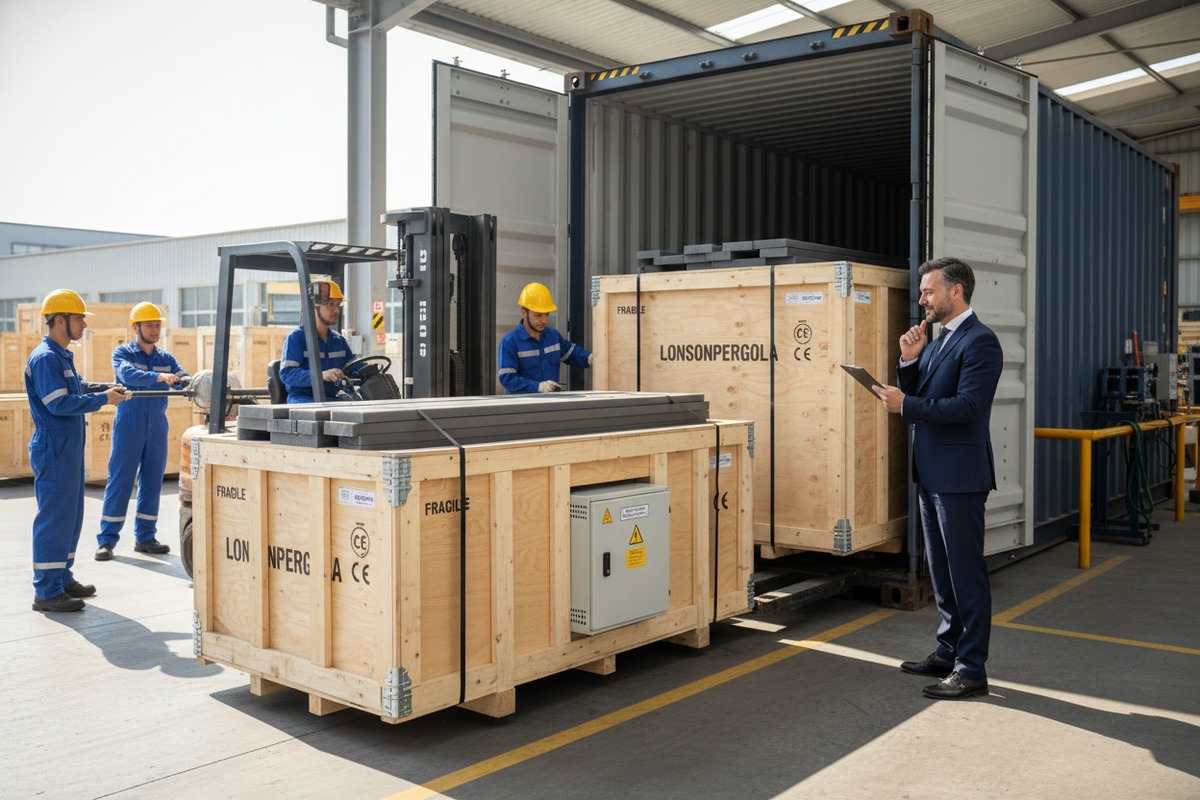
Include clauses requiring the supplier to deliver a valid EU Declaration of Conformity, component-level test reports from accredited labs, full traceability of sub-components, a financial penalty for non-compliance, and a warranty that all electrical parts meet LVD 2014/35/EU and applicable harmonized standards at the time of shipment.
Essential Contract Clauses
Your purchase agreement should go far beyond "product must have CE marking." Here is what to include, clause by clause.
Clause 1: Compliance Declaration
State explicitly that all electrical components within the pergola — including motors, LED drivers, power supplies, junction boxes, cables, and control modules — must comply with LVD 2014/35/EU, EMC 2014/30/EU, and RoHS 2011/65/EU. Reference the specific harmonized standards (EN 60335-1, EN 60598-1, etc.) that apply.
Clause 2: Documentation Delivery Schedule
Require the supplier to deliver the following documents at least 14 days before shipment:
- EU Declaration of Conformity 9 for the complete assembly
- Component-level test reports from accredited labs
- Technical file including circuit diagrams and risk assessment
- Bills of materials with sub-component manufacturer names and batch numbers
Clause 3: Traceability and Quality Control
Require batch-level traceability for all electrical sub-components. Each motor, LED driver, and control unit should carry a traceable serial number linked to the original component manufacturer. This protects you if a recall becomes necessary — you can identify exactly which units are affected.
Clause 4: Financial Penalties
Include a liquidated damages clause 10. For example: "If any shipment is detained at EU customs due to non-compliant electrical documentation, the Supplier shall bear all storage, re-testing, re-labeling, and return shipping costs, plus a penalty of X% of the order value." This creates a direct financial incentive for compliance.
Clause 5: Right to Audit and Inspect
Reserve the right to send a third-party inspector to the factory at any time during production. The inspector should have access to the production line, testing equipment, and raw material storage. We welcome these audits at our facility — they build confidence and catch problems early.
Sample Contract Compliance Table
| Clause | Requirement | Deadline | Penalty for Non-Compliance |
|---|---|---|---|
| LVD Compliance | All electrical parts meet 2014/35/EU | Before production starts | Order cancellation + refund |
| Documentation | Full DoC + test reports delivered | 14 days before shipment | Shipment hold until provided |
| Traceability | Batch numbers for all electrical sub-components | With each shipment | €500 per missing record |
| Pre-Shipment Inspection | Third-party electrical spot check passed | 5 days before container loading | Rework at supplier's cost |
| Warranty | 24-month warranty on all electrical components | From delivery date | Replacement parts shipped within 10 days |
Governing Law and Dispute Resolution
Specify that the contract is governed by the law of a neutral jurisdiction (e.g., Singapore, or the buyer's home country). Include an arbitration clause with a recognized institution like the ICC or HKIAC. This matters because enforcing a Chinese court judgment in Europe — or vice versa — is extremely difficult without a pre-agreed arbitration framework.
Practical Advice from Our Experience
We always recommend that new European clients start with a trial order of 10–20 units. Use this batch to validate every aspect of compliance — documentation, labeling, component quality, and packaging. Fix any issues before scaling up. It is far cheaper to resolve problems on a small batch than on a 500-unit container.
Also, insist on DDP (Delivered Duty Paid) terms for at least the first shipment if possible. Under DDP, the supplier handles customs clearance and bears the risk of any compliance-related delays. This aligns the supplier's financial interest with your compliance needs perfectly.
Conclusione
Ensuring LVD compliance for China-sourced pergola electrical components requires certificate verification, rigorous testing, trusted brands, and airtight contracts — protecting your business at every step.
Note a piè di pagina
1. Official text of the Low Voltage Directive 2014/35/EU. ︎
2. Details the purpose and methodology of dielectric strength testing. ︎
3. Provides information on Somfy's product quality and certifications. ︎
4. Replaced HTTP 404 with current European Commission page on harmonized standards. ︎
5. Explains the role and function of Notified Bodies in EU conformity assessment. ︎
6. Defines Ingress Protection (IP) ratings for electrical enclosures. ︎
7. Official text of the Electromagnetic Compatibility Directive 2014/30/EU. ︎
8. Official text of the Restriction of Hazardous Substances Directive 2011/65/EU. ︎
9. Provides official information on the EU Declaration of Conformity. ︎
10. Explains the legal concept and application of liquidated damages in contracts. ︎