Every year, our logistics team fields the same panicked call from European buyers: "Why is my final cost nearly double the factory quote?" The gap between an EXW price 1 and the actual money leaving your account is where most importers get blindsided. After shipping over 80,000 pergola sets annually to markets across Europe, we have seen firsthand how a €200 per-unit quote can balloon to €535 once freight, duties, VAT, and hidden fees stack up.
To calculate total landed cost for aluminum pergolas from China to Europe, add together the product cost (EXW or FOB), ocean freight, inland transport at both ends, customs duties under HS code 7610.90 (typically 6–8%), EU VAT (19–25%), marine insurance, brokerage fees, and overhead costs like CBAM charges and currency hedging.
Below, we break each cost layer into plain numbers so you can budget with confidence HS code 7610.90 2. We will walk through real freight quotes, duty calculations, hidden fees, and how your customization choices change the final price tag. Let's get into it.
How can I estimate the sea freight and DDP charges for my bulk pergola shipment?
Shipping bulky aluminum structures across continents is not cheap, and our warehouse team spends more time optimizing container loading than almost any other task CBAM charges 3. Getting the freight estimate wrong by even 10% can wreck your project margin.
Sea freight from China to Europe for aluminum pergolas typically runs €3,000–€5,000 per 40ft container in 2026, with transit times of 25–35 days. DDP charges add 25–40% on top of FOB prices because the supplier bundles freight, duties, VAT, insurance, and brokerage into one quote.
Understanding Container Capacity for Pergolas
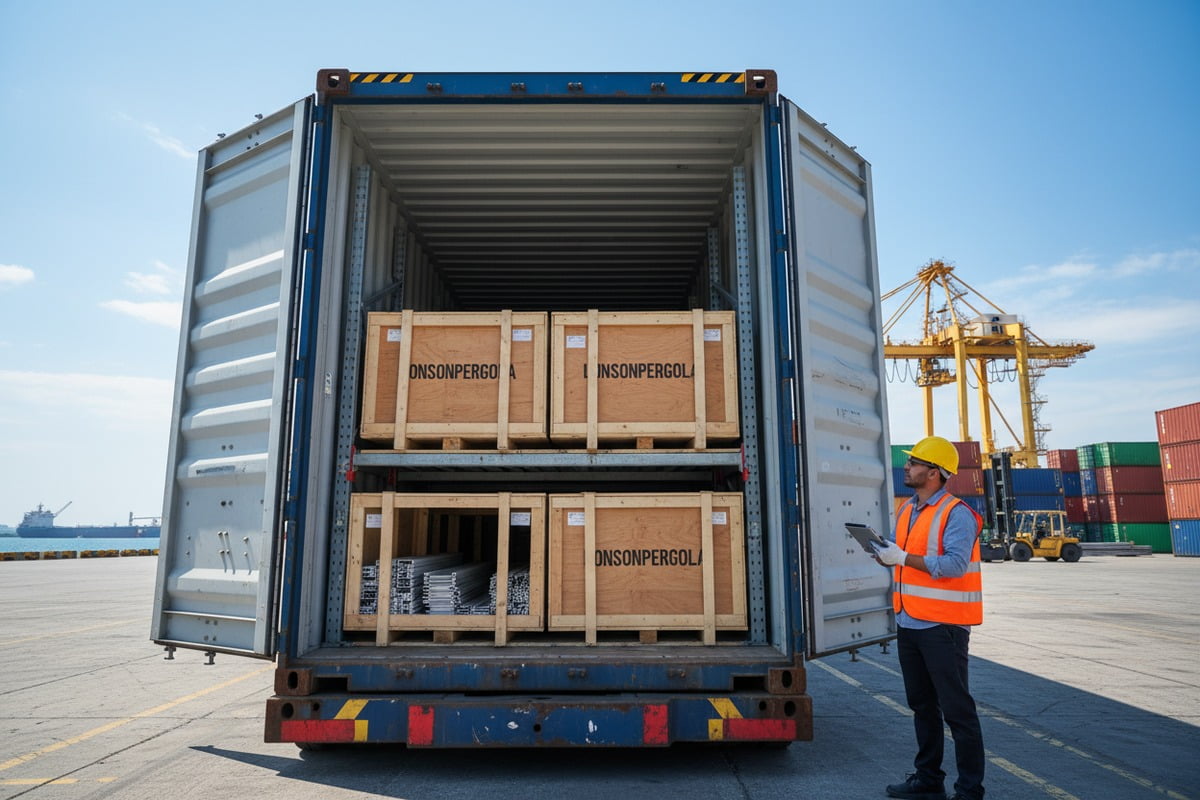
Aluminum pergolas are bulky. A standard 3×4 meter louvered pergola weighs 200–300 kg and occupies 5–10 CBM depending on packaging. That means a 20ft container (roughly 28 CBM usable) holds only 4–6 units. A 40ft container fits 8–12 units. This low density per container is exactly why freight cost per unit feels so high compared to smaller goods.
When we load containers at our Hainan facility, we use custom steel racks to stack frames vertically. This can push capacity up by 15–20%. Still, you must plan for the worst-case scenario when budgeting.
Freight Rate Benchmarks: 2026 Reality
Red Sea disruptions and carrier capacity constraints have pushed rates up 20–30% year over year. Here is what we are seeing right now:
| Route | Container Size | Rate Range (2026) | Transit Time |
|---|---|---|---|
| Shanghai → Rotterdam | 20ft FCL | €2,000 – €3,500 | 28–35 days |
| Shanghai → Rotterdam | 40ft FCL | €3,500 – €5,000 | 28–35 days |
| Ningbo → Felixstowe | 40ft FCL | €3,200 – €4,800 | 25–32 days |
| LCL (any China port → EU) | Per CBM | €150 – €250/CBM | 30–40 days |
For a small order of 4–6 pergolas filling one 20ft container, your freight alone is €400–€700 per unit. For larger orders filling multiple 40ft containers, it drops to €300–€500 per unit.
FOB vs. DDP: Which Incoterm Saves You Money?
FOB (Free on Board) means you pay the factory price plus loading onto the vessel in China. Everything after that — ocean freight, insurance, customs clearance, duties, VAT, inland delivery in Europe — is on you.
DDP (Delivered Duty Paid) 4 means the supplier handles everything to your warehouse door. It sounds easier, but suppliers mark up DDP quotes by 25–40% to cover their risk and margin on logistics. In our experience, buyers who manage their own freight forwarding save 10–15% compared to DDP, but they need a reliable EU-side customs broker.
The smart middle ground is DAP (Delivered at Place). The supplier arranges freight to your nearest port or warehouse, but you handle customs clearance and duty payment. This gives you control over VAT recovery while the supplier manages the ocean leg.
Inland Transport: The Forgotten Cost
Many buyers forget there are two inland legs. Getting goods from our factory to Ningbo port costs €400–€600 per container. Then, trucking from Rotterdam or Antwerp to your warehouse in Milan or Munich adds another €500–€800. These costs add up to €1,000–€1,400 per shipment — roughly €100–€200 per pergola unit.
What import duties and VAT rates apply to my aluminum pergola order from China?
Our export documentation team classifies hundreds of shipments per month, and we have seen European buyers hit with unexpected duty bills simply because their HS code was wrong. Getting this step right is non-negotiable.
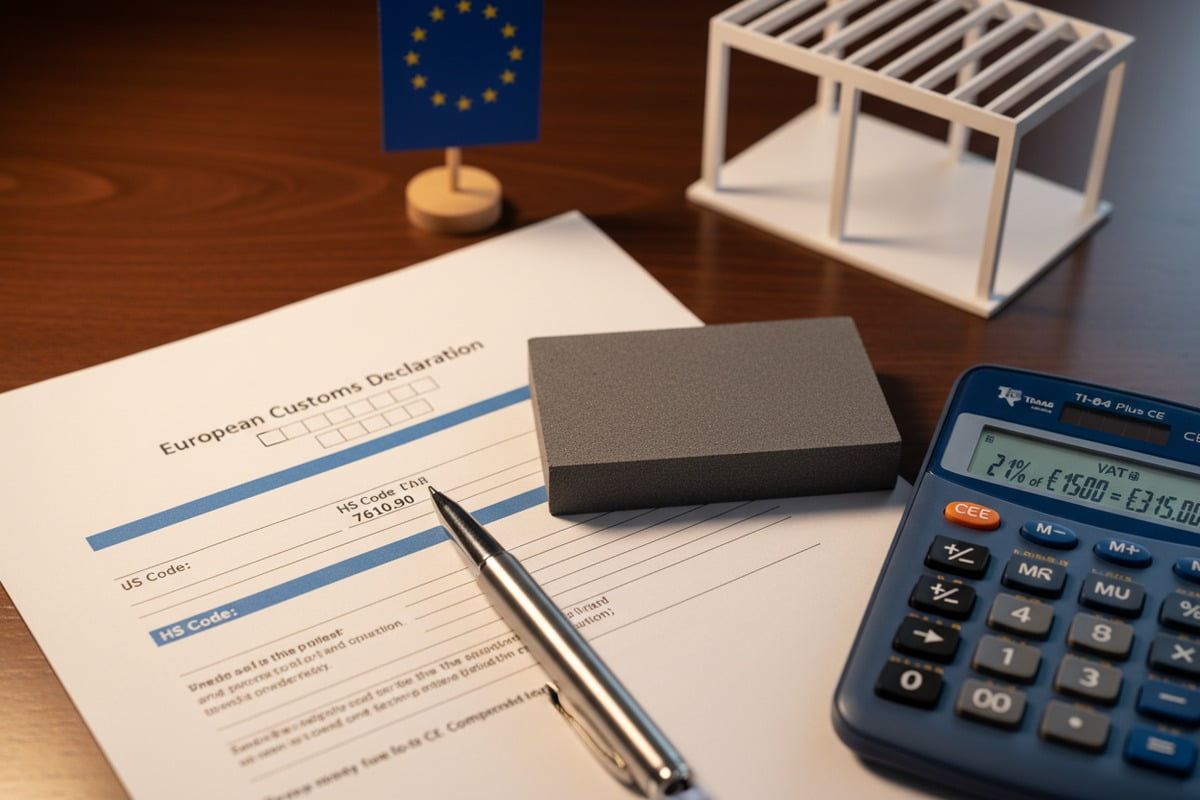
Aluminum pergolas typically fall under HS code 7610.90 (aluminum structures), attracting EU import duties of 6–8% on the CIF value. EU VAT ranges from 19% in Germany to 25% in Denmark, calculated on the CIF value plus duties. From 2026, CBAM adds an estimated €50–€200 per ton for embedded carbon emissions in aluminum.
HS Code Classification: Why It Matters
The Harmonized System code determines your duty rate. Aluminum pergolas with louvered roofs, retractable screens, and integrated motors could theoretically be classified under several codes. The most common and correct classification is HS 7610.90 — "aluminum structures and parts of structures, not elsewhere specified."
If your pergola includes electrical components like motorized louvers or LED lighting, customs may argue for a different classification with higher duties. Always confirm your HS code using the EU TARIC database 5 before shipping.
Duty Calculation: Step by Step
The EU calculates import duties on the CIF value 6 — that is, the cost of goods plus insurance plus freight. This is different from the US, which uses FOB value. Here is a worked example:
| Cost Component | Amount |
|---|---|
| FOB price (10 pergolas × €500) | €5,000 |
| Ocean freight (20ft container) | €2,500 |
| Marine insurance 7 (1% of FOB + freight) | €75 |
| CIF value | €7,575 |
| EU duty at 7.5% on CIF | €568 |
| Duty-inclusive value | €8,143 |
| EU VAT 8 at 21% (Netherlands) | €1,710 |
| Total duties + VAT | €2,278 |
That is €228 per pergola just in duties and taxes — a 45% surcharge on your FOB price. Many first-time importers do not realize VAT is charged on the CIF value plus the duty, not just on the product cost.
The CBAM Factor in 2026
The EU Carbon Border Adjustment Mechanism is now fully phased in as of 2026. Aluminum is one of the targeted materials. If your Chinese supplier's smelter uses coal-fired electricity (most do), the embedded emissions are high. Estimates range from €50 to €200 per metric ton of aluminum, depending on the supplier's verified carbon intensity.
For a 250 kg pergola, that is roughly €12–€50 per unit in CBAM costs. It sounds small per unit, but across a 1,000-unit annual order, it adds €12,000–€50,000 to your landed cost. We recommend asking your supplier for emissions data upfront and using the EU's CBAM transitional registry to estimate charges.
VAT Recovery: Don't Leave Money on the Table
If you are VAT-registered in an EU member state, you can recover import VAT through your regular VAT return. This means the 19–25% VAT is a cash flow cost, not a permanent expense. However, you must have clean documentation: the import declaration (C88/SAD), commercial invoice, and proof of payment. Missing paperwork means you eat the VAT.
Some importers use bonded warehouses to defer VAT until goods are sold. This is especially useful for wholesalers and distributors who hold inventory. Goods sit in the bonded warehouse duty-free and VAT-free until they are released for sale.
On our production floor, we have learned that the cost of a single missing bolt can exceed the price of a full pergola once it reaches a job site in Rome or Berlin. Hidden costs are the silent killers of import margins.
Budget 5–10% of your product cost for packaging upgrades (custom crating, foam inserts, moisture barriers), €200–€500 per inspection for third-party quality checks (SGS, Bureau Veritas), and €500–€2,000 for CE certification testing. Also reserve 1–3% for currency fluctuation hedging and 1% for marine insurance.
Packaging: The First Line of Defense
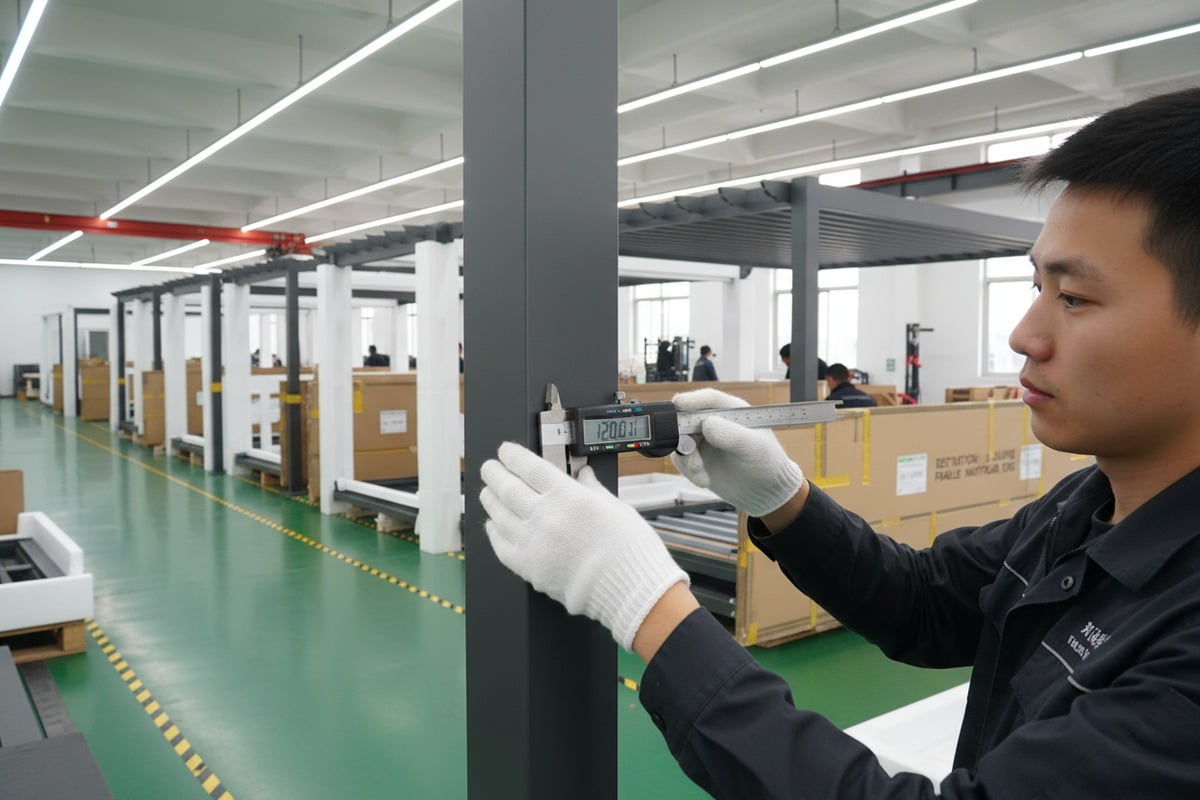
Aluminum profiles are strong but scratch easily. A cosmetic scratch on a powder-coated charcoal grey post means rejection by your end client. Standard export packaging — bubble wrap and cardboard — is not enough for a 35-day ocean journey with rough handling at port.
At our facility, we use EPE foam sleeves on every profile, corner protectors on all joints, and custom plywood crates for louvered roof panels. We also apply moisture-absorbing desiccant packs inside shrink-wrapped pallets. This packaging upgrade costs €15–€30 per unit. Skipping it to save money almost always costs more in damage claims.
Quality Inspections: What to Check and When
There are three inspection stages, and each serves a different purpose:
| Inspection Type | Timing | Cost | Was wird abgedeckt? |
|---|---|---|---|
| Pre-production inspection | Before manufacturing | €200–€350 | Raw material quality, wall thickness, alloy grade |
| During-production inspection | At 30–50% completion | €250–€400 | Dimensions, welding quality, powder coating adhesion |
| Pre-shipment inspection (PSI) | After packing, before loading | €300–€500 | Full unit assembly check, component count, packing quality |
We strongly recommend at minimum a pre-shipment inspection. Third-party agencies like SGS, Bureau Veritas, or TÜV can conduct these. The €300–€500 cost is trivial compared to the €5,000+ cost of returning defective goods from Europe or sending replacement parts by air freight.
CE Marking and Compliance Testing
If your pergolas include motorized louvers, integrated LED lighting, or electrical zip blinds, they need CE-Kennzeichnung 9 for the EU market. This involves EMC (electromagnetic compatibility) testing, LVD (low voltage directive) compliance, and sometimes the Machinery Directive.
Testing costs range from €500 to €2,000 per product family. If you are ordering the same pergola model repeatedly, you only need to test once and keep the certificate on file. But if you change the motor supplier or electronics, retesting is required.
Currency Fluctuation and Insurance
The CNY-EUR exchange rate can swing ±10% over a contract period. A €50,000 order placed when the rate is 7.8 CNY/EUR could cost €3,000 more if the rate moves to 7.5 by payment date. Options include forward contracts through your bank or simply negotiating EUR-denominated invoices with your supplier.
Marine insurance at 1% of CIF value is standard. In 2026, premiums have risen roughly 10% for shipments through the Red Sea diversion route (via Cape of Good Hope). Budget 1.0–1.5% to be safe. If your goods are uninsured and a container falls overboard, you lose everything.
How do customization requirements and order volume impact my final landed price?
When our engineering team receives a request for a non-standard RAL color or an unusual 5×6 meter span, we know the cost implications ripple through every downstream calculation — from raw material waste to container loading efficiency.
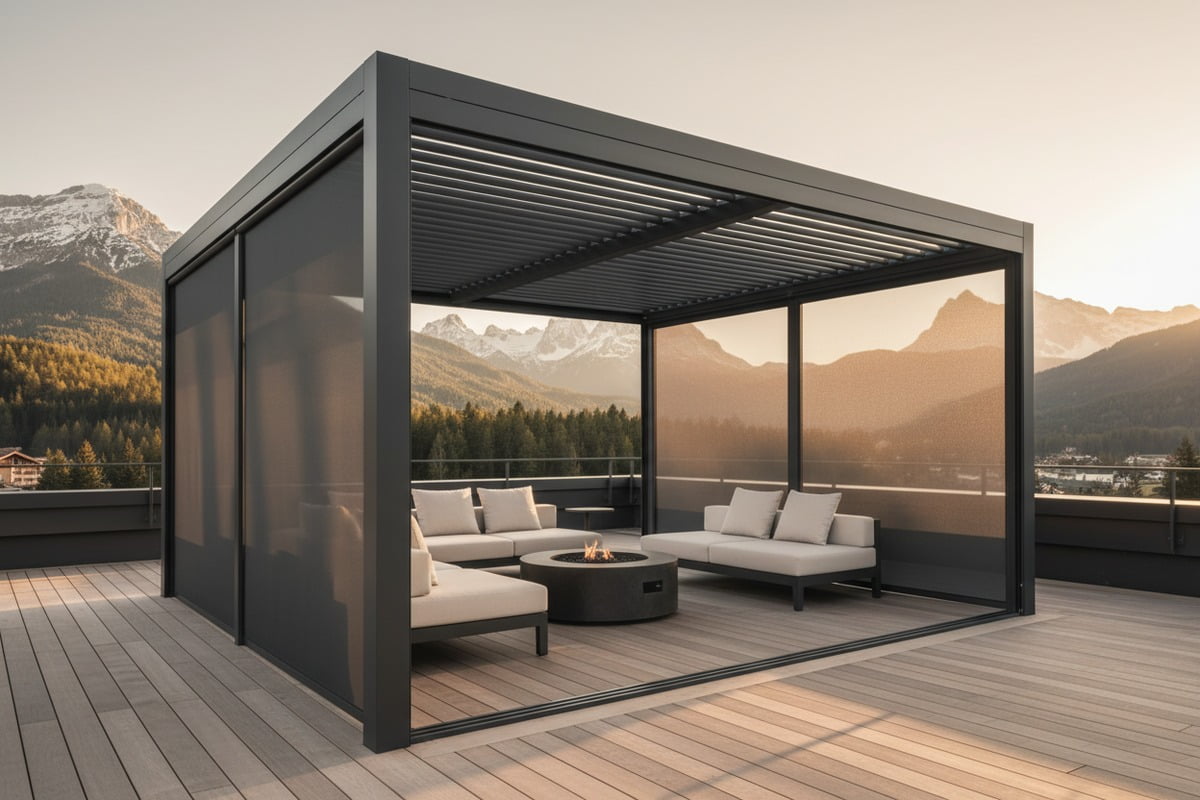
Customization can add 10–30% to your per-unit product cost due to non-standard extrusion dies (€2,000–€5,000 each), special RAL color runs (minimum 50 units), and engineering time. However, higher order volumes dramatically reduce landed cost per unit — a 100-unit order can cut per-unit landed cost by 40–50% compared to a 10-unit order through freight optimization and volume discounts.
How Customization Drives Up Cost
Every custom element adds a cost layer. Here is how the most common customization requests affect pricing:
- Non-standard dimensions require new extrusion dies. A single die costs €2,000–€5,000 and is only economical if amortized over 100+ units. For a 10-unit order, that die cost alone adds €200–€500 per pergola.
- Special RAL colors require a dedicated powder coating run. Our coating line needs a minimum batch of 50 units to justify the color change, cleaning, and quality validation. Smaller batches incur a surcharge of 8–15%.
- Motorized louvers and zip screens with specific certifications (e.g., Somfy motors with CE) cost 20–30% more than standard Chinese-brand motors.
- Custom packaging with your private label adds €5–€15 per unit for printed instructions, branded boxes, and bilingual assembly manuals.
Volume Effects on Landed Cost: A Real Comparison
The biggest lever you have to reduce landed cost is order volume. Here is a side-by-side comparison using our actual pricing tiers:
| Cost Component | 10 Units | 50 Units | 200 Units |
|---|---|---|---|
| Product cost (FOB per unit) | €550 | €480 | €420 |
| Ocean freight per unit | €500 | €200 | €100 |
| Inland transport per unit | €150 | €60 | €30 |
| Duties + VAT per unit | €252 | €155 | €115 |
| Insurance per unit | €11 | €7 | €5 |
| Inspection + handling per unit | €50 | €15 | €5 |
| Total landed per unit | €1,513 | €917 | €675 |
The 200-unit order achieves a landed cost of €675 per unit — 55% less than the 10-unit order. This is not just about factory discounts. Freight cost per unit drops dramatically because you fill containers efficiently. Inspection and handling costs get spread across more units. Even duties decrease per unit because freight per unit (part of the CIF base) is lower.
Practical Tips to Optimize Your Landed Cost
Bundle shipments. If you need 30 pergolas now and 30 in three months, consider ordering all 60 at once and storing half in a bonded warehouse. The freight savings alone can exceed the warehousing cost.
Standardize where possible. Choose 2–3 standard sizes and colors instead of 10 custom variants. This lets us batch production, reduce material waste, and load containers more efficiently.
Use rail freight as an alternative. China-Europe rail 10 (via the China-Europe Express) takes 18–22 days — faster than sea — at roughly 20% higher cost than ocean freight but 60% cheaper than air. For time-sensitive orders, it is a strong middle option.
Negotiate payment terms. A 30% deposit with 70% against copy of bill of lading gives you leverage and cash flow breathing room. We offer these terms to long-term partners, and they help buyers manage currency risk by splitting payments across different rate dates.
The Nearshoring Question
Some European buyers are exploring Turkish or Eastern European suppliers to avoid China-EU tariffs and CBAM costs. Turkish aluminum pergolas are typically 15–25% more expensive at the factory gate, but shorter transit times (7–10 days), zero CBAM exposure, and EU-Turkey customs union benefits can close the gap. For buyers ordering fewer than 20 units per year, nearshoring may actually deliver a lower landed cost. For volumes above 50 units, Chinese manufacturing with optimized logistics remains more competitive in most cases.
Schlussfolgerung
Calculating total landed cost is not optional — it is the difference between a profitable import and a budget disaster. Map every cost layer from EXW to your warehouse door, verify your HS code, and let volume work in your favor.
Fußnoten
1. Official rules for EXW Incoterm from International Chamber of Commerce. ︎
2. Direct link to the official EU TARIC database for this HS code. ︎
3. Official European Commission explanation of the Carbon Border Adjustment Mechanism. ︎
4. Official Incoterms 2020 rules from the International Chamber of Commerce. ︎
5. Official portal for the Integrated Tariff of the European Union. ︎
6. Official Incoterms 2020 rules from the International Chamber of Commerce. ︎
7. Website of the International Union of Marine Insurance, an authoritative body. ︎
8. Replaced with the official European Commission page detailing VAT rules and rates in the EU. ︎
9. Official European Commission information on CE marking requirements. ︎
10. Replaced with the Wikipedia page for 'Trans-Eurasia Logistics', which is also known as 'CHINA RAILWAY Express'. ︎