
Not every shiny aluminum pergola sample tells the truth ISO 2409 1. Over 25 years on our production lines, we have seen buyers lose thousands because they trusted appearances over evidence.
Evaluating aluminum pergola samples for quality requires hands-on inspection of wall thickness, alloy grade, coating adhesion, motor certifications, structural joints, drainage integration, and packaging integrity. Cross-reference every physical finding against the manufacturer's technical documentation and relevant European standards before committing to bulk orders.
This guide breaks down the exact steps you should follow when a pergola sample arrives at your warehouse. We will cover material specs, safety certifications, customization accuracy, and shipping protection — the four areas where problems hide most often.
How can I verify that the aluminum wall thickness and coating quality meet my long-term durability standards?
When we ship evaluation samples to our European partners, this is always the first conversation. A profile can look perfect on the outside and still be dangerously thin inside.
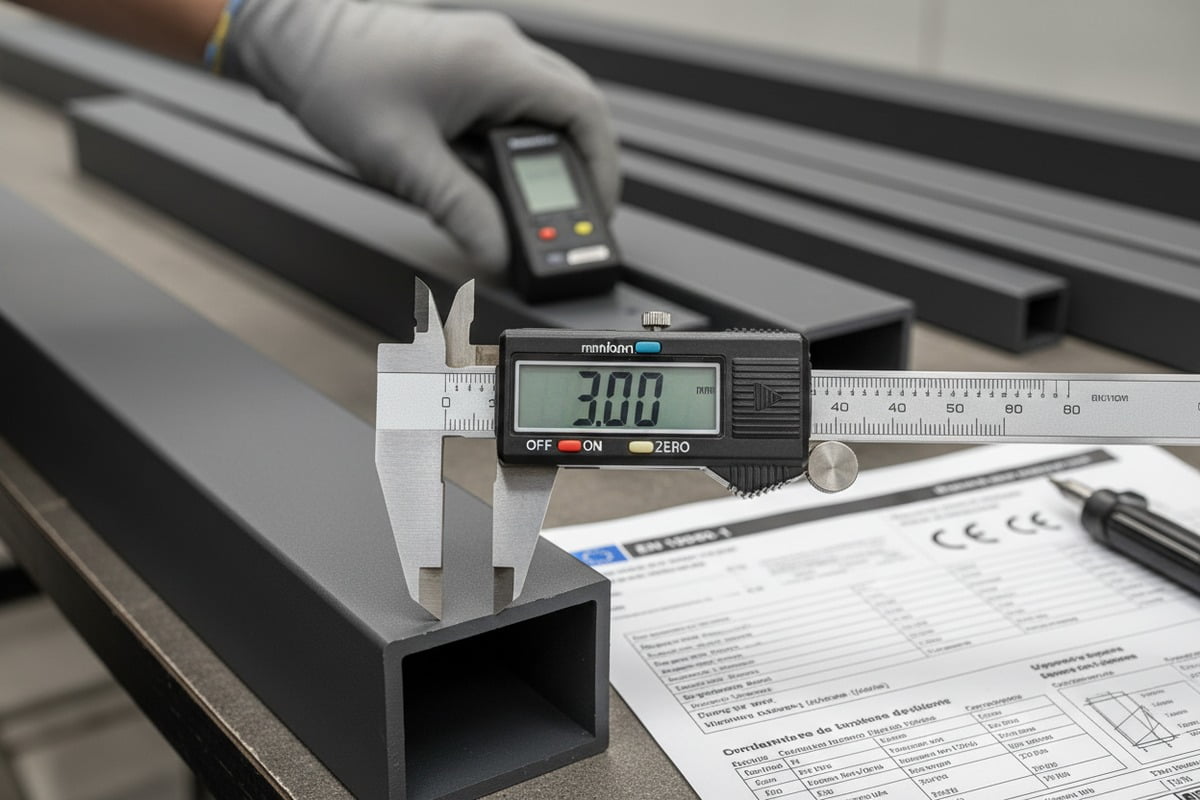
Verify aluminum wall thickness using a digital caliper on main load-bearing members, confirming a minimum of 3.0 mm for structural posts. Test coating quality by checking thickness with a dry-film gauge (≥60 microns for powder coat) and performing a cross-hatch adhesion test per ISO 2409.
Why Wall Thickness Is Non-Negotiable
Wall thickness directly determines wind and snow load capacity. In our testing lab, we have seen budget imports with walls as thin as 1.2 mm on posts that claim to handle 100 km/h winds. That is a structural failure waiting to happen. For any pergola intended for European climates — especially coastal Italy, southern France, or the Netherlands — you need main columns with at least 3.0 mm walls and roof beams no thinner than 2.0 mm.
Use a digital caliper. Measure at multiple points: top, middle, and bottom of each post. Measure inside the beam channels. Cheap extrusions often vary by 0.3–0.5 mm along their length because the dies wear out and the factory does not replace them.
Alloy Grade Matters More Than You Think
Ask the supplier for a mill certificate showing the exact alloy. The two most common grades are 6063-T5 2 and 6061-T6. Here is how they compare:
| Property | 6063-T5 | 6061-T6 3 |
|---|---|---|
| Tensile Strength | ~185 MPa | ~310 MPa |
| Common Use | Standard pergola frames, decorative profiles | High-load structural members, hurricane-rated frames |
| Corrosion Resistance | Excellent | Very Good |
| Cost | Lower | Higher |
| Extrudability | Easier, smoother finish | Slightly harder |
For most mid-to-high-end pergolas, 6063-T5 works well for standard wind zones. If your projects target coastal or high-wind regions, push for 6061-T6 on primary structural members. We use 6063-T5 as our default and switch to 6061-T6 when project engineering demands it.
How to Test the Coating
A good powder coat is your pergola's armor. Here is what to check:
- Thickness: Use a dry-film thickness gauge. For inland installations, you need at least 60 microns. For coastal environments exposed to salt spray, demand 80+ microns or a fluorocarbon (PVDF) finish at 40+ microns.
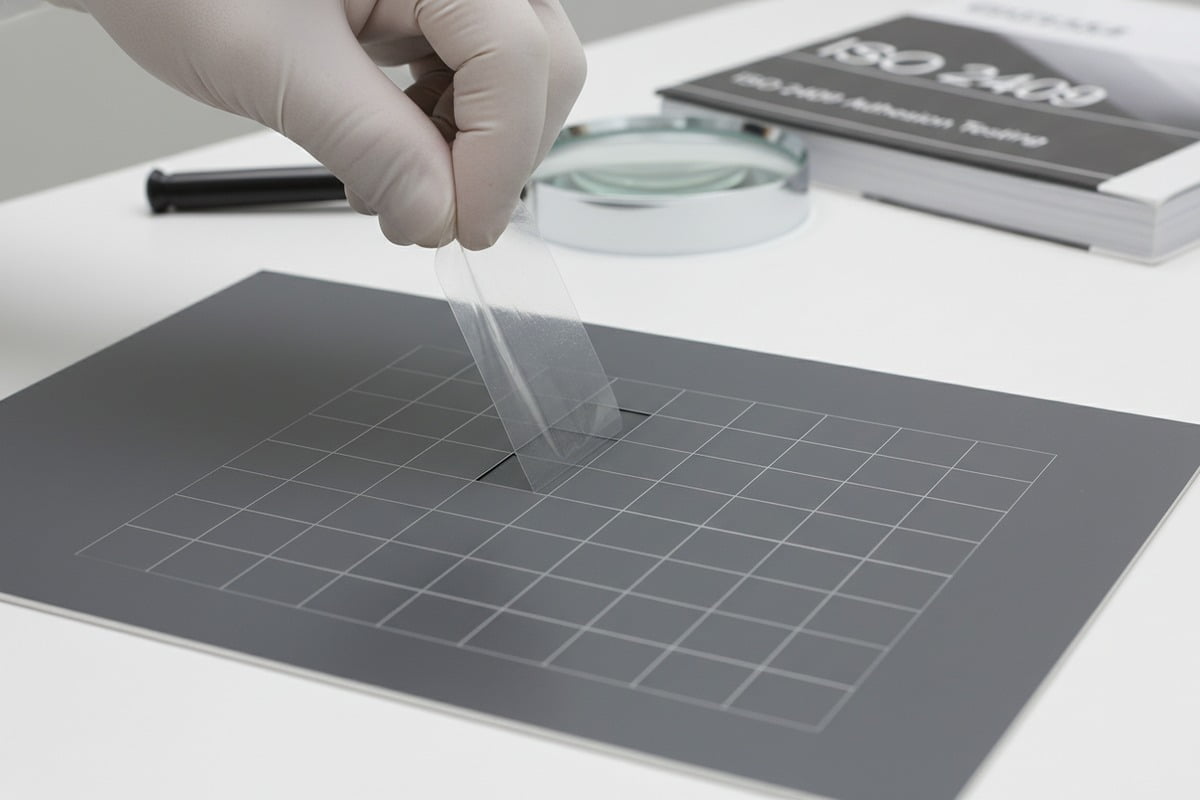
- Adhesion: Perform a cross-hatch test. Score a grid into the coating with a sharp blade, press adhesive tape over it, and pull. If more than 5% of the squares lift, the coating bond is poor.
- Uniformity: Look for runs, sags, orange-peel texture, or bare spots. Rotate the profile under bright light. Inconsistent sheen means inconsistent protection.
- Hardness: Try scratching with a 2H pencil. A quality powder coat resists this. If it scratches easily, the cure cycle was too short.
| Coating Standard | Min. Thickness | UV Resistance | Salt Spray Hours | Am besten für |
|---|---|---|---|---|
| AAMA 2603 | 50 µm | 1 year Florida | 1,000 hrs | Mild inland |
| AAMA 2604 | 50 µm | 5 years Florida | 3,000 hrs | General outdoor |
| AAMA 2605 4 | 50 µm | 10 years Florida | 4,000 hrs | Coastal / harsh UV |
| Qualicoat Class 2 5 | 60 µm | 1,000 hrs QUV | 1,000 hrs | European standard |
On our lines, every batch gets a salt-spray test for 1,000 hours minimum. We recommend you ask your supplier for their test reports. If they cannot produce them, that is a red flag.
Weight as a Quick Quality Indicator
A heavy pergola is usually a better pergola. Budget kits for a 3m × 4m size weigh around 110 kg. Our commercial-grade structures for the same footprint come in at 350–400 kg. The difference is wall thickness, reinforcement channels, and solid hardware. Pick up a post from the sample. If it feels light and hollow when you tap it, the walls are thin.
What specific tests should I perform to ensure the motor and zip blind fabric comply with European safety certifications?
After years of exporting motorized pergolas and zip blinds to the EU, our engineering team has learned that certification gaps cause more shipment rejections than any other single issue.
Test motors for CE marking, EN 13659 compliance, and IP44+ ingress protection. For zip blind fabrics, verify fire resistance per EN 13501-1 (Class B-s2,d0 minimum), UV stability exceeding 2,000 hours, and tensile strength. Request original test reports from accredited labs such as TÜV or SGS, not just supplier declarations.
Motor Certification Essentials
In the European market, every motorized component must carry a CE mark 6. But a CE sticker alone means nothing if there is no Declaration of Conformity and supporting test documentation behind it. Here is what to verify:
- CE Declaration of Conformity: The motor manufacturer must provide this document listing the specific EU directives covered — typically the Low Voltage Directive (2014/35/EU) 7 and the EMC Directive (2014/30/EU).
- EN 13659: This is the European standard for external shutters and blinds, including motorized systems. EN 13659 8 It covers safety, performance, and durability requirements.
- IP Rating: Outdoor motors need IP44 minimum for rain exposure. For coastal or fully exposed installations, IP55 is safer.
- Brand Origin: We integrate Somfy motors as our standard for European orders. Somfy motors come with full EU compliance documentation. If a supplier offers a generic Chinese motor with no brand identity, demand the test reports or walk away.
Run the motor at least 50 full open-close cycles during your sample evaluation. Listen for grinding, hesitation, or speed inconsistency. Check the limit-switch accuracy — the louvers or blind should stop at exactly the same position every cycle.
Zip Blind Fabric Testing
Zip blind fabric is not just a screen. It is a safety component. In public installations like hotels and restaurants, it must meet fire codes. Here is a practical checklist:
- Fire Resistance: Request a test certificate per EN 13501-1 9. Class B-s2,d0 is the minimum for most commercial applications. For residential, Class C may suffice, but confirm with local regulations.
- UV Stability: The fabric should withstand at least 2,000 hours of accelerated UV exposure without significant color fade or tensile loss. Ask for xenon arc test results.
- Tensile Strength: Pull a fabric sample firmly. Quality mesh holds shape. Cheap fabric stretches, distorts, and will sag in the guide rails within one season.
- Color Consistency: Compare the sample fabric to the color card under natural daylight, not just warehouse fluorescent lights. Dye-lot variation is a common complaint.
What to Check on the Electronics
Beyond the motor, check the control box, wiring, and any sensors:
- All wiring should be rated for outdoor use (UV-resistant jacket).
- The control unit should carry CE and RoHS marks.
- Rain sensors and wind sensors, if included, must have their own IP ratings documented.
- Smart home integration (e.g., KNX, Zigbee, or Wi-Fi) should be tested with actual devices during the sample review.
On our production line, we run every motorized unit through a 72-hour burn-in test before it ships. We recommend you ask your supplier what end-of-line testing they perform. If the answer is vague, the risk is yours.
How do I assess if the manufacturer's customization capabilities can accurately match my project's technical drawings and RAL colors?
From our experience handling over 500 custom OEM orders per year, we know that customization accuracy separates serious manufacturers from assemblers pretending to be factories.
Assess customization capability by submitting detailed technical drawings with tolerances and requesting a physical sample matching your exact dimensions, RAL color, and connection details. Measure the sample against your drawings, compare color under D65 daylight, and evaluate the turnaround time and communication quality throughout the process.
The Drawing Test
Send your most complex drawing first. Not the simple 3m × 4m rectangle — send the L-shaped pergola that needs to wrap around a building corner, or the unit that must integrate with an existing roof drainage system. Watch how the manufacturer responds:
- Response time: A capable factory returns a feasibility analysis within 48 hours. If it takes a week with no questions, they either did not study it or will not study it.
- Questions asked: Good factories ask smart questions. They want to know the snow load requirement, the attachment substrate (concrete, steel, wood), and whether the gutter connects to existing downpipes. Silence is not confidence — it is indifference.
- DWG/STEP capability: We work in AutoCAD and SolidWorks daily. If a supplier can only accept PDF screenshots, they likely lack in-house engineering and are outsourcing your design work.
RAL Color Accuracy
RAL color matching 10 sounds simple. It is not. A RAL 7016 (Anthracite Grey) from one powder supplier looks subtly different from another. Here is how to verify:
- Request a sprayed sample panel in your exact RAL code, not a color chip.
- Compare under D65 standard daylight (6500K). Indoor warm lighting will hide yellow shifts.
- Check gloss level: RAL colors come in matte, satin, and gloss. Specify the gloss unit (GU) range. Our standard is 30–40 GU for satin, which is the most popular finish in Europe.
- Batch consistency: Ask the supplier how they control color across a production run. We keep powder coat samples from every batch and measure with a spectrophotometer. Delta E should be under 1.0 for acceptable color consistency.
| RAL Color Check | What to Do | Acceptable Result |
|---|---|---|
| Visual Match | Compare sample panel to RAL fan under D65 light | No visible deviation at arm's length |
| Gloss Level | Measure with gloss meter at 60° | Within ±5 GU of specified level |
| Delta E (Spectrophotometer) | Measure CIE Lab* values | ΔE < 1.0 |
| Batch Variation | Compare panels from start and end of run | ΔE < 0.5 between panels |
Dimensional Tolerance
For extrusion profiles, standard tolerance is ±0.3 mm on wall thickness and ±1.0 mm on overall profile dimensions per EN 755-9. For cut-to-length parts, we hold ±0.5 mm. If your project has tighter needs, state them upfront and confirm the factory agrees in writing.
Check your sample with a tape measure and calipers. Measure the critical dimensions: post height, beam length, louver width, and mounting hole positions. If the sample deviates more than the agreed tolerance, the production batch will too.
Accessory Integration
Custom projects often need integrated LED channels, fan mounting plates, heater brackets, or speaker housings. During your sample review, verify that these attachment points are precisely located per your drawing and that the hardware provided actually fits. We once had a client discover that a competitor's sample had LED channels that were 2 mm too narrow for standard European LED strips. That small error would have caused a complete retrofit on 40 installed units.
What should I look for in the sample packaging to prevent component damage and missing parts during international shipping?
Having shipped over 15,000 pergola sets by sea to Europe, our logistics team has documented every packaging failure mode. The lessons were expensive, and we now apply them so our partners do not pay the price.
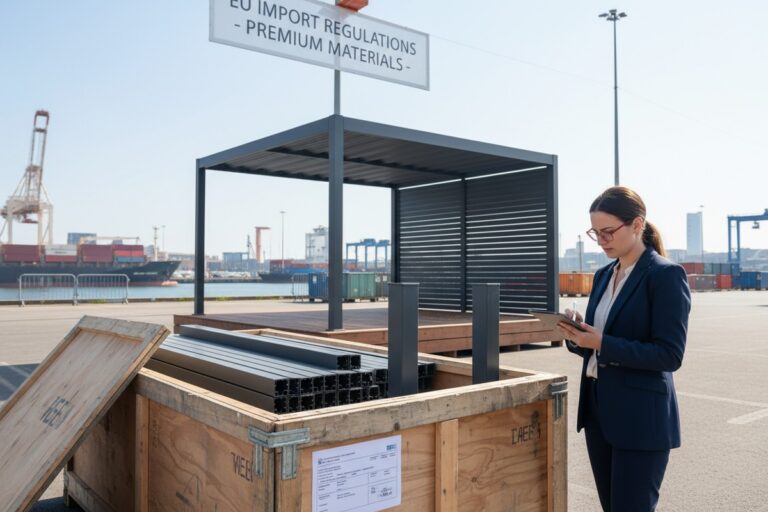
Inspect sample packaging for individual EPE foam wrapping on all profiles, corner protectors on every post, anti-scratch interleaving between louvers, clearly labeled cartons with a numbered packing list matching a BOM, and a sturdy wooden crate or pallet rated for ocean freight stacking loads.

Why Packaging Is a Profit-or-Loss Decision
A scratched profile is not a minor annoyance. For your end client, it is a rejected delivery. For you, it is a refund, a reshipping cost, and a damaged reputation. During ocean freight from China to Europe (typically 30–45 days), containers experience humidity swings, vibration, and stacking pressure. Packaging must survive all of this.
The Physical Inspection Checklist
When your sample arrives, treat the unboxing as a formal inspection. Document everything with photos and notes:
- Outer crate/pallet: Is it fumigation-stamped (ISPM 15)? Without this, European customs will reject or fumigate at your cost. Is the wood dry and structurally sound?
- Inner protection: Each aluminum profile should be wrapped in EPE foam or PE film. Louver blades must have interleaving material between them. Posts need corner protectors on all four edges.
- Hardware bag: All screws, bolts, brackets, and connectors should be in a sealed, labeled bag. Count every piece against the Bill of Materials (BOM).
- Moisture control: Look for silica gel desiccant packs inside the carton. Without them, condensation during shipping causes water stains on anodized or powder-coated surfaces.
- Labeling: Each carton should be numbered (e.g., 1/5, 2/5) and list its contents. This is not a luxury — it is the difference between a 4-hour install and a full-day parts hunt.
The Missing Parts Problem
This is the single most expensive packaging failure in international pergola trade. One missing bracket can delay a project by 3–4 weeks while you wait for a replacement shipment. Here is how to prevent it:
- Demand a detailed BOM with every sample, listing every component, quantity, and part number.
- Count during unboxing and compare to the BOM immediately.
- Check for spare parts: A good manufacturer includes 2–5% extra hardware (screws, clips) to cover minor losses on the job site.
Our Packaging Standard vs. Common Shortcuts
| Packaging Element | Our Standard | Common Budget Approach |
|---|---|---|
| Profile wrapping | Individual EPE foam sleeve | Shared plastic wrap, profiles touching |
| Corner protection | Molded corner caps on all posts | None or cardboard strips |
| Louver separation | PE foam interleaving sheets | Stacked directly, friction scratches |
| Hardware | Sealed bag, labeled, BOM-matched | Loose in box, no list |
| Crate | ISPM 15 fumigated wood, steel-strapped | Cardboard box only |
| Desiccant | Silica gel packs per carton | None |
| Labeling | Numbered cartons, QR code to packing list | Handwritten or missing |
When we developed our current packaging system, we tested it by shipping 20 sample crates to five different European ports and inspecting every piece on arrival. The investment in better packaging added less than 3% to the product cost but eliminated damage claims almost entirely.
Ask for a Trial Shipment
Before placing a bulk order, request that the manufacturer ship 2–3 complete sets using their standard export packaging to your warehouse. Inspect them as if they were going to a job site tomorrow. This one step has saved many of our partners from discovering packaging problems only after 500 sets arrive at a port with damaged goods.
Schlussfolgerung
Evaluating aluminum pergola samples demands hands-on measurement, documentation review, and deliberate stress testing. Invest the time upfront, and you protect every project downstream.
Fußnoten
1. International standard for cross-cut test to assess paint adhesion. ︎
2. Details properties and common uses of 6063-T5 aluminum alloy. ︎
3. Provides properties and applications of 6061-T6 aluminum alloy. ︎
4. Describes the high-performance exterior specification for architectural coatings. ︎
5. Replaced with the official QUALICOAT website, which is the authoritative body for Qualicoat standards and provides information on their specifications, including Class 2. ︎
6. Official information on the mandatory CE marking for products in the EEA. ︎
7. EU directive ensuring electrical equipment safety within specified voltage limits. ︎
8. European standard for performance requirements of shutters and external blinds. ︎
9. European standard for fire classification of construction products. ︎
10. Official information on the RAL color system for standardized color communication. ︎