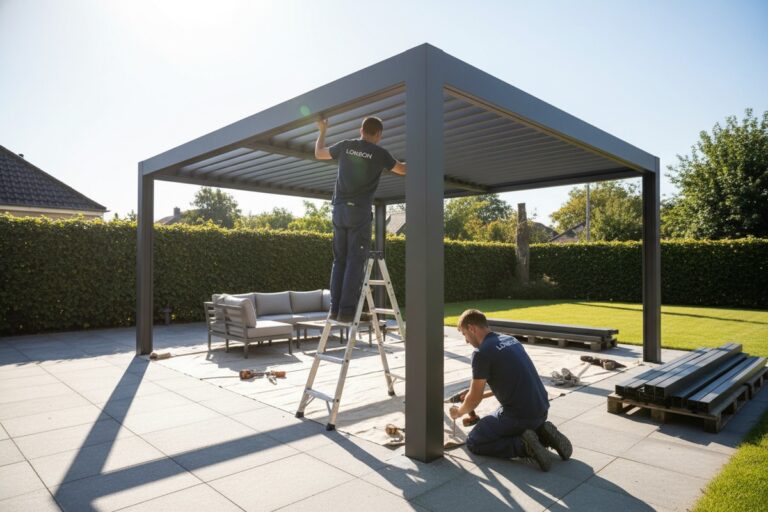

Every year, our production floor processes thousands of custom pergola orders for European contractors, and the single biggest complaint we hear from buyers switching suppliers is extrusion inconsistency that caused project failures.
To verify extrusion precision when sourcing high-end aluminum pergolas, request certified mill test reports, confirm alloy temper specifications like T66, check dimensional tolerances with CMM data, inspect surface finish quality against European coating standards, and compare total unit weight as a reliable indicator of actual material quality.
This guide walks you through the exact steps our engineering team uses internally, so you can apply the same checks when evaluating any supplier certified mill test reports 1. Let's break it down by the questions that matter most.
How can I confirm that the aluminum wall thickness matches the structural load-bearing specs I need?
When our engineers run load simulations for a new pergola model, wall thickness is the first variable they lock down alloy temper specifications 2. Getting this wrong means structures that sag, flex, or outright fail under snow and wind loads.
Confirm wall thickness by requesting the supplier's mill test certificates showing actual measured thickness, verifying the aluminum alloy grade and temper condition (T6 or T66 preferred), and cross-referencing the weight of a sample unit against the stated specifications to detect any material shortcuts.
Why Wall Thickness Is Non-Negotiable
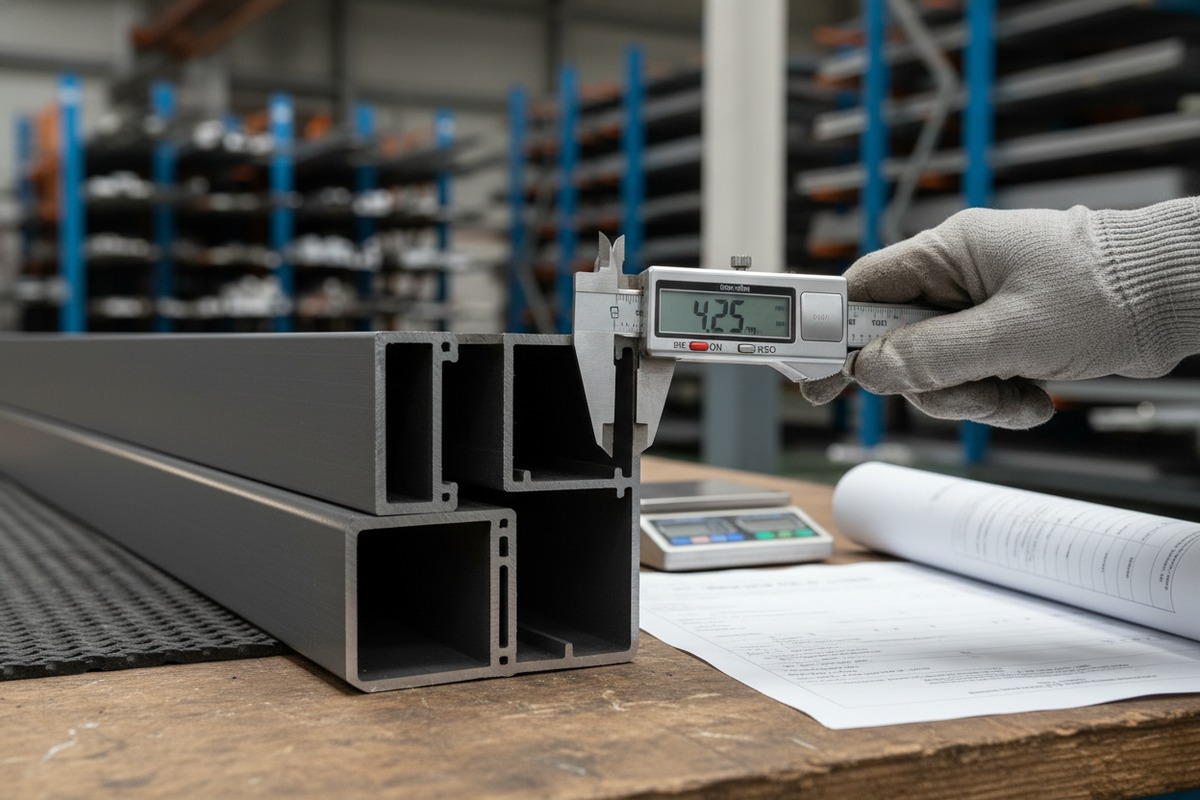
Wall thickness determines how much load a pergola beam or post can carry CMM (Coordinate Measuring Machine) inspection reports 3. Thin walls save the manufacturer money, but they transfer risk directly to your project. A beam that looks identical on the outside can have vastly different internal wall measurements Qualicoat standards 4. The only way to know is to measure or to demand documentation.
In our facility, every extrusion run is sampled and measured with digital calipers at multiple points along the profile. We record these measurements and include them in batch reports. If your current supplier cannot provide this, that is a warning sign.
Understanding Alloy and Temper Differences
Not all aluminum is equal. The alloy and temper condition change the mechanical properties 5 dramatically. Here is a comparison that our technical team shares with buyers during the quotation phase:
| Property | 6063-T5 | 6063-T6 | 6066-T66 |
|---|---|---|---|
| Tensile Strength 6 (MPa) | ~186 | ~241 | ~310+ |
| Yield Strength (MPa) | ~145 | ~214 | ~270+ |
| Typical Use | Decorative trim | Standard structural | Heavy load-bearing |
| Cost Level | Low | Medium | Higher |
| Recommended For | Budget pergolas | Mid-range projects | Premium, engineered pergolas |
T66 temper delivers roughly 29% higher tensile strength and 22.7% higher yield strength compared to T5. That gap is the difference between a pergola that lasts 10 years and one that lasts 25 years or more.
The Weight Test
Total weight is the single best quick-check for build quality. It reveals how much aluminum is actually in the structure. For a standard 10x13 pergola unit, these weight ranges tell the story:
| Weight Range (lbs) | Quality Tier | Expected Lifespan | Climate Suitability |
|---|---|---|---|
| 250–450 | Mass-market import | 5–10 years | Mild only |
| 500–900 | Mid-range | 10–15 years | Moderate |
| 1,500–1,800+ | Commercial-grade | 25+ years | Any climate |
If a supplier claims premium quality but ships a 10x13 unit weighing under 500 lbs, the math does not add up. Ask for the total shipping weight and compare it against these benchmarks.
How to Request Proof
Ask for three things: the mill test certificate for the specific alloy and temper, a dimensional inspection report showing wall thickness at multiple points, and a sample piece you can measure yourself. A trustworthy supplier will provide all three without hesitation.
How can I verify that the extrusion tolerances won't lead to costly installation delays for my team?
Our export team has seen this scenario too many times: a contractor in Europe receives a container, starts assembly, and discovers that louver blades do not seat properly or post brackets are off by two millimeters. The entire project stalls.
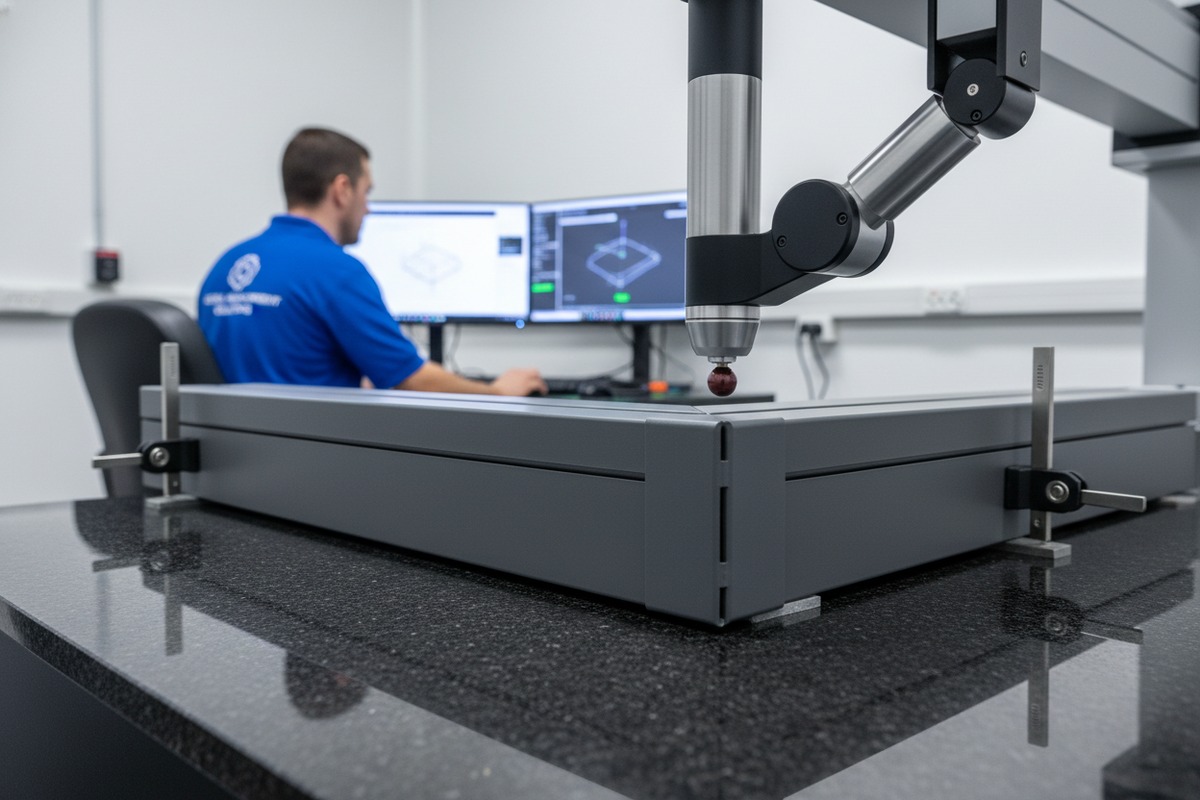
Verify extrusion tolerances by requesting CMM (Coordinate Measuring Machine) inspection reports for critical dimensions, confirming that the supplier follows ASTM-B-221 or equivalent standards, and testing a pre-production sample assembly on-site before approving bulk production.
What Tolerances Actually Mean for Installation
A tolerance is the allowed variation in a dimension. If a post is specified at 150mm x 150mm with a ±0.5mm tolerance, any measurement between 149.5mm and 150.5mm is acceptable. But if that tolerance drifts to ±1.5mm on a budget extrusion, your installer will struggle to align beams, fit brackets, and close louver gaps.
For motorized louver pergolas, tolerance is especially critical. Each louver blade must rotate smoothly within a defined channel. Even a 1mm deviation across a 4-meter span can cause binding, uneven gaps, or motor strain. This is why our die maintenance schedule is strict: we inspect and replace dies on a fixed cycle, not when they start producing visibly bad parts.
Key Dimensions to Check
Not every dimension needs micron-level precision. Smart engineering means applying tight tolerances only where they matter. Here is a guide we share with our buyers:
| Dimension | Standard Tolerance | Critical Tolerance (Louver Systems) | Measurement Tool |
|---|---|---|---|
| Wall thickness | ±0.3mm | ±0.15mm | Digital caliper / micrometer |
| Profile width/height | ±0.5mm | ±0.25mm | CMM or optical comparator |
| Straightness (per meter) | ≤1.0mm | ≤0.5mm | Straightedge / CMM |
| Twist (per meter) | ≤1.0° | ≤0.5° | Surface plate + dial indicator |
| Hole position (CNC machined) | ±0.5mm | ±0.2mm | CMM |
Strategic Tolerance Specification
One common mistake buyers make is demanding the tightest possible tolerance on every dimension. This sounds like it guarantees quality, but in practice it increases your cost and extends lead times without adding functional value. Work with your supplier to identify which dimensions are truly critical, such as louver channels, interlocking joints, and bracket holes, and apply tight tolerances only there.
The Pre-Production Assembly Test
Before you approve a bulk order, request a pre-production sample set. Assemble it yourself, or have your installation team do it. This is the most reliable way to catch tolerance issues that no report can fully predict. Our team routinely ships sample kits to European buyers for exactly this purpose. The small upfront cost of a sample test prevents massive delays on-site.
Die Maintenance Matters
The precision of an extrusion depends heavily on the condition of the die. A new die produces profiles within spec. After thousands of meters of extrusion, the die wears. If the manufacturer does not track die usage and replace dies proactively, the last profiles off a worn die will be out of tolerance. Ask your supplier about their die maintenance protocol. If they cannot answer clearly, that is a red flag.
How do I identify if the surface finish on my custom profiles meets high-end European aesthetic standards?
Walking through a luxury outdoor living showroom in Milan or Munich, you notice immediately that finish quality separates premium products from everything else. Our powder coating line runs six days a week to meet European color and texture expectations, and we still reject batches that pass basic inspection but fail our visual standard.
Identify high-end surface finish quality by checking for uniform color and gloss, verifying powder coating thickness meets AAMA 2604 or Qualicoat standards (minimum 60 microns), testing adhesion with cross-hatch methods, and confirming UV and corrosion resistance through salt spray test documentation.

What "High-End European Aesthetic" Actually Means
European buyers expect more than just a coat of paint. They expect a finish that looks flawless from one meter away, resists Mediterranean sun for a decade, and matches the exact RAL color code they specified. This means the coating must be uniform in color, thickness, and texture across every profile in the shipment.
In our experience exporting to Italy, Germany, and France, the most common complaints about competitor products are color inconsistency between batches, orange-peel texture on flat surfaces, and early fading or chalking after two to three years of outdoor exposure.
Coating Standards You Should Know
Two major certification systems govern architectural aluminum coatings in Europe:
- Qualicoat — The European quality label for powder and liquid coatings on aluminum. It specifies minimum film thickness, adhesion, hardness, and weathering resistance. Qualicoat Class 2 is typically required for exterior architectural applications.
- AAMA 2604 — The American standard widely referenced globally, requiring coatings to withstand 10 years of South Florida equivalent UV exposure.
Both standards require a minimum dry film thickness of approximately 60 microns. Below this threshold, UV protection and corrosion resistance degrade rapidly.
Wood-Grain Finishes: A Precision Indicator
Wood-grain finishes are created through a sublimation process, where a printed film is transferred onto the powder-coated surface using controlled heat and pressure. This process is technically demanding. If the temperature is too low, the pattern does not transfer fully. Too high, and the colors distort. Uneven pressure creates blurry or misaligned grain patterns.
When we produce wood-grain profiles, we calibrate oven temperature and dwell time for each color variant. The quality of the wood-grain finish is actually a useful proxy for overall manufacturing precision. A supplier that produces clean, sharp wood-grain patterns almost certainly maintains tight control over the entire production process.
Visual and Physical Checks
When you receive samples, perform these checks:
- Color match — Compare against the RAL fan deck under natural daylight, not fluorescent lighting.
- Gloss level — Use a gloss meter or compare against a known reference. Matte finishes should read below 30 GU; satin finishes between 30–60 GU.
- Surface defects — Look for orange peel, runs, sags, pinholes, and inclusions at a distance of 50cm.
- Adhesion — Perform a cross-hatch tape test 7 per ISO 2409. The coating should not lift.
- Thickness — Use an eddy current coating thickness gauge. Readings below 60 microns on exterior profiles are unacceptable.
Anodizing vs. Powder Coating
Some high-end pergolas use anodized finishes instead of powder coating. Anodizing creates a hard oxide layer that is part of the aluminum itself, offering excellent scratch resistance and a distinctive metallic appearance. However, anodizing limits color options and is more expensive. Powder coating offers a wider palette, including custom RAL colors and textured finishes, and is the dominant choice for European pergola projects.
What documentation should I request to prove the extrusion precision meets my project's compliance standards?
When our sales team prepares a quotation package for a European contractor, the documentation file is often thicker than the product brochure. That is intentional. In our industry, claims without paperwork are just marketing.
Request mill test certificates for alloy and temper verification, CMM dimensional inspection reports, mechanical test results (tensile, yield, elongation), powder coating certification (Qualicoat or AAMA), CE declarations where applicable, and full traceability documentation linking each batch to its raw material source.

The Essential Documentation Checklist
Here is the complete list of documents our quality department prepares for every shipment. Use this as your baseline when evaluating any supplier:
-
Mill Test Certificate (MTC) — Issued by the aluminum billet supplier or the extrusion facility. It confirms alloy grade, temper, and chemical composition. Without this, you have no proof of what alloy is in the profiles.
-
Dimensional Inspection Report — Shows measured dimensions versus specified dimensions for critical features. Should reference the measurement tools used (calipers, CMM, optical comparator) and include pass/fail status.
-
Mechanical Test Report — Results from tensile testing showing yield strength, ultimate tensile strength, and elongation percentage. These values must meet or exceed the minimums for the specified alloy and temper per ASTM-B-221 9 or EN 755.
-
Coating Test Report — Thickness measurements, adhesion test results, salt spray test hours (minimum 1,000 hours for Qualicoat Class 2), and UV resistance data. If the supplier uses an external coating vendor, this report should come from that vendor with their certification number.
-
CE Declaration of Conformity — For products sold in the EU, a CE declaration confirms the product meets applicable European directives. For pergolas with motorized components, this includes the Machinery Directive and Low Voltage Directive.
-
ISO-Zertifizierung — ISO 9001 10 for quality management systems is a minimum expectation. ISO 14001 for environmental management is increasingly requested by European buyers.
-
Traceability Records — Each extrusion batch should be traceable back to the specific billet lot, extrusion press, die number, and production date. This allows you to investigate any quality issue after installation.
How to Read a Mill Test Certificate
A mill test certificate should include the heat number (linking to the specific aluminum melt), the alloy designation (e.g., 6063 or 6066), the temper (T5, T6, or T66), the chemical composition percentages (silicon, magnesium, iron, etc.), and mechanical test results. Compare the listed values against the standard minimums. If any value falls below the standard, reject the batch.
Red Flags in Supplier Documentation
Watch for these warning signs:
- Generic certificates that do not reference your specific order or batch number.
- Test reports from third-party labs that the supplier cannot identify or that have no verifiable accreditation.
- Missing temper designation on the mill test certificate.
- Coating thickness values that are suspiciously uniform across all measurement points, which suggests fabricated data rather than real measurements.
- Refusal or long delays when you request documentation.
Building a Verification Routine
For ongoing supply relationships, establish a verification routine. Request documentation with every shipment, not just the first order. Spot-check by sending random samples to an independent lab once or twice per year. Track your supplier's delivery performance, defect rates, and documentation completeness over time. This is exactly how our long-term European partners manage quality, and it works.
Schlussfolgerung
Verifying extrusion precision protects your project, your reputation, and your budget. Use alloy specifications, weight checks, tolerance reports, surface finish testing, and complete documentation to hold every supplier accountable.
Fußnoten
1. Provides a comprehensive definition and overview of mill test reports. ︎
2. Details the various temper designations and their impact on aluminum properties. ︎
3. Explains the purpose and content of CMM inspection reports for dimensional verification. ︎
4. Links to the official website of the European quality label for aluminum coatings. ︎
5. Explains how alloy and temper influence the mechanical characteristics of aluminum. ︎
6. Defines tensile strength as a critical mechanical property for material integrity. ︎
7. Describes the methodology of the cross-hatch test for coating adhesion. ︎
8. Provides information on the AAMA 2604 standard for architectural aluminum coatings. ︎
9. References the official ASTM standard for aluminum and aluminum-alloy extrusions. ︎
10. The original URL returned an HTTP 403 error. This replacement is a dedicated and comprehensive resource explaining the ISO 9001 standard for quality management systems. ︎