
Every year, our sales team encounters buyers who got burned by suppliers holding fake ISO certificates—resulting in defective aluminum profiles and costly project delays.
To verify a supplier's ISO 9001 certification, request the full certificate, confirm the certification body is IAF-accredited, cross-check the certificate number on the IAF CertSearch database, and ensure the scope specifically covers aluminum pergola manufacturing processes.
Below, I'll walk you through each verification step, the red flags to watch for, and the tools that make this process fast and reliable.
How can I verify that my pergola supplier's ISO 9001 certificate is authentic and up to date?
When we onboard new distributors, one of the first documents they ask for is our ISO 9001 certificate—and rightfully so, because fake certificates are more common than most buyers realize European co-operation for Accreditation 1.
Verify authenticity by checking the certificate number on the IAF CertSearch database (iafcertsearch.org), confirming the certification body holds IAF-recognized accreditation, and ensuring the certificate's expiry date has not passed and the scope covers aluminum fabrication.
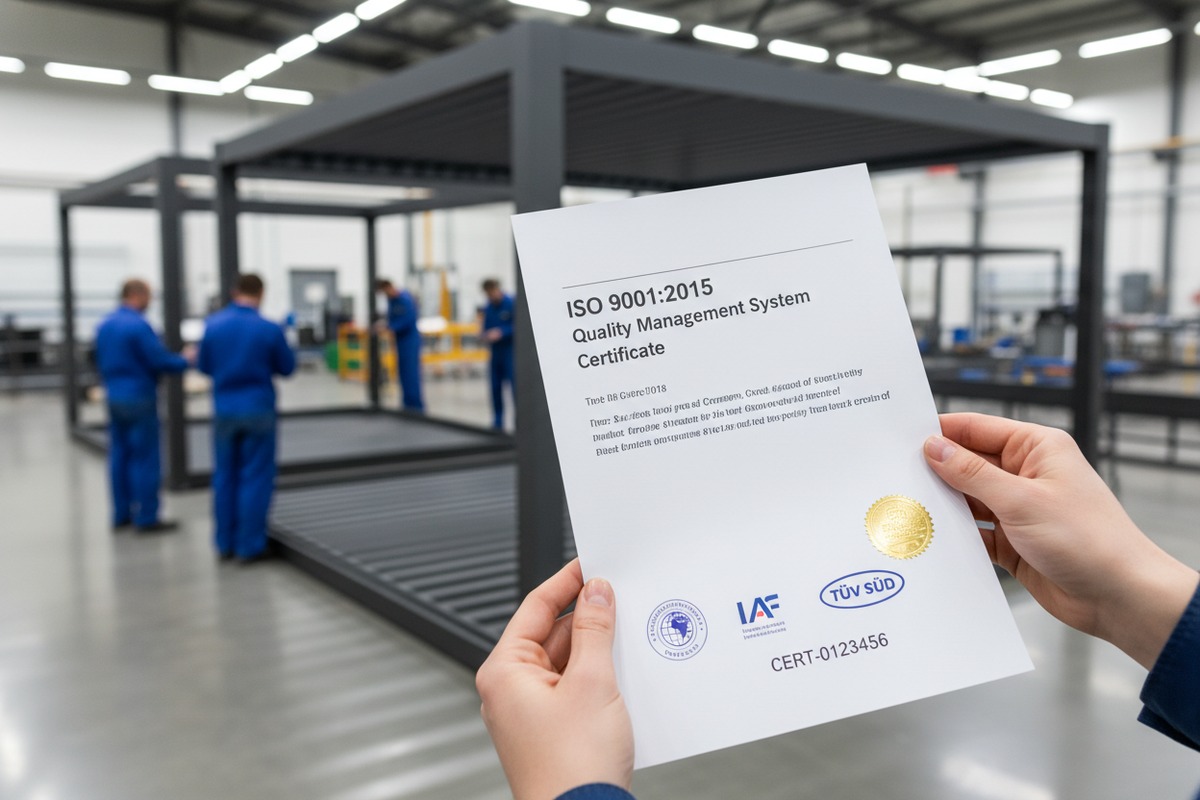
Step 1: Request the Full Certificate
Ask your supplier for a high-resolution PDF. A legitimate certificate always includes these elements:
| Certificate Element | What to Look For |
|---|---|
| Certification Body 2 (CB) Name & Logo | Recognized body like TÜV, SGS, Bureau Veritas |
| Accreditation Body (AB) Logo | UKAS, ANAB, CNAS, or other IAF member |
| Certificate Number | Unique identifier for online verification |
| Issue & Expiry Dates | Must be current; typical cycle is 3 years |
| Scope of Certification | Should mention aluminum manufacturing, extrusion, or outdoor structures |
| Certified Organization Name & Address | Must match the supplier's legal entity |
If any of these are missing, stop and investigate further CE-Kennzeichnung 3.
Step 2: Use IAF CertSearch
Go to iafcertsearch.org. Enter the company name or certificate number. IAF CertSearch database 4 The database covers over 3 million certificates worldwide. If the supplier does not appear, their certificate may be issued by a non-accredited body—meaning it holds no international validity.
Step 3: Verify the Certification Body Itself
Not all CBs are equal. Check that the CB is accredited by an IAF member. The IAF/ILAC directory lists 75 accreditation bodies and 1,362 certification bodies globally. If the CB on the certificate is not in this directory, treat the certificate as suspect.
Step 4: Contact the CB Directly
When online tools don't give clear results, email or call the certification body. Use the contact details from the CB's official website—not from the certificate itself, in case it's been forged. Ask them to confirm the certificate number and its current status.
From our experience shipping to European markets, buyers who complete all four steps avoid 99% of certification fraud. It takes 30 minutes but saves months of headaches.
What red flags should I look for when reviewing a manufacturer's quality management documents?
Our quality team reviews supplier documents regularly for our own raw material sourcing, and we've learned to spot problems fast—before they become expensive.
Red flags include missing accreditation body logos, certification scopes that don't mention aluminum or pergola processes, expired dates without renewal evidence, reluctance to share documents, and certification bodies that cannot be found in any IAF directory.

Document-Level Red Flags
Watch for these specific issues when you receive quality management documents 5:
| Red Flag | Warum es wichtig ist |
|---|---|
| No AB logo on certificate | Likely issued by non-accredited body |
| Scope says "general manufacturing" | Does not confirm aluminum pergola capability |
| Certificate expired more than 30 days ago | Supplier may have failed recertification |
| Company address doesn't match factory | Certificate may belong to a different entity |
| Supplier refuses to share internal audit reports | May not actively maintain QMS |
| Low-resolution or blurry certificate images | Possibly edited or fabricated |
Behavioral Red Flags
Beyond the documents themselves, pay attention to how the supplier responds. If they delay providing the certificate for weeks, offer excuses, or provide only partial information, this signals a problem. Legitimate suppliers—ourselves included—keep certificates readily available because we know buyers need them for due diligence.
Scope Mismatch Issues
This is the most overlooked red flag. A supplier might hold valid ISO 9001-Zertifizierung 6 for, say, steel wire production. But if you're buying aluminum pergolas, that scope is irrelevant. The scope must explicitly cover processes like aluminum extrusion, powder coating, assembly, or outdoor structure fabrication. If it doesn't, their QMS was never audited for the product you're buying.
What About Alternative Quality Evidence?
Some smaller suppliers skip ISO 9001 due to cost but provide material test reports (MTRs), third-party inspection results, or ASTM certifications for aluminum alloys. These can supplement your assessment, but they don't replace a systematic quality management framework. For high-volume pergola orders destined for European markets, ISO 9001 remains the baseline expectation.
How does a supplier's ISO 9001 compliance protect my business from receiving defective aluminum profiles?
In our 25 years of manufacturing aluminum pergolas, we've seen how a well-maintained QMS catches defects at the source—before products ever reach a shipping container.
ISO 9001 compliance protects buyers by requiring suppliers to maintain documented processes for material inspection, production control, traceability, corrective actions, and continuous improvement—systematically reducing the risk of defective aluminum profiles reaching your warehouse.

How ISO 9001 Prevents Defects at Each Stage
A certified supplier must control quality at every production phase. Here's how this directly protects your pergola order:
| Production Stage | ISO 9001 Requirement | How It Protects You |
|---|---|---|
| Raw Material Intake | Incoming inspection procedures | Rejects substandard aluminum alloys before processing |
| Extrusion | Process parameters documented and monitored | Ensures consistent wall thickness and dimensional accuracy |
| Powder Coating | Surface treatment standards and testing | Prevents peeling, fading, and corrosion failures |
| Assembly | Work instructions and inspection checklists | Reduces missing components and fitment errors |
| Final Inspection | Statistical sampling and acceptance criteria | Catches defects before shipment |
| Post-Delivery | Complaint handling and corrective action | Forces root-cause fixes, preventing repeat issues |
Traceability Saves You in Disputes
ISO 9001 requires traceability. This means every batch of aluminum profiles can be traced back to the raw material source, production date, and operator. If a defect appears after delivery, you can pinpoint exactly what went wrong and hold the supplier accountable with documentation.
Risk-Based Thinking
The 2015 revision of ISO 9001 introduced risk-based thinking 7. For aluminum pergolas, this means the supplier must identify risks like inconsistent alloy quality, equipment calibration drift, or coating adhesion failures—and implement preventive controls before problems occur.
Real-World Impact
When our factory processes 80,000 sets annually, even a 1% defect rate means 800 defective units. Our QMS drives that rate far below 1% through systematic controls. Without ISO 9001, suppliers may rely on ad hoc inspection, which inevitably lets defects slip through on large orders.
For buyers like construction contractors in Europe, receiving defective profiles doesn't just mean returns—it means project delays, penalty clauses, and reputational damage. ISO 9001 compliance is your first layer of defense.
Where can I cross-reference a factory's certification to ensure it meets European compliance standards?
Many of our European distributors need to confirm that our certifications align with EU market expectations—especially when their end clients are construction firms bound by local building regulations.
Cross-reference factory certifications using the IAF CertSearch database, European accreditation body directories (like EA member lists), and the European co-operation for Accreditation (EA) MLA signatory register to confirm mutual recognition and EU-level compliance validity.
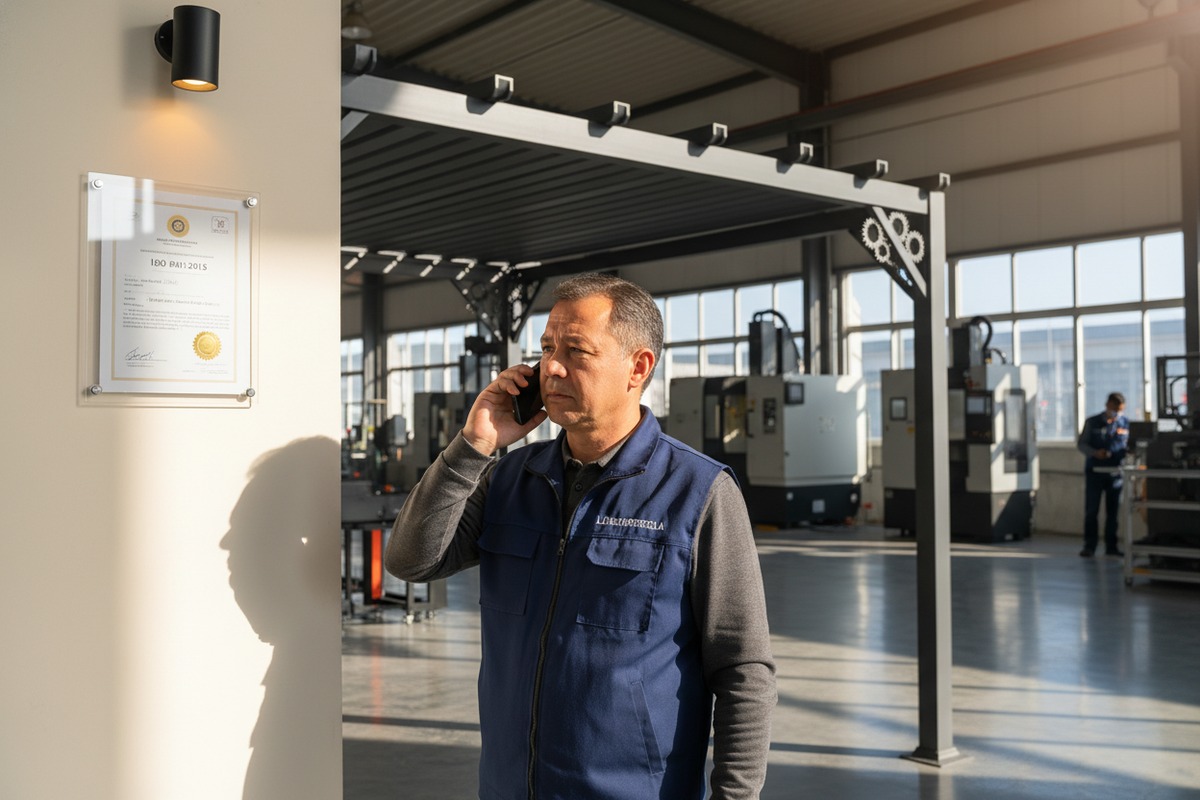
Key Databases for European Verification
For European buyers, it's not enough that a certificate exists. You need to confirm the entire accreditation chain is recognized within Europe.
IAF CertSearch (iafcertsearch.org): Start here. It aggregates certificates from IAF-member accreditation bodies globally. If the certificate appears with active status, it's internationally recognized—including within Europe.
European co-operation for Accreditation (EA): The EA manages the Multilateral Agreement (MLA). Certificates issued under an EA MLA signatory accreditation body are automatically accepted across all EU/EEA member states. Check ea.europe.org for the signatory list.
National Accreditation Bodies: Each EU country has one. For example:
- UKAS (United Kingdom)
- ACCREDIA (Italy)
- DAkkS (Germany)
- COFRAC (France)
If your Chinese supplier's CB is accredited by CNAS (China's accreditation body), and CNAS is an IAF MLA signatory, the certificate carries equivalent international standing.
Beyond ISO 9001: Additional European Requirements
For aluminum pergolas sold in Europe, ISO 9001 is the quality system baseline. But you may also need:
- CE-Kennzeichnung for structural products under the Construction Products Regulation
- EN 1090 for structural steel and aluminum components
- Motor certifications (CE, EMC directives) for motorized louver systems
ISO 9001 alone does not replace product-specific compliance. But a supplier without ISO 9001 is unlikely to meet these additional standards either.
Practical Workflow for European Buyers
- Receive ISO 9001 certificate from supplier
- Search IAF CertSearch for certificate number
- Confirm the accreditation body is an EA MLA or IAF MLA signatory
- Verify scope covers aluminum pergola processes
- Request supplementary certifications (CE, EN 1090) as needed
- Document everything for your own supply chain audit trail
This workflow takes under an hour and provides full confidence that your supplier's quality system meets European expectations.
Schlussfolgerung
Verifying your pergola supplier's ISO 9001 certification protects your projects, your reputation, and your budget—use the steps and tools above before placing your next order.
Fußnoten
1. Provides information on the European co-operation for Accreditation and its mutual recognition agreement. ︎
2. Explains the role of a certification body in the ISO certification process. ︎
3. Explains the mandatory CE marking for products sold within the European Economic Area. ︎
4. Direct access to the official global database for verifying accredited certifications. ︎
5. Details the essential documents required for an ISO 9001 quality management system. ︎
6. Provides a foundational understanding of what ISO 9001 certification entails. ︎
7. Explains the concept of risk-based thinking as a key element of ISO 9001:2015. ︎