
Every week, our sales team fields dozens of emails from buyers across Europe who share surprisingly similar worries about choosing the right aluminum pergola for their projects.
Before buying an aluminum pergola, customers most frequently ask about structural load ratings versus local codes, color and dimension customization, packaging integrity during shipping, and installation support. Answering these four questions upfront prevents costly project delays, compliance failures, and post-delivery disputes.
Below, we break down each of these top questions with the practical detail you need to make a confident sourcing decision national annex 1. Whether you are a contractor, wholesaler, or hospitality buyer, this guide turns common uncertainties into a clear action plan.
How can I verify that the aluminum pergola's wind and snow load capacity meets my local building codes?
This is the question that keeps project managers up at night. Over 25 years of exporting pergolas from our factory, we have seen what happens when load ratings are assumed rather than verified—and the consequences are expensive.
To verify wind and snow load capacity, request the manufacturer's certified structural calculation report, confirm the aluminum wall thickness, cross-reference ratings with your local Eurocode or national building standard, and ask for third-party test certificates before placing an order.
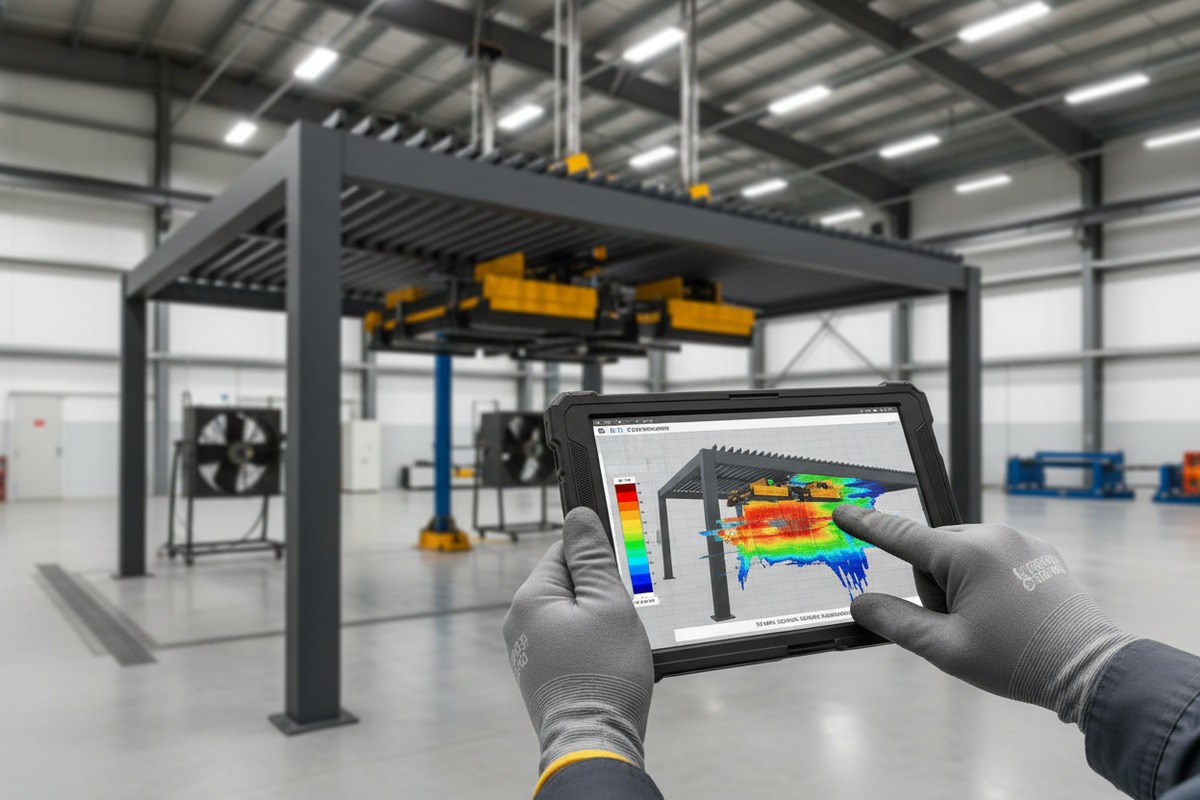
Why Load Ratings Matter More Than You Think
Building codes exist to protect people. In Italy, for example, snow loads in alpine regions can exceed 2.0 kN/m², while coastal areas face wind pressures above 1.5 kN/m². A pergola that looks identical on the outside may have completely different internal reinforcement. Some suppliers cut costs by using thinner aluminum walls—sometimes as thin as 1.2 mm—while advertising "heavy-duty" performance. When a heavy snowfall hits, that structure can buckle.
Our engineering team designs every pergola profile with a minimum wall thickness of 2.0 mm for main beams and 1.5 mm for secondary members. We provide a full static calculation report with each project, and we encourage buyers to share that document with their local structural engineer or building authority.
What Documents Should You Request?
Here is a simple checklist of verification documents:
| Document | What It Proves | Who Issues It |
|---|---|---|
| Structural calculation report | Wind and snow load capacity for specific dimensions | Manufacturer's engineering team or licensed engineer |
| CE marking certificate | Compliance with EU construction product regulations | Notified body or manufacturer's declaration |
| Third-party load test report | Independent verification of stated ratings | Accredited testing laboratory |
| Aluminum alloy certificate | Material grade (e.g., 6063-T5) and actual wall thickness | Aluminum supplier or mill |
How to Cross-Reference With Local Codes
Start by identifying your local wind zone and snow zone. In Europe, Eurocode 1 (EN 1991) 2 defines wind actions, and your national annex adjusts values for your region. Ask your pergola supplier to provide load ratings in kN/m² 3 so you can directly compare them. If the supplier only provides vague terms like "strong" or "heavy-duty" without numbers, treat that as a red flag.
We routinely customize beam dimensions and internal reinforcement for high-load regions. A pergola destined for southern Spain has very different structural needs than one installed in the Austrian Alps. The cost difference for upgraded reinforcement is usually small compared to the risk of failure or code rejection.
The Hidden Risk of Thin Walls
One issue we encounter repeatedly is competitors advertising identical-looking pergolas at lower prices by reducing wall thickness. The exterior dimensions match, but the internal strength does not. A 1.2 mm wall main beam can lose up to 40% of its load-bearing capacity compared to a 2.0 mm wall beam of the same profile. Always request a cross-section drawing 4 with annotated wall thickness before comparing quotes.
Can I customize the pergola dimensions and RAL colors to fit my specific project branding?
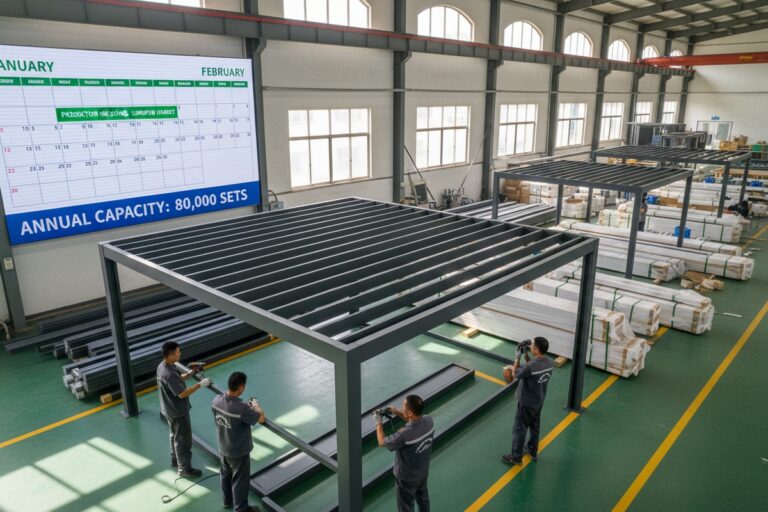
Branding consistency matters to our buyers—especially hotel groups, restaurant chains, and distributors who sell under their own label. From our production floor in Hainan, we handle hundreds of custom orders each year with non-standard sizes and specific RAL color requests.
Yes, reputable manufacturers offer full OEM/ODM customization including non-standard dimensions, specific RAL colors, and private-label branding. Confirm the supplier's minimum order quantity for custom colors, turnaround time for approval drawings, and whether they powder-coat in-house to control quality and lead time.
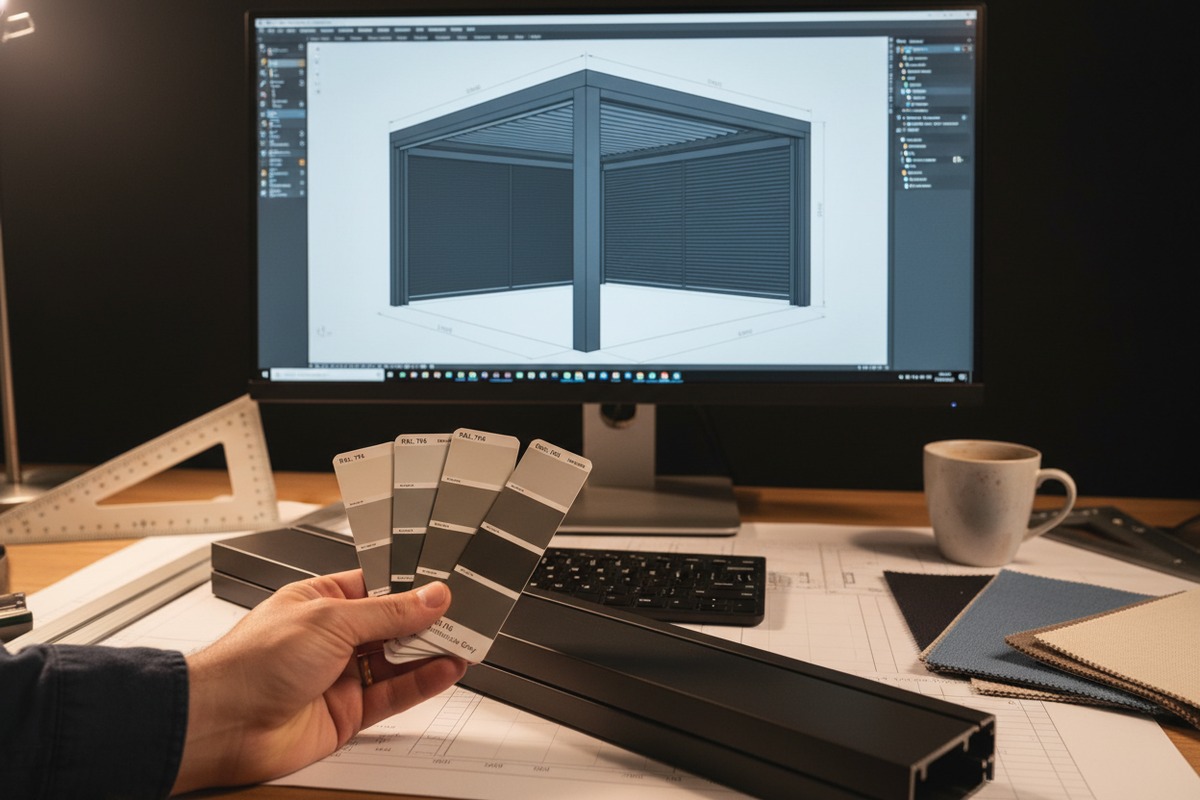
Dimensions: Standard vs. Custom
Most factories stock standard sizes—typically 3×3 m, 3×4 m, 4×4 m, and 4×6 m. Custom dimensions are possible but involve new cutting templates and sometimes new extrusion dies for unique profiles. Here is how the two paths compare:
| Factor | Standard Size | Benutzerdefinierte Größe |
|---|---|---|
| Lead time | 15–20 days | 25–35 days |
| Minimum order | Often 1 set | Typically 5–10 sets |
| Engineering drawing | Pre-approved, ready to ship | Requires new approval drawing and client sign-off |
| Price premium | Base price | 5–15% above base, depending on complexity |
| Structural recalculation | Not needed | Required for non-standard spans |
We provide 3D approval drawings within 3 business days for custom orders. Once you sign off, production begins. This step prevents the costly misunderstandings that happen when dimensions are confirmed only verbally.
RAL Colors and Powder Coating Quality
RAL color matching 5 is standard in our facility. We maintain an in-house powder coating line with a capacity of over 200 sets per week. The process includes chromate-free pretreatment 6, electrostatic powder application, and oven curing at 200°C. This gives a coating thickness of 60–80 microns, which meets the Qualicoat Class 1 standard 7 for outdoor architectural aluminum.
Some buyers ask why they cannot simply repaint in the field. Field painting cannot replicate the adhesion and UV resistance of factory powder coating. If you need a specific RAL shade—say RAL 7016 (anthracite grey) for a hotel project or RAL 9010 (pure white) for a Mediterranean villa—order it from the factory.
Private-Label and Branding Options
For distributors, we offer engraved logos on posts, branded packaging, and custom user manuals with your company name and contact information. This is part of our OEM service. All you need to provide is a vector file of your logo and your preferred manual language. We currently support English, Italian, French, German, Spanish, and Dutch manuals.
A Word on Color Consistency Across Batches
Color consistency is a real concern for large projects or repeat orders. We keep powder samples and batch records for every order. If you reorder six months later, we match against the original batch record to ensure the new shipment looks identical next to the old installation. Ask your supplier how they guarantee color consistency—if they outsource coating, this becomes harder to control.
How do you ensure the packaging prevents shipping damage and that all small components are included?
Damaged goods and missing screws—these two issues have caused more project delays than almost anything else in our industry. After years of refining our packing process, we treat packaging as an engineering problem, not an afterthought.
We prevent shipping damage by wrapping every aluminum profile in EPE foam and placing it inside reinforced plywood crates sized for container loading. A dedicated QC team photographs and inventories every component, including non-standard screws and connectors, using a numbered parts checklist sealed inside each crate.
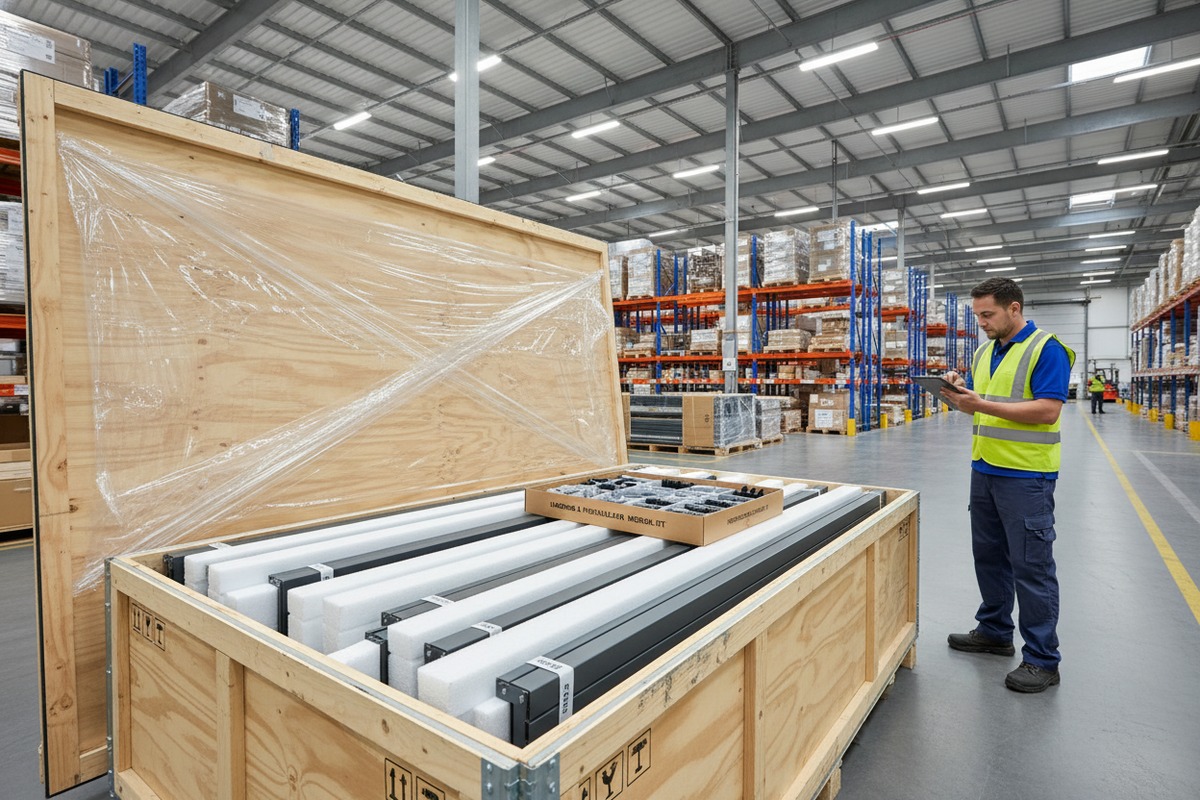
Why Packaging Deserves Serious Attention
Aluminum profiles are strong but not scratch-proof. A single deep scratch on a visible beam means that beam must be replaced—or your end client will reject the entire installation. During ocean freight, containers are stacked, shifted by waves, and exposed to humidity. Profiles can slide inside a poorly packed crate, causing dents and surface damage.
Our packing protocol follows a five-layer system:
- Profile wrapping — Each profile gets individual EPE foam sleeves 8.
- Bundle strapping — Profiles of the same type are bundled together with nylon straps.
- Inner box — Bundles go into cardboard cartons with corner protectors.
- Outer crate — Cartons are loaded into fumigated plywood crates with internal bracing.
- Container loading plan — A loading diagram ensures crates fit tightly, minimizing movement.
The Small Components Problem
Missing a single M8 bolt can halt an installation. In international trade, sending replacement parts after the fact costs time and money far exceeding the value of the missing piece. Our warehouse team uses a bar-coded parts checklist 9 for every order. Each bag of hardware is labeled by assembly step, and a master inventory sheet is photographed and included inside the crate.
| Component Category | Packing Method | Verification Step |
|---|---|---|
| Main beams and posts | Individual EPE foam wrap, plywood crate | Visual inspection + dimensional check |
| Lamellen | Stacked with foam dividers in dedicated carton | Count verification + surface check |
| Screws, bolts, anchors | Labeled zip bags sorted by assembly step | Bar-coded inventory checklist |
| Motors and electronics | Anti-static bags inside cushioned boxes | Function test before packing |
| Rubber seals and gaskets | Sealed plastic bags, stored flat | Material and length verification |
What Happens When Something Goes Wrong
Even with the best packing, things occasionally happen. We include 5% extra of all standard fasteners in every shipment as a buffer. For structural components, we photograph every piece before crating. If a claim arises, we can compare the pre-shipment photos against the damage report and resolve the issue quickly—usually by shipping replacement parts via air express at our cost within 7 days.
Tips for Buyers
Before your first order, ask for packing samples or photos of past shipments. Request the loading plan for your container. And specify in your purchase contract that a numbered parts checklist and pre-shipment photos are mandatory. These small steps eliminate the most common post-delivery headaches.
What installation support and 3D guides do you provide to help my team avoid setup delays?
Nothing frustrates a contractor more than standing on a job site with a pile of parts and a confusing paper manual. Our product development team learned this early, and it changed how we approach every order.
We provide step-by-step 3D animated installation videos, multilingual PDF manuals with exploded-view diagrams, a dedicated technical WhatsApp line for real-time support, and optional on-site training for large orders—all designed to help your crew complete installation correctly on the first attempt.
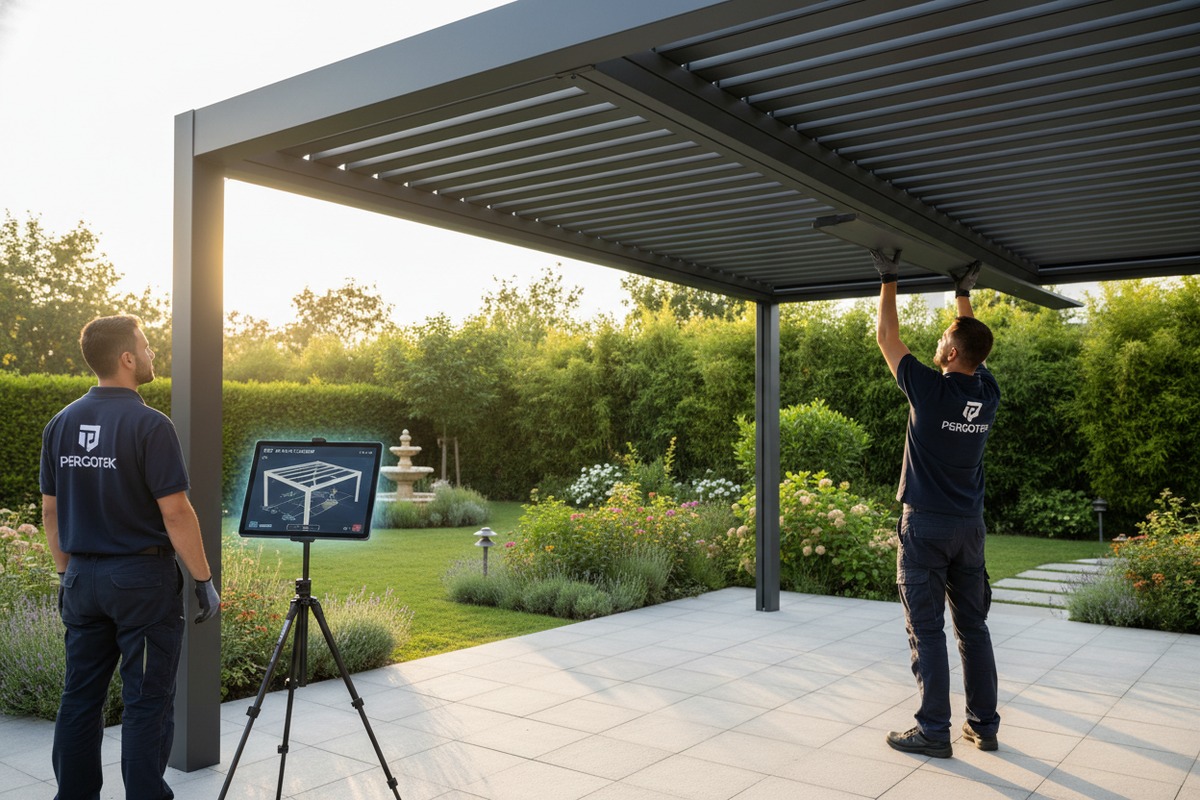
Why Installation Support Is a Competitive Differentiator
An aluminum pergola is not flat-pack furniture. A typical 4×4 m motorized louvered pergola has over 150 individual components, including louver blades, gutter channels, motors, wiring harnesses, brackets, and fasteners. If the installation guide is unclear, errors multiply. A beam mounted upside down, a motor wired incorrectly, or a drainage slope set in the wrong direction can each cause a callback that costs far more than the part itself.
We invest heavily in installation documentation because we know that our product's reputation depends on how it looks and performs after it is installed—not when it leaves our warehouse.
What Our Installation Package Includes
Every order ships with the following support materials:
- 3D animated video — A full assembly walkthrough rendered from our CAD models, showing each step from foundation anchoring to final louver calibration. Videos are hosted online and accessible via QR code printed on the crate.
- Multilingual PDF manual — Available in English, Italian, French, German, Spanish, and Dutch. Each manual uses exploded-view diagrams 10 with numbered callouts matching the labeled hardware bags.
- Foundation template — A printable 1:1 scale drilling template for anchor bolt placement.
- Wiring diagram — For motorized models, a separate electrical schematic showing motor connections, rain sensor placement, and control unit wiring.
- WhatsApp technical line — Our technical support team is available during European business hours via WhatsApp for real-time troubleshooting, including photo and video exchange.
Common Installation Mistakes and How We Prevent Them
| Common Mistake | Consequence | How Our Guides Prevent It |
|---|---|---|
| Incorrect anchor bolt spacing | Posts do not align; structure is unstable | 1:1 printable foundation template included |
| Louver blades installed upside down | Water pools on blades instead of draining | 3D video shows blade orientation with close-up |
| Motor wired with reversed polarity | Louvers open when they should close | Color-coded wiring diagram with labeled connectors |
| Drainage slope set incorrectly | Water overflows gutter during rain | Manual specifies minimum 1% slope with visual guide |
| Sealant omitted at gutter joints | Leaks develop within weeks | Step-by-step sealant application shown in video |
On-Site Training for Large Projects
For orders above 20 sets—common with hotel or resort projects—we offer on-site training. One of our installation engineers travels to the project site to train the local crew on the first two or three installations. After that, the team can complete the remaining units independently. This service has dramatically reduced callback rates for our largest European clients.
Real-Time Remote Support
Even with the best guides, unexpected situations arise. Maybe the mounting surface is not perfectly level, or the electrical supply differs from the specification. Our technical team can join a live video call to assess the situation and recommend a solution on the spot. Response time during European business hours is typically under two hours.
The bottom line is this: installation support is not a bonus feature. It is a core part of the product. A pergola that cannot be installed correctly and efficiently is a liability, not an asset.
Schlussfolgerung
Asking the right questions before you buy an aluminum pergola prevents project delays, compliance failures, and budget overruns. Verify structural loads, confirm customization capabilities, demand proper packaging, and insist on comprehensive installation support.
Fußnoten
1. Explains how Eurocodes are adapted to national conditions. ︎
2. Official European standard for structural design actions. ︎
3. Defines a standard unit for structural load measurement. ︎
4. Illustrates the internal structure and dimensions of an object. ︎
5. Standardized system for defining colors in industry. ︎
6. Environmentally friendly surface preparation for powder coating. ︎
7. Industry standard for quality of architectural powder coatings. ︎
8. Common packaging material for protecting delicate surfaces. ︎
9. System for accurate inventory and component verification. ︎
10. Visual aid for assembly instructions, showing components' relationships. ︎