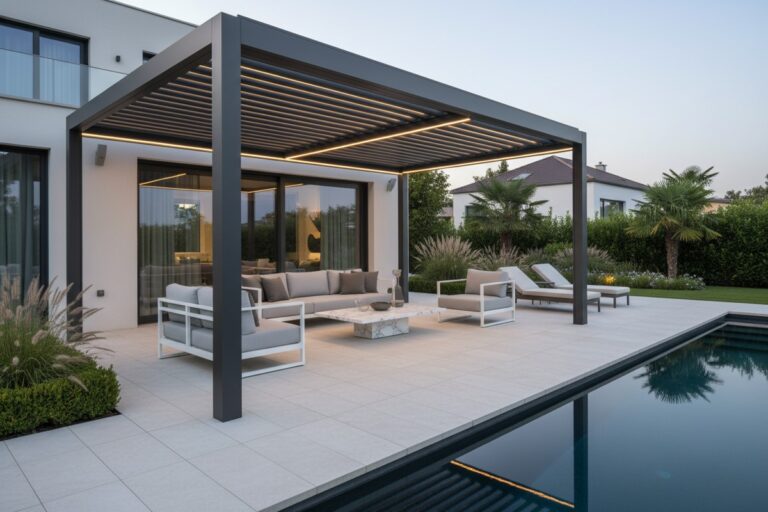

Every year, we see containers of pergolas rejected at European ports because coatings failed within months of coastal installation.
To request European standard salt spray tests when sourcing aluminum pergolas, specify DIN EN ISO 9227 in your RFQ, select the correct variant (NSS, AASS, or CASS), define minimum test hours based on your installation environment, and require third-party lab reports from ISO 17025-accredited facilities before placing production orders.
This guide walks you through each step. You will learn how to write the right test specs, which documents to demand, how to protect your coating investment, and how to build salt spray testing into your OEM quality agreement DIN EN ISO 9227 1. Let's start with the basics.
How do I specify the exact salt spray test hours required for my aluminum pergola order?
When we first started exporting pergolas to Mediterranean markets over a decade ago, specifying "corrosion resistant" in contracts meant almost nothing without hard numbers.
To specify exact salt spray test hours, identify your installation environment (inland, urban, or coastal), choose the correct ISO 9227 variant (NSS for powder coat, CASS for anodized aluminum), and state a minimum hour requirement—typically 500 hours for inland and 1000+ hours for coastal pergola applications—directly in your purchase order.
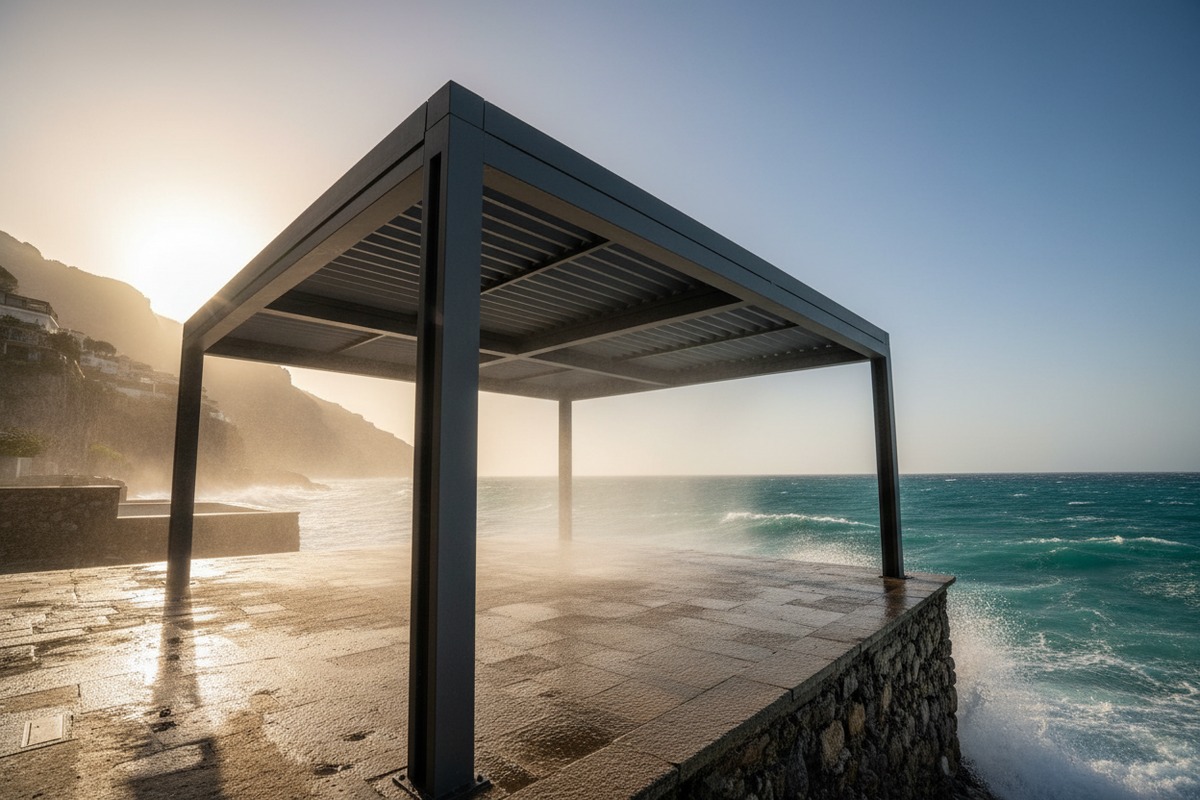
Why Hours Matter More Than Words
Saying "high corrosion resistance" in a contract is vague. A supplier in one region might interpret that as 96 hours of neutral salt spray 2. Another might mean 480 hours. Neither may match what your coastal Italian project actually needs. The fix is simple: write a number.
Our engineering team learned early that the single most important line in any RFQ is the test duration tied to a specific standard. For example: "All aluminum pergola frame components shall pass 720 hours NSS per EN ISO 9227 with no base metal corrosion, blistering, or filiform corrosion 3 beyond 1 mm from scribe."
Understanding the Three ISO 9227 Variants
ISO 9227 is not one test. It contains three distinct methods. Each serves a different purpose.
| Variant | Full Name | Conditions | Best For |
|---|---|---|---|
| NSS | Neutral Salt Spray | 5% NaCl, pH 6.5–7.2, 35°C | Powder-coated aluminum, general coatings |
| AASS | Acetic Acid Salt Spray | Acidified, pH 3.1–3.3, 35°C | Decorative chromium plating, some anodized parts |
| CASS | Copper-Accelerated Acetic Acid Salt Spray | CuCl₂ added, ~50°C, pH 3.1–3.3 | Anodized aluminum, decorative finishes |
For most powder-coated aluminum pergolas—the type we produce in the highest volume—NSS is the standard choice. If your pergola features anodized aluminum louvers or decorative trim, request CASS testing instead. CASS is harsher and specifically designed to stress-test anodized layers.
How to Match Hours to Your Environment
Not every pergola sits by the sea. An inland installation in Bavaria faces very different conditions than a beachfront terrace in Sardinia. Here is a practical guide we share with our European distribution partners:
| Installation Environment | Recommended Test | Minimum Hours | Typical Coating Thickness |
|---|---|---|---|
| Inland, low pollution | NSS | 480–600 | 60–80 µm powder coat |
| Urban, moderate pollution | NSS | 600–720 | 80–100 µm powder coat |
| Coastal, within 1 km of sea | NSS or CASS | 1000+ | 100–120 µm powder coat or 20–30 µm anodize |
| Marine, direct salt exposure | CASS | 1000–2000 | 120+ µm powder coat over chromate pretreatment |
Writing It Into Your RFQ
Here is a template clause you can paste directly into your next purchase order or RFQ:
"Supplier shall provide salt spray test certification per EN ISO 9227 NSS for all powder-coated aluminum components. Minimum test duration: 1000 hours. Acceptance criteria: no base metal corrosion, no blistering greater than rating 2 per ISO 4628 4-2, and no filiform corrosion exceeding 1 mm from X-scribe. Test samples must be production-representative, including welded joints and fastener holes. Reports from ISO 17025-accredited laboratories 5 only."
This kind of precision eliminates ambiguity. It also tells your supplier you understand the standard, which immediately raises the quality of the conversation.
A Note on Cost
Salt spray testing is not free. Lab fees typically run €100–500 per day of chamber operation per sample set. A 1000-hour test can cost €1,500–2,500. But compare that to a single rejected container of pergolas worth €40,000 or more. The math is clear. Testing is insurance.
What European certification documents should I demand to verify my supplier's corrosion resistance claims?
In our years supplying European contractors, we have seen suppliers present everything from handwritten notes to professional-looking PDFs that turned out to be fabricated. Knowing which documents are legitimate is critical.
Demand an ISO 9227 test report from an ISO 17025-accredited laboratory, a CE Declaration of Conformity where applicable, material certificates (EN 10204 Type 3.1), powder coating batch test reports per Qualicoat or GSB standards, and a supplier quality agreement specifying testing frequency and sample selection methods.

The Core Documents You Need
When we prepare export documentation for our European partners, we provide a standardized package. You should expect no less from any supplier.
1. ISO 9227 Salt Spray Test Report
This is the centerpiece. A valid report must include:
- The accredited lab's name, address, and ISO 17025 accreditation number
- Test variant used (NSS, AASS, or CASS)
- Exact test parameters: salt concentration, pH, temperature, collection rate
- Sample description, including coating type and measured thickness
- Duration of exposure
- Photographic evidence of samples before and after testing
- Evaluation results referencing ISO 4628 (for blistering, rusting, cracking, flaking)
If a supplier hands you a one-page summary without photos or parameter details, push back.
2. Material Test Certificates (EN 10204 Type 3.1)
These confirm the aluminum alloy grade (e.g., 6063-T5 or 6061-T6) and chemical composition. A Type 3.1 certificate is issued by the material producer and validated by an independent inspector. EN 10204 Type 3.1 6 It proves the raw aluminum meets the mechanical and chemical specifications you agreed on.
3. Coating Certification: Qualicoat or GSB
For powder-coated pergolas targeting the European market, the two leading quality labels are Qualicoat (based in Zurich) and GSB (based in Germany). Qualicoat or GSB standards 7 Both require:
- Approved powder coating suppliers
- Regular salt spray testing of production samples
- Adhesion tests, hardness tests, and gloss retention checks
- Annual audits of the coating facility
If your supplier holds a Qualicoat Seaside license, that is the highest tier for coastal applications. It mandates 1000+ hours NSS on coated aluminum.
4. CE Declaration of Conformity
While CE marking for pergolas relates more to structural calculations under the Construction Products Regulation (CPR) and EN 1090 for steel/aluminum structures, having it confirms the supplier understands EU market access requirements. CE Declaration of Conformity 8 Always ask for the Declaration of Performance (DoP) alongside the CE mark.
Red Flags in Supplier Documentation
| Red Flag | What It Means | What to Do |
|---|---|---|
| No lab accreditation number on test report | Report may be from an unaccredited facility | Request ISO 17025 lab certificate |
| Test hours below your specification | Supplier tested to a lower standard | Reject and request retest at correct duration |
| Photos show no scribe marks on samples | Critical failure mode (filiform corrosion) was not evaluated | Require X-scribed samples per ISO 9227 |
| Generic "passed" without ISO 4628 ratings | No objective evaluation criteria applied | Request detailed evaluation per ISO 4628-2 through 4628-6 |
| Certificate date is over 2 years old | Coating process may have changed | Request current batch testing |
Third-Party Verification
For high-value orders—or the first order from a new supplier—consider sending your own samples to an independent European lab. Labs like TÜV Rheinland, SGS, or Bureau Veritas offer ISO 9227 testing with full reporting. This costs more but eliminates any doubt. Our own clients in Italy and Germany frequently request this, and we welcome it because it builds trust.
How can I ensure the powder coating on my pergolas will withstand harsh coastal environments?
On our production line, we have tested dozens of powder coating formulations over 25 years. The difference between a coating that survives five years on the coast and one that fails in eighteen months often comes down to three things: pretreatment, powder quality, and film thickness.
To ensure coastal durability, require a multi-stage chromate-free pretreatment process, specify Qualicoat Seaside or GSB Master-approved polyester powder coatings at 100–120 µm minimum dry film thickness, and mandate 1000+ hours NSS or CASS testing on production-representative scribed samples before shipment.
Pretreatment Is the Foundation
The powder coat itself is only as good as the surface it bonds to. A poorly pretreated aluminum surface will allow moisture to creep under the coating, causing blistering and filiform corrosion—even if the powder is excellent.
Modern pretreatment for coastal aluminum follows a multi-step process:
- Alkaline degreasing to remove oils and residues
- Acid etching to create a micro-rough surface profile
- Chromate-free conversion coating (e.g., zirconium or titanium-based) to form a chemical bond layer
- Deionized water rinse to eliminate contaminants
- Drying at controlled temperature before powder application
We switched to chromate-free pretreatment several years ago to comply with REACH regulations 9. The performance matches or exceeds traditional chromate systems when properly controlled.
Powder Selection: Not All Polyester Is Equal
Standard polyester powder coatings work fine for inland pergolas. But coastal installations demand super-durable polyester or fluoropolymer-enhanced formulations. Here is a comparison:
| Coating Type | UV Resistance | Salt Spray Performance (NSS) | Relative Cost | Best For |
|---|---|---|---|---|
| Standard polyester | Moderate (3–5 years gloss retention) | 480–720 hours | Low | Inland, covered installations |
| Super-durable polyester | High (8–10 years gloss retention) | 720–1000 hours | Medium | Urban, semi-exposed |
| PVDF/Kynar 70/30 blend | Excellent (15+ years) | 1000–2000 hours | High | Coastal, direct marine exposure |
| Qualicoat Seaside approved | High to excellent | 1000+ hours mandatory | Medium–High | Any coastal European project |
When writing your specification, name the coating standard. For example: "Powder coating shall be Qualicoat Class 2, Seaside approved, super-durable polyester at minimum 100 µm DFT." This removes all guesswork.
Film Thickness: The Hidden Variable
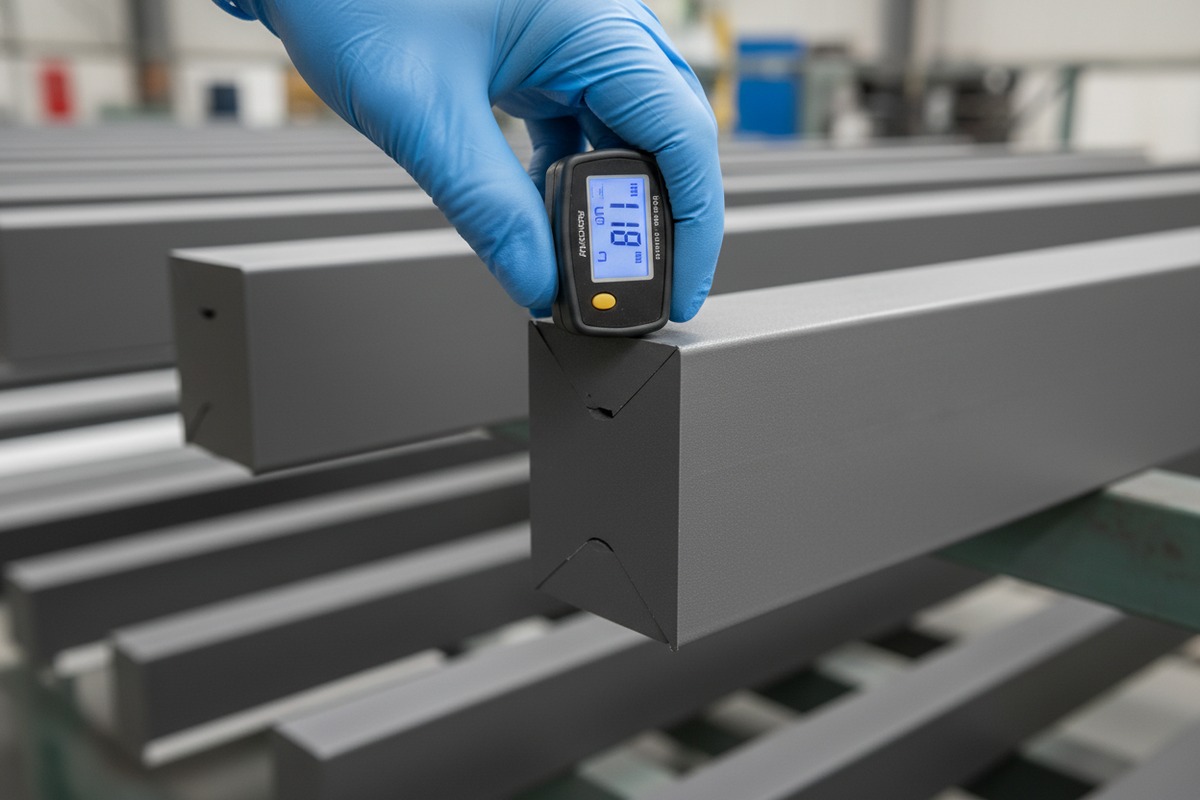
We measure dry film thickness 10 (DFT) on every batch using calibrated gauges. The target range for coastal pergolas is 100–120 µm. Below 80 µm, salt spray resistance drops sharply. Above 140 µm, the coating becomes brittle and may crack during thermal cycling.
Ask your supplier for DFT measurement records. A responsible manufacturer measures at multiple points on each profile—flat surfaces, inside corners, and edges. Edges are the weakest link because powder naturally thins at sharp corners. Our profiles use radiused edges (minimum 0.5 mm radius) to ensure adequate coverage.
Combining Salt Spray with Real-World Simulation
Salt spray testing alone has limits. It simulates constant salt fog, but real coastal environments cycle between wet, dry, hot, and UV-exposed conditions. Progressive buyers now request combined testing:
- ISO 9227 NSS or CASS for baseline corrosion resistance
- ISO 16474 (xenon arc weathering) for UV and moisture cycling
- ISO 6270 (humidity testing) for condensation resistance
This trio gives you the most complete picture of how your pergola coating will actually perform over a 10–20 year service life. We can arrange all three through our partner labs and include them in the quality documentation package.
What steps should I take to include salt spray testing in my OEM quality control agreement?
During contract negotiations with our European distributors, the quality control agreement is where we define exactly what gets tested, how often, and who pays. Getting this right upfront prevents every dispute later.
To include salt spray testing in your OEM quality agreement, define the test standard (EN ISO 9227), specify test variant and hours, set sample selection rules (random production samples with welds and fasteners), require ISO 17025-accredited lab reports before each shipment, and establish clear fail criteria with remedies including rework, re-coating, or order rejection.

Building the Quality Agreement Step by Step
A quality control agreement (QCA) is a binding document between buyer and supplier. It sits alongside your purchase order and defines measurable quality expectations. Here is how to structure the salt spray testing section.
Step 1: Define the Scope
State which components are covered. For a louvered aluminum pergola, this typically includes:
- Main frame posts (square-profile columns)
- Horizontal beams and crossbars
- Louver blades (both fixed and adjustable)
- Brackets, clips, and hardware
- Any welded or mechanically joined assemblies
Each of these has different coating challenges. Louver blades have thin edges. Welded joints have heat-affected zones where coating adhesion may weaken. Your QCA should explicitly require test samples from each category.
Step 2: Set Testing Frequency
Testing every single piece is impossible. Instead, define a statistical sampling plan. Here is what we use and recommend:
| Production Batch Size | Minimum Test Samples | Testing Trigger |
|---|---|---|
| 1–500 pieces | 3 samples per component type | Every new order or color change |
| 501–2000 pieces | 5 samples per component type | Every 500 pieces or weekly |
| 2000+ pieces | 8 samples per component type | Every 1000 pieces or bi-weekly |
| New coating supplier or formula change | 5 samples minimum | Mandatory before production release |
Step 3: Specify Sample Preparation
This is where many agreements fail. If your supplier tests only flat panels cut from scrap, the results will not reflect real-world performance on complex pergola profiles. Require:
- Samples cut from actual production profiles (not lab panels)
- Inclusion of at least one welded joint per sample set
- Inclusion of at least one drilled/punched fastener hole
- X-scribe marks (two intersecting cuts through the coating to bare metal) for filiform and creep evaluation
- Measured and recorded DFT on each sample before chamber exposure
Step 4: Define Pass/Fail Criteria
Use objective metrics. Reference ISO 4628 for evaluation:
- Blistering: Maximum rating 2 (few, small blisters) per ISO 4628-2
- Rusting: Maximum Ri 0 (no rust) per ISO 4628-3
- Cracking: Maximum rating 1 per ISO 4628-4
- Filiform corrosion from scribe: Maximum 1 mm creep per ISO 4628-10
- Adhesion post-test: Minimum Gt 1 per ISO 2409 cross-cut test
Step 5: Establish Remedies for Failure
Your agreement must state what happens when samples fail. Options include:
- Rework and retest: Supplier strips and re-coats the affected batch at their cost, then retests
- Batch rejection: Buyer has the right to reject the entire batch represented by the failed samples
- Financial penalty: A percentage deduction (e.g., 5–10%) for marginal failures that do not warrant full rejection
- Order cancellation: For repeated or severe failures, buyer may cancel remaining orders without penalty
Step 6: Witness Testing Rights
Reserve the right to witness salt spray tests in person or via live video. We offer this to all our clients. It builds confidence, especially during the first order cycle. Some buyers also send a third-party inspector (SGS, Bureau Veritas, TÜV) to supervise sample selection and chamber loading.
Step 7: Digital Reporting and Traceability
Modern labs provide digital reports with timestamped photographs at intervals (e.g., every 24 or 48 hours of exposure). Require these in your QCA. They create a complete visual record of how corrosion progressed—or did not—over the test duration. We archive all test data linked to batch numbers so any pergola installed in Europe can be traced back to its specific salt spray certification.
Conclusion
Requesting European standard salt spray tests is not complicated once you know the right standards, documents, and contract language. Use this guide as your sourcing playbook, and protect every pergola you import.
Footnotes
1. Official standard for salt spray tests. ↩︎
2. Explains the specific NSS test method. ↩︎
3. Describes a specific type of localized corrosion. ↩︎
4. Replaced HTTP 404 link with an authoritative introduction to the ISO 4628 series for evaluating coating degradation from BSI. ↩︎
5. Standard for competence of testing and calibration labs. ↩︎
6. Standard for inspection documents for metallic products. ↩︎
7. Industry standards for coating quality. ↩︎
8. Official EU document declaring product compliance. ↩︎
9. European regulation on chemicals. ↩︎
10. Explains the concept of coating thickness. ↩︎