Every hour spent wrestling with heavy beams or mismatched parts on a job site costs real money—and after 25 years running our production lines, we have seen how the right pergola design 1 can cut that pain in half.
Aluminum pergolas simplify contractor installation through pre-drilled and pre-cut modular components, lightweight frames, hidden fastener systems, factory-applied powder coating, organized labeled hardware kits, professional 3D installation videos, and custom sizing that eliminates risky on-site cutting and modifications.
Below, we break down the exact features that save your crew time, reduce errors, and keep projects on schedule. Each section answers a real question contractors ask us every week.
How do pre-drilled components and modular designs reduce my on-site assembly time?
When our engineering team designs a new pergola system, the goal is always the same: fewer field decisions, faster assembly, and zero return trips for missing parts.
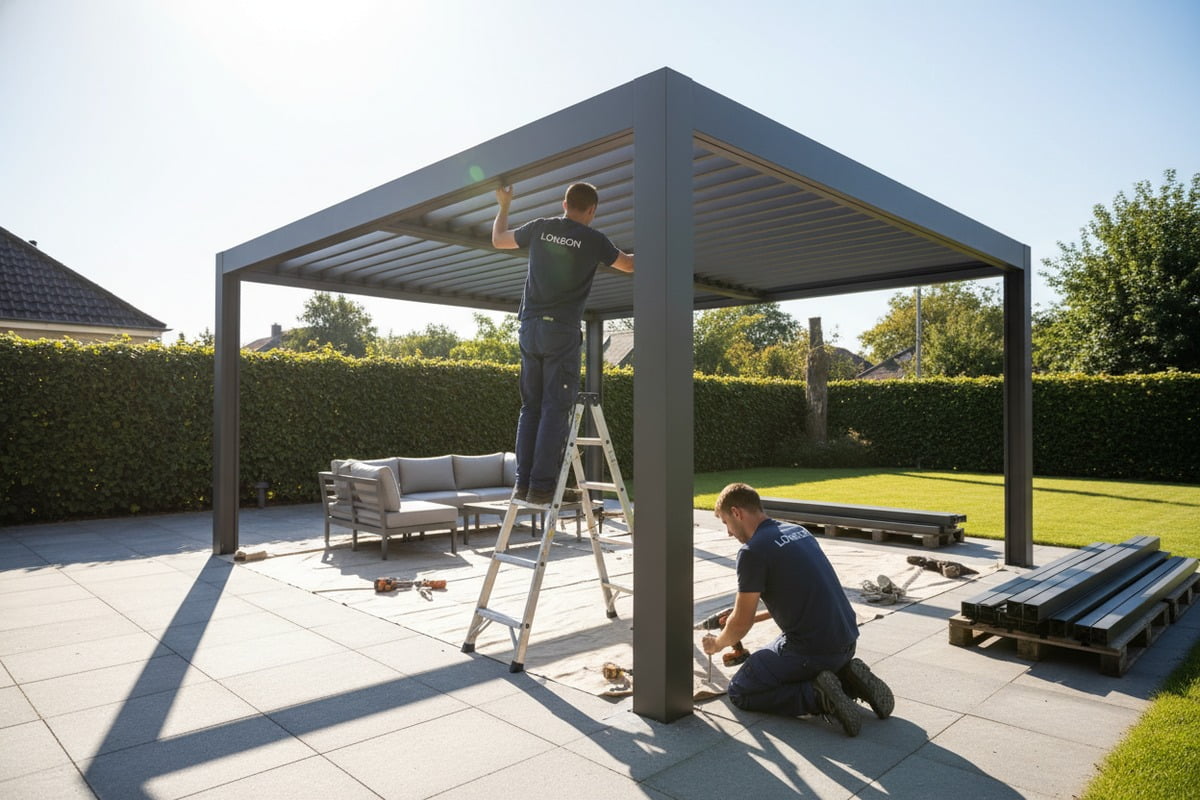
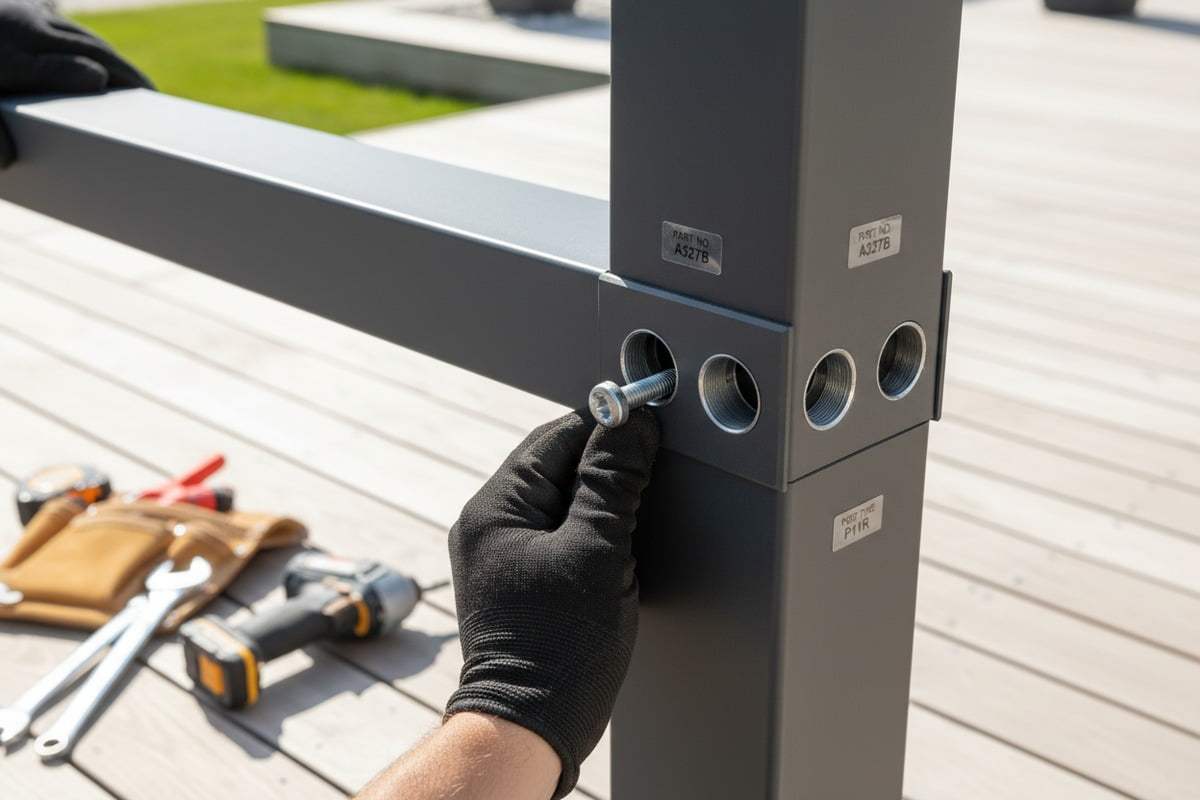
Pre-drilled components and modular designs reduce on-site assembly time by eliminating measuring, cutting, and drilling at the job site. Contractors simply align labeled parts, insert fasteners into factory-machined holes, and connect modular sections in sequence—often cutting total labor time by 40–60 percent.
Why Pre-Drilled Holes Matter More Than You Think
On a traditional wood pergola job, your crew spends significant time measuring, marking, and drilling. Each hole is a chance for error. A misaligned hole means re-drilling, shimming, or replacing an entire beam. With pre-drilled aluminum components, every hole is CNC-machined 2 at the factory to tolerances within 0.5 mm. That precision means parts align on the first attempt.
We have tracked feedback from contractors across Europe, and the pattern is clear. Projects that use pre-drilled kits report fewer callbacks and fewer on-site adjustments. The math is simple: less drilling equals less dust, less noise, and less risk of damaging a client's patio or deck surface.
How Modular Design Changes the Workflow
Modular pergola systems 3 break the structure into repeatable sections. Posts, beams, rafters, and louver panels each connect through standardized joints. This approach has three main benefits:
- Parallel work. Two crew members can assemble different modules at the same time.
- Staged delivery. On tight sites, you can bring modules in one at a time instead of stockpiling every piece.
- Future expansion. If the client wants to extend the pergola later, modular bays bolt on without re-engineering the original structure.
Time Comparison: Pre-Drilled Modular vs. Traditional Build
| Task | Traditional Wood Pergola | Pre-Drilled Aluminum Modular Kit |
|---|---|---|
| Measuring and marking | 2–3 hours | 0 hours (factory done) |
| Drilling holes on site | 1.5–2 hours | 0 hours (pre-drilled) |
| Cutting beams to length | 1–2 hours | 0 hours (pre-cut) |
| Frame assembly | 4–6 hours | 2–3 hours |
| Finishing (paint/stain) | 3–5 hours | 0 hours (powder coated) |
| Total estimated labor | 11.5–18 hours | 2–3 hours |
These numbers assume a standard 3 m × 4 m freestanding pergola with a two-person crew. Real times vary with site conditions, but the ratio stays consistent.
Snap-Fit and Interlocking Connections
The best modular systems go beyond basic bolt connections. Our product lines include interlocking channel joints that slide together and lock with a single pin or set screw. This removes the need for specialized tools. A standard Allen key and a rubber mallet handle most of the assembly. Contractors tell us this is the single feature that makes the biggest difference when training new crew members.
Hidden Fasteners Save Finishing Time
Exposed screws require countersinking, capping, or touch-up paint. Hidden fastener systems 4 use internal brackets, T-slot channels, or concealed clips. The result is a cleaner appearance and zero post-assembly cosmetic work. For mid-to-high-end residential and hospitality projects, this detail matters to the end client—and it keeps your crew from spending an extra hour on finishing.
Can I access professional 3D installation videos and multilingual manuals to guide my team?
One of the most common complaints we hear from purchasing managers in Europe is this: "The product was fine, but my installer had no idea how to put it together because the manual was in Chinese only."
Yes—reputable aluminum pergola manufacturers now provide professional 3D installation videos, step-by-step multilingual manuals, and even QR-code-linked augmented reality guides. These resources reduce installation errors, speed up crew training, and eliminate costly miscommunication on international projects.
Why Installation Guides Are a Make-or-Break Feature
A beautifully engineered pergola kit is useless if the installer cannot follow the assembly sequence. This is especially true in B2B international trade, where the crew on site may speak Italian, German, French, or Dutch—not English or Chinese. Poor guides lead to three expensive problems:
- Wrong assembly sequence. Installing a louver panel before the gutter channel is in place can mean disassembling half the roof.
- Damaged parts. Forcing a connection that should slide freely because the manual was unclear often bends or scratches profiles.
- Delayed projects. When a crew stops work to call the supplier across time zones, the project loses a full day or more.
What Good Installation Support Looks Like
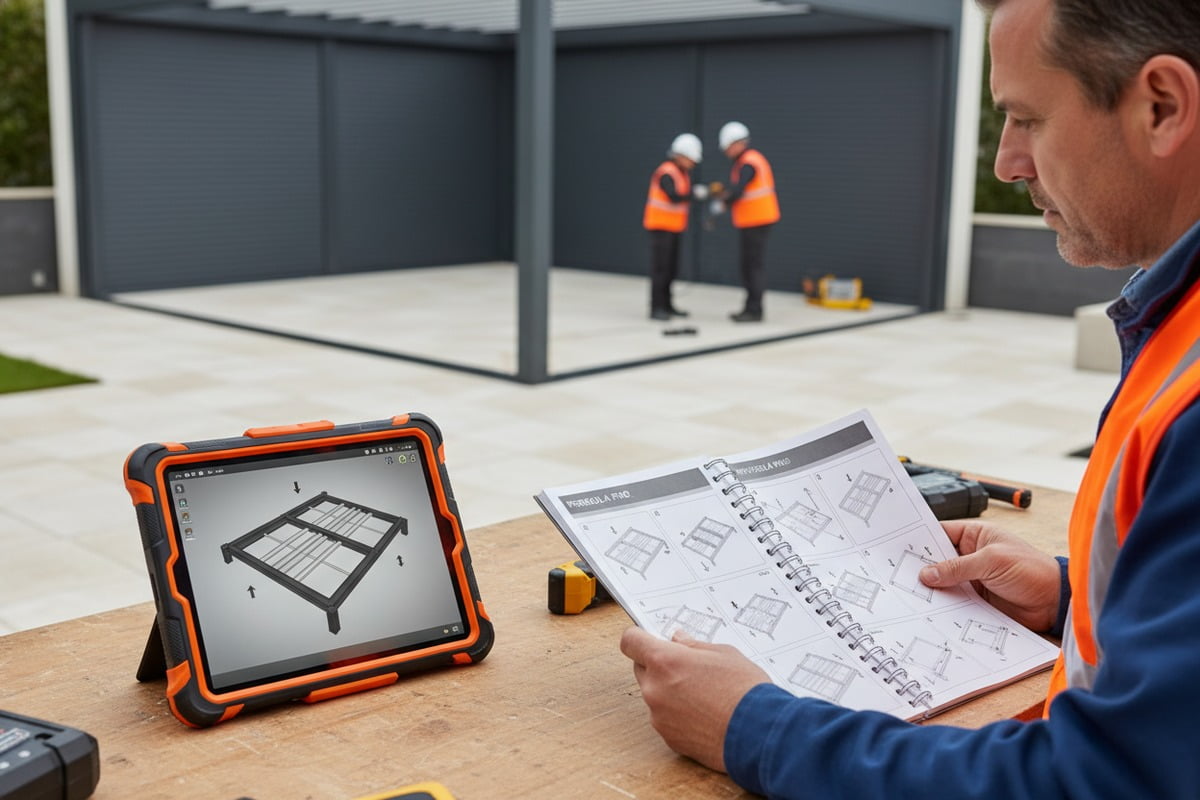
At our facility, we produce 3D animated videos 6 for every product line. These videos show each step from multiple camera angles, with numbered parts matching the labels on the actual hardware bags. We also provide printed manuals in English, Italian, German, French, and Spanish as standard. Other languages are available on request.
More recently, we have added QR codes 7 to packaging. Scanning the code opens the video directly on a phone or tablet. This means the installer does not need to search for files or download anything in advance.
Comparing Installation Support Levels
| Support Feature | Basic Supplier | Mid-Level Supplier | Premium Supplier (Our Standard) |
|---|---|---|---|
| Printed manual | Single language only | English + 1 other | 5+ languages |
| Assembly diagrams | 2D line drawings | 2D exploded views | Full 3D rendered views |
| Video guide | None | Basic slideshow | Professional 3D animation |
| QR code access | No | Sometimes | Yes, on every package |
| AR overlay guide | No | No | Available for select models |
| Dedicated tech support | Email only, slow | Email + phone | Rapid response via WhatsApp/video call |
Augmented Reality: The Next Step
Some of our newer models support AR installation guides 8. The installer scans a QR code, points the phone camera at the pergola frame, and sees a digital overlay showing exactly where the next part goes. This technology is still emerging, but early feedback from contractors in Italy and Germany has been very positive. It cuts the learning curve for new installers dramatically.
The Real Cost of Bad Manuals
Consider this scenario: a contractor in Milan receives a pergola shipment on Monday. The manual is only in Chinese. The crew guesses at the assembly order, installs the side screen tracks before the drainage channel, and has to disassemble the entire left wall on Tuesday. That mistake costs 8 hours of labor—roughly €400–€600 depending on the market. A clear multilingual manual would have prevented the error entirely.
We invest in professional documentation because we know it protects our partners' margins. Every euro saved on rework is a euro that stays in the contractor's pocket.
How does organized packaging and labeled hardware prevent delays during my project installation?
When we ship 80,000 pergola sets per year across Europe, we have learned that a missing bolt or an unlabeled bag can halt an entire installation. Packaging is not glamorous, but it is one of the most important installation features.
Organized packaging with individually labeled hardware bags, numbered component bundles, and protective wrapping prevents installation delays by ensuring every part arrives intact, identifiable, and in the correct assembly sequence—eliminating time wasted searching, sorting, and replacing missing items.
The Hidden Cost of Poor Packaging
Aluminum profiles 9 are lightweight but long. They scratch easily during transit. A single deformed extrusion can delay a project by weeks if the replacement must ship from China. That is why our packing process includes:
- EPE foam wraps around every profile to prevent surface scratches.
- Corner protectors on all beams and posts.
- Cardboard separators between louver blades.
- Shrink-wrapped pallets for sea freight stability.
But protection is only half the story. Organization is the other half.
How Labeled Hardware Eliminates Guesswork
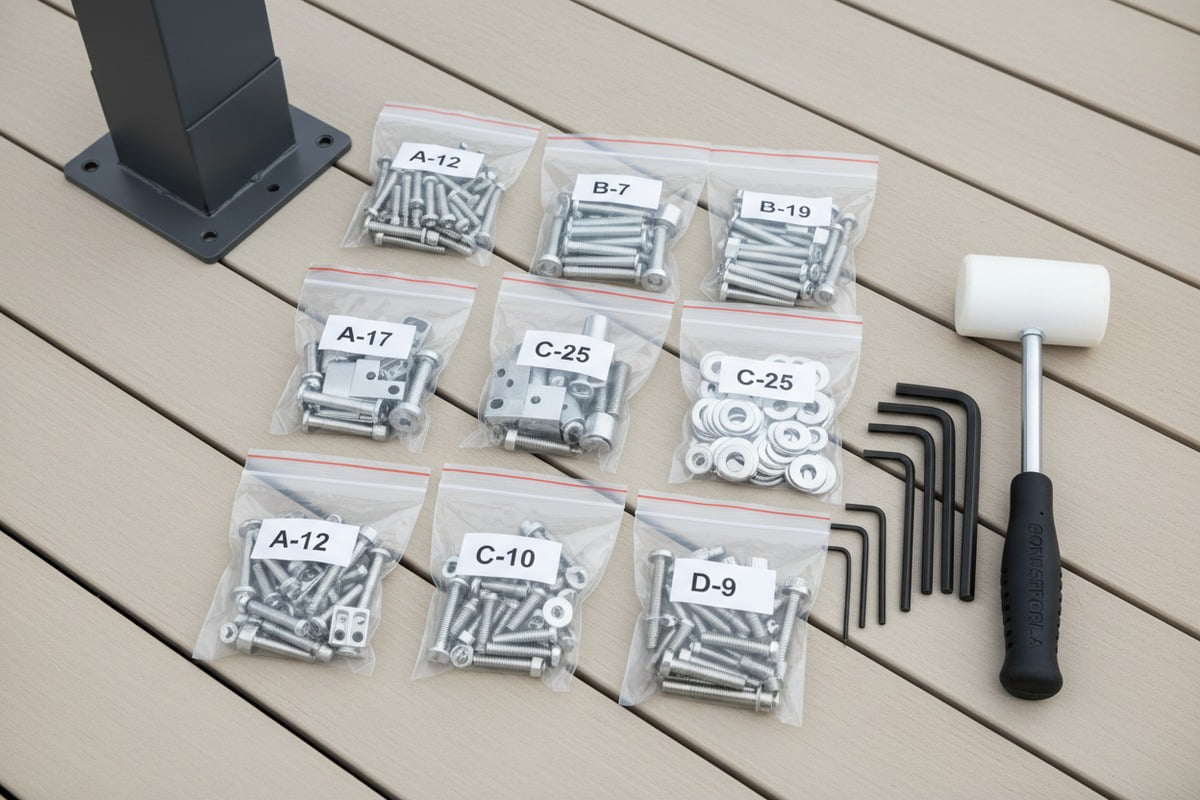
Each pergola kit we ship includes multiple bags of hardware—bolts, screws, brackets, rubber gaskets, drainage connectors, and motor cables. If these arrive in one large bag, the installer spends 30–60 minutes just sorting. We label every bag with a part number that matches the installation manual and video. The bags are packed in assembly sequence order, so the first bag you open contains the parts for step one.
Packaging Organization Breakdown
| Packaging Element | Purpose | Time Saved On Site |
|---|---|---|
| Numbered hardware bags | Match parts to manual steps | 30–60 min per project |
| Color-coded labels | Distinguish left/right or front/back parts | 15–20 min per project |
| Pre-counted fastener packs | Eliminate counting and re-ordering | 10–15 min per project |
| Spare parts bag | Cover minor losses or damage in transit | Prevents 1–2 day delay |
| Protective foam wrapping | Prevent profile scratches and dents | Avoids replacement orders |
| Assembly sequence packing | Parts unpacked in build order | 20–30 min per project |
Why Spare Parts Matter
We include a small bag of spare fasteners and gaskets in every shipment. This is a low-cost addition that prevents a high-cost problem. If one screw strips or one gasket falls into a gap, the installer does not need to stop work and source a replacement locally. For international projects, finding a matching M6 stainless steel flanged bolt at a local hardware store in rural Italy is not always easy.
Preventing Damage During Long-Distance Shipping
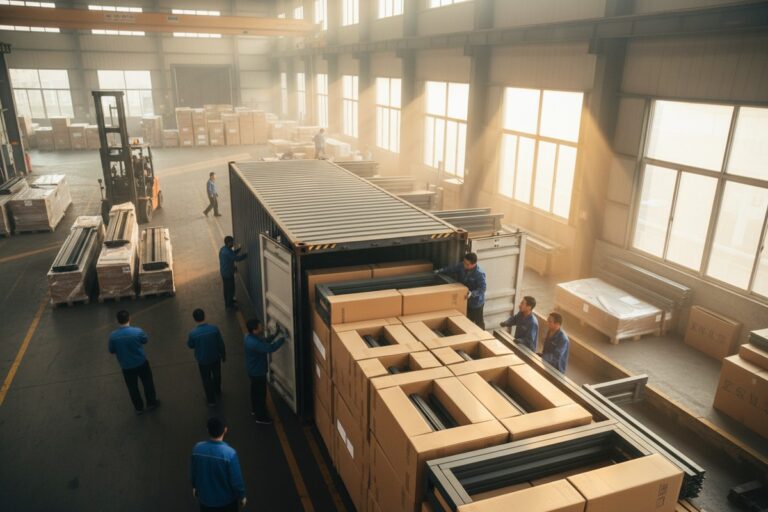
Sea freight from China to Europe takes 25–35 days. Containers shift, vibrate, and experience temperature changes. Our packaging engineering team tests every packing configuration with simulated vibration and drop tests. We also photograph each packed pallet before sealing the container. This documentation helps resolve any damage claims quickly and gives our partners confidence that we take transit protection seriously.
The Contractor's Unboxing Experience
Think of the installation starting from the moment the truck arrives. If the crew opens the packaging and finds everything labeled, protected, and organized, they can begin assembly within 15 minutes. If they open the packaging and find loose parts in a jumble, the first hour is wasted. That first-hour experience sets the tone for the entire project. We treat packaging as the first step of installation, not the last step of shipping.
Will choosing custom-sized pergolas eliminate the need for my contractors to perform risky on-site modifications?
Our OEM/ODM team processes hundreds of custom size requests every month. The question behind this question is really about risk: what happens when a standard-size pergola does not fit the job site?
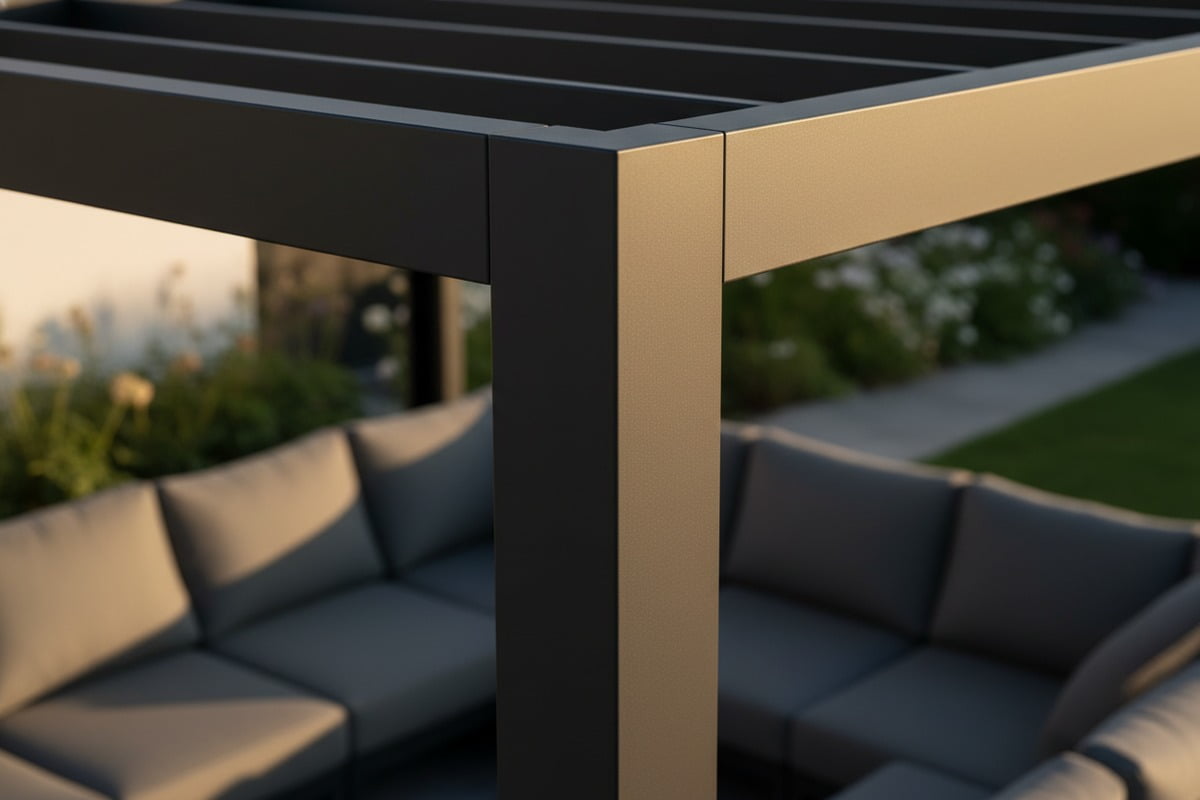
Yes—ordering custom-sized pergolas engineered to exact project dimensions eliminates dangerous and time-consuming on-site cutting, grinding, and drilling of aluminum profiles. Factory customization ensures proper structural integrity, clean finishes, and code-compliant load ratings that field modifications cannot guarantee.
The Problem with On-Site Cutting of Aluminum
Unlike wood, aluminum does not forgive rough cuts. Cutting aluminum profiles on site creates several problems:
- Burrs and sharp edges that require deburring tools and extra labor.
- Exposed raw aluminum at cut ends that will not match the powder-coated finish.
- Compromised drainage channels if internal gutters are cut incorrectly.
- Voided warranties because the manufacturer cannot guarantee structural performance of field-modified parts.
- Safety risks from metal shavings near client furniture, pools, or landscaping.
When a contractor cuts a pre-engineered beam to fit a non-standard opening, they also remove material that may be load-bearing. This is especially critical in regions with high wind or snow load requirements.
How Factory Customization Works
When our partners submit a project with non-standard dimensions, our process follows these steps:
- Site measurements provided by the contractor (we offer measurement templates).
- CAD drawing review within 48 hours, showing the custom layout with all connection points.
- Structural calculation to confirm wind and snow load compliance at the new dimensions.
- CNC cutting and drilling at the factory to exact specifications.
- Powder coating of all cut ends so the finish is seamless.
- Test assembly of critical joints before packing.
This process adds a few days to production, but it removes hours of risky work from the job site. For projects in the commonly estimated range of $30–$60 per square foot, the cost of factory customization is a small fraction of the total project value.
Custom vs. Standard: Risk Comparison
| Factor | Standard Size (Field Modified) | Custom Factory Size |
|---|---|---|
| Structural integrity | Compromised at cut points | Fully engineered |
| Finish quality | Raw ends visible | Full powder coat coverage |
| Drainage function | May be damaged by cuts | Channels intact and sealed |
| Warranty status | Often voided | Fully covered |
| Installation time | Adds 2–4 hours for cutting/fitting | No extra time needed |
| Safety on site | Metal shavings, sharp edges | Clean, deburred parts |
| Load rating documentation | Not available for modified parts | Provided with delivery |
When Custom Sizing Is Essential
Some situations absolutely require custom dimensions:
- Wall-mounted pergolas where the span must match the exact distance between architectural features.
- L-shaped or irregular patios that cannot accommodate rectangular standard kits.
- Rooftop installations with specific setback requirements.
- Commercial projects where the pergola must align with existing columns, doorways, or signage.
- Sloped sites where post heights must vary to create a level roof plane.
The 30-Day Delivery Advantage
One concern contractors have about custom sizing is lead time. A custom order that takes 90 days defeats the purpose of simplifying installation. Our production line delivers custom-sized pergolas within 30 days, including structural calculations and full powder coating 10. This rapid turnaround means contractors can order custom dimensions without blowing their project schedule.
Code Compliance and Engineering Documents
For European markets, contractors often need documentation proving the pergola meets local wind and snow load codes. Standard kits come with generic engineering data, but a custom-sized pergola needs calculations specific to its dimensions. We provide these documents as part of every custom order, which saves the contractor from hiring a separate structural engineer.
The bottom line is straightforward. Factory customization costs a little more upfront but eliminates the most dangerous, time-consuming, and warranty-voiding work that contractors face on non-standard installations.
Conclusion
The aluminum pergola features that truly simplify contractor installation are pre-drilled modular components, professional multilingual guides, organized labeled packaging, and factory-customized sizing—each one reducing labor, risk, and costly rework on every project.
Footnotes
1. Provides a comprehensive guide to pergola design principles and considerations. ↩︎
2. Explains the automated control of machine tools by a computer in manufacturing. ↩︎
3. Details the advantages of modular construction, including efficiency and quality control. ↩︎
4. Explains different types of hidden fasteners and their applications in construction. ↩︎
5. Explains the types of loads, including environmental loads like wind and snow, that structures must withstand. ↩︎
6. Defines technical 3D animation and its applications for visualizing complex processes. ↩︎
7. Provides a comprehensive overview of QR code technology, history, and diverse applications. ↩︎
8. Explores the use of augmented reality to streamline construction processes and improve efficiency. ↩︎
9. Describes various types of aluminum extrusion profiles and their applications. ↩︎
10. Highlights the numerous advantages of powder coating, including durability and environmental benefits. ↩︎