
Every week, our sales team fields dozens of inquiries from European distributors asking the same question — which pergola styles and sizes actually sell well across the EU bioclimatic louvered designs 1? Getting the answer wrong means dead stock, wasted container space, and frustrated partners.
To find popular aluminum pergola styles and sizes for Europe, research bioclimatic louvered designs, wall-mounted and freestanding configurations, and standard widths from 3 to 7 meters. Cross-reference trending features like motorized louvers, integrated LED lighting, and RAL color options with CE compliance data and regional climate demands.
This guide breaks down the styles, sizes, compliance requirements, and sourcing strategies that matter most for the European pergola market integrated LED lighting 2. Each section draws from our 25 years of manufacturing and exporting experience. Let's dig in.
How do I identify which aluminum pergola styles are currently trending in the European market?
Tracking European style trends from our factory floor gives us a unique vantage point RAL color options 3. We see order patterns shift season by season, and right now, certain designs clearly dominate the production queue. Ignoring these trends means missing the biggest share of buyer demand CE compliance data 4.
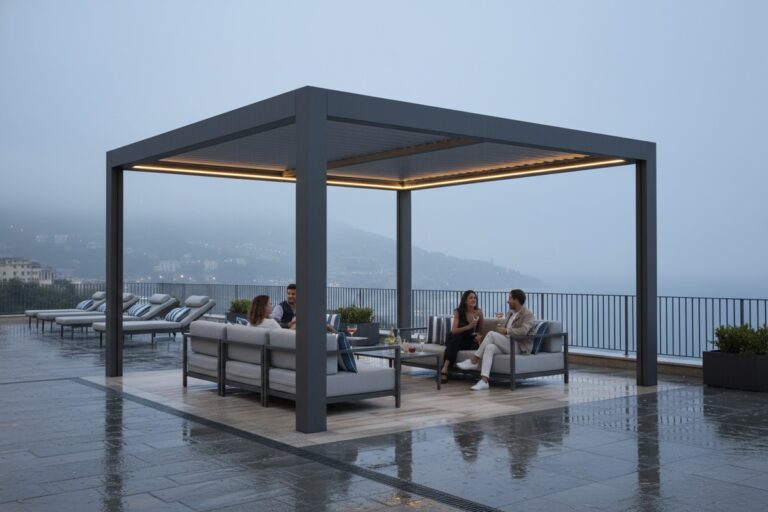
Bioclimatic louvered pergolas lead the European market, followed by wall-mounted lean-to structures and freestanding models. Buyers increasingly request motorized louver control, integrated LED lighting, retractable mesh screens, and smart home compatibility — all in minimalist, clean-line aluminum frames with neutral powder-coat finishes.
Bioclimatic Pergolas Dominate European Demand
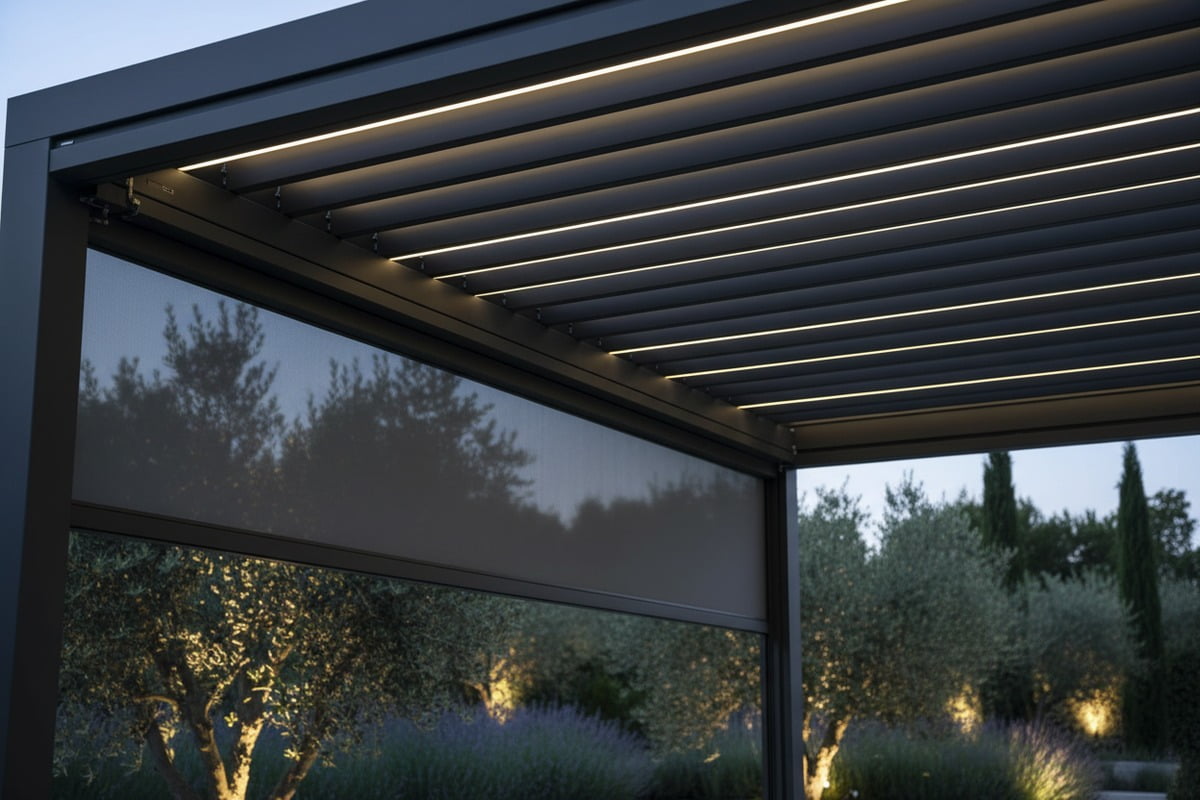
The bioclimatic pergola is not just a trend. It is the standard expectation across France, Belgium, Italy, Germany, and the Netherlands. These structures feature adjustable louvers 5 — typically rotating from 0° to 135° — that let end users control sunlight, airflow, and rain protection in real time. Our production line runs bioclimatic models more than any other style. Premium brands like Renson, Gibus, and Solisysteme have set the benchmark, and European distributors expect comparable quality from any supplier they work with.
Wall-Mounted vs. Freestanding Configurations
Two structural configurations cover most European residential and hospitality projects. Wall-mounted (lean-to) pergolas attach directly to the building facade and serve as patio extensions. Freestanding pergolas sit independently in gardens, poolside areas, or commercial terraces. Our order data shows roughly a 60/40 split in favor of wall-mounted units across Southern and Western Europe, while Northern European markets lean slightly more toward freestanding models with full enclosure options.
Key Style Features European Buyers Want
European buyers do not just buy a frame. They buy a complete outdoor living system. Here is what our European partners request most often:
| Feature | Popularity Level | Typical Application |
|---|---|---|
| Motorized adjustable louvers | Très élevé | Standard on most bioclimatic models |
| Integrated LED strip lighting | Haut | Evening dining, hospitality venues |
| Retractable mesh/zip screens | Haut | Insect protection, wind screening |
| Rain sensors with auto-close | Moyenne-élevée | Automated weather response |
| Glass side panels | Moyen | Winter garden conversion |
| Integrated heating elements | Moyen | Year-round outdoor use in Northern Europe |
| RAL custom color powder coating | Très élevé | Architectural matching |
Aesthetic Direction: Minimalism Wins
Clean lines, thin beams, and geometric precision define the European aesthetic. Charcoal grey, anthracite (RAL 7016), matte black, and white dominate color requests. Our powder-coating team processes RAL 7016 more than any other code. Bulky or ornamental designs do not sell well in this market. European architects and designers want pergolas that look like they belong to the building — not bolted onto it as an afterthought.
Smart Integration Is No Longer Optional
App-controlled louvers, wind sensors, and compatibility with home automation systems like KNX or Somfy are increasingly expected rather than premium add-ons. When we develop new OEM products, smart connectivity is built into the design from day one.
What are the most common pergola sizes I should stock for my European customers?
When our logistics team plans container loading, size distribution matters enormously. Stocking the wrong dimensions leads to unsold inventory and wasted warehouse space. European properties vary widely, but clear size patterns emerge from years of export data.
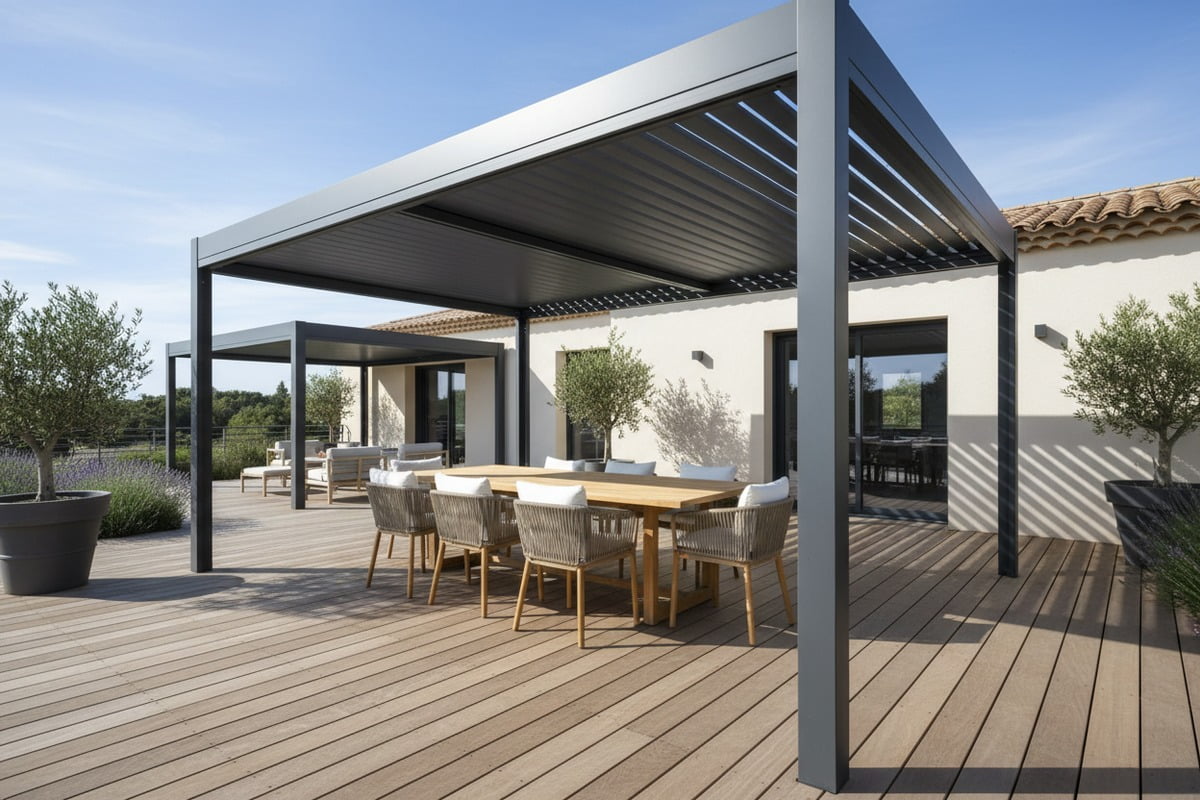
The most common pergola sizes for Europe range from 3 meters to 4 meters in width and 3 meters to 5 meters in projection. Popular configurations include 3×3m, 3×4m, 4×3m, and 4×4m for residential use, while commercial projects often require 4×5m, 5×6m, or modular assemblies up to 7 meters wide.
Residential Size Standards
Most European homes have patios, terraces, or garden areas that fall within a predictable size range. Urban apartments with balconies or small terraces lean toward compact units. Detached homes in Southern France, Spain, or Italy often have larger outdoor areas. Here is what we ship most frequently:
| Size (Width × Projection) | Market Segment | Typical Use Case |
|---|---|---|
| 3m × 3m | Urban residential | Small patios, balcony extensions |
| 3m × 4m | Residential | Standard terrace cover |
| 3.5m × 4.75m | Mid-premium residential | Dining area + lounge space |
| 4m × 3m | Residential | Wide but shallow patio cover |
| 4m × 4m | Premium residential | Full outdoor living room |
| 4m × 5m | Large residential / boutique hospitality | Generous entertaining space |
| 4m × 7m | Premium residential / commercial | Extended terrace or poolside |
Commercial and Hospitality Sizes
Hotels, restaurants, and resorts across Southern Europe need larger footprints. Commercial orders from Italy, Greece, and Spain typically start at 4m × 5m and go up to modular configurations covering 12 meters or more in width. Our modular coupling system lets installers join multiple units side by side without visible gaps. This approach handles irregular spaces better than a single oversized frame.
Height Considerations
Standard post height in the European market sits between 2.5m and 3m. Wall-mounted versions often require adjustable height to accommodate sloped facades or drainage gradients. We recommend a minimum clearance of 2.2m at the lowest point for comfortable use. Most of our European clients request 2.7m as a default.
Why Made-to-Measure Matters
European manufacturers like Corradi and Renson emphasize bespoke sizing. Our OEM process supports custom dimensions with lead times as short as 30 days. However, if you are a distributor stocking standard inventory, the sizes in the table above cover approximately 80% of European residential demand. Start there, then add custom orders as your market matures.
Modular Systems for Flexibility
Modular pergola systems let you cover large or irregular spaces by connecting standard units. This approach reduces manufacturing complexity, simplifies shipping, and speeds up installation. A 3m × 4m module paired with another 3m × 4m module creates a seamless 6m × 4m installation. Our engineering team designs coupling brackets that hide connection points for a clean finish.
How can I ensure my customized pergola designs meet European wind load and CE requirements?
Compliance failures are the most expensive mistake in our industry. We have seen competitors ship containers of pergolas to Europe only to have them rejected at customs or fail on-site inspections. Our engineering department treats CE compliance as a non-negotiable starting point, not a box to check at the end.
To meet European wind load and CE requirements, your pergola designs must comply with EN 1090 for structural aluminum, EN 13561 for external blinds and screens, and relevant Eurocodes for wind and snow loads. Motors and electronics require CE marking with proper EMC and Low Voltage Directive testing. All documentation must be available before goods ship.
Understanding the CE Marking Framework
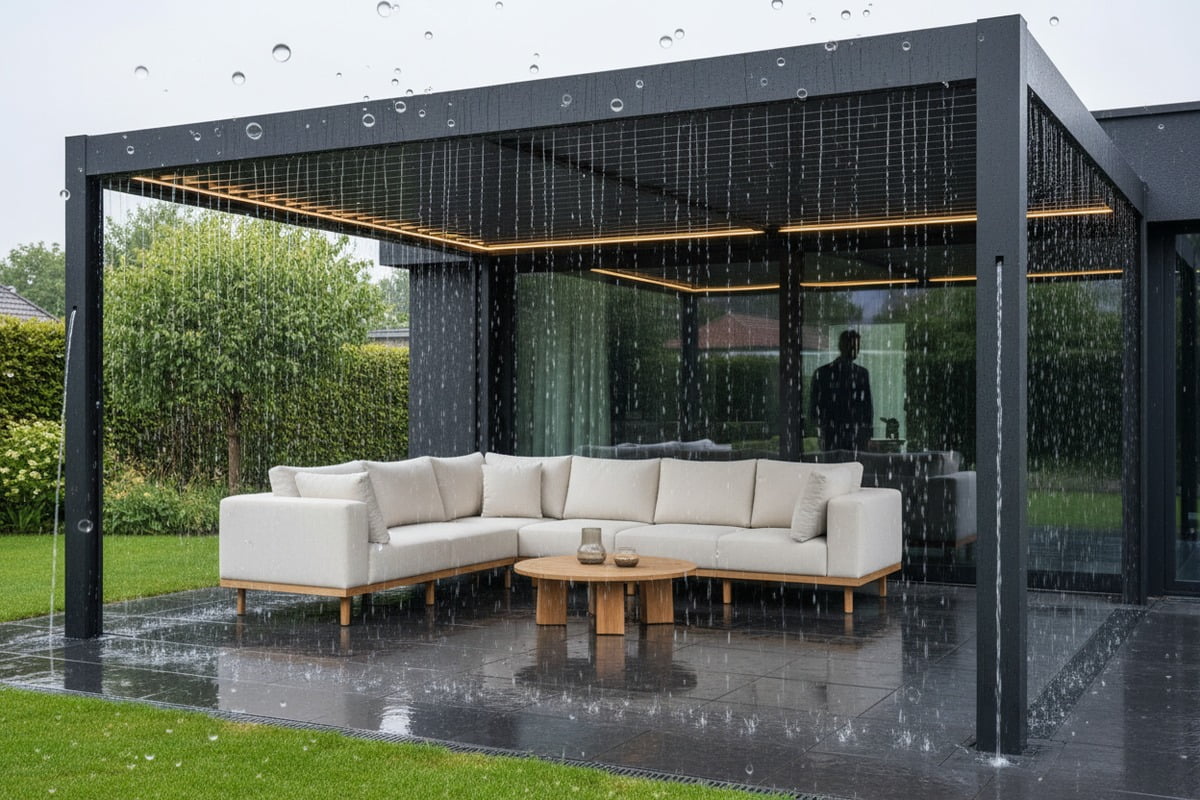
CE marking is not a single certificate. It is a system of directives that apply to different components of your pergola. The aluminum structure itself falls under the Construction Products Regulation 6 (CPR). Motorized louvers and electronic controls fall under the Machinery Directive and the Low Voltage Directive 7. Zip screens and retractable fabrics must meet EN 13561. Each component needs its own conformity assessment.
Wind and Snow Load Standards
European Eurocodes 8 define structural loading requirements. Wind loads vary dramatically by region. A pergola installed on the coast of Brittany faces different forces than one in a sheltered Tuscan courtyard. Here is a simplified reference:
| Load Type | Standard | Typical Values for Pergolas |
|---|---|---|
| Wind load | EN 1991-1-4 (Eurocode 1) | 80–130 km/h depending on zone |
| Snow load | EN 1991-1-3 (Eurocode 1) | 0.5–2.0 kN/m² depending on altitude and region |
| Structural aluminum | EN 1090-1 / EN 1090-3 | Execution class EXC2 minimum |
| Motor/electronics | Low Voltage Directive 2014/35/EU | CE marking with test reports |
| External screens/blinds | EN 13561 | Wind resistance class 1–6 |
Wall Thickness and Structural Integrity
One of the biggest compliance risks comes from thin-walled aluminum profiles. Cutting corners on wall thickness saves material cost but destroys wind load capacity. Our standard profiles use a minimum 2.0mm wall thickness for main beams and 1.5mm for secondary members. Every new design goes through FEA (Finite Element Analysis) before we approve tooling. We share these structural calculations with our OEM partners so they can present them during local building permit applications.
Motor and Electronics Compliance
Somfy, Cherubini, and other European motor brands come pre-certified. If you use Chinese-sourced motors, you must ensure they carry valid CE certificates — not just self-declarations. Our default specification includes Somfy motors for the European market precisely because their CE documentation is comprehensive and accepted without question by European authorities. We also test our integrated LED systems and rain sensors against EMC (Electromagnetic Compatibility) requirements.
Documentation You Must Have Ready
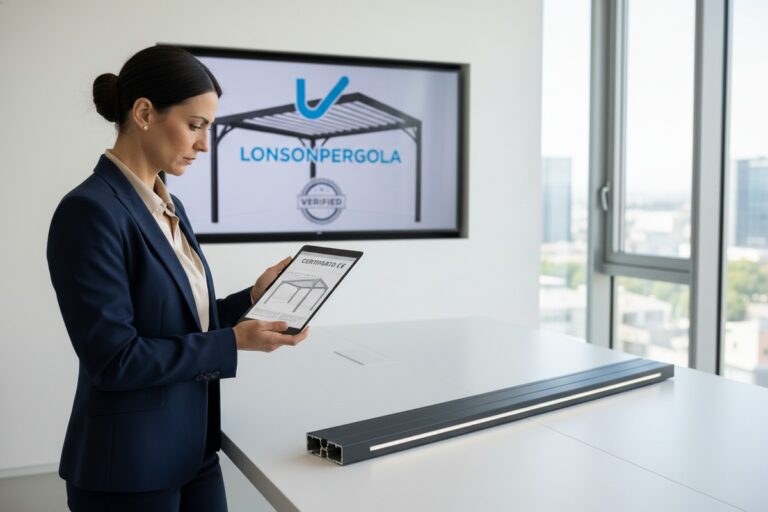
European customs and building inspectors may request: Declaration of Performance (DoP), CE Declaration of Conformity, structural calculation reports, motor CE certificates, material test reports for aluminum alloy grade (typically 6063-T5 or 6061-T6), and powder coating test results per Qualicoat standards 9. We prepare a full compliance dossier for every OEM order shipping to Europe. This documentation package is part of our standard service, not an add-on.
Fabric and Screen Compliance
If your pergola includes zip screens or retractable fabric elements, the textiles must meet fire resistance standards (typically EN 13501-1) and UV degradation standards. We source our screen fabrics from certified European and Australian suppliers, and every batch comes with test certificates that our partners can present to local authorities.
Where can I find a manufacturer that offers the OEM flexibility my European brand needs?
Our production floor processes orders for over 30 private-label brands across Europe. We understand what OEM flexibility really means because we live it every day. Finding the right manufacturing partner can make or break your European pergola business, and the wrong choice shows up in every scratched profile, missing bolt, and delayed shipment.
Look for a manufacturer with proven OEM/ODM experience, an annual capacity exceeding 50,000 units, in-house powder coating with full RAL color support, engineering teams capable of custom structural calculations, CE-compliant component sourcing, and a documented quality control process. Request factory audits, reference clients, and sample orders before committing to volume.
What OEM Flexibility Actually Means
OEM flexibility is not just about putting your logo on a standard product. True flexibility means your manufacturing partner can adjust profile dimensions, louver blade angles, post cross-sections, color finishes, hardware specifications, motor brands, packaging design, and installation manual language — all within a reasonable lead time. At our facility, we maintain over 200 active extrusion dies and can develop new custom dies within 15 days.
Key Evaluation Criteria for Your Manufacturer
When vetting a potential pergola supplier, use this checklist:
- Production capacity: Can they handle your volume plus seasonal spikes? Our annual capacity of 80,000 sets means we can absorb large orders without pushing back delivery dates.
- Customization speed: How fast can they turn around a custom drawing? We deliver initial 3D renderings within 48 hours.
- Material traceability: Can they provide mill certificates for aluminum alloy grades? We use 6063-T5 as standard and provide full material traceability.
- Powder coating quality: Do they follow Qualicoat or equivalent standards? Our in-house coating line processes all RAL colors with a minimum 60-micron coating thickness.
- Component sourcing: Do they use certified European motors and electronics, or unbranded alternatives?
- Packaging and logistics: Do they understand European pallet dimensions, container optimization, and DDP shipping requirements 10?
Les signaux d'alerte à surveiller
Avoid suppliers who cannot show you a physical sample before committing to bulk orders. Be cautious if they refuse a factory audit or cannot provide references from existing European clients. If their quoted lead time sounds too good to be true, it probably is. We maintain transparent production schedules shared with clients via our project management portal so there are no surprises.
Why Hainan-Based Manufacturing Works for Europe
Our headquarters in Hainan gives us access to one of China's most efficient shipping corridors to European ports. Transit times to Rotterdam, Hamburg, and Genoa typically run 25–30 days. Combined with our 30-day production cycle for standard orders, a European distributor can go from confirmed order to warehouse delivery in approximately 60 days. We also stock popular standard models — including 3×3m, 3×4m, and 4×4m bioclimatic units in anthracite and white — for immediate dispatch.
Building a Long-Term Partnership
The best OEM relationships evolve over time. Start with a sample order. Move to a small trial container. Once quality and communication are proven, scale up. We assign a dedicated project manager to every European client, fluent in English and familiar with European compliance requirements. After-sales support includes video call troubleshooting, replacement part dispatch within 48 hours, and annual product development reviews where we share trend data and suggest new SKUs based on market shifts.
Comparing Sourcing Options
| Criteria | European Manufacturer | Chinese OEM (Budget) | Chinese OEM (Mid-to-High End, e.g., Lonsonpergola) |
|---|---|---|---|
| Unit cost | Haut | Faible | Competitive |
| Customization range | Limited to catalog | Basic modifications | Full OEM/ODM flexibility |
| CE compliance | Built-in | Often missing | Included with documentation |
| Lead time | 6–10 weeks | 4–6 weeks | 4–5 weeks (30-day standard) |
| Minimum order quantity | Haut | Very low | Flexible (as low as 10 units for samples) |
| Motor quality | European standard | Variable | Somfy/Cherubini standard options |
| After-sales support | Strong | Weak | Dedicated project manager, 48-hour response |
Conclusion
Finding the right aluminum pergola styles, sizes, and manufacturing partner for Europe requires research, compliance knowledge, and a trusted supplier. Start with bioclimatic designs in standard sizes, ensure full CE documentation, and build a long-term OEM relationship that supports your brand growth.
Notes de bas de page
- Explains how bioclimatic pergolas with adjustable louvers function for climate control and weather protection. ︎
- Provides information on standards and technology for exterior LED lighting systems and their integration. ︎
- Wikipedia provides an authoritative overview of the RAL color standard. ︎
- Explains the purpose and requirements of CE marking for products sold within the European Economic Area. ︎
- Defines louvers and explains their function in controlling light, air, and weather protection. ︎
- Outlines the EU's legal framework for construction products, including safety and environmental standards. ︎
- Specifies safety requirements for electrical equipment within certain voltage limits in the EU. ︎
- Provides European standards for structural design, ensuring safety and stability of structures. ︎
- Details the quality label and specifications for powder coating on aluminum for architectural applications. ︎
- Explains Delivered Duty Paid (DDP) Incoterms, outlining the seller's maximum responsibilities in shipping. ︎