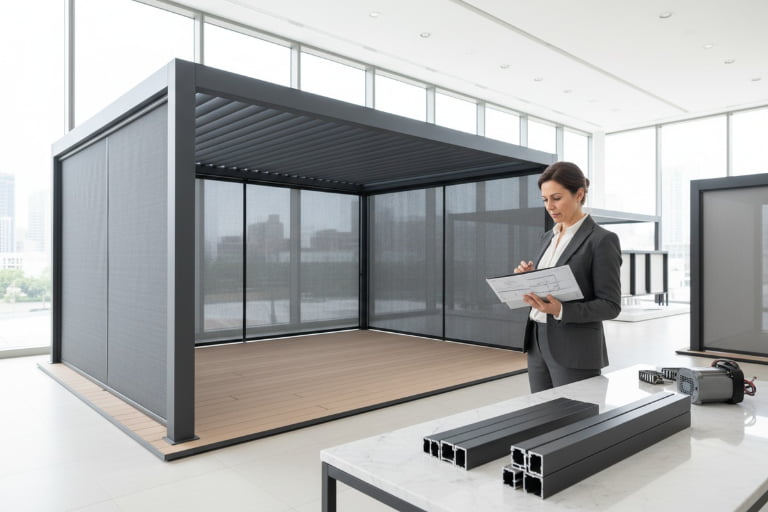

Every week, our sales team receives calls from buyers confused by dimension callouts, missing hardware lines, or unclear material specs on pergola drawings.
To read aluminum pergola technical drawings and BOMs, start with the title block for scale and units, match each numbered callout to its BOM line item, verify aluminum wall thickness and finish codes, and cross-check hardware quantities against the assembly sequence.
This guide breaks down each step so you can audit drawings and BOMs with confidence before placing your next order. Let's walk through the essentials together.
How do I interpret the technical symbols and dimensions on my pergola blueprints?
When we ship drawings to European distributors, dimension misreads cause roughly 20% of pre-production queries. A few minutes learning the basics saves weeks of back-and-forth.
Technical drawings use standardized views (plan, elevation, section), dimension lines in millimeters, material codes like "Al" for aluminum, and tolerance notations such as ±2mm/m to communicate exact fabrication and assembly requirements.
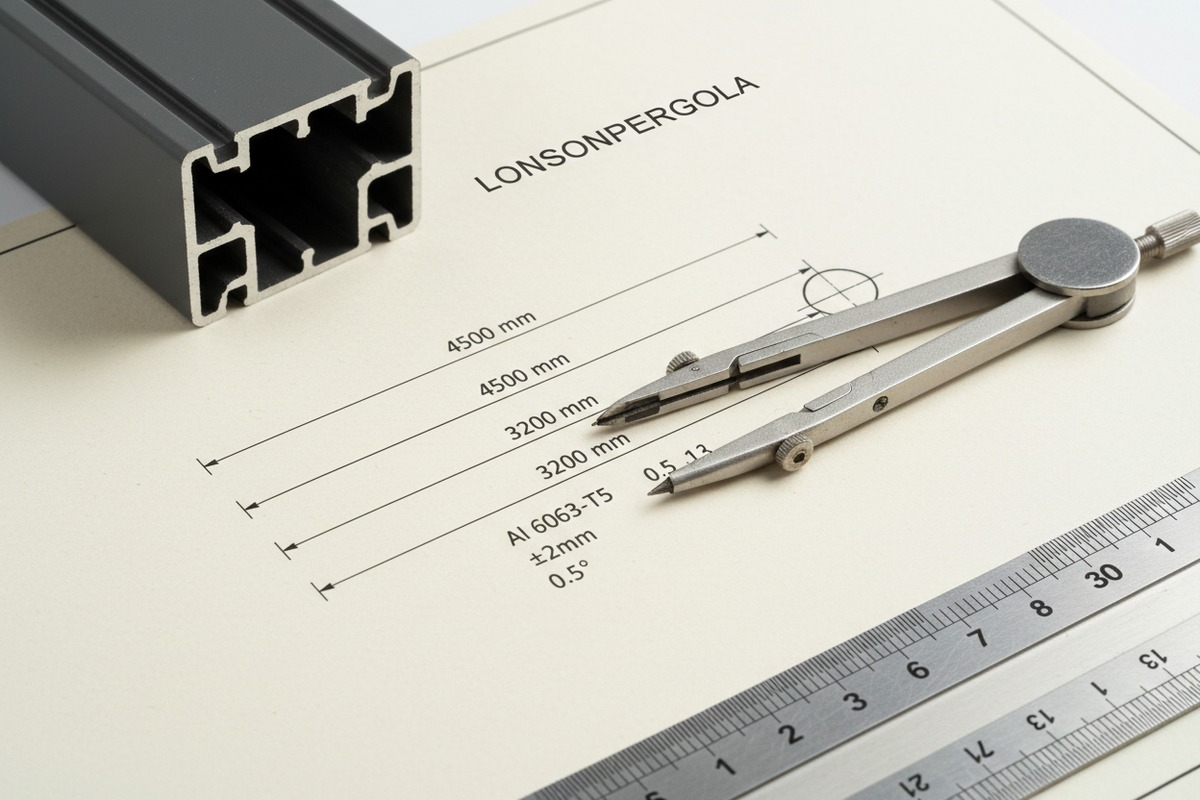
Start With the Title Block
The title block sits in the bottom-right corner. It tells you the drawing number, revision date, scale (e.g., 1:20), and unit of measurement. Always confirm units first—mixing inches and millimeters is a costly mistake.
Views You Will Encounter
| View Type | What It Shows | Procurement Use |
|---|---|---|
| Plan (Top) | Footprint, post spacing | Verify site fit |
| Elevation (Front/Side) | Height, beam profiles | Check clearance requirements |
| Section (Cut-through) | Wall thickness, internal channels | Confirm structural grade |
| Isometric (3D) | Overall assembly | Understand part relationships |
Common Symbols and Line Types
| Symbol / Line | Meaning | Example |
|---|---|---|
| Solid thick line | Visible edges | Outer profile of a post |
| Dashed line | Hidden edges | Internal drainage channel |
| Center line (dash-dot) | Axis or symmetry | Center of a bolt hole |
| "Al 6063-T5 1" | Aluminum alloy grade | Main beam material |
| Ø12 | Diameter 12mm | Bolt hole size |
| M8×12 | Metric bolt, 8mm diameter, 12mm length | Fastener spec |
Reading Dimensions and Tolerances
Dimensions appear between extension lines with arrows. For our louvered pergola beams, you might see "225×50" meaning 225mm height by 50mm width. Tolerances like ±2mm per meter mean the actual part can vary by 2mm over each meter of length. Plumb tolerance of ±1° ensures posts stand vertical. Diagonal measurements should match within ±3mm—if they don't, the frame is out of square.
Finish and Coating Callouts
Look for notes like "RAL 7016 powder coat" or "Pu 60μm min." These specify the exact color and minimum coating thickness. On our production line, we mark these clearly because a missing finish code means the factory defaults to standard—which may not match your project.
Where can I verify the aluminum wall thickness and load-bearing capacity in the technical specs?
Our engineers often find that buyers accept quoted wall thicknesses at face value. But after 25 years of manufacturing, we know that verifying this single number prevents the most dangerous quality failures.
Check the section view on technical drawings for wall thickness dimensions (e.g., 2.0mm or 2.5mm), and look for the load table or structural calculation sheet specifying wind and snow loads in kN/m² or kg/m² per local building codes.
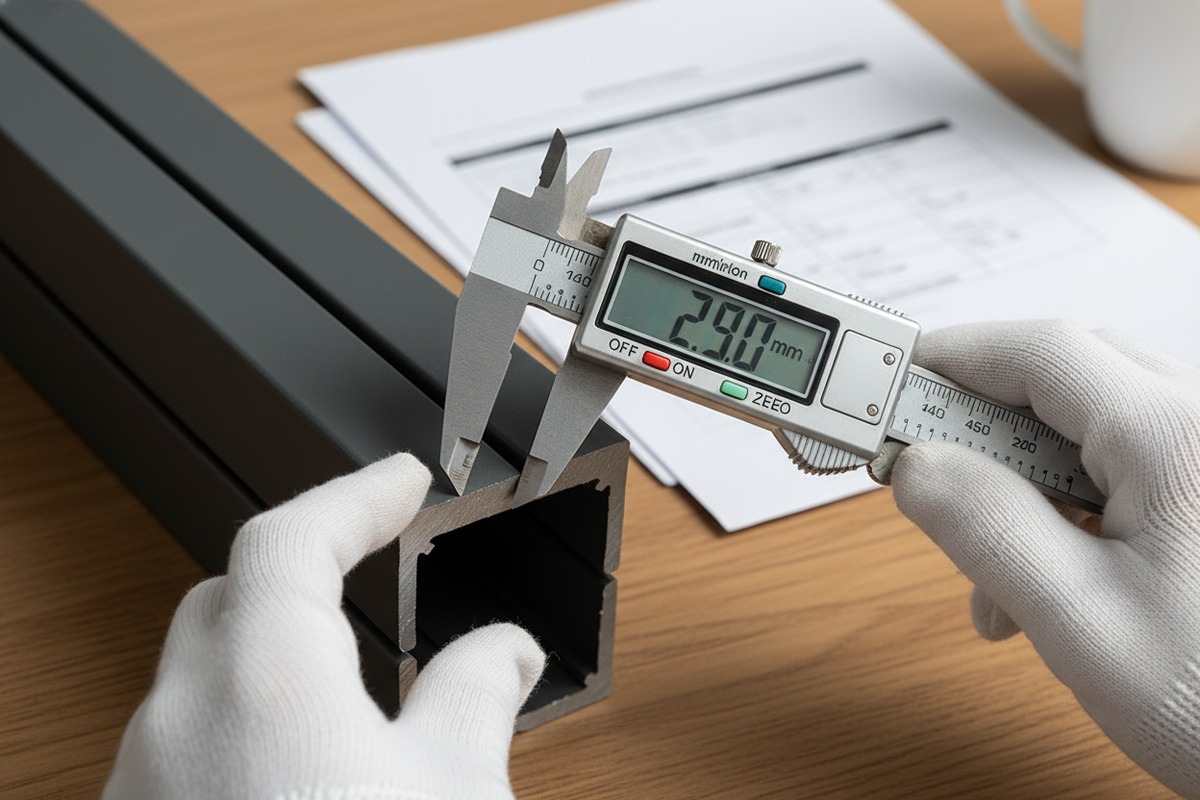
Where Wall Thickness Appears
In the section view (cut-through drawing), you will see the aluminum profile sliced open. The wall thickness is dimensioned there—typically between 1.5mm and 3.0mm for pergola posts and beams. Our standard posts use 2.0mm walls; heavy-duty versions use 2.5mm.
Load-Bearing Capacity Documentation
Load capacity is not always on the assembly drawing itself. Request these separate documents:
- Structural calculation report — shows maximum wind load (e.g., 120 km/h) and snow load (e.g., 75 kg/m²)
- Test certificate — third-party lab results confirming deflection limits
- Material certificate (Mill Test Certificate) — proves the alloy is genuinely 6063-T5 or 6061-T6
Quick Reference: Wall Thickness vs. Load Capacity
| Wall Thickness | Typical Application | Approximate Wind Resistance |
|---|---|---|
| 1.5mm | Light decorative pergola | Up to 80 km/h |
| 2.0mm | Standard residential | Up to 120 km/h |
| 2.5mm | Commercial / coastal | Up to 150 km/h |
| 3.0mm | Heavy-duty / snow regions | Up to 180 km/h |
How to Spot Corners Being Cut
If a supplier quotes 2.0mm but the section view shows no dimension, ask for a caliper measurement photo or request a sample. On our end, we include wall thickness in every section view because transparency builds trust. A 0.3mm reduction may seem small, but it can reduce load capacity by 15–20%.
Cross-Check With Local Codes
European buyers must match load specs to Eurocode EN 1991 4 for wind and snow actions. If your project is in northern Italy with heavy snowfall, you need at least 100 kg/m² snow load capacity. The spec sheet should state this explicitly.
How do I audit the BOM list to ensure all critical connectors and hardware are included?
Missing a single non-standard connector can halt installation for weeks when you are sourcing from overseas. We learned this the hard way in our early export years—now every BOM we issue goes through a three-stage internal audit.
Audit your BOM by grouping items into structural members, connectors, hardware, and accessories; then cross-reference each assembly step in the drawing to confirm every bolt, bracket, and seal is listed with correct quantities and specs.
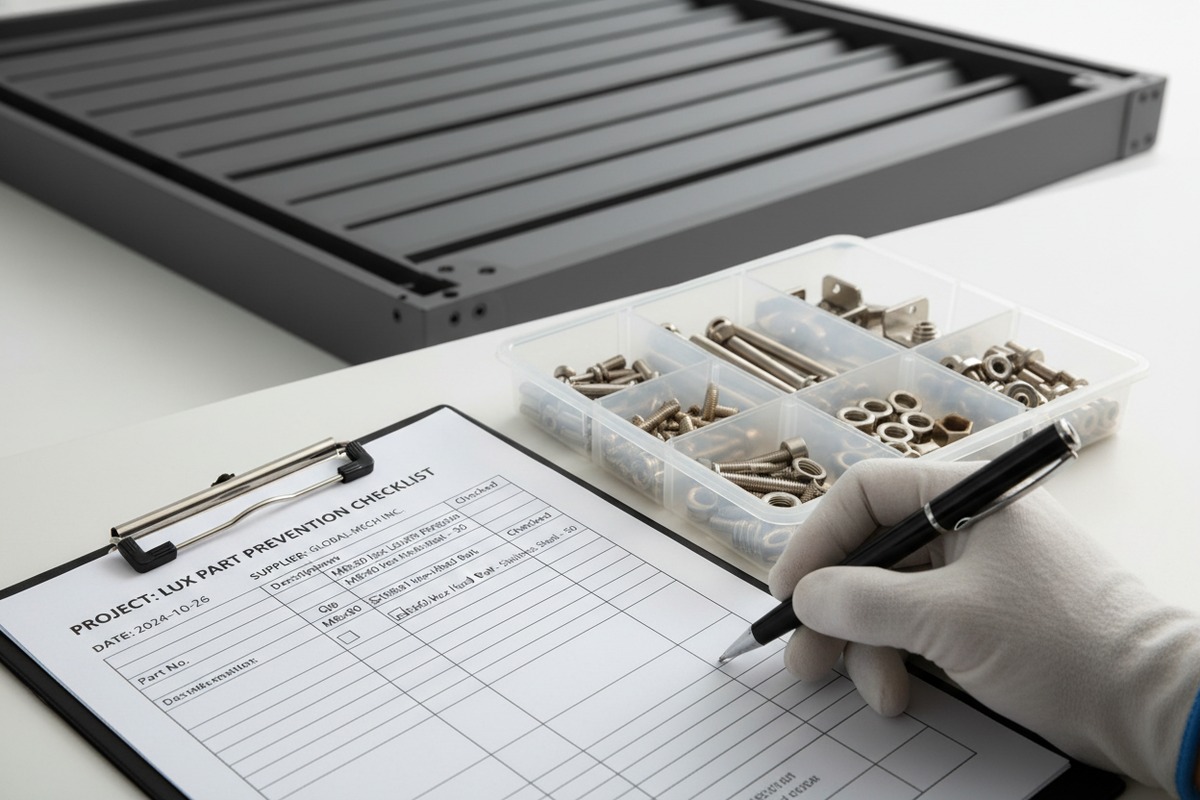
BOM Structure Breakdown
A proper BOM has these columns: item number, part description, material, specification (size/grade), quantity, and sometimes weight. Bill of Materials 5 Group items into categories for easier auditing.
Critical Categories to Check
Structural members: Posts, beams, rafters, gutters. Verify dimensions match drawing callouts.
Connectors and brackets: L-brackets, T-connectors, base plates, wall-mount plates. These are most commonly missing from incomplete BOMs.
Fasteners: Bolts, nuts, washers, self-tapping screws, Allen screws. Check both size (M8×12) and quantity.
Accessories: Motor assemblies, end caps, rubber seals, drainage fittings, cable covers.
Step-by-Step Audit Method
- Print the assembly drawing sequence (Steps 1 through final).
- For each step, identify every part shown.
- Tick each part off on the BOM.
- Flag any part visible in the drawing but absent from the BOM.
- Confirm fastener counts—multiply per joint by number of joints.
Common Items Buyers Miss
| Often Overlooked Item | Why It Matters | Typical Quantity |
|---|---|---|
| Base plate anchors | Secures posts to concrete | 4 per post (16 total for 4-post) |
| Rubber seal strips | Prevents water ingress at joints | 1 per beam connection |
| End caps | Covers open profile ends | 2 per beam/rafter |
| Cable gland | Protects motor wiring | 1–2 per motorized unit |
| Touch-up paint pen | Covers cut-edge corrosion risk | 1 per order |
Our Internal Rule
We never ship a pergola kit without running the BOM against the 3D assembly model. Each fastener is counted digitally. If you receive a BOM without fastener quantities, push back immediately. A missing M8 bolt costs €0.10 at the factory but €50+ in project delays overseas.
What specific details should I check to confirm my custom RAL colors and motor compliance?
Color mismatches and non-compliant motors are two issues that damage buyer-supplier relationships fastest. In our powder coating facility, we process over 200 RAL colors annually—and precision here requires explicit documentation on both sides.
Confirm custom RAL colors by checking the RAL code, gloss level (matte/satin/gloss), and coating thickness on the spec sheet; verify motor compliance by requesting CE declarations, IP ratings, and torque specifications matching your market's electrical standards.
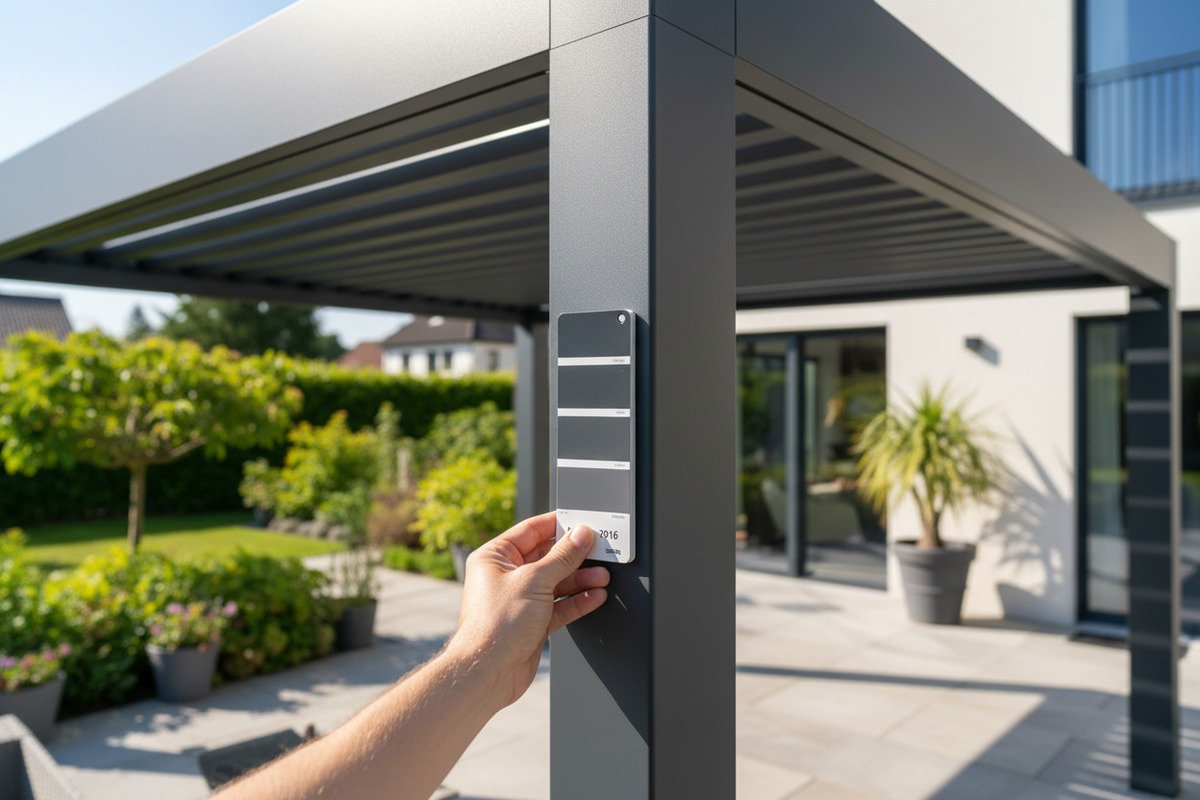
RAL Color Verification Checklist
Never assume "dark gray" means the same thing to you and your supplier. RAL 7016 (Anthracite Gray) and RAL 7024 (Graphite Gray) look similar on screen but differ noticeably in person.
Check these details in your specs:
- RAL code — exact 4-digit number
- Gloss level — matte (<30 GU), satin (30–60 GU), gloss (>60 GU)
- Coating thickness — minimum 60μm for outdoor durability
- Substrate pretreatment — chromate-free conversion per QUALICOAT standards 6
Request a Physical Color Sample
Digital screens distort color. Always request a sprayed aluminum sample plate before mass production. We ship sample panels within 5 days for approval. Keep the approved panel for goods-receipt comparison.
Motor Compliance Details
For motorized louvered pergolas, the linear motor or rotary motor must meet your market's requirements:
| Compliance Item | Europe (CE) | Detail to Verify |
|---|---|---|
| CE marking 7 | Mandatory | Declaration of Conformity document |
| IP rating | IP44 minimum for outdoor | Stated on motor label |
| Voltage | 230V / 50Hz | Matches local grid |
| Torque | Per louver weight calculation | Nm rating in spec sheet |
| Noise level | <45 dB preferred | Test report available |
| Remote protocol | RF 433MHz or integrated | Compatible with home automation |
Why This Matters for Procurement
A motor lacking CE certification cannot legally be installed in the EU. If customs flags it, your entire shipment may be held. On our production line, we only source motors from certified suppliers (Somfy, Nice, or equivalent-tier) and include the Declaration of Conformity in every shipment package.
Coating Durability Tests to Request
Ask for QUALICOAT or GSB certification test results: salt spray (1000+ hours), UV resistance (Florida test or accelerated weathering), and adhesion (cross-cut test ISO 2409). These prove your pergola won't fade or peel within 2–3 years.
Conclusion
Reading technical drawings and BOMs is a learnable skill that protects your budget, timeline, and reputation. Start with the basics, verify every detail, and always request documentation before production begins.
Notes de bas de page
1. Details the properties, composition, and common applications of this specific aluminum alloy. ︎
2. Explains the fundamental concept and purpose of technical drawings in engineering. ︎
3. Provides context for the international standard governing dimensioning and tolerances in technical drawings. ︎
4. Explains the European standard for actions on structures, including wind and snow loads. ︎
5. Defines the Bill of Materials (BOM) and its critical role in manufacturing and production. ︎
6. Provides official specifications and requirements for the quality label of architectural powder coatings. ︎
7. Clarifies the mandatory European conformity standard for products sold within the EU. ︎