

Every year, our shipping team handles thousands of aluminum pergola crates bound for Europe—and one rejected shipment taught us a costly lesson about wood packaging rules. EU ISPM 15 compliance 1
To verify EU ISPM 15 compliance for aluminum pergola wood packaging, inspect all solid wood thicker than 6mm for the official IPPC stamp showing the country code, producer number, and treatment method (HT). Request phytosanitary certificates from your supplier and confirm their NPPO accreditation before shipment.
This guide walks you through every step—from spotting the right markings to choosing the safest packaging materials. wood packaging materials 2 Whether you import one container or fifty, these checks can save you thousands at the EU border.
How can I identify the official ISPM 15 mark on my pergola's wooden crates?
When we first started exporting pergolas to Italy and Germany, our logistics team assumed all pallets from local suppliers were compliant. A border hold in Rotterdam proved otherwise.
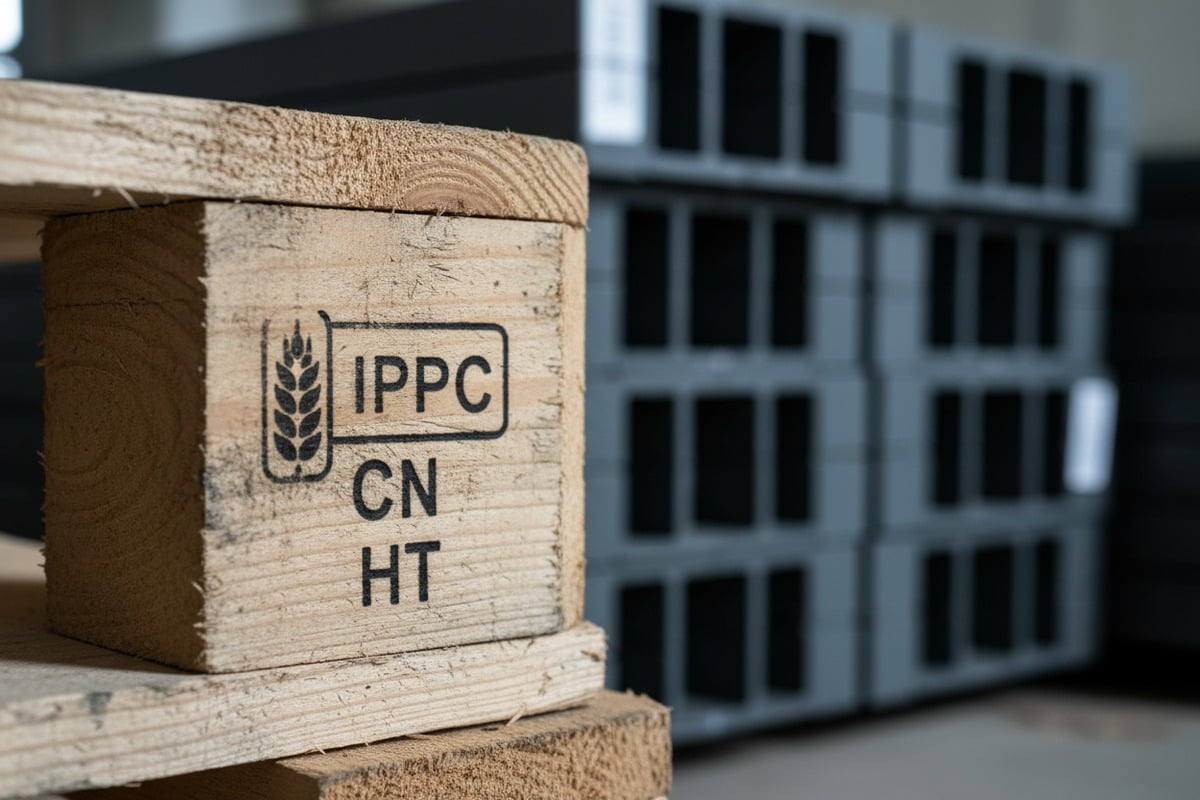
The official ISPM 15 mark features the IPPC wheat-ear logo alongside a two-letter country code, the producer's unique registration number, and a treatment code such as "HT" for heat treatment. This mark must be stamped clearly, permanently, and directly on every regulated wood component.
Breaking Down the IPPC Stamp
The ISPM 15 mark is your first line of defense. It tells EU customs officers three things at a glance: where the wood was treated, who treated it, and how. Here is what each element means.
| Mark Element | What It Shows | Example |
|---|---|---|
| IPPC Logo | International Plant Protection Convention 3 endorsement | Wheat-ear symbol |
| Country Code | Two-letter ISO code of the treating country | CN (China) |
| Producer Number | Unique ID assigned by the National Plant Protection Organization 4 | 1234 |
| Treatment Code | Method used to eliminate pests | HT (Heat Treatment) |
| Debarking Code | Confirms bark removal | DB (Debarked) |
Where to Look on Your Pergola Crates
Not every piece of wood in a shipment needs the mark. Only solid wood thicker than 6mm falls under ISPM 15. Thin plywood 5 panels, particleboard, or OSB sheets are exempt. When our factory packs a louvered aluminum pergola, the main structural crate uses solid pine battens—those need the stamp. The thin plywood side panels do not.
Look for the mark on at least two opposite sides of each pallet or crate. It should be visible without unstacking. The stamp must be burned, stenciled, or printed with permanent ink. Hand-written marks are never valid.
Common Marking Errors We See
In our experience coordinating with multiple wood suppliers in China, the most frequent problems are:
- Faded or smudged stamps — caused by poor ink quality or stamping on wet wood.
- Missing treatment code — the IPPC logo is present, but no "HT" or "DB" appears.
- Incorrect producer number — the number does not match NPPO records.
- Mark placed only on one side — EU inspectors sometimes cannot see it when containers are opened.
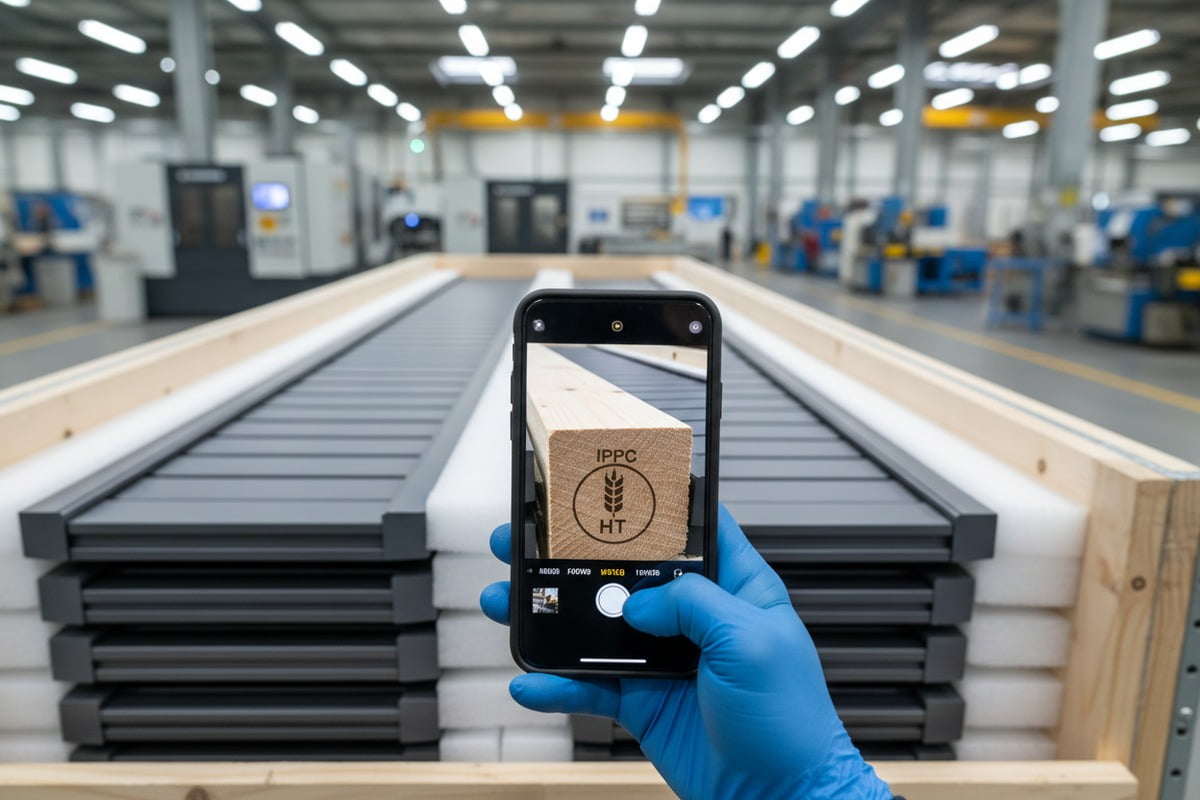
If any of these issues appear, the entire shipment is at risk. We now photograph every marked pallet before container loading and share images with our European buyers for pre-approval.
Quick Inspection Checklist
- Confirm the IPPC wheat-ear logo 6 is present.
- Read the two-letter country code.
- Note the producer registration number.
- Verify "HT" or another valid treatment code.
- Check that the mark is legible, permanent, and on at least two visible faces.
- Cross-reference the producer number with NPPO databases when possible.
This five-minute visual check at the warehouse can prevent a five-week delay at the port.
What specific phytosanitary documents should I request from my Chinese supplier to pass EU customs?
Our team learned early on that a stamp on wood is not enough—EU buyers also need a paper trail. One missing document can turn a smooth delivery into a warehouse headache.
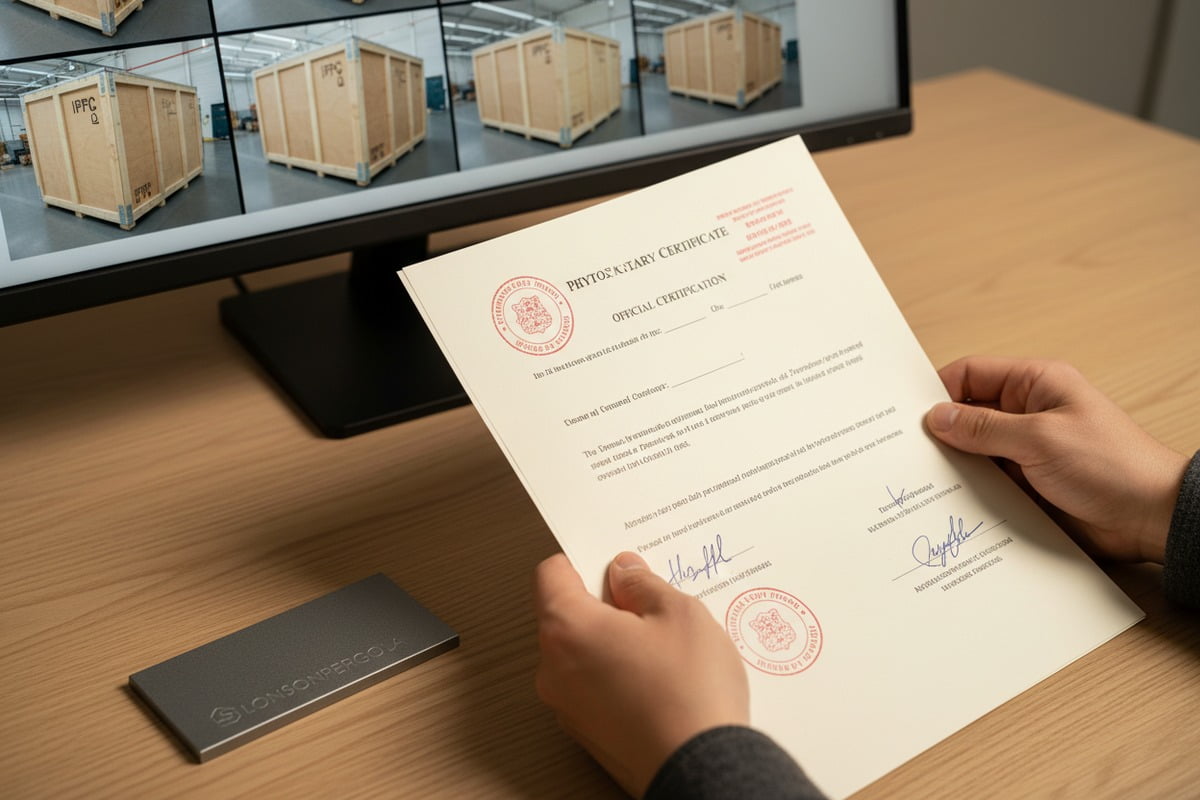
Request a phytosanitary certificate issued by China's NPPO (General Administration of Customs), the treatment facility's NPPO accreditation certificate, a packing declaration listing all wood materials used, and photographic evidence of the IPPC marks on every crate before shipment.
The Core Document Set
Different EU member states may have slightly different inspection frequencies, but the baseline documentation stays the same. Here is what we include with every pergola shipment headed to Europe.
| Document | Issued By | Purpose |
|---|---|---|
| Phytosanitary Certificate 7 | China's NPPO (GACC) | Confirms the wood packaging meets plant health requirements for the destination country |
| NPPO Accreditation Certificate | Treatment facility | Proves the heat treatment provider is officially registered and audited |
| Packing Declaration | Exporter (us) | Lists all wood types and thicknesses used, confirms ISPM 15 compliance |
| Pre-shipment Photos | Exporter (us) | Visual proof of IPPC marks on crates, pallets, and dunnage |
| Treatment Report / Certificate | Treatment facility | Details treatment date, duration, core temperature reached |
Why a Packing Declaration Matters
A packing declaration is a simple one-page statement. It lists every wood component in the shipment, its thickness, whether it is solid wood or processed material, and its treatment status. We sign it and stamp it with our company seal.
This document is especially useful when your pergola shipment combines different packaging materials. For example, our charcoal-gray powder-coated aluminum pergola frames often ship on heat-treated pine pallets but are wrapped with exempt plywood panels. The packing declaration clarifies which parts are regulated and which are exempt.
Verifying Your Supplier's NPPO Accreditation
Do not just take your supplier's word. Ask for the accreditation certificate number and cross-check it. China's NPPO maintains a registry of approved treatment facilities. If your supplier cannot provide this number, that is a red flag.
At our factory, we work with two NPPO-accredited heat treatment providers. We rotate between them based on capacity, but both hold current certifications. We share these certificates proactively with every new European client.
Pre-Shipment Photo Protocol
We send a photo set to every buyer before the container doors close. Each photo shows:
- The full crate with the IPPC mark clearly visible.
- A close-up of the mark showing all four elements.
- The container number alongside the crate for traceability.
This small step builds trust and gives your customs broker ammunition if questions arise at the destination port.
What Happens If Documents Are Incomplete?
If your shipment arrives at an EU port without proper documentation, customs officers may:
- Hold the goods for physical inspection.
- Require re-treatment at your expense.
- Charge storage fees while the shipment waits.
- In worst cases, order destruction of non-compliant packaging.
We always prepare a complete document folder—both digital and printed copies—for every shipment. It adds maybe 30 minutes to the export process but saves days or weeks on the import side.
What are the legal and financial risks if my aluminum pergola shipment fails ISPM 15 inspection in Europe?
We once had a client in southern France whose shipment was flagged because one pallet in a 20-foot container had a missing treatment code. The entire container was held for 12 days. The cost? Over €8,000 in port storage, re-inspection fees, and lost project time.
Failing ISPM 15 inspection in Europe can result in shipment detention, mandatory re-treatment or re-packaging at your cost, port storage fees of €50–€200 per day, official fines under Regulation (EU) 2016/2031, forced re-exportation, or outright destruction of the non-compliant wood packaging.
The Cascade of Costs
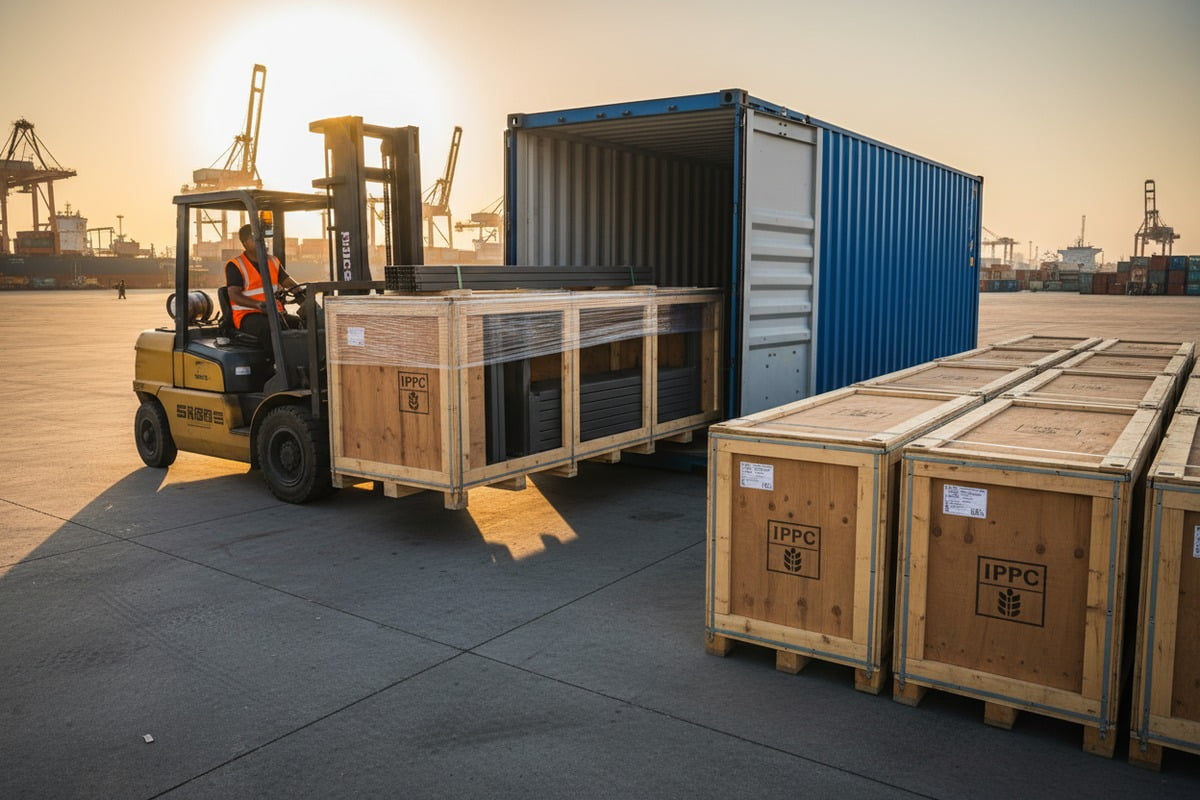
A single ISPM 15 failure does not just cost you a fine. It triggers a chain reaction. Here is a realistic breakdown of what can happen, based on cases we have seen from our European partners.
| Risk Category | Potential Cost | Timeline Impact |
|---|---|---|
| Port storage fees | €50–€200/day | Immediate, ongoing |
| Re-treatment at EU facility | €300–€1,000 per shipment | 3-7 jours |
| Re-packaging labor | €500–€2,000 | 2–5 days |
| Customs fines | €1,000–€10,000+ depending on member state | Variable |
| Re-exportation shipping | €2,000–€5,000+ | 2–4 weeks |
| Destruction of packaging | €500–€1,500 | 1–3 days |
| Project delay penalties | Contractually defined, often 1–5% of project value per week | Weeks to months |
| Reputation damage | Unquantifiable | Long-term |
Legal Framework: Regulation (EU) 2016/2031
The EU Plant Health Law (Regulation (EU) 2016/2031 8) is the legal backbone. It mandates that all wood packaging entering EU territory from non-EU countries must meet ISPM 15 standards. Enforcement is handled by national plant protection services—like ANSES in France or the Julius Kühn-Institut in Germany.
Each member state sets its own fine schedule, but the regulation gives them authority to detain, destroy, or re-export non-compliant goods. Some countries are stricter than others. The Netherlands and Germany, for example, are known for thorough inspections.
Who Bears the Cost?
This is a critical question for purchasing managers. In most CIF or DDP contracts, the exporter bears responsibility for packaging compliance. If you buy on FOB terms, the importer may inherit the risk once goods are loaded.
At our factory, we include ISPM 15 compliance as a standard contractual clause. Our sales contracts specify that all wood packaging will meet ISPM 15 requirements, and we provide the documentation to prove it. This protects both sides.
Repeat Offender Consequences
If your company is flagged multiple times, your import profile changes. EU customs may classify you as a higher-risk importer, meaning every future shipment gets inspected. This slows down your supply chain permanently until you demonstrate consistent compliance.
For contractors and project managers with tight deadlines—like those building pergola installations for hotels or resorts—a two-week delay is not just inconvenient. It can trigger penalty clauses in construction contracts.
Real-World Prevention
The best prevention is upstream control. Before any pergola leaves our production floor, our quality team verifies every wood component. We photograph, document, and archive. If something looks off, we replace the pallet before loading. The cost of a new compliant pallet is €15–€30. The cost of a border rejection starts at €5,000 and climbs fast.
Should I choose heat-treated wood or plywood to ensure my pergola packaging meets EU import standards?
Our engineering and logistics teams debated this question for years. After shipping over 80,000 pergola sets, we settled on a hybrid approach—and the reasoning is simpler than you might think.
Heat-treated solid wood with the IPPC "HT" mark is the traditional compliant choice, but plywood—made from processed veneers bonded with glue and heat—is fully exempt from ISPM 15 requirements. For aluminum pergola packaging, using plywood or presswood eliminates the compliance burden entirely.
Understanding the Exemption
ISPM 15 only regulates raw solid wood thicker than 6mm. Materials that have been sufficiently processed—through heat, pressure, and adhesive bonding—are considered pest-free by default. This includes:
- Plywood
- Particleboard
- Oriented strand board (OSB)
- Veneer
- Presswood pallets (e.g., INKA brand)
These materials do not need the IPPC mark. They do not need phytosanitary certificates for wood packaging purposes. They pass EU customs without any wood-related scrutiny.
Head-to-Head Comparison
| Facteur | Heat-Treated Solid Wood 9 | Plywood / Presswood |
|---|---|---|
| ISPM 15 compliance required | Yes – must be treated, marked, and documented | No – exempt from ISPM 15 |
| Cost per pallet | €10–€30 + treatment cost (10–20% premium) | €15–€40 (slightly higher base cost) |
| Strength for heavy pergola frames | Excellent for crating large aluminum beams | Good for moderate loads; presswood handles heavy loads well |
| Customs risk | Moderate – depends on mark quality and documentation | Zero – no wood inspection triggered |
| Moisture resistance | Moderate (kiln-dried helps) | Better (glue layers resist moisture) |
| Sustainability | Requires energy-intensive kiln treatment | Uses wood byproducts; considered more resource-efficient |
| Reusability | Can be reused if marks remain intact and no repairs needed | Can be reused without re-marking concerns |
When Solid Wood Still Makes Sense
For very large, heavy pergola structures—like our 6-meter by 4-meter louvered roof models with integrated motorized systems—solid wood crating offers superior rigidity. The thick battens and corner blocks absorb impact during ocean transit better than thinner plywood panels.
In these cases, we use heat-treated pine. Our treatment partners kiln-dry the wood to reach 56°C at the core for a minimum of 30 minutes. Every batch gets a treatment certificate, and every pallet gets stamped on at least two visible faces.
When Plywood Is the Smarter Choice
For standard-size pergola shipments—especially when buyers want to minimize customs risk entirely—we recommend plywood crating. It costs a bit more per unit, but you save on documentation, inspection time, and anxiety.
Many of our European distributors now specify plywood-only packaging in their purchase orders. They have calculated that the small price increase is worth the complete elimination of ISPM 15 risk.
The Hybrid Approach
Our most common solution is a hybrid: heat-treated solid wood pallets on the bottom (for structural support under the container's forklift pockets) and plywood panels for the crate walls and top. This gives us the best of both worlds—strong base, exempt walls, minimal compliance surface area.
Methyl Bromide: Not an Option for Europe
Some treatment facilities still offer methyl bromide 10 (MB) fumigation as an ISPM 15 method. Do not use it for EU-bound shipments. The EU banned methyl bromide under the Montreal Protocol due to its ozone-depleting properties. If your wood bears an "MB" treatment code, it will likely be rejected at the EU border.
Always confirm that your wood supplier uses heat treatment ("HT") or dielectric heating ("DH")—never methyl bromide—for any shipment destined for Europe.
Conclusion
ISPM 15 compliance protects your pergola investment at every EU border. Verify marks, collect documents, choose smart materials, and work with suppliers who take packaging as seriously as the product itself.
Notes de bas de page
1. Official EU requirements for wood packaging material imports. ︎
2. Provides a guide from the IPPC on regulating wood packaging material in international trade. ︎
3. Official website of the intergovernmental treaty protecting plants from pests. ︎
4. Defines the responsibilities of National Plant Protection Organizations under ISPM 15. ︎
5. Wikipedia provides a clear explanation of ISPM 15 exemptions, including plywood. ︎
6. Explains the components and significance of the internationally recognized IPPC stamp. ︎
7. Provides an overview of EU plant health rules and phytosanitary certificate requirements for imports. ︎
8. Official text of Regulation (EU) 2016/2031 on protective measures against plant pests. ︎
9. Explains the specific requirements and process for ISPM 15 compliant heat treatment. ︎
10. Discusses fumigation regulations, including the EU ban on methyl bromide for ISPM 15. ︎