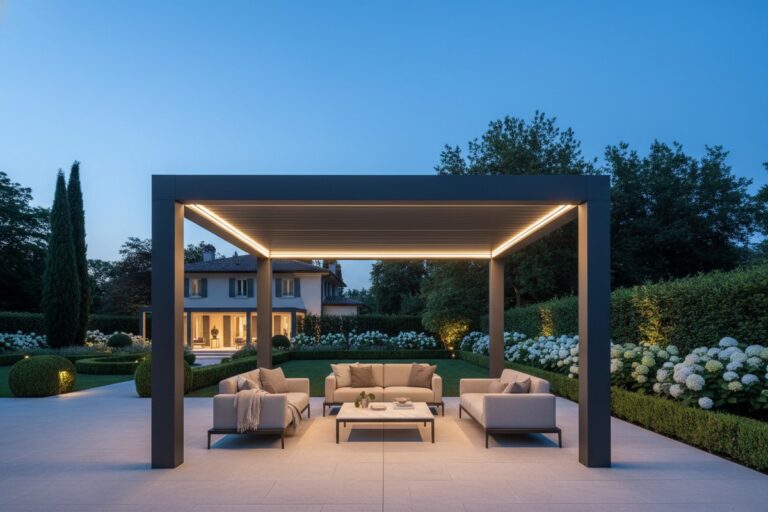
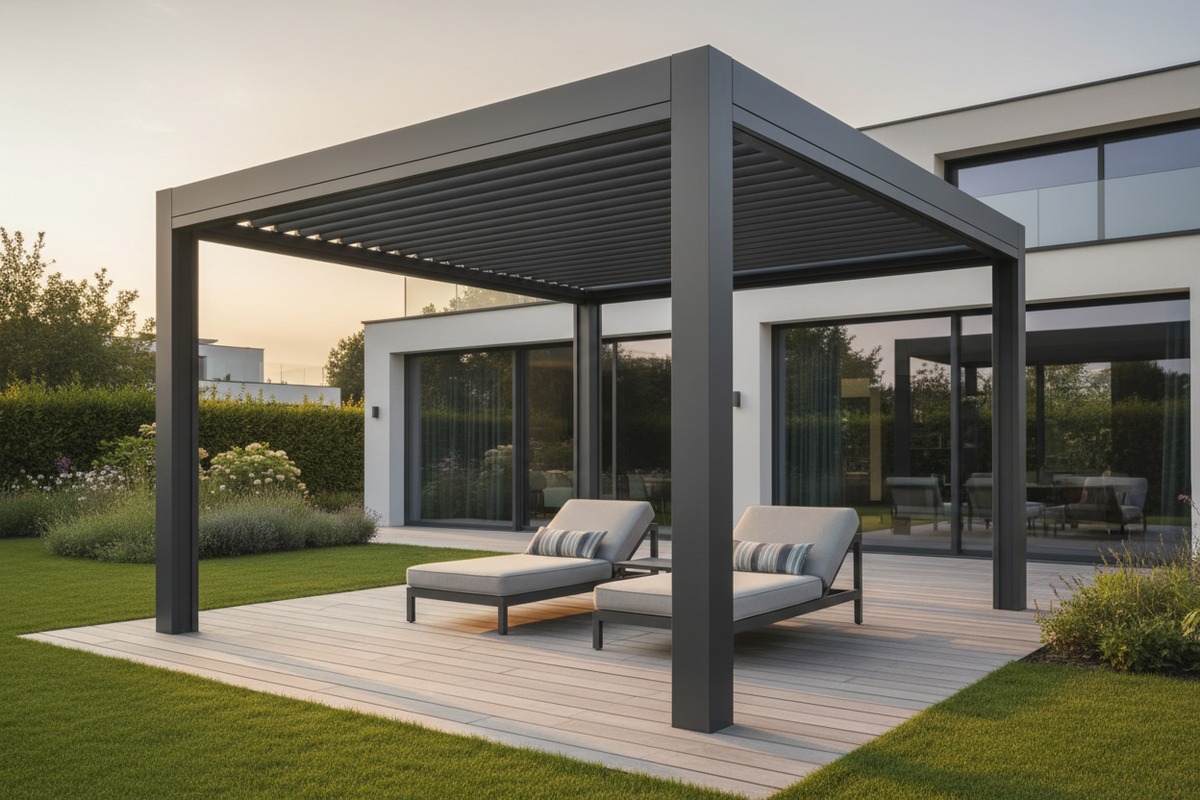
Every week on our production line, we see the same pattern powder-coated finishes 1. Buyers send reference photos of pergolas that look expensive, then ask what makes them different from budget options.
A premium aluminum pergola achieves its high-end look through concealed hardware, architectural proportions, refined powder-coated finishes, integrated drainage, and clean geometric lines. Luxury is defined by what you hide, not what you add.
Below, we break down the specific design details that separate a commodity pergola from one that feels custom and architectural AAMA 2605 2. Each section covers a decision you will face when specifying or sourcing your next project.
How can I choose the right powder coating finish to give my pergola a high-end look?
When we calibrate our coating line for European clients, the finish conversation always starts with gloss level, not color Qualicoat Class 2 3. Most buyers pick a color first and regret it later when the sheen feels wrong.
Choose a low-gloss or matte powder coating in neutral tones like charcoal, bronze, or anthracite grey. Ensure the coating meets AAMA 2604 or higher standards for UV and corrosion resistance, and verify color consistency across all components.
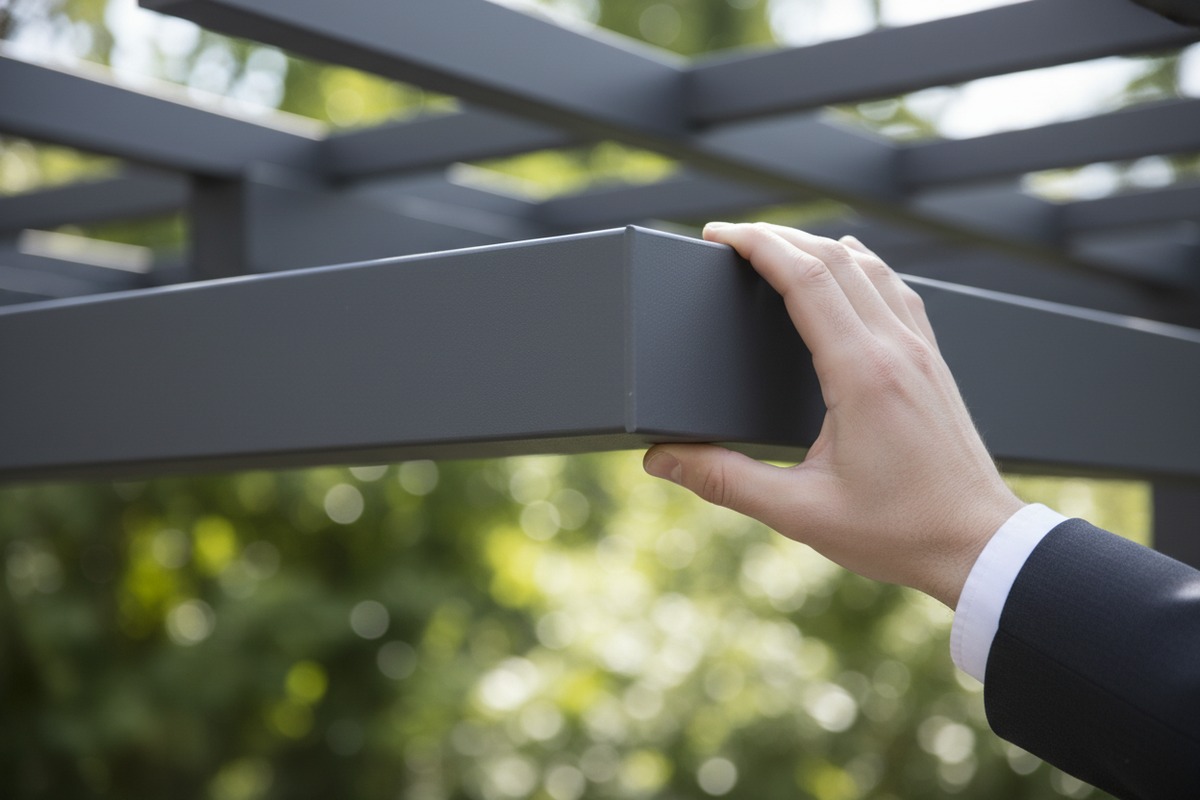
Why Gloss Level Matters More Than Color
A high-gloss finish reflects light unevenly across large flat surfaces concealed bolt-and-lock connections 4. This highlights imperfections and makes the structure look like painted metal rather than architectural material. Low-gloss and matte finishes absorb light softly. They mimic the look of anodized metal or high-end window frames internal drainage channels 5. Our engineers tested this across hundreds of sample panels, and the result is consistent: anything below 30% gloss reads as more expensive.
The Most Popular Premium Colors
| Color Name | RAL Code | Typical Gloss | Best For |
|---|---|---|---|
| Anthracite Grey | RAL 7016 | 20-30% | Modern homes, urban settings |
| Matte Black | RAL 9005 | 10-20% | Bold contrast, contemporary |
| Bronze Metallic | Custom | 15-25% | Warm tones, Mediterranean |
| Signal White | RAL 9003 | 25-35% | Coastal, classic architecture |
| Charcoal | RAL 7024 | 20-30% | Versatile, pairs with wood |
Coating Standards to Specify
Not all powder coatings perform equally. For outdoor aluminum exposed to UV and rain, you need a coating that will not chalk, fade, or peel within a few years LED strips 6. Here is what to ask your supplier:
- AAMA 2604: Good for most residential applications. Provides 5-year Florida exposure resistance.
- AAMA 2605: The premium standard. Requires 10-year Florida exposure resistance. This is what high-end curtain wall systems use.
- Qualicoat Class 2: The European equivalent for superior outdoor durability.
On our production floor, we default to AAMA 2604 7 minimum for all export orders. For coastal projects or Middle Eastern climates, we recommend 2605. The price difference is small compared to the reputational cost of a faded pergola after two summers.
Color Consistency Across Components
One detail that separates premium from average is color match. If your posts come from one batch and your louvers from another, you may see a visible color shift. We solve this by coating all components for a single order in one run. Ask your supplier whether they batch-coat or coat on demand. Batch coating ensures every piece matches perfectly under natural light.
Our R&D team spent two years redesigning our beam-to-post connection specifically to eliminate visible bolts. The reason was simple: European contractors kept telling us that exposed fasteners were the first thing their clients complained about.
Look for concealed bolt-and-lock connections, internal drainage channels routed through posts, hidden gutter systems inside beams, and flush base plates. These features eliminate visual clutter and make the pergola look purpose-built rather than assembled from parts.
Concealed Connections
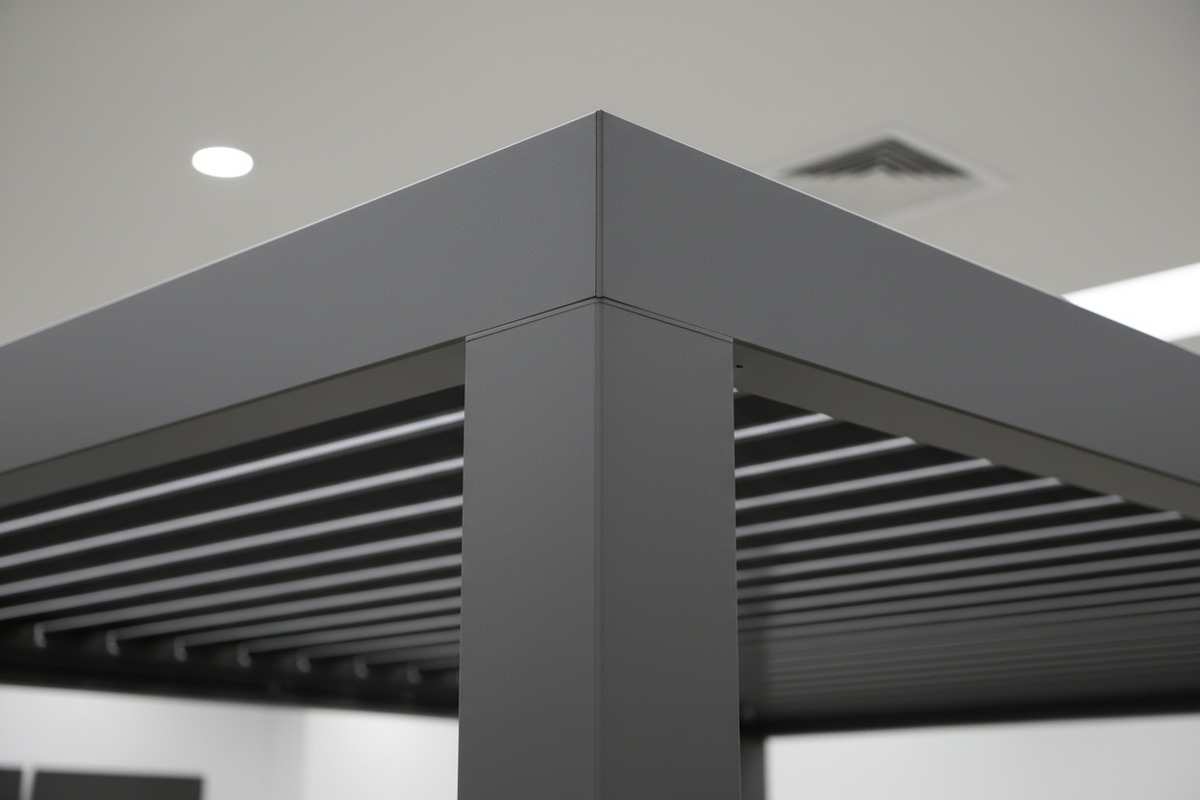
The joint where a beam meets a post is the most visible structural point. Budget pergolas use external brackets or visible through-bolts. Premium systems use internal locking mechanisms. The beam slides over a concealed steel connector, then is secured from inside with hidden set screws. From the outside, you see only a clean 90-degree junction.
Internal Drainage Design
Water management is where hidden engineering really shows. In a premium system, the louver channels collect rainwater and direct it into the main beam. The beam contains an internal gutter that slopes toward the posts. Inside each post, a vertical channel carries water down to ground level. No external downspouts. No add-on gutters.
| Drainage Feature | Budget Pergola | Premium Pergola |
|---|---|---|
| Gutter location | External, bolt-on | Internal, inside beam |
| Downspout | Visible external pipe | Hidden inside post |
| Roof edge | Visible drip channel | Flush, clean edge |
| Water exit point | Mid-post or base visible | Concealed at base plate |
Base Plate and Anchor Details
How the post meets the ground matters. A visible base plate with exposed anchor bolts looks industrial. Premium options include recessed anchor systems covered by a trim ring, or posts that sit inside a sleeve that hides the mounting hardware entirely. We offer both options depending on whether the installation is on concrete, decking, or raised platforms.
Corner Caps and End Treatments
Every extrusion has an open end. Budget products leave these open or cap them with a generic plastic insert. Premium pergolas use machined aluminum end caps that sit perfectly flush. The color matches exactly. There is no gap, no lip, no visible seam. This small detail costs very little to produce but changes the entire perception of the product.
Why Hidden Features Signal Quality
When a buyer or end user looks at a pergola and cannot see how it was assembled, they subconsciously read it as custom-made. Visible fasteners say "kit." Hidden fasteners say "architecture." This psychological effect is well documented in product design research and applies directly to outdoor structures.
How do I integrate LED lighting and zip blinds without ruining the minimalist aesthetic?
We learned this lesson the hard way on early export orders. Clients would install beautiful pergolas, then bolt aftermarket lights and screen tracks onto the frame. The result looked like a retrofit, not a design.
Integrate LED strips inside dedicated channels within the beam profiles, and specify zip blind guide rails that are built into the post extrusion from the factory. Pre-wiring during manufacturing keeps cables invisible and maintains the clean silhouette.
Lighting That Disappears by Day
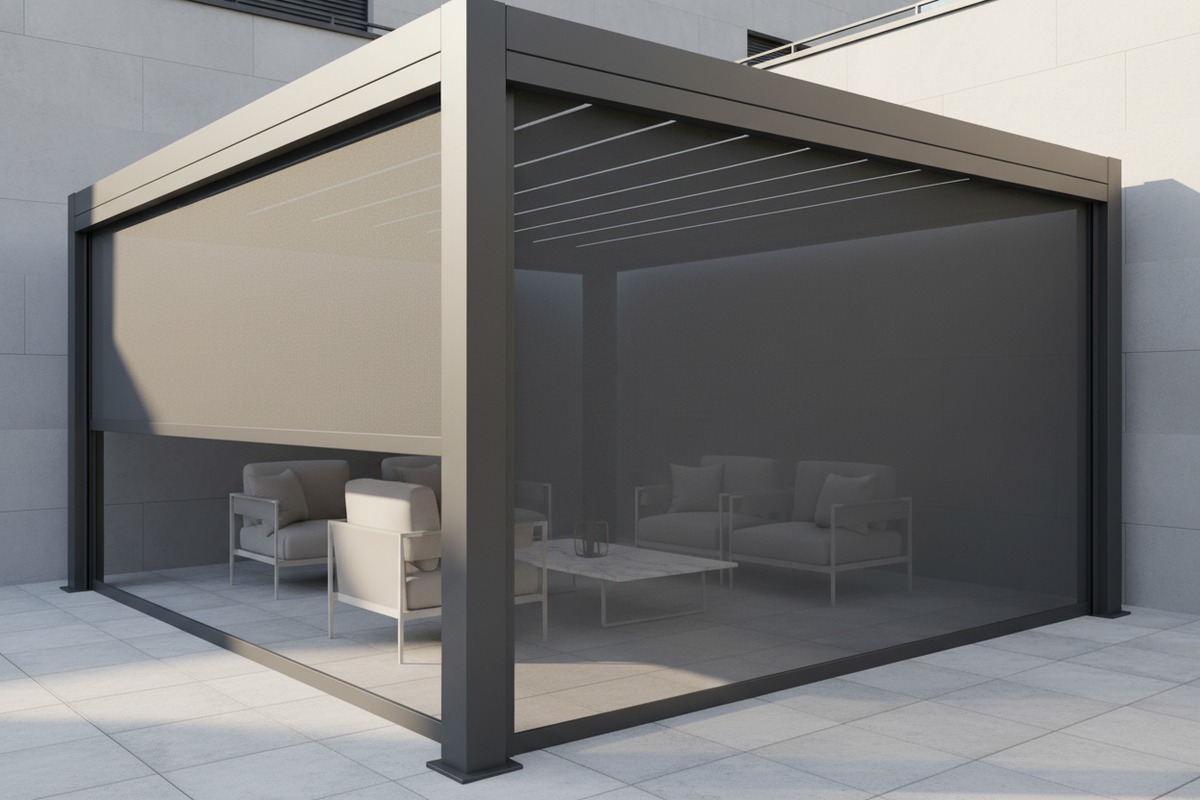
The key principle is simple: lighting should be invisible when off. Recessed LED channels inside the underside of beams achieve this. The light strip sits behind a frosted diffuser that is flush with the beam surface. When turned off, you see only a subtle line. When on, you get a warm, even glow across the ceiling plane.
We now design our beam extrusions with a dedicated LED slot as standard. This means the installer does not need to surface-mount anything. The wiring runs inside the hollow beam cavity, enters the post through an internal passage, and exits at the base where it connects to a concealed junction box.
Warm Light Temperature
Color temperature matters enormously. Cool white light (5000K+) feels commercial and harsh. Warm white (2700K-3000K) feels residential and inviting. For premium outdoor spaces, we recommend 3000K as the default. It creates a golden ambiance without looking yellow.
Zip Blind Integration
Zip blinds are increasingly popular for wind protection, privacy, and insect screening. But they can ruin a clean look if the guide rail is bolted to the outside of the post. The premium approach is to integrate the zip track directly into the post extrusion.
| Integration Method | Visual Impact | Installation Complexity | Cost Impact |
|---|---|---|---|
| Surface-mounted track | High - visible rail and brackets | Faible | Faible |
| Channel-integrated track | Minimal - track sits inside post | Moyen | Moyen |
| Fully recessed cassette | Zero - blind hidden when retracted | Haut | Haut |
Wiring Strategy
All cables for lights, motors, blinds, and sensors should be routed internally before the structure ships. We pre-drill cable passages at the factory and include a wiring diagram with every order. This means the electrician on site only connects at terminal points. No surface conduit. No cable clips on the frame.
Avoiding Feature Overload
A common mistake is adding too many accessories. Lights, fans, heaters, speakers, screens, and misting systems all at once can make even a well-designed pergola look cluttered. The premium approach is restraint. Choose two or three integrated features and execute them flawlessly rather than bolting on everything available.
On our extrusion line, we produce five different louver profiles. Each one creates a different shadow pattern, drainage behavior, and visual weight. The profile you choose defines the character of the entire pergola.
Select louver profiles with aerodynamic cross-sections, tight rotational tolerances, and integrated water channels. Elliptical or airfoil-shaped louvers with 200-250mm width create the best balance of visual elegance, rain protection, and light control for premium positioning.
Common Louver Profile Types
Not all louvers are equal. The cross-sectional shape determines how the roof looks from below, how water drains, and how much light passes through when partially open.
| Profile Shape | Width | Visual Character | Rain Seal | Best Application |
|---|---|---|---|---|
| Flat rectangular | 150mm | Simple, industrial | Moderate | Budget systems |
| Elliptical | 200mm | Soft, refined | Good | Mid-to-high end residential |
| Airfoil | 220mm | Architectural, sleek | Excellent | Premium commercial and residential |
| Double-skin hollow | 250mm | Substantial, quiet | Excellent | High-wind areas, acoustic needs |
| Curved asymmetric | 200mm | Distinctive, modern | Good | Design-forward projects |
Why Airfoil Profiles Look Premium
An airfoil louver 8 has a teardrop cross-section inspired by aircraft wing shapes. This creates a smooth, continuous surface when closed. When open, the tapered edge casts a thinner shadow line than a flat louver. The result is a roof that looks more engineered and less like a set of metal slats.
Rotational Precision
Premium louvers rotate smoothly with minimal gap variation between adjacent blades. This requires tight manufacturing tolerances on the pivot points and consistent blade straightness across the full span. On our production line, we hold louver straightness to within 0.5mm over a 4-meter span. This prevents the uneven gaps that make a roof look cheap from below.
Integrated Water Channels
Each louver blade can include a small channel along its edge that captures water when the blade is in the closed position. This water flows to the beam gutter without dripping between blades. Without this detail, rain can leak through even when louvers appear closed. It is a hidden feature that buyers notice only when it is missing.
Custom vs Standard Louver Widths
Wider louvers mean fewer blades per meter. Fewer blades create a cleaner ceiling plane with less visual repetition. However, wider louvers require stronger extrusion walls and more powerful motors. The sweet spot for premium residential systems is 200-250mm blade width. This gives a clean, open look while maintaining structural integrity and motor compatibility.
Standing Out in the Market
If you are a distributor or contractor looking to differentiate, the louver profile is your strongest visual tool. Most competitors use the same flat 150mm blade. Moving to a 220mm airfoil profile immediately signals a different tier of product. Pair this with tight gap tolerances and concealed pivot hardware, and you have a roof system that looks custom even when produced at scale.
Conclusion
Premium aluminum pergola design comes down to discipline: hide the hardware, refine the finish, proportion the frame to the space, and integrate every feature invisibly. The details you remove matter as much as the ones you add.
Notes de bas de page
1. Explains powder coating process, types, and importance for durability. ︎
2. Replaced HTTP 403 with a reputable company's explanation of AAMA specifications, including 2605. ︎
3. Explains Qualicoat Class 2 standards for superior outdoor durability in architectural aluminum. ︎
4. Discusses how hidden fasteners create seamless aesthetics in architectural design. ︎
5. Replaced HTTP unknown with an article on integrating seamless architectural drainage solutions. ︎
6. Comprehensive guide on architectural LED lighting systems, including strip applications. ︎
7. Replaced HTTP 403 with a reputable company's explanation of AAMA specifications, including 2604. ︎
8. Defines airfoil louvers and their aerodynamic design benefits in architectural applications. ︎