
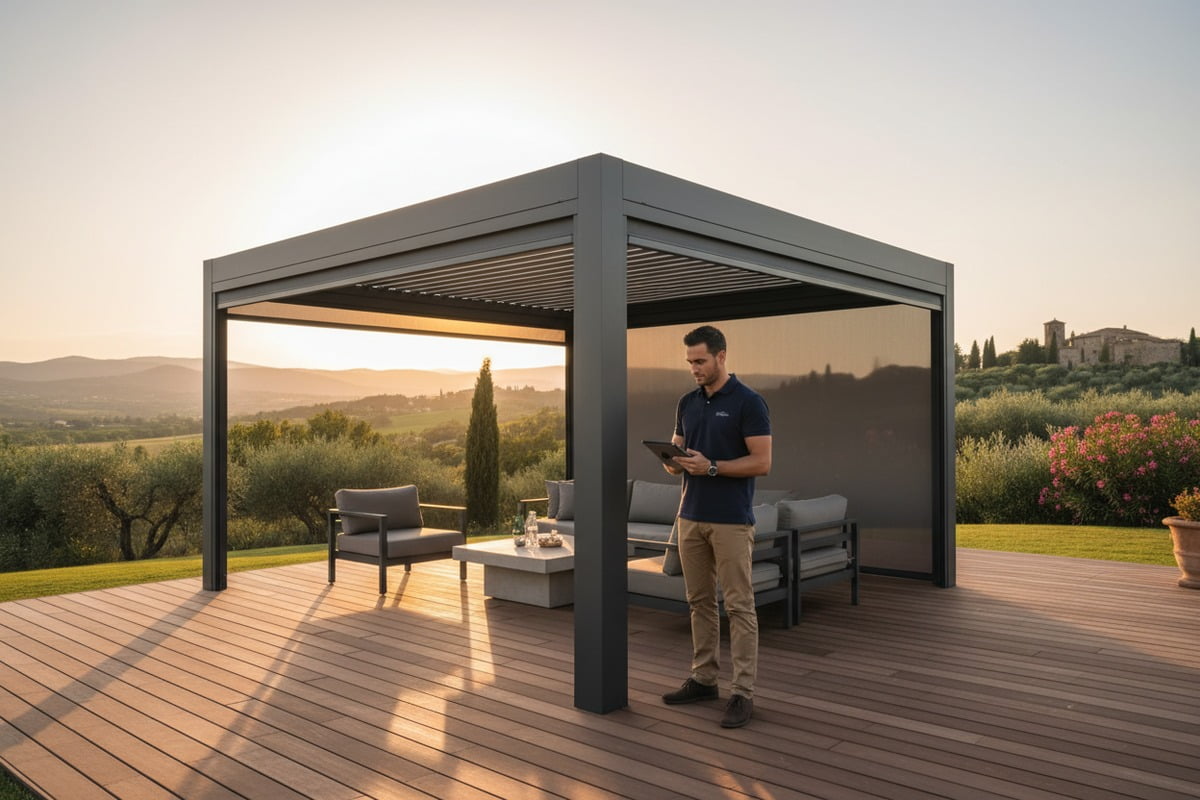
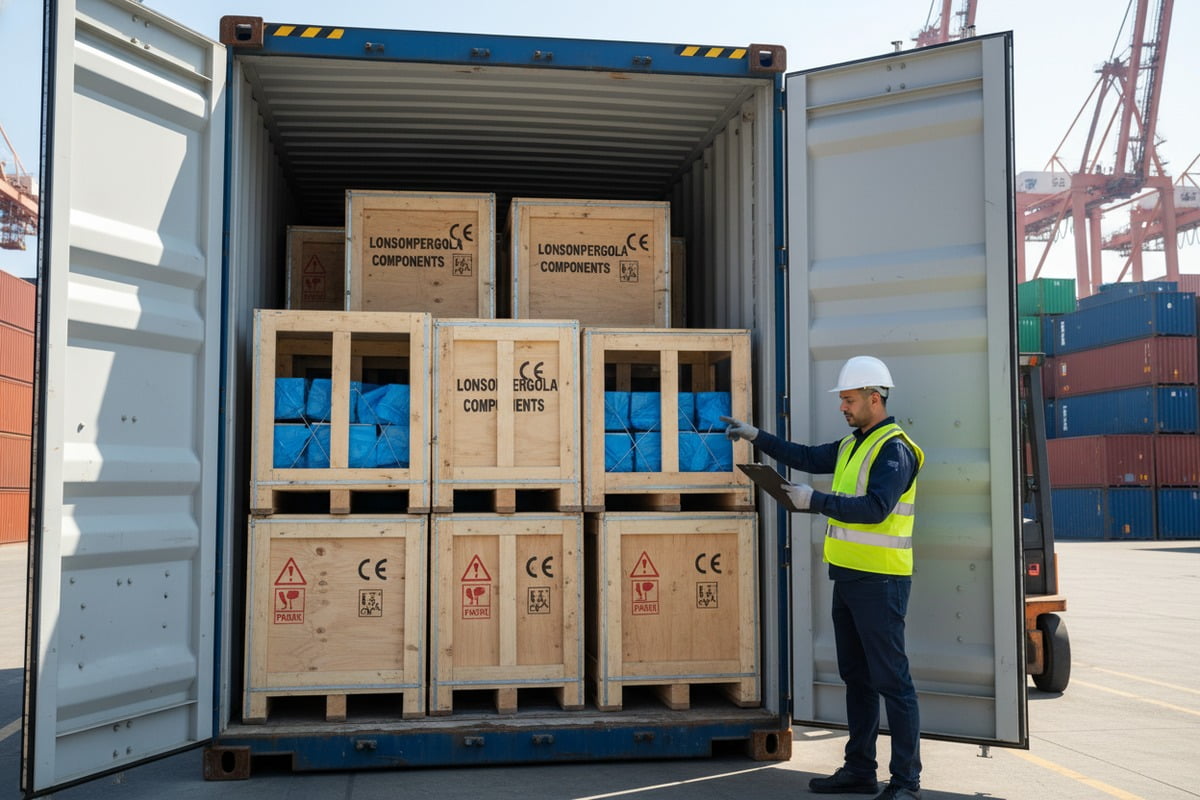
Every year, we ship thousands of aluminum pergola sets from our Hainan production base to European distributors and contractors CE marking directives 1. The question we hear most often is not about price or lead time — it is about compliance. One rejected shipment at a European port can cost tens of thousands of euros and destroy a business relationship overnight.
Sourcing aluminum pergolas from China for the European market requires compliance with CE marking directives, structural load certifications, REACH and RoHS chemical regulations, the Low Voltage and EMC directives for motorized components, anti-dumping duty assessments, and the new Carbon Border Adjustment Mechanism reporting obligations starting from 2026.
This guide walks you through each regulation step by step Low Voltage Directive (LVD) 2014/35/EU 2. We break down the certifications you need, the documents you should demand from your supplier, and the hidden cost traps that catch first-time importers off guard. Let us start with the most visible requirement: the CE mark.
How do I verify that my Chinese supplier's aluminum pergolas carry the mandatory CE marking for the European market?
We have seen too many European buyers receive containers of pergolas only to discover the CE mark on the packaging was self-declared with zero supporting documentation Electromagnetic Compatibility Directive (EMC) 2014/30/EU 3. This creates massive legal exposure under the new EU General Product Safety Regulation 4.
To verify CE marking, request the full Declaration of Conformity, the technical file referencing applicable directives, and third-party test reports from an EU-recognized notified body. Cross-check the certificate number against the NANDO database maintained by the European Commission.

What the CE Mark Actually Covers for Pergolas
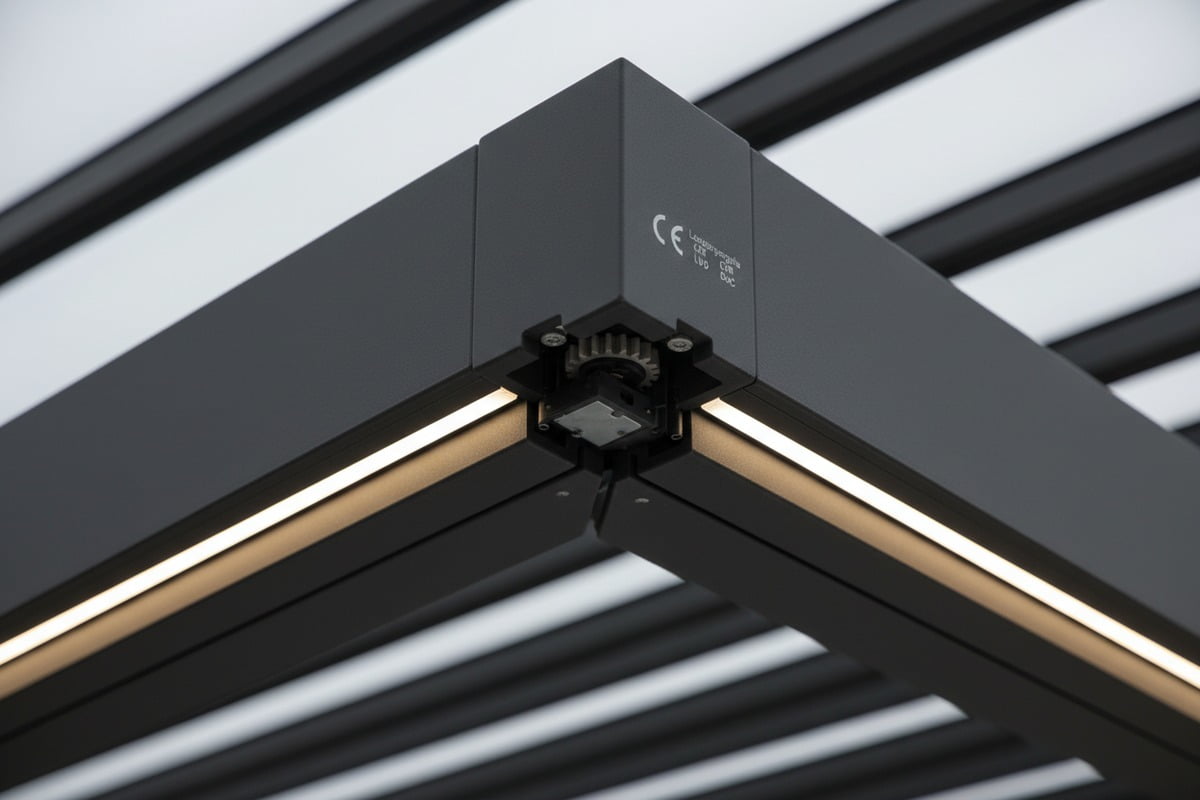
The CE mark is not a single certification. It is a declaration that a product meets all applicable EU directives. For an aluminum pergola with motorized louvers, retractable screens, and integrated LED lighting — like the models we produce on our line — several directives apply simultaneously.
The Construction Products Regulation (CPR) covers the structural aluminum frame. Construction Products Regulation (EU) 2024/3110 5 The Low Voltage Directive (LVD) covers motors and electrical connections. The Electromagnetic Compatibility Directive (EMC) covers electronic controls. If the pergola has wireless connectivity for app-controlled louvers, the Radio Equipment Directive (RED) also kicks in.
Steps to Verify Authenticity
First, ask your supplier for the Declaration of Conformity (DoC). This is a legal document signed by the manufacturer. It must list the product name, model numbers, applicable directives, harmonized standards used, and the name and address of the person responsible for compiling the technical file.
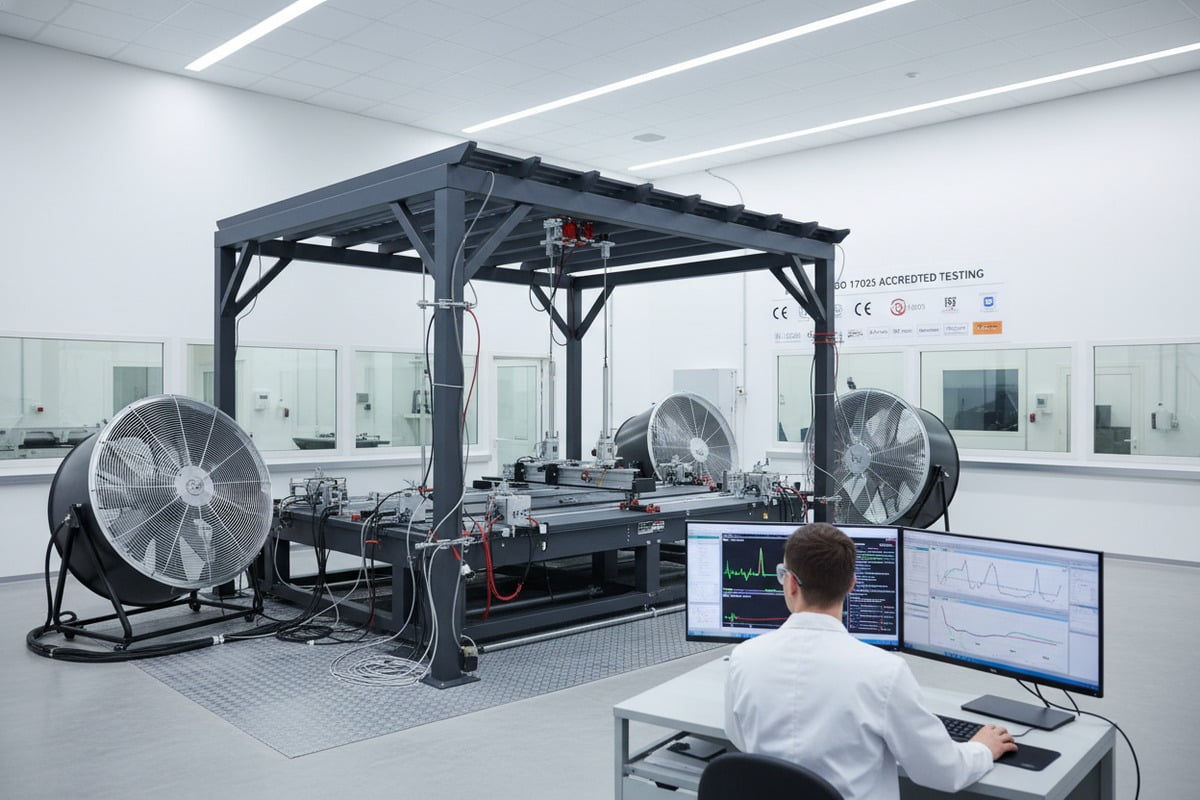
Second, check whether the test reports come from an accredited laboratory. Look for ISO 17025 accreditation. If a notified body was involved, search for the body's four-digit number on the European Commission's NANDO database 6.
Third, since December 13, 2024, the EU General Product Safety Regulation (GPSR) requires every consumer product to have an EU-based "responsible person." This person must be named on the product or packaging. If your supplier cannot name one, you as the importer become that person — and you inherit all liability.
Key Documents Checklist
| Document | Purpose | Who Provides It |
|---|---|---|
| Declaration of Conformity (DoC) | Legal declaration of compliance with EU directives | Manufacturer (your supplier) |
| Technical File | Full design, risk assessment, test reports | Manufacturer, kept available for 10 years |
| Third-Party Test Reports | Proof of testing to harmonized standards | Accredited testing laboratory |
| GPSR Responsible Person Details | EU contact for product safety authorities | Manufacturer or EU-based representative |
| NANDO Verification | Confirms notified body legitimacy | European Commission database |
At our factory, we compile the complete technical file during the R&D stage and assign a European-based responsible person for every order destined for the EU. This is not optional. It is the law.
Watch Out for Self-Declared CE Marks
Many Chinese suppliers apply CE marks based on self-declaration alone. For purely structural aluminum frames without electrical components, self-declaration may be legally acceptable under certain conditions. But the moment you add a motor, sensor, or LED strip, third-party testing becomes practically essential to defend your position if authorities challenge you.
One of our Italian distributors once sourced a sample batch from another factory. The CE mark was printed on the box but the supplier could not produce a single test report. Italian market surveillance seized the shipment. The cost was not just the lost goods — it was six months of delayed project deliveries.
What specific wind and snow load certifications should I demand to ensure structural safety in my region?
When our engineering team designs a pergola for a client in northern Germany versus southern Spain, the structural calculations are completely different. Getting this wrong does not just risk a warranty claim — it risks a roof collapse.
Demand wind and snow load test reports calculated according to Eurocode EN 1991 (Actions on Structures), specifying the exact wind zone and snow zone for your installation region. Your supplier must provide structural calculations signed by a qualified engineer confirming the pergola meets local load requirements.
Why One Size Does Not Fit All
Europe is divided into wind zones and snow zones under the Eurocode system. A pergola installed in coastal Netherlands faces wind loads that can exceed 1.5 kN/m², while an installation in the Italian Alps may need to handle snow loads above 2.0 kN/m². The same pergola frame that performs perfectly in Lisbon could fail catastrophically in Munich.
The relevant standard is EN 1991-1-3 for snow loads and EN 1991-1-4 for wind actions 7. These are not optional recommendations. They are referenced in national building codes across EU member states.
What Your Supplier Must Provide
Ask for a structural calculation report, not just a generic brochure claim like "wind resistant up to 120 km/h." That number means nothing without context. The report should specify the design wind pressure in kN/m², the snow load capacity in kN/m², the aluminum alloy grade used (typically 6063-T5 or 6061-T6), and the wall thickness of each profile.
At our production facility, we use finite element analysis (FEA) software to model every custom pergola design before production. We generate project-specific load reports that our European clients can submit to their local building authorities.
Regional Load Reference Table
| Region Example | Typical Wind Load Requirement | Typical Snow Load Requirement | Eurocode Reference |
|---|---|---|---|
| Southern Spain, coastal | 0.8–1.0 kN/m² | 0.2–0.4 kN/m² | EN 1991-1-4, Zone A |
| Central France | 0.9–1.2 kN/m² | 0.5–1.0 kN/m² | EN 1991-1-3/4 |
| Northern Germany, coastal | 1.2–1.8 kN/m² | 0.5–0.85 kN/m² | EN 1991-1-4, Zone 3-4 |
| Austrian Alps, 1000m+ | 0.7–1.0 kN/m² | 2.0–4.5 kN/m² | EN 1991-1-3, Zone 3 |
| Netherlands, flat terrain | 1.0–1.5 kN/m² | 0.7 kN/m² | NEN-EN 1991 |
These are simplified reference ranges. Your structural engineer should calculate exact values based on the specific altitude, terrain category, and building exposure of each project site.
National Building Permits
Beyond the Eurocode standards, each EU member state — and sometimes each municipality — has its own building permit requirements. In Germany, pergolas above a certain size require a Baugenehmigung. In France, a déclaration préalable de travaux may be needed. Your supplier's structural documentation must be robust enough to satisfy these local authorities.
We always recommend that our clients work with a local structural engineer who can stamp the calculations for their specific jurisdiction. Our role is to provide the raw data, alloy specifications, and FEA models they need to complete that process quickly.
The Hidden Risk of Thin Walls
One of the most common cost-cutting tactics in our industry is reducing the wall thickness of aluminum extrusions from 2.0 mm to 1.2 mm. On paper, the pergola looks identical. In a storm, it folds like cardboard. Always request a material certificate showing the exact alloy, temper, and wall thickness. Then verify the supplier's claims against the structural calculation.
How can I confirm that the integrated motors and electronic components meet EU low voltage and electromagnetic compatibility standards?
Our production line integrates Somfy, Becker, and in-house motors into pergola systems every day. The difference between a compliant motor and a non-compliant one is invisible to the naked eye but absolutely critical at customs.
Confirm compliance by requesting LVD test reports per EN 60335-1 (general safety) and EN 60335-2-97 (motorized awnings/blinds), plus EMC test reports per EN 55014-1 (emissions) and EN 55014-2 (immunity). Verify certificates come from accredited labs and match the exact motor model installed in your pergola.
The Two Directives You Cannot Ignore
Any pergola with motorized louvers, retractable zip screens, or integrated lighting falls under two critical EU directives:
Low Voltage Directive (LVD) 2014/35/EU covers electrical safety for equipment operating between 50V and 1000V AC. This applies to the motor, the transformer, the wiring, and any control unit.
Electromagnetic Compatibility Directive (EMC) 2014/30/EU ensures the electronic components do not emit electromagnetic interference that disrupts other devices, and that they can withstand interference from nearby equipment.
Which Standards Apply to Pergola Motors
The harmonized standards for pergola motor systems are specific. Generic "CE certificates" that reference broad standards are a red flag.
| Composant | Applicable Standard | What It Tests |
|---|---|---|
| Motor unit | EN 60335-2-97 | Safety of motor-operated shutters, awnings, blinds |
| General electrical safety | EN 60335-1 | Household appliance safety baseline |
| EMC emissions | EN 55014-1 | Limits on electromagnetic disturbance |
| EMC immunity | EN 55014-2 | Resistance to external electromagnetic interference |
| Remote control (RF) | EN 300 220 / RED 2014/53/EU | Radio frequency compliance for wireless controls |
| LED lighting | EN 62031, EN 61347 | LED module and driver safety |
How to Spot Fake or Mismatched Certificates
We encounter this problem frequently when buyers bring us competitor quotes for comparison. A supplier provides a CE certificate for a motor, but the model number on the certificate does not match the motor actually installed in the pergola. Or the certificate references a different voltage or power rating.
Always cross-reference three things: the motor model number, the voltage and power rating, and the testing laboratory's accreditation. If the lab is not listed in the ILAC (International Laboratory Accreditation Cooperation) database, treat the report with extreme caution.
WEEE and RoHS Obligations
If your pergola includes any electrical or electronic components, it falls under the WEEE Directive (2012/19/EU). This means you must register with the national WEEE compliance scheme in each EU country where you sell, contribute to recycling costs, and label products with the crossed-out wheelie bin symbol.
RoHS compliance (Directive 2011/65/EU) restricts hazardous substances like lead, mercury, and cadmium in electrical components. Request a RoHS test report for every electronic part in the pergola — motor, control board, LED driver, remote receiver.
Smart Pergola Considerations
For pergolas with app-controlled louvers, rain sensors, or integrated smart home connectivity, the Radio Equipment Directive (RED) applies. Additionally, emerging EU cybersecurity regulations will soon require connected devices to meet baseline security requirements. If your pergola has Wi-Fi or Bluetooth, prepare for this now.
Our R&D team designs control systems with firmware update capability specifically to future-proof against these evolving cybersecurity requirements. This is not a theoretical concern. The EU Cyber Resilience Act is expected to apply to connected consumer products by 2027.
What material safety reports do I need to request to prove my imported pergolas comply with REACH and environmental regulations?
During a recent factory audit by one of our German wholesale partners, the first documents they asked for were not about structural strength or motor performance. They asked for our REACH SVHC declarations and powder coating test reports. Environmental compliance is now a deal-breaker, not a nice-to-have.
Request a REACH SVHC (Substances of Very High Concern) declaration, a powder coating test report per EN 12206-1 or Qualicoat standards, a material composition certificate for all aluminum alloys, and CBAM embedded emissions data. These documents prove chemical safety, coating durability, and carbon compliance for EU import.
REACH Regulation: What It Means for Aluminum Pergolas
REACH (EC 1907/2006) 9 requires that any product imported into the EU must not contain Substances of Very High Concern (SVHCs) above 0.1% by weight in any article. The SVHC candidate list is updated twice per year and currently contains over 230 substances.
For aluminum pergolas, the main REACH risks come from:
- Powder coatings that may contain restricted pigments or heavy metals
- Chromate conversion coatings used in surface pretreatment (hexavalent chromium is an SVHC)
- Rubber seals and gaskets that may contain restricted plasticizers
- Stainless steel fasteners that may release nickel above permitted levels
Our surface treatment line uses chromium-free pretreatment processes specifically to eliminate the hexavalent chromium risk. This decision cost more upfront but saves our clients the compliance headache entirely.
Powder Coating Durability Standards
European buyers, especially in the Mediterranean and coastal regions, demand high-performance powder coatings. Two main certification systems govern coating quality:
Qualicoat is the European standard for powder-coated architectural aluminum. It specifies adhesion, hardness, gloss retention, UV resistance, and corrosion resistance. Seaside Class (Class 3) is required for installations within 5 km of the coast.
EN 12206-1 is the harmonized European standard that underpins Qualicoat testing. It defines the minimum requirements for powder coatings on aluminum for architectural applications.
Environmental Compliance Document Checklist
| Document | Regulation | Key Content |
|---|---|---|
| REACH SVHC Declaration | EC 1907/2006 | Confirms no SVHCs above 0.1% threshold |
| RoHS Declaration (electrical parts) | 2011/65/EU | Confirms restricted substance limits for electronics |
| Powder Coating Test Report | EN 12206-1 / Qualicoat | Adhesion, UV, salt spray, humidity resistance results |
| Material Test Certificate (MTC) | EN 10204 3.1 | Alloy composition, mechanical properties of aluminum |
| CBAM Emissions Report | EU 2023/956 | Embedded CO2 emissions per ton of aluminum |
| Scrap/Recycled Content Declaration | Voluntary / ESPR future | Percentage of post-consumer recycled aluminum used |
The CBAM Factor
Starting in 2026, the Carbon Border Adjustment Mechanism 10 will impose a carbon price on aluminum imports based on their embedded emissions. During the current transitional phase (2023–2025), importers must report emissions but do not yet pay. From 2026, you will purchase CBAM certificates tied to the EU Emissions Trading System carbon price.
Chinese primary aluminum production is heavily coal-powered, resulting in roughly 16–20 tons of CO2 per ton of aluminum produced. The EU average is around 6–8 tons. This differential means Chinese-sourced pergolas will carry a significant CBAM cost.
At our facility, we track embedded emissions across our supply chain and provide CBAM-ready data to our European importers. We are also increasing our use of recycled aluminum billet to reduce the carbon intensity of our products. Currently, about 35% of our aluminum input comes from post-consumer scrap.
Anti-Dumping Duties: Current Status
Anti-dumping duties on Chinese aluminum flat-rolled products, which were in the range of 14.3%–24.6%, expired on October 12, 2026. However, duties on specific aluminum foil types persist. Aluminum extrusion profiles — the primary component of pergola frames — have faced separate AD investigations in some markets.
Always confirm the correct HS code classification for your pergola. Garden structures may fall under 7308 (structures of iron or steel/aluminum) or 9406 (prefabricated buildings). The classification determines your duty rate, which typically ranges from 2%–8% plus 15%–25% VAT depending on the member state.
Supply Chain Circumvention Risks
The EU actively investigates circumvention schemes where Chinese aluminum is routed through Turkey, Thailand, or Vietnam with minimal processing to avoid AD duties. If your supplier proposes shipping from a third country, ensure genuine substantial transformation occurs there. Otherwise, you risk retroactive duty assessments and penalties.
Conclusion
European market access for Chinese aluminum pergolas demands rigorous attention to CE marking, structural certifications, electrical compliance, and environmental regulations. Partner with a supplier who provides complete documentation proactively — it protects your business, your reputation, and your customers.
Notes de bas de page
- Official EU information on CE marking requirements and benefits. ︎
- Official EU information on electrical safety for equipment within voltage limits. ︎
- Official EU information on limiting electromagnetic interference from equipment. ︎
- Official text of Regulation (EU) 2023/988 on general product safety on EUR-Lex. ︎
- The previous Construction Products Regulation (EU) No 305/2011 has been superseded by Regulation (EU) 2024/3110. This is the official EUR-Lex link for the new regulation. ︎
- Official European Commission database for notified bodies under EU directives. ︎
- Detailed engineering overview of the specific Eurocode standard for wind loads. ︎
- General overview of the European standards for structural design. ︎
- Official European Commission overview page for the REACH (Registration, Evaluation, Authorisation and Restriction of Chemicals) Regulation (EC 1907/2006). ︎
- Official European Commission overview page for the Carbon Border Adjustment Mechanism (CBAM). ︎