Every week, our sales team receives inquiries from buyers who love our aluminum pergolas 1 but hesitate because the MOQ feels too high for a first order.
To negotiate aluminum pergola MOQs with Chinese suppliers, offer a 20–30% unit price premium on a trial order of 50–200 sets, present a clear long-term volume forecast, request stock aluminum profiles instead of custom extrusions, and propose a phased ordering plan that scales to full MOQ within 3–6 months.
This guide walks you through the exact tactics that work—based on real conversations we have with buyers every day at our Hainan facility custom OEM designs 2. Let's break it down step by step.
How can I convince a Chinese supplier to lower the MOQ for my first trial shipment?
Most buyers assume the MOQ posted on Alibaba is carved in stone. Our experience shipping over 80,000 sets per year tells a very different story.
You can convince a Chinese supplier to lower the MOQ by showing genuine long-term buying intent, sharing sales forecasts or market data, accepting a higher unit price for the trial batch, and choosing stock aluminum profiles and standard colors to reduce the supplier's setup costs.
Why Suppliers Set High MOQs in the First Place
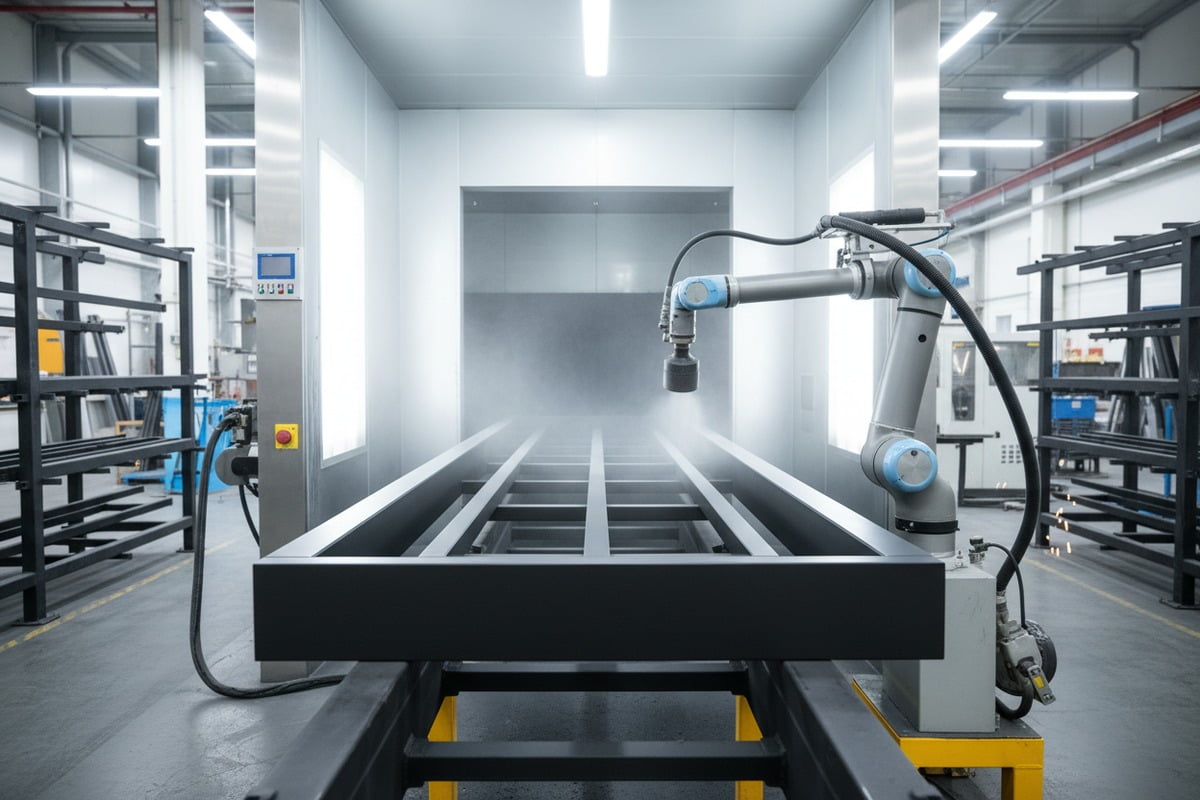
Understanding the "why" gives you leverage. When our production team sets up an extrusion line for a specific pergola profile, there are real costs: die preparation, powder coating calibration 3, welding fixture setup, and quality inspection protocols. These costs are fixed whether we run 50 sets or 500. A high MOQ spreads those costs across more units, keeping the per-unit price low.
Here is a quick breakdown of typical setup costs for aluminum pergola production:
| Cost Category | Approximate Cost (USD) | Spread Over 500 Units | Spread Over 100 Units |
|---|---|---|---|
| Extrusion die setup 4 | $800–$1,500 | $1.60–$3.00/unit | $8.00–$15.00/unit |
| Powder coating calibration | $200–$400 | $0.40–$0.80/unit | $2.00–$4.00/unit |
| Welding fixture preparation | $300–$600 | $0.60–$1.20/unit | $3.00–$6.00/unit |
| Quality inspection setup | $100–$200 | $0.20–$0.40/unit | $1.00–$2.00/unit |
| Total setup overhead | $1,400–$2,700 | $2.80–$5.40/unit | $14.00–$27.00/unit |
As you can see, the math changes fast when you shrink the order. But that does not mean negotiation is impossible. It means you need to address the supplier's real concern: covering those costs.
Practical Steps to Lower the MOQ
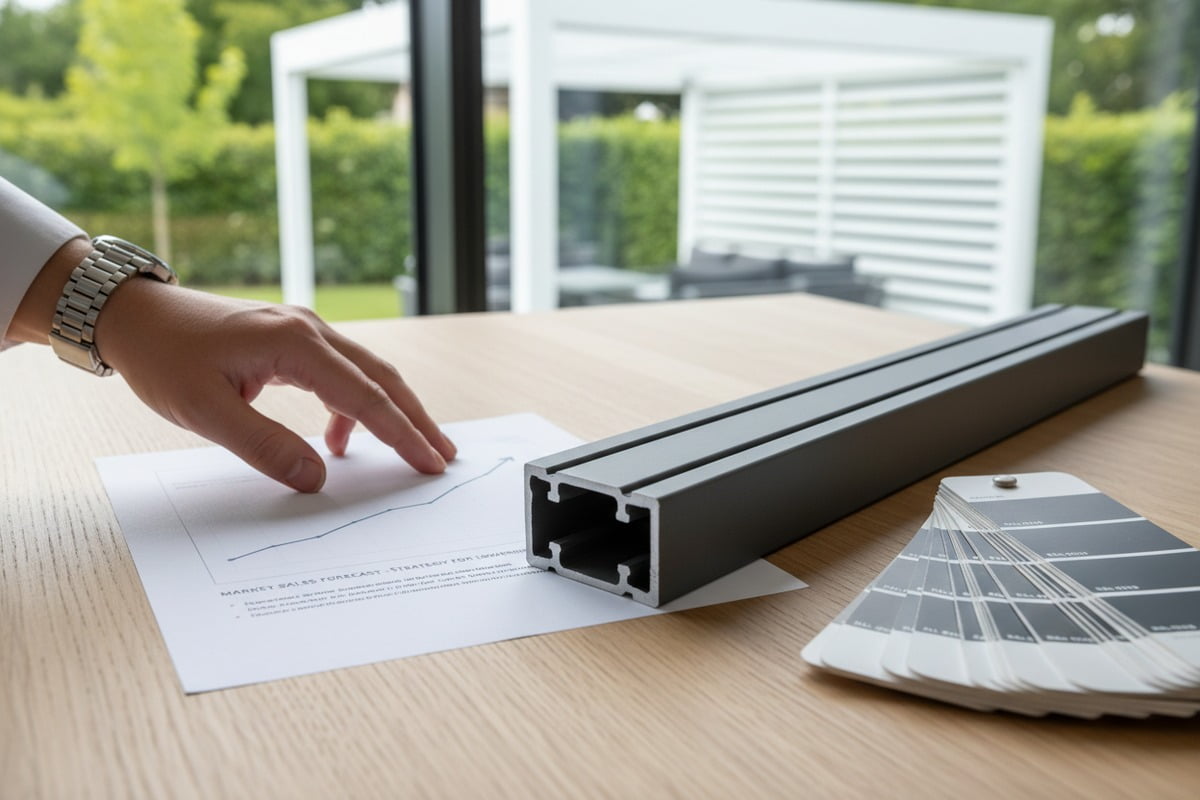
Step 1: Choose stock profiles. Most factories, including ours, keep standard aluminum extrusion profiles (square posts, louvered blades, beam channels) in inventory. When you use these instead of requesting custom cross-sections, you eliminate the biggest cost barrier.
Step 2: Stick to standard RAL colors. Common colors like RAL 7016 (anthracite grey), RAL 9005 (jet black), and RAL 9016 (traffic white) are always loaded in our coating line. Custom colors require a full flush and re-calibration.
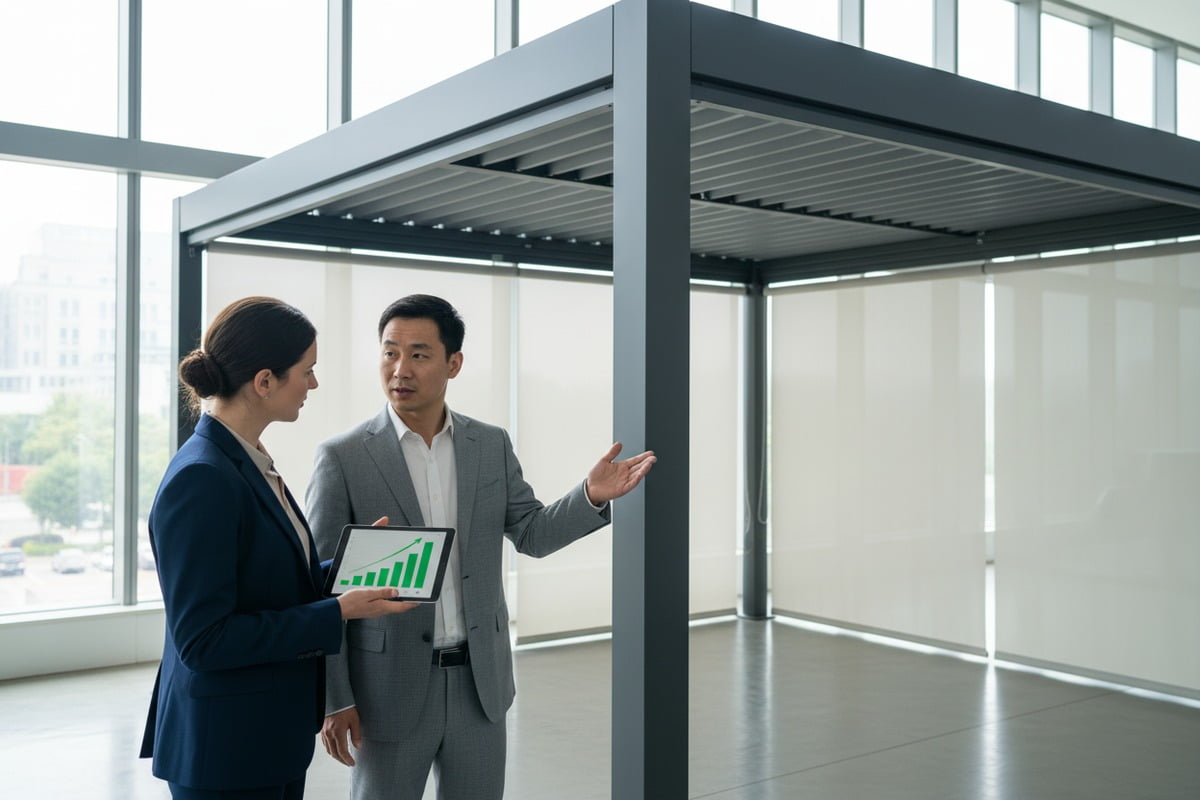
Step 3: Share your volume roadmap. Tell the supplier: "I plan to test 100 units in Q1. If they sell, I will order 500 in Q2 and 1,000 by Q4." This is exactly the kind of language that moves our production planning team to approve a smaller first run.
Step 4: Offer to pay a deposit upfront. A 50% deposit on a trial order signals commitment. It covers the supplier's material procurement risk and often unlocks flexibility.
Step 5: Target the right supplier type. Factories in Guangdong and Foshan hubs often have overcapacity on extrusion lines, especially in low season. Trading companies may accept 100-unit orders but typically add a 10–20% markup. Go direct to factories if you want the best negotiation room.
Will my request for custom OEM designs make it harder to negotiate a smaller order quantity?
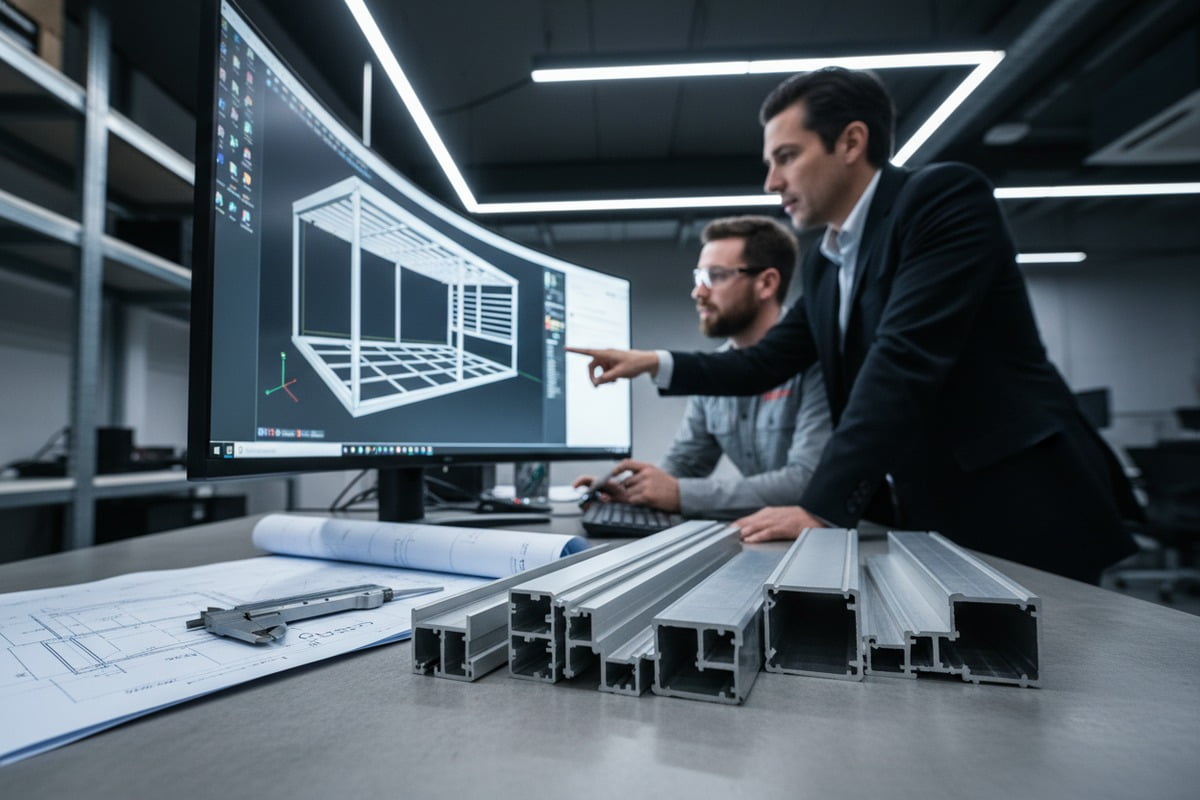
When our engineering team receives a request for a non-standard pergola size with a unique louver profile and a special RAL color, the conversation about MOQ changes immediately.
Yes, custom OEM designs typically raise the MOQ because they require new extrusion dies, unique welding jigs, and dedicated powder coating runs. However, you can minimize the impact by modularizing your design, sharing tooling costs, and limiting customization to branding elements rather than structural components.
How Customization Drives Up MOQ
Every custom element adds a setup layer. A new extrusion profile needs a new die, which costs $800–$2,000 and takes 15–25 days to produce. A unique welding configuration requires a new jig. A special surface finish demands a separate coating run. The supplier needs to recover these investments, and the easiest way is to require more units.
But here is the nuance: not all customization is equal. There is a big difference between changing the structural cross-section of a post and simply laser-engraving your logo on a standard beam.
The Customization Spectrum
| Level of Customization | Examples | Impact on MOQ | Typical MOQ Range |
|---|---|---|---|
| Branding only | Laser logo, custom packaging, label | Minimal | 50–100 sets |
| Dimensional tweaks | Adjusting a 3x4m standard to 3.5x4.5m | Moderate | 100–200 sets |
| New color or finish | Non-standard RAL, wood-grain transfer | Moderate to high | 150–300 sets |
| New extrusion profile | Custom louver blade shape, unique post design | High | 300–500 sets |
| Full ground-up design | Entirely new structure with proprietary joints | Very high | 500+ sets |
Smart Strategies for Custom Orders at Low MOQ
Use modular design. Our R&D team often advises buyers to keep the main frame standardized and customize only the accessories—roof panels, drainage channels, or integrated LED tracks. This way, the factory can batch-produce the structural components across multiple clients and dedicate a short custom run only to your unique parts.
Split the tooling cost. Offer to pay 50% or even 100% of the die cost upfront. When our buyer in Italy did this for a curved beam profile, we approved a 120-unit trial instead of our standard 300-unit MOQ. The die becomes the buyer's asset, and it signals serious commitment.
Ask about existing molds. Many factories have libraries of dies from previous projects. Our facility alone has over 200 extrusion die sets. Your "custom" design might already be close to something we have produced before, requiring only minor modification.
Negotiate OEM versus ODM carefully. If you bring your own complete design (OEM), the supplier bears less design risk but more tooling risk. If you ask the supplier to design for you (ODM), they may absorb some tooling cost because they can potentially reuse the design for other buyers. Use this dynamic to your advantage.
How do I balance the unit price increase when I'm only ordering a few sets of pergolas?
Our finance team sees this tension every day: buyers want small trial quantities, but the price per set jumps enough to squeeze their margins back home.
To balance the unit price increase on small pergola orders, focus on reducing non-essential customization, choose knock-down flat-pack designs to lower shipping costs per unit, bundle pergola accessories like zip blinds or LED kits into the order, and negotiate a retroactive discount clause that refunds part of the premium once you scale to full MOQ.
Understanding the Price Premium Math
Let's look at a real-world pricing scenario. Say the standard price for a 3x4m louvered aluminum pergola at 500 units is $620 per set. When you drop to 100 units, the supplier needs to cover those same fixed costs across fewer sets. Here is how the numbers typically shift:
| Order Quantity | Unit Price (FOB) | Setup Cost Per Unit | Effective Total Per Unit | Premium vs. 500-Unit Price |
|---|---|---|---|---|
| 500 sets | $620 | $5 | $625 | Baseline |
| 300 sets | $650 | $9 | $659 | +5.4% |
| 200 sets | $690 | $14 | $704 | +12.6% |
| 100 sets | $745 | $27 | $772 | +23.5% |
| 50 sets | $820 | $54 | $874 | +39.8% |
The premium is real. But it is not the whole picture. There are several ways to claw back margin.
Tactics to Offset the Premium
Reduce shipping cost per unit. Knock-down (flat-pack) pergola designs are a game-changer. knock-down flat-pack designs 7 A fully assembled 3x4m pergola takes enormous container space. The same pergola in knock-down format fits neatly into compact cartons. We typically fit 20–40 knock-down pergola sets in a single 40-foot container versus 8–12 assembled units. This dramatically lowers your per-unit freight cost.
Bundle accessories. Adding zip blinds, mosquito screens, LED light strips, or rain gutters to your order increases the total order value without requiring more pergola frames. Many suppliers, including our team, view total order value as more important than unit count. A 100-pergola order at $620 each is $62,000. Add $80 worth of accessories per unit and you reach $70,000—closer to the value of a 120-unit pure pergola order.
Negotiate a retroactive rebate. This is a powerful tactic. Ask the supplier to agree in writing: "If I place a follow-up order of 300+ units within 6 months, you will refund $30 per unit on my original trial order." This aligns both parties' interests. The supplier gets a committed buyer. You get a safety net on your trial margin.
Optimize your product mix. If you are testing multiple pergola models, consolidate them into one shipment. Even if each model has only 30 units, a combined shipment of 90 sets across three models often qualifies for better pricing than three separate 30-unit orders.
When the Premium Is Worth It
Do not fear the price increase if your market can absorb it. A pergola that costs you $772 on a trial order and retails for $2,500 in Europe still delivers healthy margin. The trial is not about maximizing profit on the first batch. It is about validating demand, testing logistics, and building a supplier relationship. The real money comes on order two.
Can I use a trial order to test the supplier's packaging and logistics before committing to a full container?
One of the most painful stories we hear from new buyers involves a first container arriving with scratched profiles, missing screws, and installation manuals in the wrong language. Our quality team built our entire pre-shipment checklist around preventing exactly these failures.
Absolutely. A trial order is the best way to evaluate a supplier's packaging durability, component completeness, labeling accuracy, and logistics reliability before you commit thousands of dollars to a full production run. Treat the trial as a stress test for the entire supply chain, not just the product.
What to Test During a Trial Order
A trial order is your low-risk laboratory. Here is what you should inspect—and demand—before you sign off on a long-term partnership.
Packaging Integrity
Aluminum pergola profiles are prone to scratching, denting, and bending during ocean freight. Our packing team uses EPE foam wrapping 8, corner protectors, and reinforced carton boxes with internal dividers. Ask your supplier to send you photos and videos of the packing process. Better yet, request a third-party inspection before the container is sealed.
Key items to verify:
- Are all aluminum profiles individually wrapped in protective film?
- Do cartons have internal separators to prevent profiles from rubbing?
- Are heavy components (motors, posts) packed at the bottom with lighter parts on top?
- Is the outer carton rated for stacking (at least ECT-32 for ocean freight)?
Component Completeness
Missing a single non-standard bolt can halt an entire installation job. This is a major pain point for European buyers who cannot source replacement hardware locally. During your trial, count every single fastener, connector, and bracket against the BOM (bill of materials) 9.
We include a parts checklist in every carton with QR codes linking to an online parts verification tool. Ask your trial supplier if they offer anything similar. If they do not, request a detailed packing list with photos of every hardware bag.
Installation Documentation
Clear assembly guides save your end customers hours of frustration—and save you expensive support calls. Evaluate the supplier's installation manual for:
- 3D exploded-view diagrams (not just flat drawings)
- Step-by-step numbered instructions
- Multilingual support (at minimum English; Italian, German, French for EU markets)
- Video links or QR codes to installation videos
Logistics and Shipping Performance
Track the following metrics on your trial shipment:
- Did the supplier meet the promised production lead time?
- Was the container loaded correctly (no shifting, proper weight distribution)?
- Did the freight forwarder deliver on schedule?
- Were customs documents (commercial invoice, packing list, certificate of origin 10) accurate and complete?
Using Your Trial as a Negotiation Tool
Here is the strategic angle most buyers miss. When your trial arrives and everything checks out, you now have concrete evidence to negotiate better terms on your full order. You can say: "Your packaging survived a 35-day sea voyage with zero damage. I am ready to scale to 500 units. Let's talk about the volume price." That conversation is far more powerful than any pre-order negotiation.
Conversely, if the trial reveals problems—dented profiles, missing parts, late shipment—you have identified issues at low cost. Fixing these on a 100-unit order costs far less than discovering them on a 1,000-unit shipment.
The Trial Order Roadmap
Think of your trial as a four-phase process:
Phase 1: Place a 50–100 unit trial with premium pricing. Inspect everything.
Phase 2: Provide detailed feedback. Request corrections on packaging, documentation, or product quality.
Phase 3: Place a 200–300 unit follow-up within 3 months. Negotiate pricing down toward standard MOQ rates.
Phase 4: Scale to 500+ units with optimized pricing, proven quality, and a reliable logistics channel.
This phased approach is how the most successful importers we work with build partnerships that last for years. It is methodical, low-risk, and it gives both sides time to calibrate.
Conclusion
Negotiating aluminum pergola MOQs with Chinese suppliers is not about arm-twisting. It is about showing commitment, reducing the supplier's risk, and building a partnership step by step. Start with a smart trial, test everything, and scale with confidence.
Footnotes
- Provides a general definition and modern materials used for pergolas. ↩︎
- Provides an authoritative definition of Original Equipment Manufacturer (OEM). ↩︎
- Details the importance and process of calibrating powder coating ovens for consistent results. ↩︎
- Explains what an aluminum extrusion die is and its role in the manufacturing process. ↩︎
- Explains what standard aluminum extrusion profiles are and their applications. ↩︎
- Official site for RAL colors, a globally recognized color matching system. ↩︎
- Highlights the benefits of flat-pack designs, including reduced shipping costs. ↩︎
- Describes the properties and uses of EPE foam as a protective packaging material. ↩︎
- Defines Bill of Materials (BOM) and its importance in manufacturing and supply chain. ↩︎
- Reference 10. ↩︎