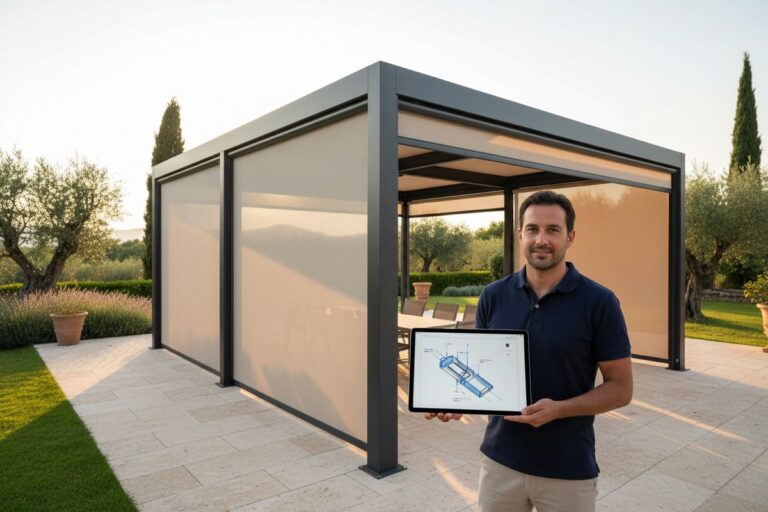

Every year, our production team hosts dozens of buyer inspection visits at our facility in China powder coating adhesion 1. One thing we notice again and again is this: buyers who skip on-site verification often face the costliest surprises.
To verify China aluminum pergola suppliers, arrange a multi-stage factory inspection covering legal documents, aluminum profile specifications, quality control systems, OEM assembly capabilities, and packaging standards. Use third-party auditors or visit in person to confirm production capacity, certifications like ISO 9001, and export compliance before placing orders.
This guide walks you through each critical step quality control process 2. You will learn what to check, what red flags to watch for, and how to protect your investment from start to shipment. Let's get into the details.
What key technical specifications should I verify during my on-site inspection of the aluminum profiles?
When we extrude aluminum profiles 3 on our production lines, even small deviations in alloy grade or wall thickness can compromise a pergola's structural safety. Many buyers overlook this until a product fails under snow load jigs and fixtures 4.
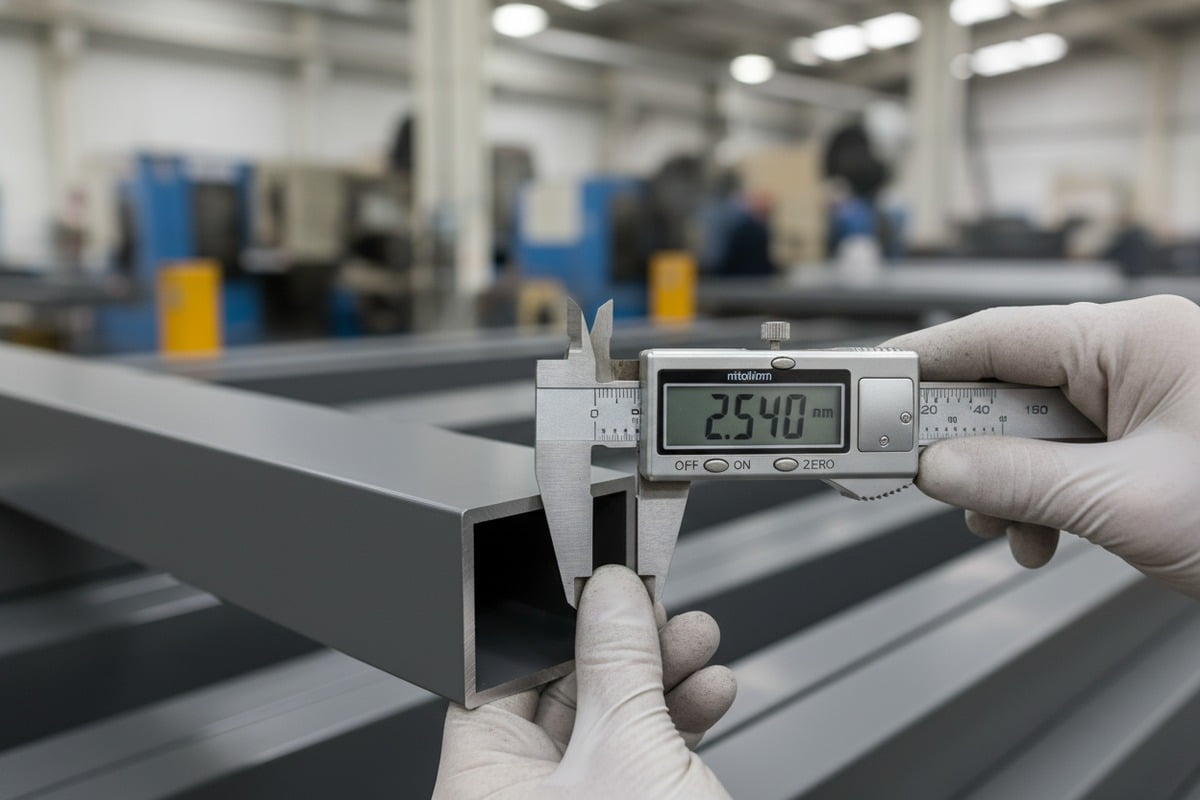
During your on-site inspection, verify the aluminum alloy grade (6063-T5 or 6061-T6), wall thickness, dimensional tolerances, surface finish quality, and powder coating adhesion. Request mill certificates, conduct caliper measurements on random samples, and perform cross-hatch adhesion tests to confirm the coating meets outdoor durability standards.
Why Alloy Grade Matters More Than You Think
Not all aluminum is the same. For outdoor pergolas, the two most common grades are 6063-T5 5 and 6061-T6. The difference affects strength, corrosion resistance, and workability. A supplier using a cheaper, unspecified alloy can put your entire project at risk.
Ask for the mill certificate (also called a material test report). This document shows the chemical composition and mechanical properties of the aluminum batch. If a factory cannot produce this, treat it as a red flag.
Dimensional Checks You Should Do Yourself
Bring a digital caliper and a tape measure. Pick profiles at random from the production floor — not from a pre-selected display. Measure wall thickness, post cross-section dimensions, and louver blade width. Compare these against your approved technical drawings.
| Specification | Acceptable Range | Tool Needed |
|---|---|---|
| Wall thickness | ≥ 1.5 mm (structural posts), ≥ 1.2 mm (louvers) | Digital caliper |
| Post cross-section | ± 0.5 mm of drawing spec | Tape measure / caliper |
| Louver blade width | ± 0.3 mm of drawing spec | Digital caliper |
| Overall beam length | ± 1.0 mm per meter | Steel tape measure |
| Surface flatness | No visible warping over 2 m span | Straight edge |
Powder Coating Quality
The powder coating is the pergola's first defense against rain, UV, and salt air. During your visit, perform a cross-hatch adhesion test 6. Use a sharp blade to score a small grid pattern into the coated surface, apply adhesive tape, then pull it off. If coating flakes away, the pre-treatment or curing process was flawed.
Also check coating thickness with a dry film thickness gauge. For outdoor aluminum pergolas, the minimum is typically 60–80 microns. Anything below 60 microns will likely fade or peel within two years.
Ask the factory to show documentation of their coating line — pre-treatment baths, curing oven temperature logs, and Qualicoat or similar certifications if they claim them. Our own line runs a six-stage pre-treatment process before powder application, and we log oven temperatures every batch. A serious factory will have similar records.
Corrosion and Weather Resistance
If the pergolas are destined for coastal European markets, request salt spray test reports. A minimum of 1,000 hours in a salt spray chamber is a good benchmark. Some buyers also require UV accelerated weathering test data, especially for RAL or Pantone custom colors.
How can I assess the factory's quality control process to ensure my pergola arrives without missing parts?
Missing a single connector or a non-standard bolt in a pergola shipment can halt an entire installation project overseas. We have seen this cause weeks of delay and thousands of euros in added cost for our partners. That is why our QC team counts and photographs every hardware kit before sealing cartons.
Assess the factory's QC process by reviewing their incoming material inspection (IQC), in-process checks, and final pre-shipment inspection (PSI) procedures. Confirm they use a parts checklist per SKU, maintain a dedicated QC team, and provide photo-documented inspection reports. Factories with ISO 9001 certification and clear defect-handling protocols are far less likely to ship incomplete orders.

The Three Stages of Quality Control
A well-run factory does not check quality only at the end. Quality control should happen at three stages: incoming materials, during production, and before shipment. Ask the factory manager to walk you through each stage and show you the actual records — not just a poster on the wall.
| QC Stage | What to Check | Evidence to Request |
|---|---|---|
| Incoming Quality Control (IQC) | Raw aluminum profiles, motors, hardware, fabrics | Material test reports, supplier approval list |
| In-Process Quality Control (IPQC) | Welding seams, drilling accuracy, assembly fit | Inspection checklists, defect rate logs |
| Pre-Shipment Inspection (PSI) | Complete unit count, parts kit, finish quality, packaging | Photo report, packing list cross-check |
Look for a Dedicated QC Team
During your factory visit, ask to meet the QC staff. A factory with 100 or more workers should have at least 3–5 full-time QC personnel. If the "QC manager" is also the sales manager or the factory owner's relative with no technical background, that is a warning sign.
Check if they use any standardized inspection forms. Serious factories use AQL (Acceptable Quality Level) sampling 7. For a pergola order, AQL 2.5 for major defects and AQL 4.0 for minor defects is a common standard.
The Parts Checklist Method
One of the most effective ways to prevent missing parts is a per-SKU parts checklist. This is a printed sheet listing every single component — from main beams and louver blades down to screws, washers, anchoring brackets, and even the Allen key. The packer ticks off each item, signs the sheet, and places a copy inside the carton.
Ask the factory to show you a completed example. If they do not have this system, suggest it. It is simple and nearly eliminates the missing-parts problem.
Third-Party Inspection as a Safety Net
Even with strong internal QC, hiring a third-party inspector 8 for a pre-shipment check adds a valuable safety layer. Companies like QIMA, SGS, and Tetra Inspection can schedule an audit in 24–48 hours across Guangdong and Foshan — the main aluminum pergola manufacturing hubs. A typical PSI costs between $250 and $400 and you receive a same-day photo report.
According to QIMA's 2024 quality report, only 59% of Chinese factories passed compliance audits. That means roughly 4 out of 10 suppliers have issues that an unassisted buyer might miss. The cost of an inspection is trivial compared to the cost of a failed shipment.
Defect Handling Procedures
Ask the factory: "What happens when your QC team finds a defect?" A good factory isolates defective parts, logs them, traces the root cause, and documents corrective actions. A weak factory just discards the part and moves on without learning from the mistake.
What should I look for in the assembly area to confirm the supplier's OEM customization expertise?
Over our 25 years of manufacturing pergolas, we have learned that the assembly floor tells you more about a factory's real capability than any sales presentation ever will. This is where promises meet reality.
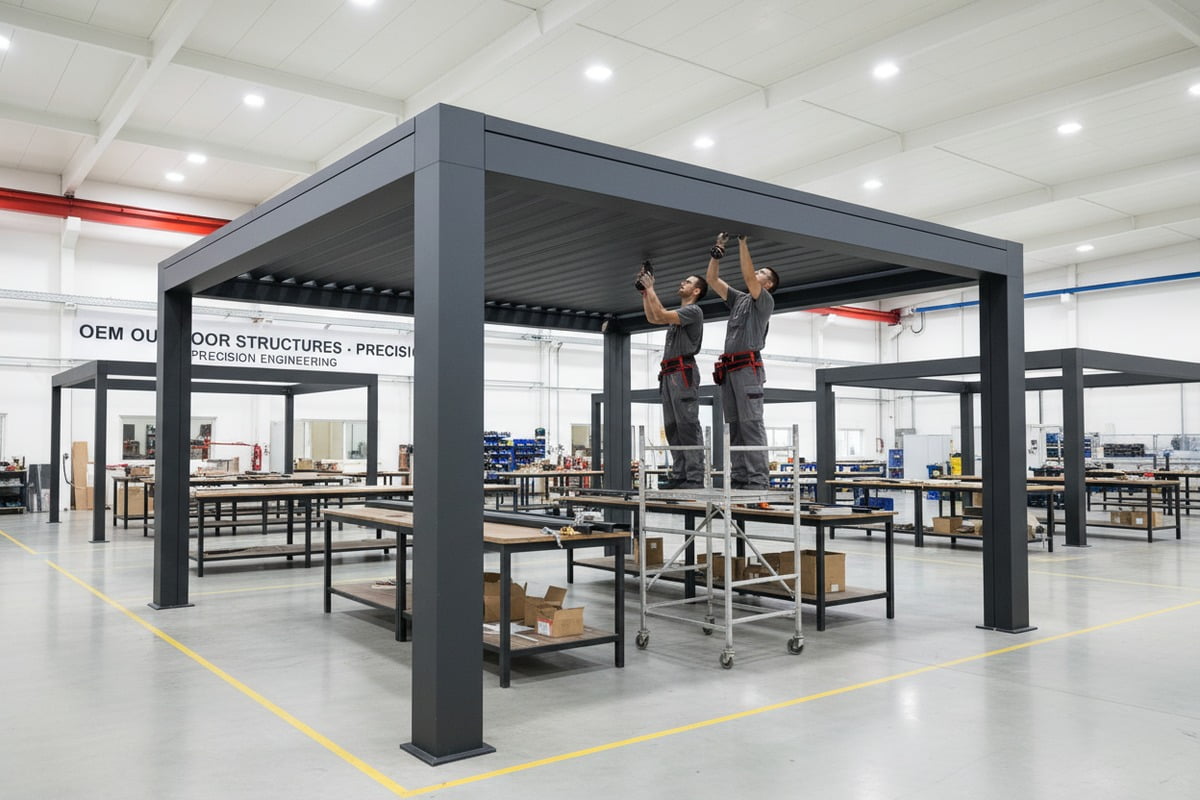
In the assembly area, look for organized workstations with jigs and fixtures for repeatable accuracy, a sample or golden sample display for reference, evidence of handling non-standard sizes and RAL colors, skilled workers performing trial assemblies, and clear work instructions posted at each station. These signs confirm the factory can execute OEM customization reliably, not just produce generic units.
Trial Assembly Is Non-Negotiable
A factory that does OEM work properly will trial-assemble at least one complete unit from each production batch before packing. This catches drilling misalignment, incompatible hardware, and fit issues that measurements alone cannot reveal. During your visit, ask to see a trial assembly in progress. If the factory says they do not do this, reconsider.
Watch how workers handle the profiles. Are they wearing gloves to prevent surface scratches? Do they place profiles on padded racks or toss them on bare concrete? These small details reveal the factory's true culture.
Jigs, Fixtures, and Work Instructions
Custom pergolas require drilling holes at precise locations for brackets, motors, and louver pivot points. A factory relying on hand-marking with a tape measure for every unit will have inconsistent results. Look for CNC drilling stations or at least dedicated jigs and templates that ensure repeatable accuracy across hundreds of units.
Work instructions should be posted at each station — ideally with photos or diagrams, not just text. If workers are assembling from memory, errors multiply as order complexity increases.
Golden Sample Protocol
Before mass production starts, a reputable OEM factory produces a golden sample — a fully finished, approved reference unit that stays on the production floor. Workers and QC inspectors compare every subsequent unit against it. Ask to see the golden sample area. Factories serious about customization maintain several, sometimes organized by client or market.
| Assembly Area Feature | What It Indicates | Red Flag If Missing |
|---|---|---|
| CNC drilling stations or fixed jigs | Repeatable hole placement for custom designs | Hand-drilling with manual marking |
| Golden sample on display | Clear reference standard for mass production | No reference unit; workers guess specs |
| Posted work instructions with images | Reduced assembly errors | Workers rely solely on verbal instructions |
| Padded profile storage racks | Care for surface finish | Profiles stacked on bare floor |
| Trial assembly station | Final fit check before packing | No pre-packing assembly verification |
| Dedicated motor/electrical testing bench | Smart pergola functionality verified | Electronics untested before shipping |
Smart Pergola Integration
If you are sourcing motorized louvered pergolas with integrated LED lighting or rain sensors, the assembly area should include an electrical testing bench. Workers should power on each motor, cycle the louvers open and closed, and verify sensor triggers. Ask for CE or other relevant certification documents for the motors and control boards. Our own facility tests every motorized unit through at least 500 open-close cycles before it leaves the line.
Handling Non-Standard Orders
Ask the factory about their most recent non-standard order. Can they show you a project with unusual dimensions, a specific RAL color, or a unique mounting bracket? A factory that only produces one standard size in one color may struggle with true OEM work. Ask to see their drawing department or CAD station. Confirm they have engineers who can convert your specifications into production-ready drawings within a reasonable turnaround — ideally 3–5 working days for standard customization.
How do I audit the factory's logistics and packaging standards to minimize my risk of shipping damage?
Shipping aluminum pergolas across oceans is where many deals go wrong. We have invested heavily in packaging engineering because we know that a perfect pergola means nothing if it arrives with dented profiles and scratched finishes. Our 30-day rapid delivery guarantee depends on getting this right.
Audit the factory's logistics by inspecting packaging materials (foam liners, corner protectors, reinforced cartons), verifying container loading plans, checking labeling accuracy against packing lists, and reviewing their damage claim history. Factories should use moisture-barrier film for sea freight, cushion all profile contact points, and pack parts in logical assembly sequence to reduce handling damage and simplify unpacking at destination.
Packaging Material Standards
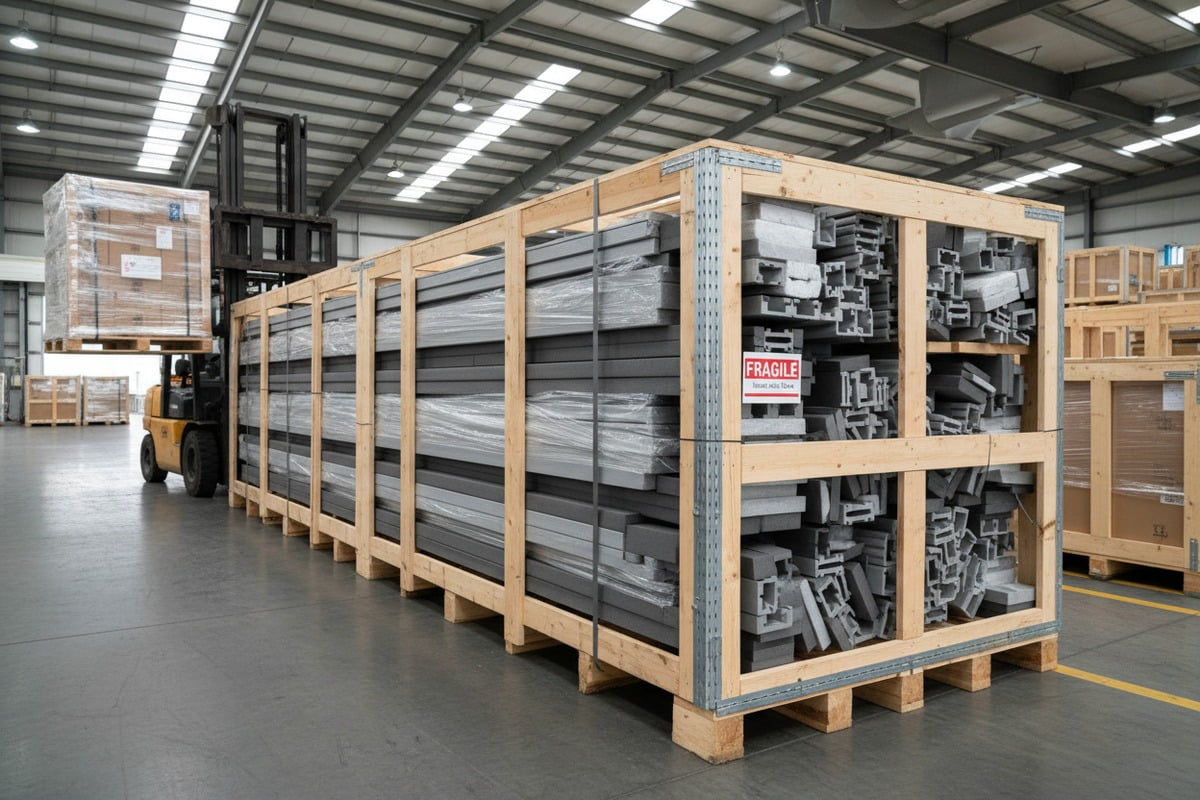
Open a finished carton on the factory floor. Check for the following: Are profiles individually wrapped in protective film? Are foam strips placed between stacked profiles to prevent metal-to-metal contact? Are corner protectors used on all exposed edges? For sea freight, is there a moisture-barrier (desiccant + poly bag) to prevent condensation damage during the 25–40 day voyage?
Cheap packaging is one of the most common cost-cutting moves. A factory might use thin single-wall cardboard that collapses under container stacking pressure. For heavy aluminum pergola components, double-wall corrugated cartons or wooden crates are the minimum standard.
Container Loading Plan
A serious factory prepares a container loading plan — a diagram showing exactly how cartons and crates are arranged inside the 20ft or 40ft container. This plan optimizes space, prevents shifting during transit, and ensures heavier items sit at the bottom.
During your audit, ask to see a loading plan from a recent shipment. Better yet, if your timing allows, attend the actual container loading (called a Container Loading Check or CLC). Watch how workers place the cartons. Are they using straps or airbags to fill gaps? Is the container floor clean and dry?
Labeling and Packing Sequence
Every carton should have clear external labels showing: order number, SKU, carton number (e.g., 1 of 15), gross weight, net weight, dimensions, and handling symbols (fragile, this side up). Inside, a packing list should itemize every component in that carton.
A smart practice — and one we use at our facility — is packing components in assembly sequence. The items the installer needs first are in carton #1. This saves hours on site and reduces the chance of parts getting lost in a pile of opened boxes.
Damage Claim History
Ask the factory directly: "What is your shipping damage rate over the past 12 months?" A transparent factory will share this data. Anything above 2% is a concern. Also ask how they handle damage claims. Do they re-ship parts at their cost? What is the response time? For our European clients, we maintain a small buffer stock of common components so replacements can ship within days, not weeks.
Moisture and Corrosion During Transit
Sea freight containers experience significant temperature swings. Condensation (known as "container rain") can form on metal surfaces and cause water stains or white oxidation on aluminum. Factories shipping to Europe should use VCI (Vapor Corrosion Inhibitor) paper 10 or silica gel desiccant packs inside moisture-barrier bags. Ask the factory to show you these materials in their packaging station.
Conclusion
Arranging a thorough factory inspection protects your investment, your project timeline, and your brand reputation. Verify profiles, audit QC systems, observe assembly, and scrutinize packaging — these four steps separate reliable suppliers from risky ones.
Footnotes
- Explains the importance of powder coating adhesion and common testing methods. ↩︎
- Defines and outlines the systematic steps involved in a quality control process. ↩︎
- Replaced with a Wikipedia page on 6063 aluminum alloy, which is the most common alloy for aluminum extrusion and relevant to architectural aluminum profiles. ↩︎
- Explains the purpose and benefits of jigs and fixtures in manufacturing for precision and efficiency. ↩︎
- Replaced with a Wikipedia page specifically detailing the properties and uses of 6063-T5 aluminum alloy, an authoritative source. ↩︎
- Describes the procedure and purpose of the cross-hatch adhesion test. ↩︎
- Explains the concept and application of Acceptable Quality Level in inspections. ↩︎
- Describes the role and benefits of using a third-party inspector for unbiased evaluations. ↩︎
- Explains the international standard for quality management systems. ↩︎
- Provides information on VCI paper and how it prevents corrosion during shipping and storage. ↩︎