
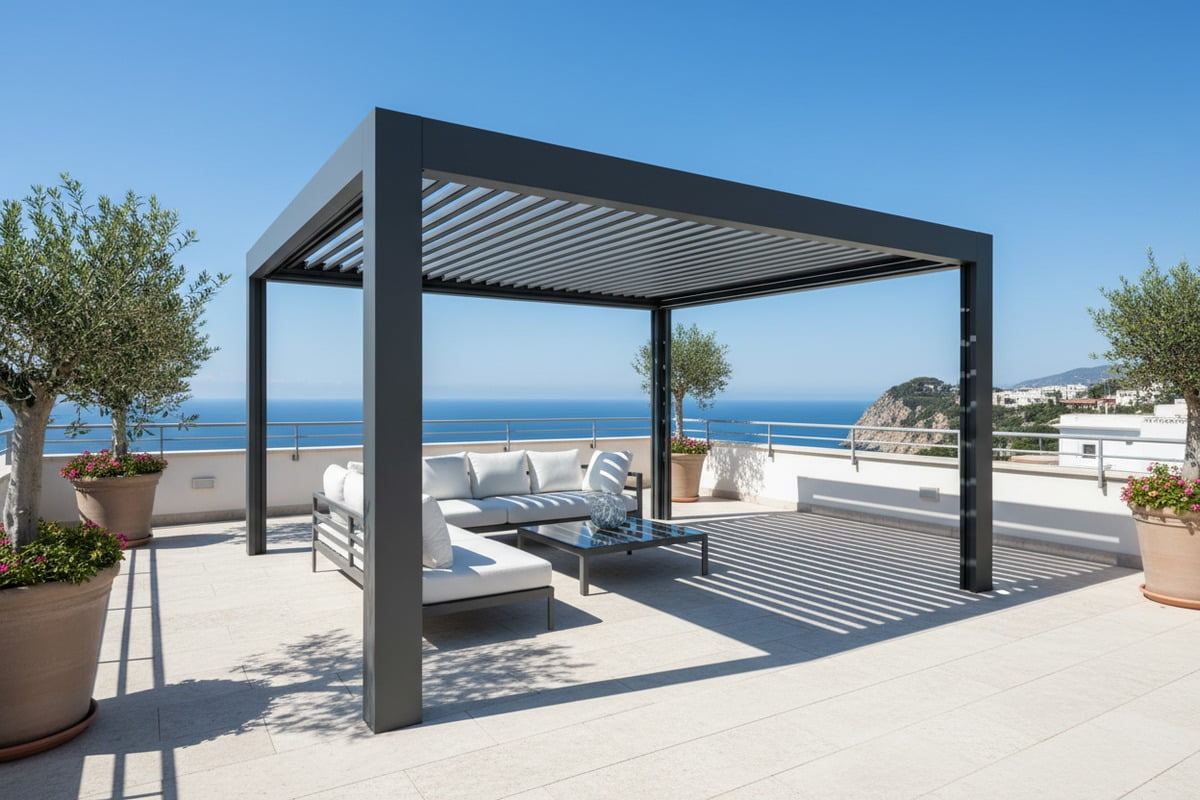
Every year, we see importers lose thousands of euros on pergolas that warp, buckle, or fail structural inspections — all because the wrong alloy grade 1 or wall thickness was specified at the sourcing stage. Having manufactured over 80,000 pergola sets annually for European markets, our engineering team has seen firsthand how a single spec error can derail an entire project.
When sourcing European pergolas, the gold standard is 6063-T6 aluminum alloy with a minimum wall thickness of 2.0–3.0 mm for structural profiles. These specifications ensure compliance with European wind and snow load requirements, offer excellent corrosion resistance, and deliver the long-term durability that distributors and contractors demand.
This guide breaks down exactly which alloy grades, temper designations 2, and wall thicknesses you need to specify — and what documents to request — so your next order meets EU standards without surprises. Let's start with the alloy itself.
Which aluminum alloy grade should I choose to ensure my pergolas meet European structural standards?
Sourcing the wrong alloy is one of the most expensive mistakes an importer can make EN 1991-1-4 3. We have had clients come to us after receiving shipments of 6060-T5 profiles 4 marketed as "European grade" that could not pass basic load tests in Northern Italy.
For European pergolas, 6063-T6 aluminum alloy is the recommended grade. It delivers a tensile strength of 241 MPa, excellent corrosion resistance, and superior extrudability for complex profiles. This temper meets the structural demands of EN-standard construction across Mediterranean and Nordic climates alike.

Why the 6000 Series Dominates Pergola Manufacturing
The 6000-series aluminum alloys 5 use silicon and magnesium as their primary alloying elements. This combination gives them three critical properties for outdoor structures: they extrude cleanly into complex shapes, they resist atmospheric corrosion 6 naturally, and they respond well to heat treatment for added strength. In our production lines, 6063 is the workhorse alloy. It flows through extrusion dies at consistent rates, producing the sharp geometric profiles — square posts, louvered blades, integrated screen channels — that modern European pergola designs require.
Understanding Temper Designations: T5 vs. T6 vs. T66
The alloy grade is only half the story. The temper tells you how the aluminum was heat-treated, which directly determines its mechanical performance.
| Temper | Treatment Process | Tensile Strength | Yield Strength | Best Use Case |
|---|---|---|---|---|
| T5 | Air-cooled after extrusion, then artificially aged | ~185 MPa | ~145 MPa | Residential pergolas in mild climates |
| T6 | Solution heat-treated, quenched, then artificially aged | ~241 MPa | ~214 MPa | Commercial and heavy-load pergolas across Europe |
| T66 | Optimized T6 with tighter process controls | ~290+ MPa | ~260+ MPa | Premium/extreme weather and coastal installations |
T5 is less expensive and easier to produce. For a small backyard pergola in southern Portugal, it can be adequate. But for the majority of European projects — where building codes demand verified wind and snow load resistance — T6 is the minimum our engineering team recommends. T66 is gaining traction among premium brands targeting Scandinavian and Alpine markets. It offers roughly 29% higher tensile strength than standard T6, though it comes at a cost premium of around 15–20%.
A Common Sourcing Pitfall: Temper Misrepresentation
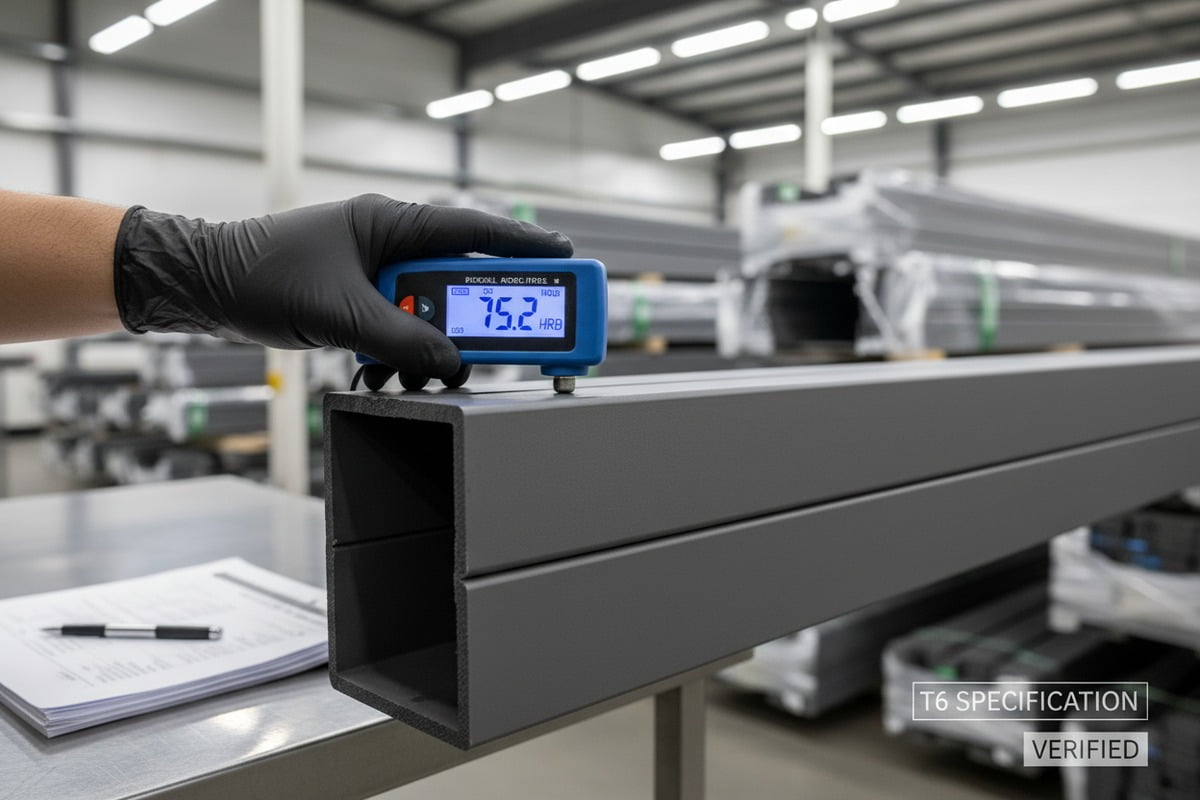
One issue we flag repeatedly for our B2B partners is temper misrepresentation. Some suppliers stamp "T6" on profiles that only received a T5 heat treatment. The profiles look identical. They weigh the same. But under load — especially cyclical wind loading over several seasons — they deform. The only reliable way to verify temper is through mill test certificates 7 and, when in doubt, independent hardness testing. If a supplier cannot provide a certificate specifying the exact temper and corresponding mechanical properties, that is a red flag.
Other Alloy Alternatives Worth Knowing
While 6063 dominates, two other grades appear occasionally in European pergola sourcing:
- 6005A: Slightly higher strength than 6063, with better weldability. 6005A 8 Used in structural applications where welded joints are critical.
- 6061: A general-purpose structural alloy with higher strength but less aesthetic surface quality after anodizing. Rarely chosen for visible pergola profiles.
For most importers serving the European outdoor living market, 6063-T6 remains the clear choice. It balances cost, appearance, and structural performance in a way no other alloy matches.
How can I determine the ideal wall thickness to guarantee wind and snow load resistance for my clients?
Wall thickness is where many sourcing negotiations go wrong. When our sales team discusses custom orders with European distributors, wall thickness is often the first specification that gets questioned — because it directly affects both material cost and structural safety.
The ideal wall thickness for European pergola profiles ranges from 2.0 mm for secondary components to 3.0 mm or more for main load-bearing posts and beams. The exact requirement depends on the local wind zone, snow load region, span width, and the alloy temper selected — all of which must be calculated per project.
Why Wall Thickness Is Not a One-Number Answer
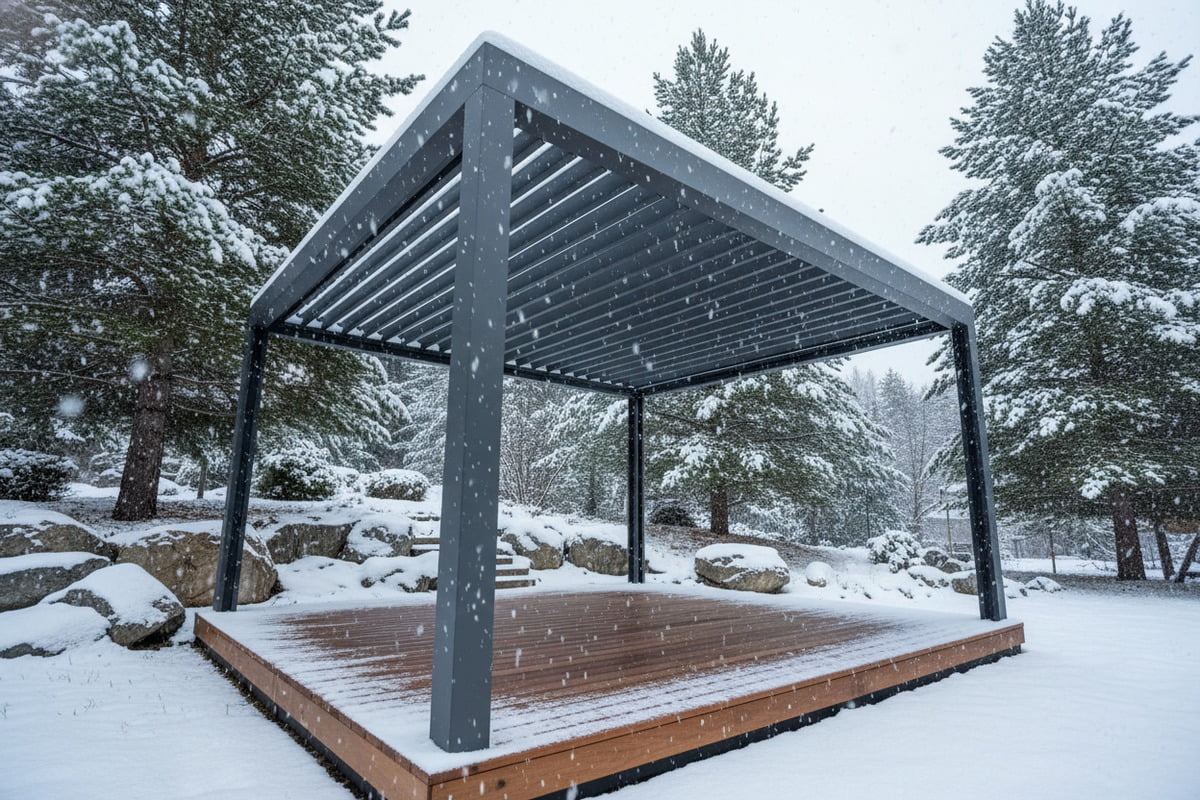
There is no single EU-wide regulation that states "all pergola walls must be X mm thick." Instead, European structural standards work through performance-based requirements. The pergola must withstand specific loads — expressed in kilonewtons per square meter for snow (EN 1991-1-3 9) and wind pressure (EN 1991-1-4). The wall thickness needed to meet those loads depends on the profile geometry, the alloy strength, and the span of the structure.
That said, practical benchmarks have emerged across the industry:
| Component | Recommended Minimum Wall Thickness | Typical Range | Notes |
|---|---|---|---|
| Main posts (columns) | 2.5 mm | 2.5–4.0 mm | Thicker for freestanding or tall structures |
| Primary beams (headers) | 2.5 mm | 2.5–3.5 mm | Span length is the key variable |
| Louvered blades | 1.5 mm | 1.5–2.0 mm | Must resist wind uplift when open |
| Screen channels / rails | 1.5 mm | 1.5–2.5 mm | Functional rather than structural |
| Gutter profiles | 2.0 mm | 2.0–2.5 mm | Must support water weight during heavy rain |
Wind and Snow Load Basics for Importers
European building codes divide the continent into wind and snow zones. A pergola destined for coastal Belgium faces different demands than one for inland Tuscany. Here are some reference figures our engineering team uses when designing custom structures:
- Snow loads: Range from 0.5 kN/m² in mild southern regions to over 4.0 kN/m² in Alpine zones. High-end pergolas with motorized louvers often advertise resistance up to 180 kg/m² (approximately 1.8 kN/m²).
- Wind loads: Coastal and elevated sites can see design wind pressures exceeding 1.5 kN/m². Pergolas rated for 150 mph (240 km/h) wind speeds are marketed for the most exposed European locations.
When a client in Italy tells us their project site is in a Zone 3 snow area, our team runs the calculations and adjusts the profile cross-sections and wall thicknesses accordingly. This is where OEM/ODM capability truly matters — a one-size-fits-all catalog product cannot serve all of Europe's climate zones safely.
The Cost Trap of Thin Walls
Some competing suppliers reduce wall thickness to 1.5 mm on main structural members to lower the per-unit price. On paper, the pergola looks cheaper. In practice, it fails. We have documented cases where thin-walled T5 posts buckled under moderate snow accumulation — not catastrophically, but enough to void warranties and damage our clients' reputations. For a purchasing manager like our typical European partner, a failed installation costs far more than the 10–15% price difference between a 2.0 mm and a 3.0 mm profile.
How to Verify Thickness Before Ordering
Always request a dimensioned cross-section drawing (DXF or PDF) of every structural profile in your order. Measure sample profiles with a digital caliper upon receipt. If the supplier's quoted thickness is 2.5 mm but the delivered profile measures 2.2 mm, that 0.3 mm difference reduces the section modulus — and load capacity — by a meaningful margin.
What specific technical documents should I request to verify the material quality of my custom order?
Over 25 years of exporting pergolas, our documentation process has evolved from simple packing lists to comprehensive technical dossiers — because European clients rightly demand proof, not promises. The documents you ask for at the quoting stage determine whether you catch problems before production or after installation.
To verify material quality, request mill test certificates (EN 10204 3.1) confirming alloy grade and temper, powder coating test reports (salt spray, adhesion, UV), structural calculation sheets for your specific span and load zone, CE Declaration of Conformity, and dimensioned profile drawings with tolerances.
The Essential Document Checklist
Here is the document set our European partners typically require, organized by category:
| Document | What It Proves | When to Request |
|---|---|---|
| Mill Test Certificate (MTC) EN 10204 3.1 | Alloy composition, temper, mechanical properties (tensile, yield, elongation) | At quoting stage; verify per batch |
| Powder Coating Test Report | Salt spray hours (≥1000h for coastal), cross-cut adhesion, gloss retention | Before production approval |
| CE Declaration of Conformity 10 | Product meets applicable EU directives (e.g., Construction Products Regulation) | Before first shipment |
| Structural Calculation Report | Load capacity for specific span, wind zone, and snow zone | During design/customization phase |
| Dimensioned Profile Drawings (DXF/PDF) | Exact wall thickness, tolerances, cross-section geometry | At quoting stage |
| Motor/Electronics Certification (CE, IP rating) | Electrical safety and weather protection rating for motorized components | Before production |
| Packing Specification Sheet | Packaging method, protective materials, container loading plan | Before shipment |
Mill Test Certificates: Your First Line of Defense
A genuine MTC per EN 10204 Type 3.1 is issued by the aluminum smelter or extrusion mill — not by the pergola assembler. It contains the heat number, chemical composition breakdown, and mechanical test results for the specific batch of aluminum used in your order. If a supplier provides only a "general" certificate that is not tied to a batch number, it is essentially meaningless. Our practice is to archive MTCs for every extrusion batch and provide them proactively with shipment documents.
Powder Coating Verification
European end-users expect outdoor coatings to last a decade or more without visible degradation. The industry benchmark is Qualicoat Class 2 certification, which requires a minimum of 1,000 hours of salt spray resistance and specific UV retention standards. When we powder coat profiles in our facility, every batch undergoes adhesion testing (cross-cut method per ISO 2409) and thickness measurement (60–120 microns is standard). Request these reports. If a supplier cannot produce them, their coating process is likely uncontrolled.
Structural Calculations: Not Optional for Europe
Many EU member states require structural calculations signed by a qualified engineer before a pergola can be installed as a permanent structure. Even where it is not legally required, contractors and distributors need these documents to protect themselves from liability. Our engineering team generates project-specific calculation sheets that reference the relevant Eurocode load combinations. This is a service — and a safeguard — that distinguishes professional suppliers from catalog resellers.
What Happens When Documents Are Missing
We have seen projects stall for weeks because a missing CE declaration triggered a customs hold in Rotterdam. We have seen contractors fined because they could not produce structural calculations during a building inspection. The cost of requesting and verifying documents upfront is negligible. The cost of not having them can be project-ending.
How do these material standards impact the long-term durability and maintenance costs of my outdoor structures?
When our after-sales team tracks warranty claims across European markets, the pattern is unmistakable: structures built with verified 6063-T6 profiles and proper powder coating generate fewer than 2% of the service calls that cheaper alternatives produce. Material standards are not just about passing an initial inspection — they define the total cost of ownership over 15 to 25 years.
Properly specified 6063-T6 aluminum with Qualicoat-certified powder coating delivers a 20–25 year service life with near-zero structural maintenance. In contrast, underspecified alloys or thin walls can lead to deformation, coating failure, and replacement costs that exceed the original purchase price within 5–8 years.
The Corrosion Advantage of Aluminum Over Steel
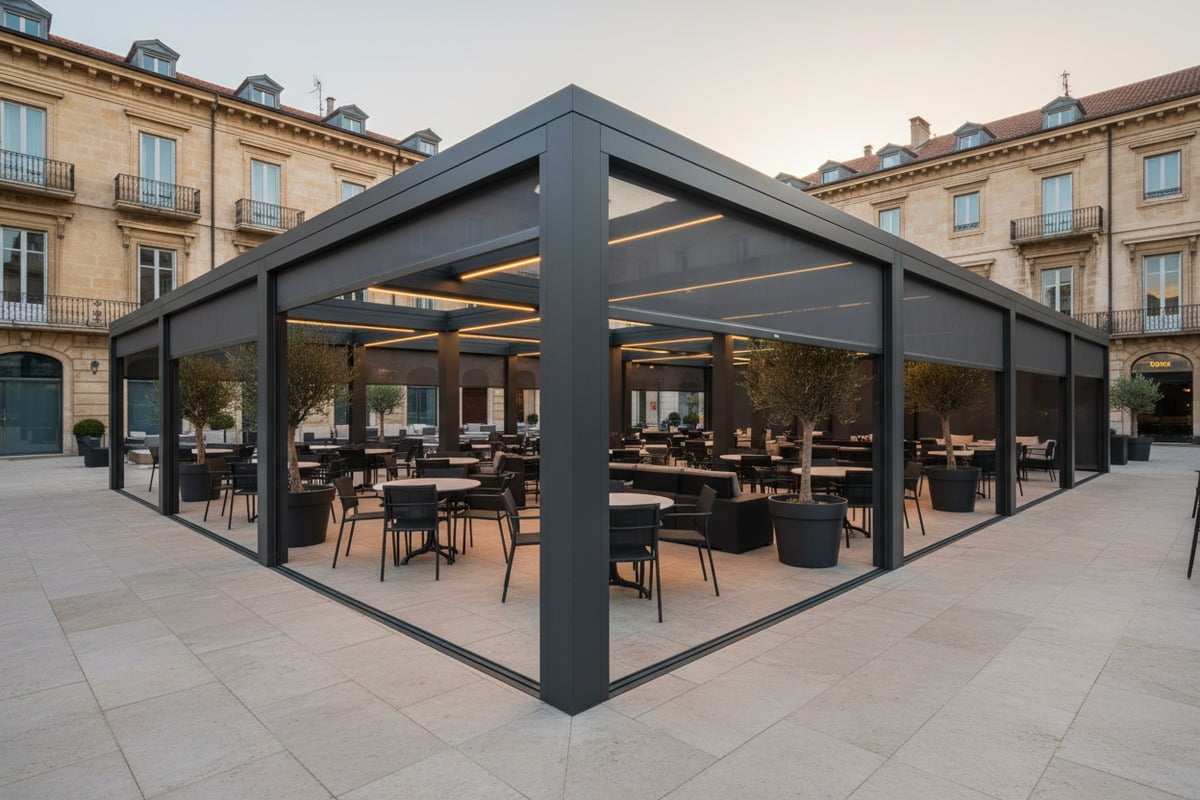
Aluminum naturally forms a thin oxide layer that protects it from atmospheric corrosion. When you add a 60–120 micron powder coat on top, the resulting barrier system is extremely resilient. Compared to steel pergolas — which require galvanizing plus coating and still risk rust at cut edges and fastener points — aluminum structures offer fundamentally lower maintenance. For coastal European installations exposed to salt air, this difference is transformative. Our clients in Greece, southern France, and the Adriatic coast consistently report that powder-coated 6063-T6 pergolas show no visible degradation after 10+ years.
How Alloy Choice Affects Lifecycle Costs
The upfront cost difference between a T5 and T6 pergola is typically 15–25%. But consider what happens over a 20-year lifecycle:
- T5 in a moderate climate: May require re-tensioning of connections, potential profile replacement if deformation occurs under cumulative snow cycles. Estimated additional maintenance cost: 10–20% of original price.
- T6 in the same climate: Maintains dimensional stability. Connections stay tight. Coating adheres properly to the harder substrate. Estimated additional maintenance cost: 2–5% of original price (cleaning and minor hardware replacement only).
- T66 in extreme climates: Highest initial investment but essentially zero structural maintenance. Ideal for hospitality and commercial projects where downtime is unacceptable.
Powder Coating: The Unsung Hero of Durability
Even the best alloy will look terrible after five years if the coating fails. Our production line uses an electrostatic powder coating process with full pre-treatment (degreasing, chromate-free conversion coating, deionized water rinse). This is not cosmetic. It is structural protection. Key performance indicators for quality coatings include:
- Salt spray resistance ≥ 1,000 hours (Qualicoat Class 2)
- Adhesion grade 0 per ISO 2409 (no flaking at cross-cut)
- Gloss retention ≥ 50% after 10 years of UV exposure
- Color shift ΔE < 1.5 after Florida-equivalent weathering test
When these specs are met, our standard warranty is 10 years on the finish — and the real-world performance typically exceeds that by a wide margin.
Sustainability and Recyclability
European buyers increasingly factor sustainability into procurement decisions. Aluminum is 100% recyclable without loss of properties. At end of life — which may be 25 years away — a pergola's aluminum can be melted down and re-extruded at roughly 5% of the energy cost of primary production. This circular economy advantage is a genuine selling point for distributors marketing to environmentally conscious end consumers. Combined with low maintenance requirements (no painting, no rust treatment, no wood preservatives), aluminum pergolas offer one of the lowest lifecycle environmental footprints of any outdoor structure material.
The Real Cost of Cutting Corners
We had a distributor in Germany who initially sourced from a competing factory offering 20% lower prices. Within three seasons, multiple installations showed post deflection and louver blade warping. The root cause: 2.0 mm walls on posts (our recommendation was 3.0 mm for that span) and T5 temper marketed as "equivalent to T6." The distributor spent more on remediation, replacements, and lost client trust than they saved on the original order. They have been our partner since 2021.
Conclusion
Specifying the right alloy grade and wall thickness is not a technical formality — it is the foundation of every successful European pergola project. Choose 6063-T6, verify with real documents, and your structures will perform for decades.
Footnotes
- Provides a comprehensive overview of aluminum grades and their properties. ↩︎
- Explains the meaning and importance of aluminum temper designations. ↩︎
- Provides an overview of the Eurocode standard for wind actions on structures. ↩︎
- Details the characteristics and applications of 6060-T5 aluminum. ↩︎
- Describes the composition, properties, and uses of 6000 series aluminum alloys. ↩︎
- Explains the phenomenon and factors influencing atmospheric corrosion of aluminum. ↩︎
- Details the requirements and significance of EN 10204 Type 3.1 mill test certificates. ↩︎
- Provides an overview of the properties and composition of 6005A aluminum alloy. ↩︎
- Replaced with an authoritative link to the Eurocode 1 Part 1-3 standard for snow loads from the British Standards Institution (BSI). ↩︎
- Explains the legal requirements and content of a CE Declaration of Conformity. ↩︎