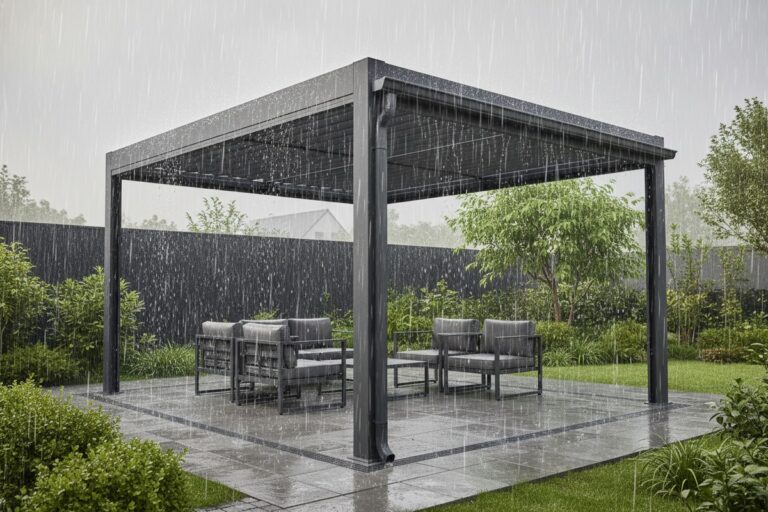
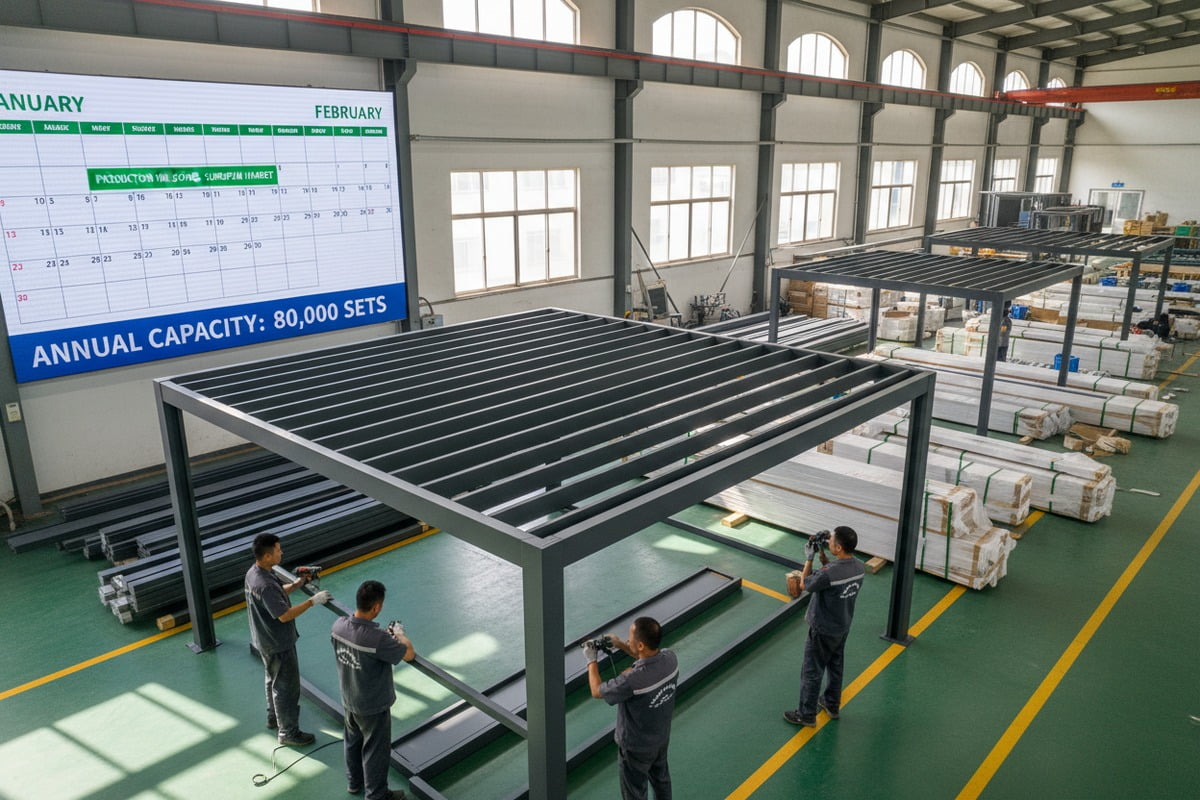
Every spring, we watch European buyers scramble for stock that should have left our factory months earlier. The gap between production timelines and seasonal demand costs real money.
To align China aluminum pergola production with European peak season inventory, manufacturers must reverse-plan from April delivery deadlines, initiating bulk production in January, shipping by late February, and building 10–15% buffer stock to absorb delays and custom order surges.
This guide breaks down the exact production scheduling, custom color management, shipping risk mitigation, and supplier evaluation steps that keep your warehouse full when European customers are ready to buy. Let's walk through each one.
How can I schedule my aluminum pergola production to ensure stock arrives before the European spring rush?
We have shipped over 80,000 sets annually from our Hainan facility, and the single biggest lesson is this: late planning kills spring sales. Buyers who place orders in March expect April delivery — but the math simply does not work that way.
To ensure stock arrives before the European spring rush, place standard pergola orders by December, begin production in January, and ship by late February. This accounts for 30–45 days of ocean freight, 5–10 days of customs clearance, and a safety buffer for port congestion.
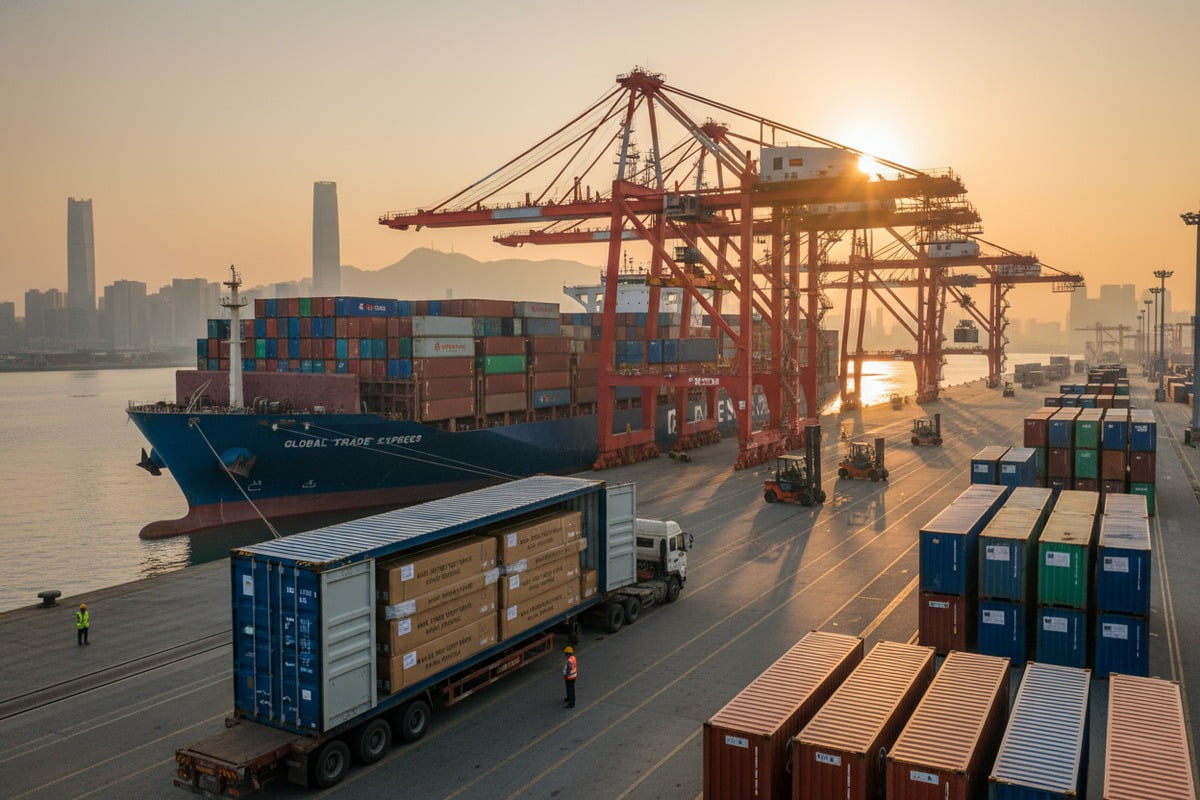
Reverse-Planning from the European Demand Window
European outdoor living demand peaks from April through September. The strongest sales window is May through July. That means your distribution center needs stock by late April at the latest. Now work backward:
- Customs clearance 1 and last-mile delivery: 5–10 days
- Ocean freight 2 from China to European ports: 30–45 days
- Quality control and packing: 5–7 days
- Production run: 15–30 days depending on volume
Add those up and you need 55–92 days from production start to warehouse arrival. That puts your ideal production start date in mid-January for standard products.
Monthly Production Calendar
| Month | Action | Notes |
|---|---|---|
| October–November | Finalize order volumes with European distributors | Use prior year sales data plus 10–15% buffer |
| December | Confirm raw material procurement and color specifications | Lock in aluminum billet prices and RAL codes |
| January | Begin bulk production of standard models | Target 500–1,000 units per month |
| February | Complete production, run QC inspections, begin shipping | Book freight early to avoid rate spikes |
| March | Goods in transit; prepare second-wave custom orders | Track shipments daily |
| Late April | Stock arrives at European distribution centers | Ready for spring sales launch |
Why Starting in January Matters
Our production floor runs at peak efficiency when we have confirmed orders and materials ready by early January. Aluminum extrusion, verniciatura a polvere 3, and louvered roof assembly each require dedicated time. Rushing these steps in March leads to quality issues — thin wall profiles, uneven coatings, and misaligned louver mechanisms.
Port congestion is another factor many buyers underestimate. European ports like Rotterdam and Hamburg see increased traffic from March onward. Shipping in late February avoids the worst bottlenecks. We recommend booking freight forwarders 4 at least 8 weeks before your planned ship date.
One practical tip: split your order into two waves. Ship 70% of standard inventory in February and 30% of custom or replenishment stock in April. This balances warehouse costs with stock availability.
Regional Timing Variations
Northern European markets like Scandinavia and the UK peak later — June through August. Mediterranean markets like Italy, Spain, and southern France peak earlier — April through June. Staggering shipments by region lets you spread production load and reduce warehousing costs.
What steps should I take to manage custom RAL color requests without delaying my peak season inventory?
Custom RAL color 5s are one of the most requested features from our European clients — especially from Italian and French distributors who need exact brand-matched tones. But each custom color adds complexity and time to the production schedule.
To manage custom RAL color requests without delaying peak season inventory, collect all color specifications by December, pre-approve color samples by early January, and run custom coating batches alongside standard production. Separating custom and standard workflows prevents bottlenecks.

The Hidden Cost of Late Color Decisions
Powder coating is not instant. Each RAL color requires specific powder procurement, spray booth calibration, and curing temperature adjustments. When a buyer changes their RAL code in February, it can delay the entire batch by 2–3 weeks. On our production line, we have seen a single late color change push an entire 200-unit order past its shipping window.
The solution is a strict color lock-in deadline. We recommend December 15 as the final date for RAL code confirmation for spring delivery orders.
Tiered Production Strategy for Colors
Not all orders need custom colors. Most European markets accept a core palette of 5–8 standard colors. Here is how we structure it:
| Order Type | Color Approach | Lead Time Impact |
|---|---|---|
| Standard inventory (60–70% of volume) | Pre-selected popular RAL colors (RAL 7016, 9005, 9016, 7024) | No additional lead time |
| Custom color orders (20–30% of volume) | Buyer-specified RAL codes confirmed by December | Adds 1–2 weeks for powder sourcing and sample approval |
| Special finish orders (5–10% of volume) | PVDF coating 6, woodgrain transfer, or textured finishes | Adds 2–3 weeks; must be scheduled first in production queue |
Sample Approval Process
We send physical color samples to buyers for approval before production begins. This step takes 7–10 days including international shipping. Digital color files are unreliable — screens display colors differently, and the actual powder coat finish depends on substrate preparation and curing. Always approve from a physical sample on an actual aluminum piece, not a painted card.
Batch Scheduling to Avoid Cross-Contamination
Switching colors on a powder coating line requires booth cleaning to prevent cross-contamination. Each color switch costs roughly 2 hours of downtime. We group orders by color family and schedule dark colors first, moving to lighter shades later. This minimizes cleaning time and prevents light-colored profiles from picking up dark powder residue.
For buyers with multiple RAL requirements, consolidating all color specifications into a single order sheet by December allows us to plan the most efficient coating sequence. This alone can save 3–5 production days on a large batch.
Common RAL Codes for European Markets
Based on our export data, these are the most popular RAL codes for European aluminum pergola orders:
| RAL Code | Color Name | Primary Market |
|---|---|---|
| RAL 7016 | Anthracite Grey | Germany, Netherlands, UK |
| RAL 9005 | Jet Black | France, Belgium |
| RAL 9016 | Traffic White | Italy, Spain |
| RAL 7024 | Graphite Grey | Scandinavia |
| RAL 8014 | Sepia Brown | Austria, Switzerland |
| RAL 6005 | Moss Green | Southern France, Portugal |
Stocking standard products in these six colors covers roughly 75% of European demand. Custom RAL orders fill the remaining 25%.
How do I mitigate the risk of shipping delays and component damage during my high-volume seasonal imports?
Last year, one of our Italian partners received a 40-foot container with scratched louver panels because the internal bracing failed during rough seas. That single container cost weeks of rework and strained the relationship. Shipping risks are real, and they multiply during peak import season.
To mitigate shipping delays and component damage, use reinforced EPE foam and corner protectors on all aluminum profiles, ship in multiple staggered containers rather than one large batch, diversify freight forwarders, and build a 10–15% inventory buffer above forecasted demand.
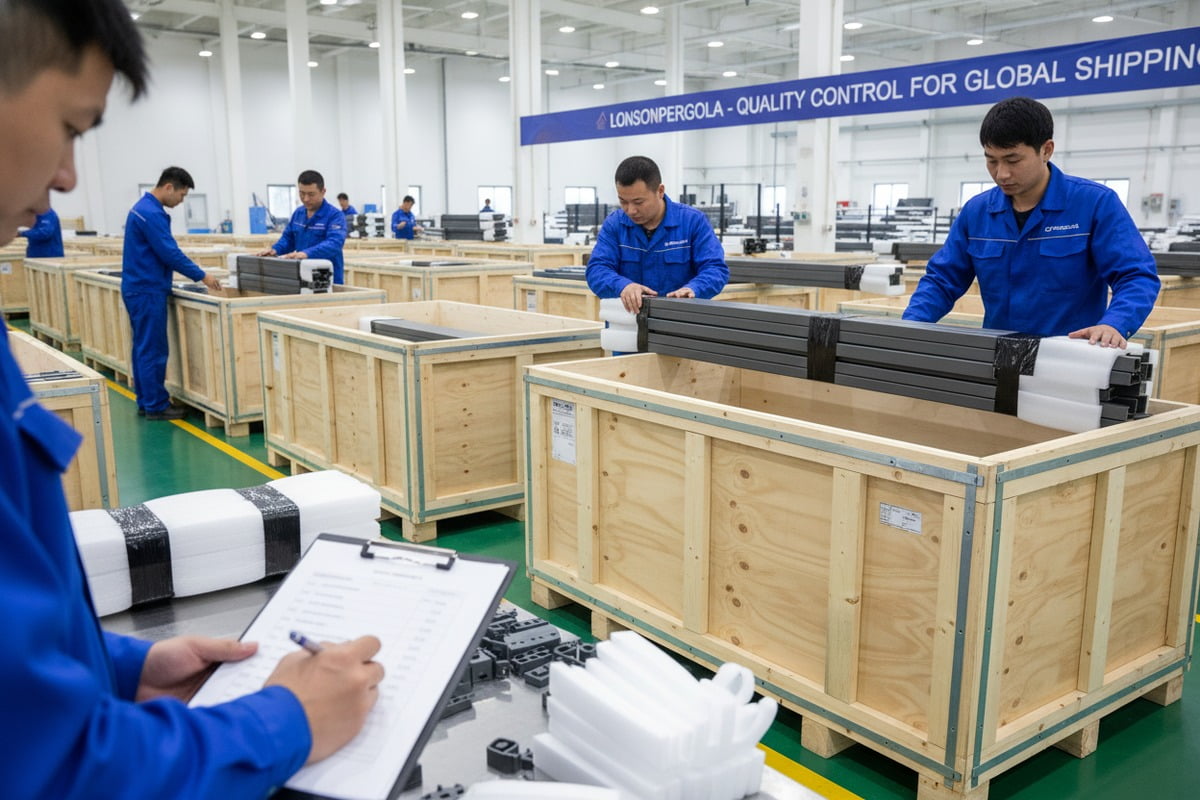
Packaging That Survives Ocean Freight
Aluminum pergola profiles are long, thin, and easily scratched or bent. Standard cardboard wrapping is not enough for 30–45 days at sea. Here is our current packaging protocol that reduced damage claims by 90% over two years:
- Individual profile wrapping: Each aluminum extrusion gets EPE foam 7 sleeve plus shrink wrap
- Corner protectors: Reinforced plastic corner guards on every bundle
- Internal container bracing: Wooden frames and steel strapping prevent shifting during transit
- Hardware separation: All screws, bolts, connectors, and motors packed in labeled, sealed bags inside rigid boxes — never loose inside the main carton
- Moisture control: Desiccant packets placed inside sealed cartons to prevent condensation damage
Staggered Shipping Strategy
Putting your entire spring inventory on one vessel is risky. If that ship is delayed or a container is damaged, your entire season is compromised. We recommend splitting orders across 2–3 shipments spaced 2 weeks apart. This way, even if one shipment faces delay, you have stock arriving on the others.
Freight Forwarder Diversification
Do not rely on a single freight forwarder. We maintain relationships with three logistics partners and allocate shipments based on current port conditions, rates, and transit times. During peak season, rates can spike 20–40%. Locking in rates 8–10 weeks before shipping protects your budget.
Missing Components: The Silent Killer
A missing bag of M8 bolts can halt an entire installation project. The cost of air-freighting replacement hardware from China to Europe often exceeds the value of the parts themselves — not to mention the project delay.
Our quality control team now uses a component checklist system. Every pergola kit is photographed during packing with all hardware laid out. The checklist and photos are shared with the buyer before the container is sealed. This creates accountability and catches missing items before they become expensive problems.
Insurance and Documentation
Always insure your cargo at full replacement value, not just the invoice value. Marine insurance 8 typically costs 0.3–0.5% of the cargo value — a small price compared to a total loss scenario. Keep all packing lists, commercial invoices, CE certificates, and bills of lading organized digitally and in hard copy. Missing compliance documentation at European customs can hold your container for weeks.
How can I evaluate if my Chinese supplier's production capacity can truly support my annual peak sales targets?
We often hear from new European partners who were burned by a previous supplier — promised 1,000 units per month but delivered 300 with quality issues. Verifying production capacity is not about trusting brochures. It requires concrete evidence and structured evaluation.
To evaluate a Chinese supplier's true production capacity, request a factory audit (in-person or third-party), verify annual output data against export customs records, check employee count and facility size, review reorder rates from existing clients, and test with a trial order before committing to peak season volumes.
What to Look for in a Factory Audit
A factory visit — or a third-party audit through firms like SGS or Bureau Veritas — reveals what brochures hide. Here are the key indicators:
| Evaluation Criteria | What to Check | Red Flag |
|---|---|---|
| Facility size | Minimum 10,000 m² for medium-scale production | Under 5,000 m² claiming 50,000 annual units |
| Employee count | 100+ workers for consistent monthly output of 500+ units | Fewer than 50 employees with high-volume claims |
| Equipment | CNC cutting machines, automated powder coating lines, louver assembly stations | Manual-only processes for high-volume orders |
| Raw material stock | Aluminum billet and extrusion inventory visible on-site | Empty warehouse with "materials arriving soon" excuses |
| Quality control | Dedicated QC team with testing equipment (wind load, coating adhesion) | No QC station or testing records available |
| Export documentation | CE certificates, ISO 9001 9, structural test reports on file | Cannot produce compliance documents on request |
Trial Order Before Peak Commitment
Never commit your full peak season volume to an untested supplier. Place a trial order of 20–50 units with your most demanding specifications — custom RAL color, motorized louvers, specific packaging requirements. Evaluate:
- Did the product match the approved sample?
- Were all components included?
- Was the delivery on time?
- How responsive was the team when you raised questions?
If the trial order succeeds, scale up. If there are issues, you have time to find an alternative before peak season.
Reorder Rates Tell the Real Story
Ask the supplier for their client reorder rate. A rate above 60% indicates that buyers return because quality and service are consistent. We maintain a reorder rate that reflects the long-term partnerships we build with European distributors — but do not take any supplier's word alone. Ask for references and contact those buyers directly.
Capacity Redundancy Planning
Even with a verified supplier, build redundancy into your sourcing plan. Work with at least two qualified suppliers. Allocate 70% of your volume to your primary partner and 30% to a secondary source. If your primary supplier faces a machine breakdown, material shortage, or labor disruption, your secondary supplier keeps product flowing.
Financial Stability Matters
A supplier that is financially unstable may cut corners to stay afloat — thinner aluminum walls, cheaper motors, or skipped QC steps. Check their business registration, annual revenue trends, and payment terms. Suppliers offering extremely low prices compared to market averages may not be able to sustain quality through a full peak season production run.
Our facility in Hainan operates with 25 years of manufacturing experience and a dedicated team of 100 employees. We maintain a 30-day rapid delivery guarantee on standard products and hold extensive standard stock ready for quick dispatch. This kind of transparency is what you should expect from any serious supplier.
Conclusione
Aligning China aluminum pergola production with European peak season is not luck — it is disciplined planning. Start early, lock in specifications by December, ship by February, and verify every supplier claim with evidence.
Note a piè di pagina
1. Replaced with a recent and comprehensive guide to customs clearance. ︎
2. Explains the definition and process of international ocean freight. ︎
3. Replaced with a recent article explaining how powder coating works, its importance, and types. ︎
4. Defines freight forwarding services and the role of freight forwarders in international trade. ︎
5. Explains the internationally recognized RAL color standard system. ︎
6. Describes the properties and applications of PVDF coatings. ︎
7. Details the properties and common applications of Expanded Polyethylene (EPE) foam. ︎
8. Explains the purpose and coverage of marine cargo insurance for goods in transit. ︎
9. Describes ISO 9001 as an international standard for quality management systems. ︎