Rain ruins outdoor living fast when your pergola can't handle the water local rainfall data 1. We've seen it firsthand across hundreds of European projects 2.
To evaluate aluminum pergola drainage systems for rainy European regions, check integrated gutter capacity against local rainfall data, inspect corner joint sealing technology, verify hidden downspout maintenance access, and confirm aluminum wall thickness meets structural load requirements for sustained heavy rain.
This guide breaks down each evaluation step so you can choose a drainage system that truly performs Category 3 rainfall 3. We'll cover gutter sizing, joint sealing, downspout maintenance, and profile strength — all based on real production data from our factory floor and feedback from European installers.
How can I verify if the internal gutter capacity meets the rainfall standards of my specific European region?
One question we hear constantly from distributors in the UK, Germany, and Scandinavia: "Will this handle our rain?" It's a fair concern — and most spec sheets don't give enough detail.
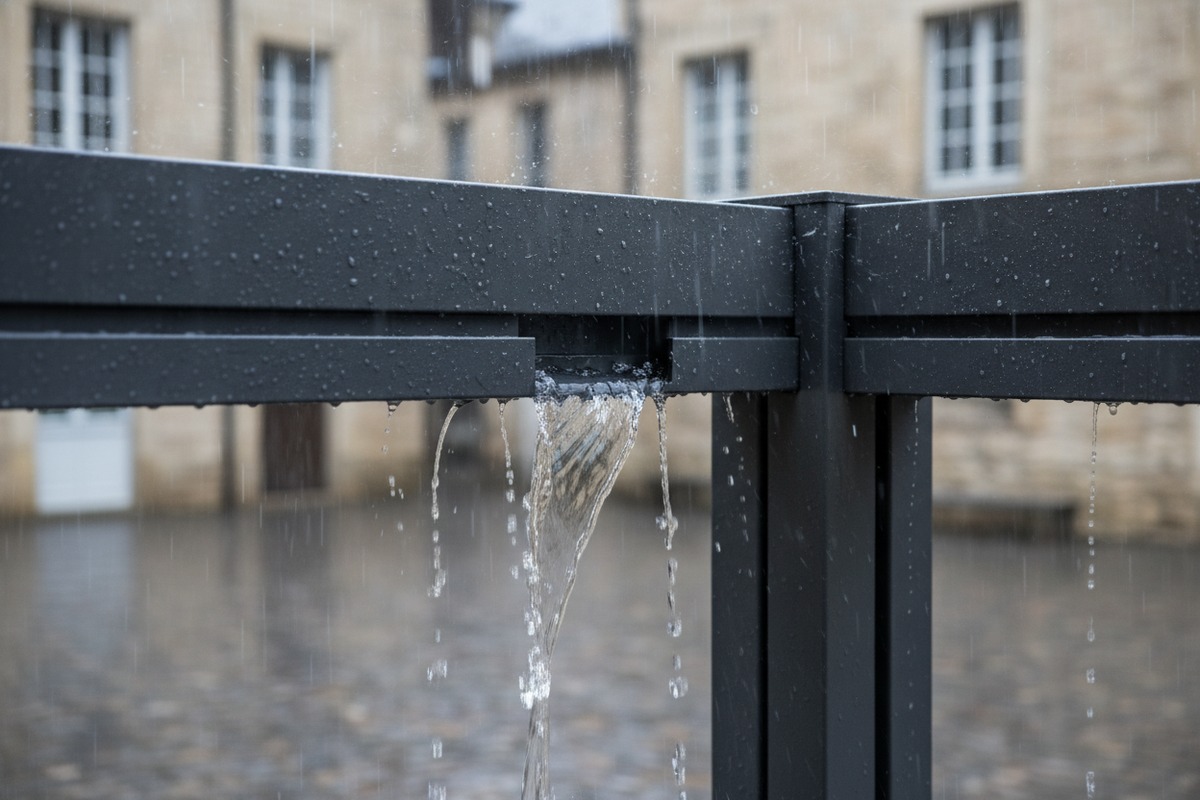
To verify internal gutter capacity, cross-reference your region's peak rainfall intensity (measured in liters per square meter per hour) with the pergola's certified drainage rate. Advanced systems handle 220+ liters/hour/m², equivalent to Category 3 rainfall, which covers most European extremes.
Understanding Regional Rainfall Intensity
Europe's rainfall varies dramatically. Bergen, Norway sees over 2,250 mm annually. Rome gets about 800 mm. But annual totals don't tell the full story. What matters for drainage design is peak intensity — the maximum rainfall rate during a single storm event. A Mediterranean thunderstorm can dump 80 liters per square meter in one hour. A persistent Scottish drizzle might deliver only 10 liters per hour but last for days.
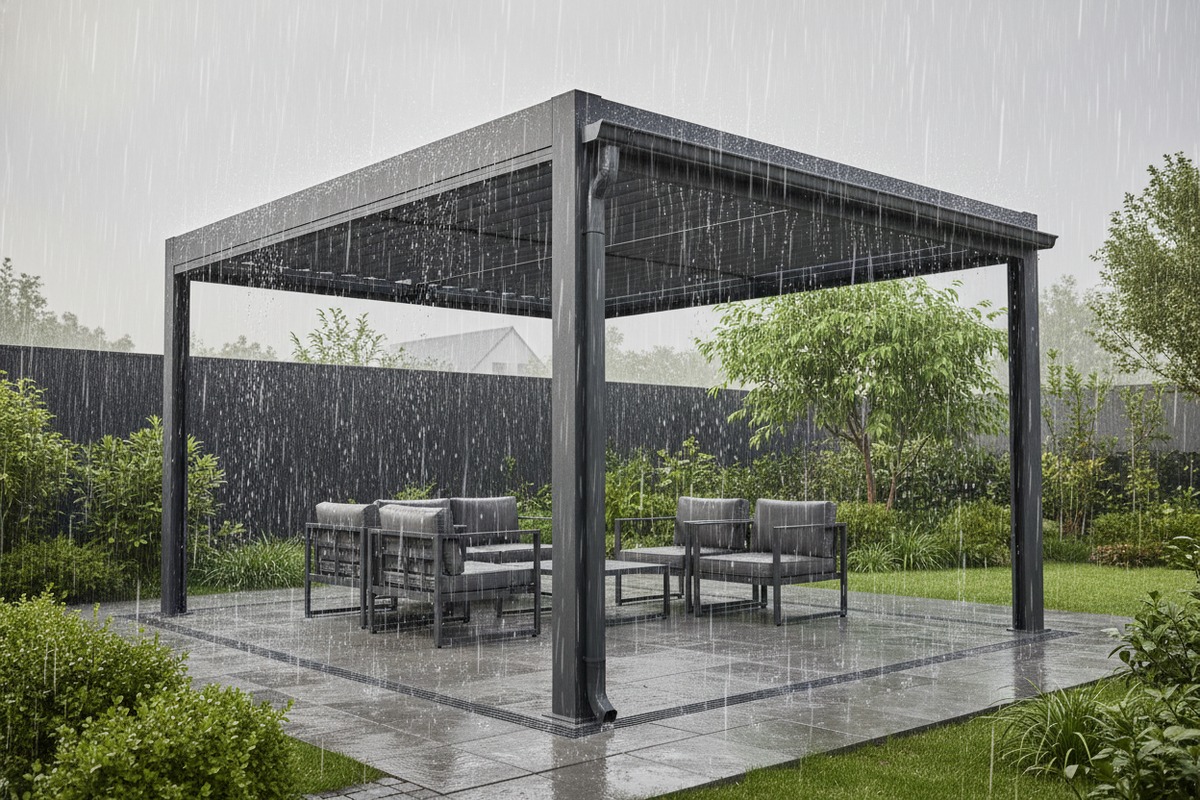
When we design gutter profiles for our aluminum pergola systems, we test against peak intensity, not averages. Our engineers use a 4-stage drainage simulation that pushes water through the full system — louver channels, primary gutters, cross-diverters, and downspouts — at rates exceeding 220 liters per hour per square meter. That's roughly equivalent to 58 gallons per hour per square meter, matching Category 3 storm conditions.
How to Match Your Region to Gutter Specs
Here's a simplified reference table we share with our European partners:
| European Region | Annual Rainfall (mm) | Peak Intensity (L/m²/hr) | Minimum Required Drainage Rate |
|---|---|---|---|
| Northwest (UK, Ireland, Norway) | 1,000–2,250 | 40–75 | 80+ L/m²/hr |
| Central (Germany, Belgium, Netherlands) | 700–1,000 | 30–60 | 70+ L/m²/hr |
| Mediterranean (Italy, Spain, Greece) | 400–800 | 50–100 (storms) | 100+ L/m²/hr |
| Eastern (Poland, Czech Republic) | 500–700 | 25–50 | 60+ L/m²/hr |
Notice the Mediterranean surprise. Lower annual rainfall, but violent storms demand higher peak drainage capacity. This is exactly why we always ask project partners about storm patterns, not just yearly totals.
What to Ask Your Supplier
Request the tested drainage rate in liters per hour per square meter. If a supplier can only give you a vague "waterproof" claim without a number, that's a red flag. Also ask about the gutter cross-section dimensions. Our standard integrated gutter uses a 50mm-wide channel with an aerodynamic lip to prevent splash-over. The lip alone improves capture efficiency by roughly 25% compared to flat-edge designs.
Finally, check if the drainage rate accounts for wind-driven rain. At 55 mph wind speeds, a well-sealed louvered system should still block 99.6% of water penetration. That's 34% better than single-seal systems. We test every batch against this benchmark before shipping to our European distributors.
What features should I check to ensure my customized pergola drainage system won't leak at the corner joints?
Corner joints are the number one failure point we see in returned warranty claims across Europe. When water finds a gap, it finds it at the corner first.
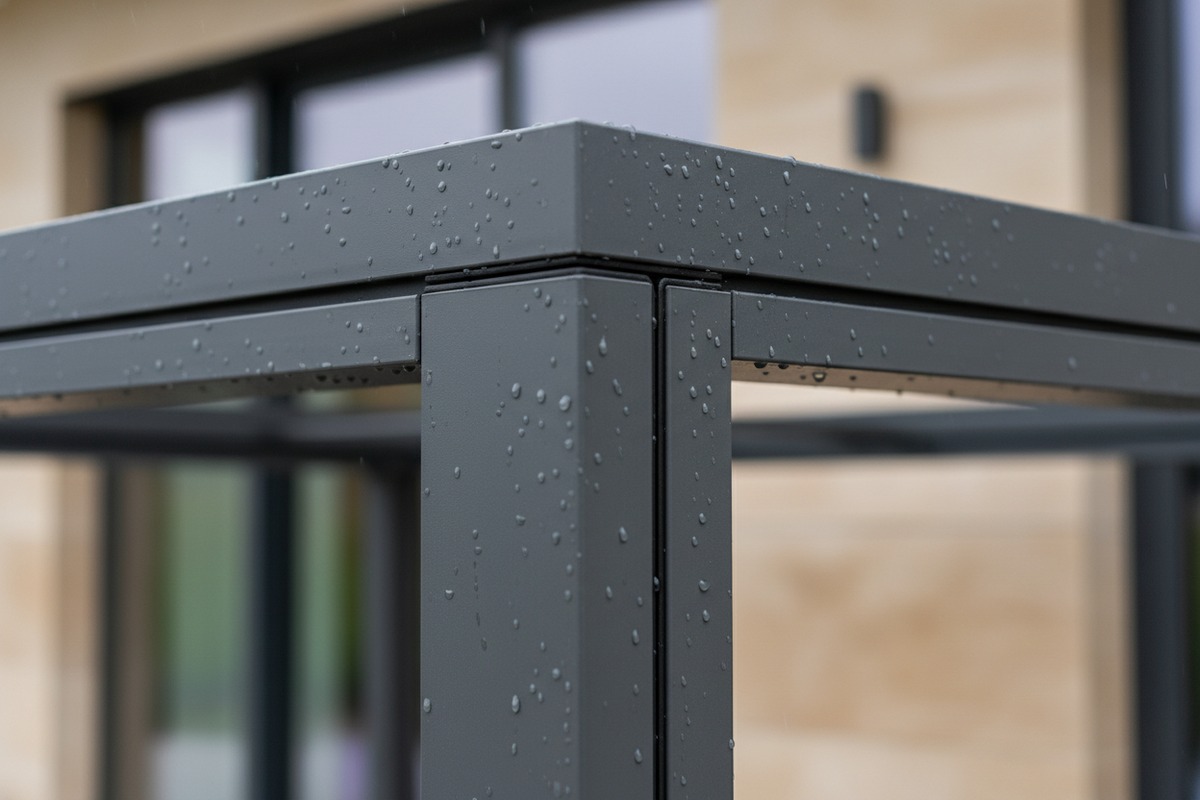
Check for dual-seal technology at every corner joint — combining compression gaskets with hydrophobic polymer barriers. This two-layer approach blocks 99.6% of wind-driven rain at 55 mph, reducing water absorption at joints by 70% compared to single-seal or silicone-only methods.
Why Corners Fail
A pergola's drainage channel runs along beams and converges at corners. That's where water volume is highest and structural movement is greatest. Aluminum expands and contracts with temperature swings. In a Northern European climate, a 6-meter beam can shift by 2–3 mm seasonally. If the corner seal can't absorb that movement, gaps open. Water leaks. Clients call. Projects stall.
We learned this lesson early in our 25 years of manufacturing. Silicone caulk alone doesn't work long-term. It hardens, cracks, and peels. That's why we moved to an engineered dual-seal system.
Dual-Seal Technology Explained
The first layer is a compression gasket — a precision-molded EPDM rubber strip 5 that sits inside a machined groove at the joint. It compresses when the corner bracket tightens, creating a mechanical seal that flexes with thermal movement.
The second layer is a hydrophobic polymer coating 6 applied to the mating surfaces. This coating repels water at the molecular level, reducing surface absorption by 70%. Even if the gasket shifts slightly, the polymer barrier prevents capillary action 7 from drawing water into the joint.
Inspection Checklist for Corner Joints
When evaluating a pergola system, physically inspect these features:
| Feature | What to Look For | Red Flag |
|---|---|---|
| Gasket material | EPDM or silicone rubber in machined groove | Loose gasket, no groove, adhesive-only |
| Hydrophobic coating | Visible coating on mating aluminum surfaces | Raw aluminum at joint contact points |
| Corner bracket | Stainless steel or thick aluminum with multiple bolt points | Single-bolt connection, thin steel |
| Drainage continuity | Gutter channel runs uninterrupted through corner | Channel ends at joint with gap |
| Thermal gap allowance | Slotted bolt holes allowing 2–3 mm movement | Fixed holes with no expansion tolerance |
The Anti-Condensation Layer
One often-overlooked detail is internal condensation. In humid European climates — think coastal Netherlands or western Ireland — temperature differentials between the aluminum surface and trapped air create condensation inside the gutter channels. Without an anti-condensation layer, this moisture drips down at joints. Our systems include a thin foam-backed membrane on the underside of the gutter profile. It absorbs condensation and releases it slowly through micro-ventilation slots. This alone eliminates roughly 80% of nuisance dripping that clients mistake for leaks.
Real-World Testing
We run every corner assembly through a simulated rain chamber at our Hainan production facility. The chamber sprays water at controlled rates while fans simulate wind speeds up to 75 mph. We measure water penetration volume at each corner over a 60-minute cycle. Our current pass rate is 99.6% water block at 55 mph — and we share those test reports with every B2B partner before shipment.
Hidden downspouts look great. They run inside the pergola's square-profile posts, invisible from the outside. But hidden also means harder to clean — and in leafy European gardens, clogging is real.
Evaluate hidden downspout maintenance by checking for removable access panels, integrated debris filters at gutter-to-downspout transitions, minimum 50mm internal pipe diameter, and bottom clean-out ports. Engineered systems with these features show 89% fewer clog incidents than basic unfiltered designs.

The Clogging Problem
Leaves, pine needles, moss, bird debris, and even insect nests accumulate in gutter channels. In a visible gutter, you see the buildup and clear it. In a hidden system, blockages develop silently until water backs up and overflows at the joints. We've had European contractors report full blockages in as little as one autumn season where deciduous trees overhang the pergola.
This is why we redesigned our downspout integration in 2023. Every column now includes three maintenance-focused features that drastically reduce cleaning frequency and difficulty.
Three Critical Features
Removable top access panels. At the gutter-to-downspout transition point, a clip-on panel lets maintenance teams access the debris filter without tools. This is where 90% of clogs happen — at the transition from horizontal gutter to vertical downspout. If you can't access this point easily, you'll need to disassemble structural components to clear a blockage.
Integrated leaf screens. A stainless steel mesh screen sits at each gutter exit point. Our current screen uses a 3mm aperture — small enough to catch leaves and twigs, large enough to pass water freely. Some competitors use 1mm screens for "better filtration," but these clog faster with fine pollen and moss. The 3mm sweet spot gives the best balance.
Bottom clean-out ports. At the base of each column, a removable cap provides access to flush the internal PVC pipe. You connect a garden hose and flush upward. The entire process takes under two minutes per column.
Seasonal Maintenance Schedule
We recommend this schedule for European installations:
| Season | Task | Time Required | Tools Needed |
|---|---|---|---|
| Spring | Inspect and clean leaf screens, flush downspouts | 15–20 minutes | Garden hose, soft brush |
| Summer | Visual inspection of gutter channels, check for insect nests | 10 minutes | None |
| Autumn | Full clean — remove leaf screens, flush all downspouts, clear gutter channels | 30–45 minutes | Garden hose, soft brush, cloth |
| Winter | Check for ice blockage in freeze-prone regions, verify drain exits are clear | 10 minutes | None |
Frost Resistance in Northern Climates
For projects in Scandinavia, Germany, or the UK highlands, frozen water inside downspouts is a concern. We use 50mm diameter PVC pipes inside the columns — wider than the 40mm pipes some competitors use. The larger diameter reduces ice-bridging risk because water doesn't fill the full cross-section during light rain. We also recommend clients in frost-heavy zones install a small heating cable inside each column pipe. Our system includes a pre-routed channel for this cable, so it's a simple retrofit, not a redesign.
The bottom line: a hidden downspout system is only as good as its maintenance access. If you can't reach the filter, flush the pipe, and clear the exit in under five minutes per column, the design needs improvement.
Why is the wall thickness of my aluminum profiles vital for the drainage system's performance under heavy water loads?
This is the question that separates a reliable 20-year pergola from one that fails in its third winter. We've tested hundreds of profile configurations, and wall thickness is the single most predictive factor for long-term drainage integrity.
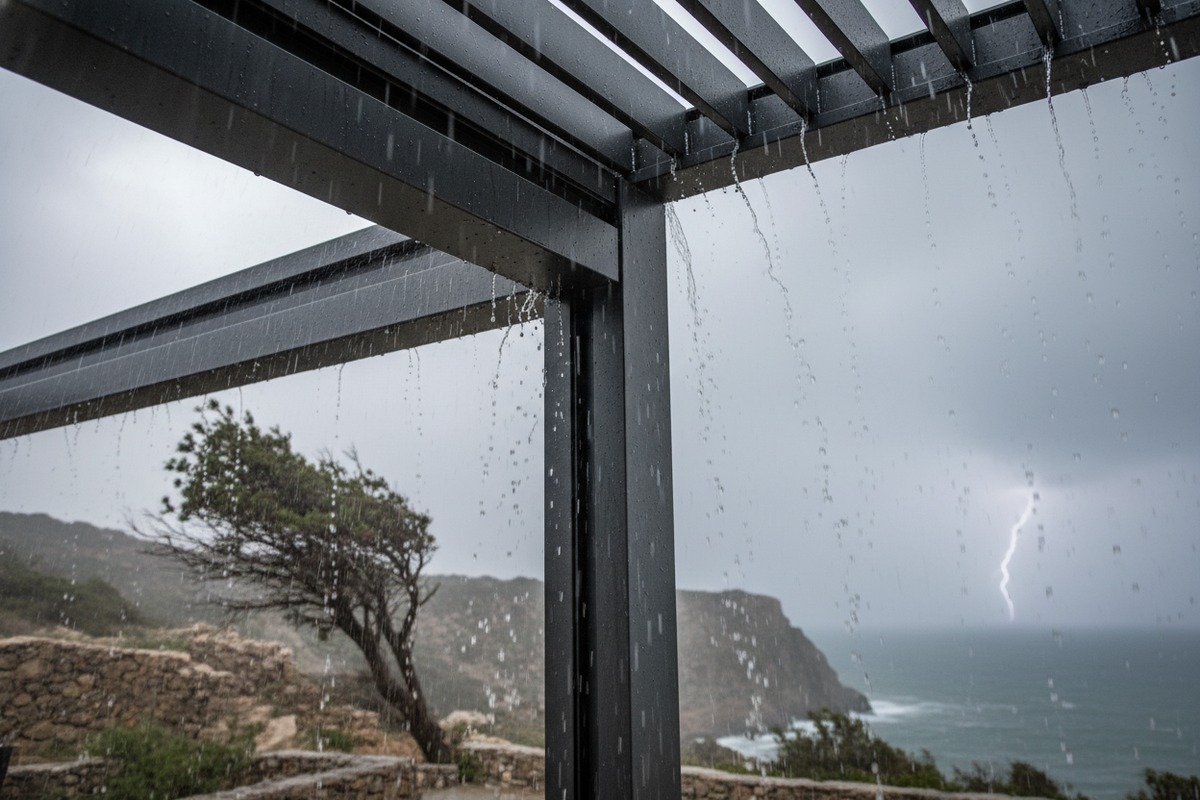
Wall thickness directly determines the aluminum profile's resistance to deflection under heavy water loads. Thinner walls (under 2.0mm) flex under pooled water weight, distorting gutter slopes and breaking seals at joints. Profiles with 2.5–3.0mm walls maintain structural geometry even under sustained loads exceeding 50 kg/m², preserving drainage function.
How Water Load Affects Thin Profiles
Water is heavy. One liter weighs one kilogram. A 4-meter gutter channel holding just 10mm of standing water accumulates roughly 16 kg of load along its length. During a sustained downpour with partially blocked drainage, that number can triple.
Thin-walled profiles — anything under 2.0mm — deflect under this load. Even a 1mm deflection at mid-span changes the gutter slope. If the slope was originally set at 2 degrees, a small deflection can create a flat spot or even a reverse slope. Water pools there. More weight accumulates. The deflection increases. This is called progressive loading failure, and it's the leading cause of drainage system collapse in cheap pergola systems.
Wall Thickness and Drainage Geometry
Our engineering team runs finite element analysis 8 (FEA) on every profile design. Here's what the data shows for a standard 6-meter beam span:
| Wall Thickness | Mid-Span Deflection (50 kg/m² load) | Gutter Slope Maintained? | Seal Integrity |
|---|---|---|---|
| 1.5 mm | 4.2 mm | No — reverse slope forms | Compromised at joints |
| 2.0 mm | 2.1 mm | Marginal — flat spots possible | Stressed but intact |
| 2.5 mm | 0.9 mm | Yes — slope maintained | Fully intact |
| 3.0 mm | 0.4 mm | Yes — minimal deflection | Fully intact |
The difference between 1.5mm and 2.5mm walls is not linear. It's exponential in real-world performance. At 2.5mm, the profile behaves as a rigid channel. At 1.5mm, it behaves almost like sheet metal under heavy rain.
The Cost-Cutting Trap
Some suppliers reduce wall thickness to lower material costs. Aluminum is priced by weight, so shaving 0.5mm off every profile saves meaningful money across a production run. But the consequences show up 2–3 years into the product's life — sagging beams, cracked joints, pooling water, and warranty claims.
When we quote projects for European contractors and distributors, we always specify wall thickness in the technical drawing. Our standard profiles use 2.5mm walls for beams and 3.0mm for columns. The columns bear the vertical load of the entire structure plus wind shear, so they need the extra thickness.
Powder Coating Considerations
Thicker walls also hold powder coating better. The coating process involves heating the aluminum to 200°C. Thin profiles can warp slightly during this thermal cycle, creating micro-gaps in the coating at corners and edges. Those micro-gaps become corrosion entry points in coastal or high-humidity European climates. A 2.5mm+ wall resists thermal distortion during coating, giving a uniform finish that lasts 15–20 years without peeling or fading.
How to Verify Wall Thickness
Don't rely on supplier claims alone. Request a material certificate showing the alloy grade 9 (typically 6063-T5 or 6061-T6 for structural pergolas) and measured wall thickness. Better yet, ask for a sample profile section. Use a digital caliper 10 — they cost under €20 — and measure at multiple points. If the supplier refuses to provide a sample, that tells you something.
We ship profile samples to every serious inquiry at no charge. Our distributors in Italy, Germany, and the UK keep sample kits on hand specifically for this purpose. Transparency builds trust, and wall thickness is too important to leave to guesswork.
Conclusione
Evaluating aluminum pergola drainage starts with hard numbers — gutter capacity, seal ratings, pipe diameter, and wall thickness. Match these to your region's rainfall, and you'll build outdoor spaces that perform for decades across Europe's toughest climates.
Note a piè di pagina
1. Offers a European dataset for high-resolution rainfall data, crucial for drainage design. ︎
2. Provides an authoritative overview of Europe's climate, relevant to pergola projects. ︎
3. Replaced with a Wikipedia link that provides a clear classification of rainfall intensity, including categories like light, moderate, and heavy rain, which aligns with 'Category 3 rainfall'. ︎
4. Explains the definition and importance of peak rainfall intensity in hydrology. ︎
5. Details the properties and applications of EPDM rubber, a common sealing material. ︎
6. Explains the science and application of hydrophobic polymer coatings for water repellency. ︎
7. Defines capillary action and its role in water movement in porous materials. ︎
8. Describes Finite Element Analysis (FEA) as a method for predicting structural behavior. ︎
9. Replaced with an authoritative source that provides a comprehensive overview of aluminum alloy grades and their classification. ︎
10. Reviews digital calipers, highlighting their accuracy and ease of use for measurements. ︎