
Over 25 years on our production lines, we have seen countless disputes that could have been avoided with better contract language Direttiva sulla bassa tensione (2014/35/UE) 1. A missing clause here, a vague promise there — and suddenly a €50,000 project stalls because nobody defined who pays for a replacement motor or how fast a technician must respond. For purchasing managers, contractors, and distributors importing aluminum pergolas 2, the warranty section of your contract is not just legal boilerplate. It is your financial safety net.
To properly specify aluminum pergola warranty and after-sales terms in a contract, you must define separate warranty durations for each component — structural frame, powder coating, motors, and accessories — detail the claims process with response timelines, list all exclusions clearly, and include binding maintenance and after-sales service obligations.
This guide walks you through the exact clauses, durations, and language you need Electromagnetic Compatibility Directive (2014/30/EU) 3. We will compare real industry benchmarks, share drafting templates, and highlight the pitfalls that trip up even experienced buyers. Let's start with the most fundamental question.
How long should my aluminum pergola warranty last and what specific components must it cover?
When we design warranty terms for our European partners, the first conversation is always about component-level coverage Qualicoat Class 2 or Class 3 4. A single blanket warranty for the entire pergola is a red flag — different parts age at very different rates.
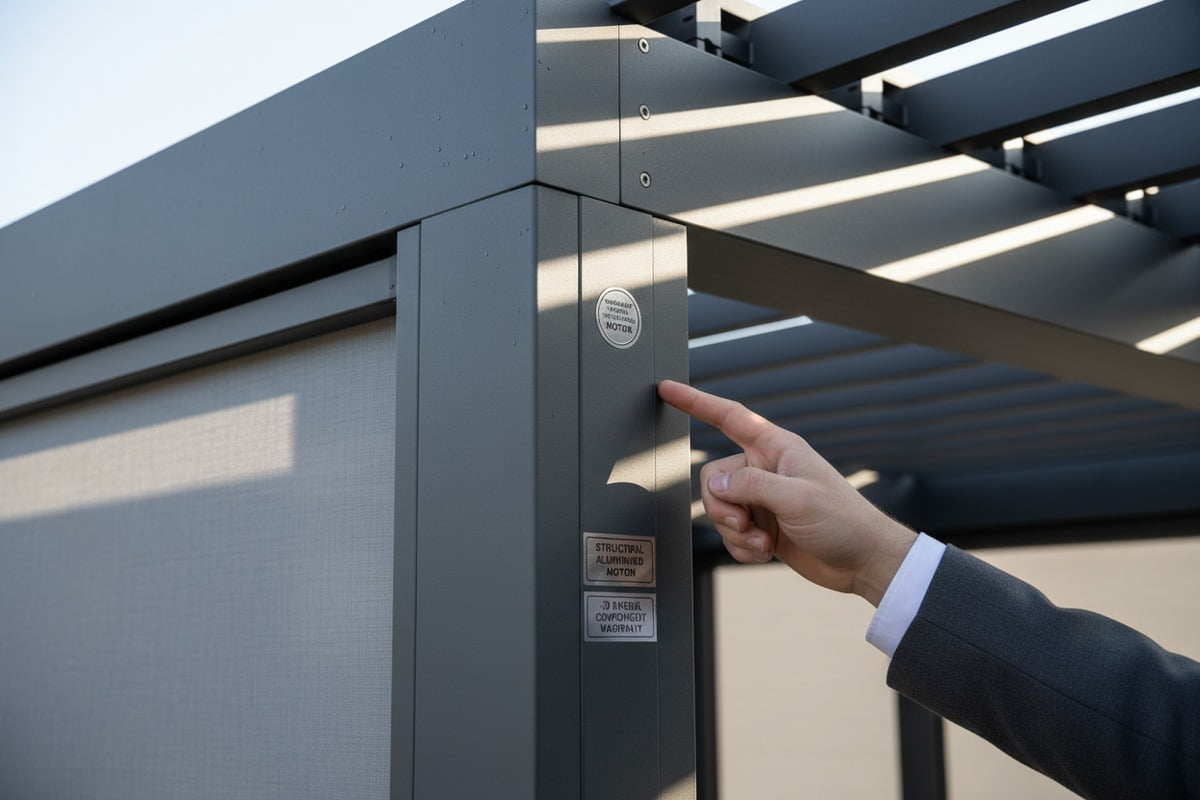
Your aluminum pergola warranty should cover structural aluminum frames for 10–20 years, powder coating for 5–15 years, motors and electrical components for 2–5 years, and fabrics or screens for 3–5 years. Each component must be listed separately with its own duration, defect definitions, and remedy options.
Why Component-Level Coverage Matters
An aluminum frame can last decades. A motor might fail in three years. If your contract says "10-year warranty" without specifying what that covers, you will face arguments when a louver motor dies in year four. The manufacturer will point to the motor's implicit 2-year lifespan. You will point to the blanket 10-year term. Nobody wins.
In our experience shipping over 80,000 sets annually, the disputes that escalate fastest are the ones where the contract lumped everything together. Separate coverage removes ambiguity.
Industry Benchmark: Warranty Durations by Component
Here is what the market currently offers. Use this table as your negotiation baseline.
| Componente | Short-End Coverage | Mid-Range Coverage | Premium Coverage |
|---|---|---|---|
| Structural Aluminum (frames, posts, beams, louvers) | 10 years | 15–20 years | Lifetime (original owner) |
| Powder Coating 5 / Finish | 5 years | 10–15 years | Lifetime (original owner) |
| Motors & Electrical Controls | 2 anni | 3–5 years | 5 years |
| LED Lighting & Sensors | 1–2 years | 2–3 years | 3 years |
| Fabrics, Screens, Zip Blinds | 2 anni | 3–5 years | 5 years |
| Hardware (screws, brackets, connectors) | 2 anni | 5 years | 10 years |
What Defects Should Be Covered?
Your contract should name the specific defect types for each component:
- Structural aluminum: Material defects, weld failures, cracking under rated loads, warping beyond tolerance.
- Powder coating: Peeling, blistering, chalking, fading beyond a defined Delta-E color shift 6 (typically ΔE ≤ 5 after 10 years).
- Motors: Mechanical failure under normal operation cycles, electrical faults not caused by power surges.
- Fabrics/screens: Tearing along seams, UV degradation beyond rated hours, zipper track jamming due to manufacturing defect.
Coastal and Harsh Environment Adjustments
One detail many buyers miss: coastal installations face accelerated corrosion 7. Some manufacturers reduce powder coating warranties from 15 years to 10 years within 1 km of saltwater. Our recommendation is to negotiate this explicitly. If your project is in Sicily or the Algarve, ask for a corrosion-resistant coating upgrade and get the standard warranty duration in writing — not a shortened version.
Transferability Clause
If your client resells the property, can the warranty transfer? Non-transferable warranties protect the manufacturer but reduce resale value for your end customer. If transferability matters, specify it. Some brands offer lifetime coverage for the original owner but cap it at 20 years for subsequent owners. This is a reasonable compromise — include it in your contract.
What clauses should I include to protect my project if parts are missing or damaged during shipping?
Missing a single non-standard bracket can halt installation for weeks when replacements must ship from China. We learned this the hard way — a €200 connector once caused a three-week delay and nearly €8,000 in project penalties for one of our Italian partners.
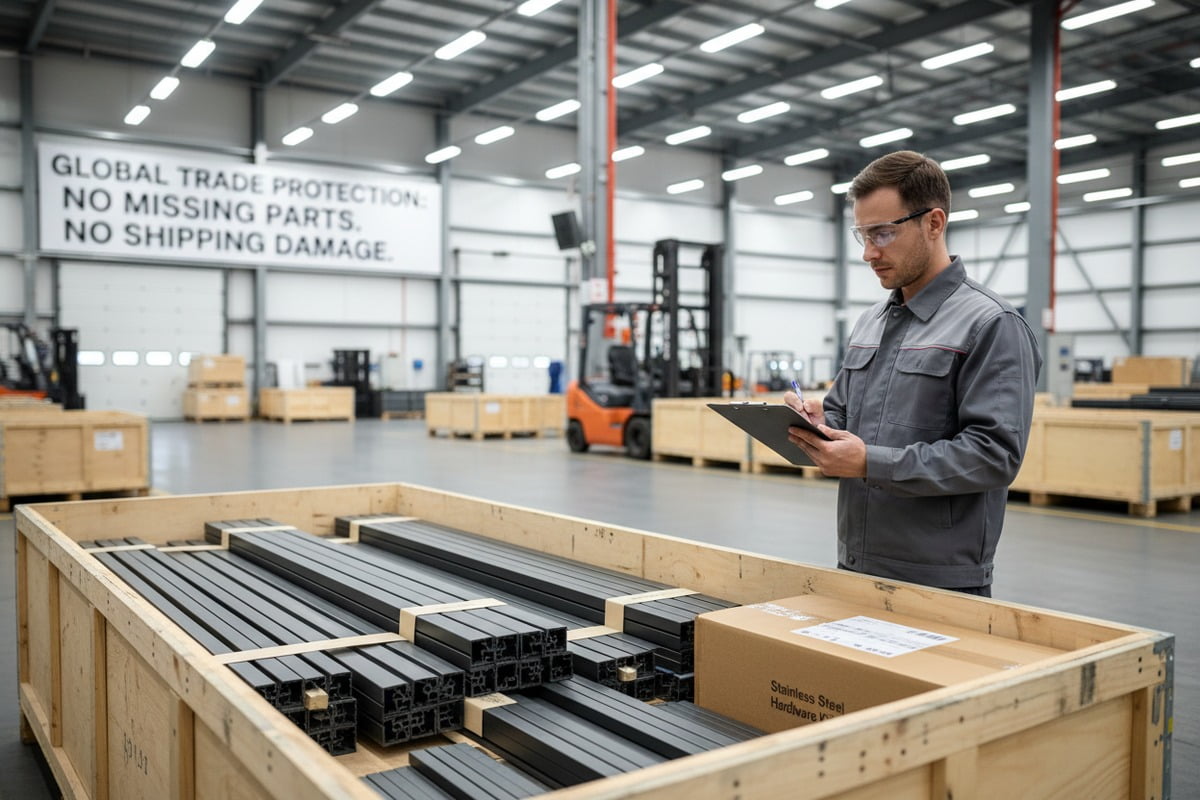
Your contract should include a mandatory pre-shipment inspection clause, a detailed packing list signed by both parties, a damage/shortage reporting window (typically 48–72 hours after delivery), photographic evidence requirements, and a defined remedy timeline for the manufacturer to ship replacements at their own cost.

Pre-Shipment Inspection
Before anything leaves our warehouse, we recommend a third-party or buyer-side inspection. Your contract should state:
- The buyer or their agent may inspect goods at the factory before shipment.
- The manufacturer must provide a complete packing list with item codes, quantities, and weight per package.
- Both parties sign off on the packing list. This becomes the reference document for any shortage claims.
Damage Reporting Window
Define exactly how many hours the buyer has to report damage or missing parts after delivery. Industry standard is 48 to 72 hours. After this window, the manufacturer's liability becomes harder to enforce. Your clause should specify:
- The buyer must inspect all packages within 72 hours of delivery.
- Any damage or shortage must be reported in writing (email is sufficient) with photographs.
- Photographs must show the outer packaging condition, the damaged/missing item, and the shipping label.
Remedy and Replacement Timeline
This is where most contracts fail. They say "manufacturer will replace" but never say when. Here is what we include in our standard agreements, and what you should insist on:
| Scenario | Required Manufacturer Response | Replacement Shipment Deadline |
|---|---|---|
| Missing standard part (screws, brackets, connectors) | Acknowledge within 24 hours | Ship via air within 5 business days |
| Missing custom/non-standard part | Acknowledge within 24 hours | Ship via air within 10 business days |
| Damaged aluminum profile | Acknowledge within 24 hours | Ship replacement within 15 business days |
| Damaged motor or electrical component | Acknowledge within 24 hours | Ship via air within 7 business days |
| Cosmetic damage (scratches, dents) | Acknowledge within 48 hours | Negotiate repair credit or replacement within 20 business days |
Who Pays for Replacement Shipping?
State it clearly: replacement parts for manufacturer-fault shortages or damage ship at the manufacturer's expense, including duties and customs fees. If you use DDP (Delivered Duty Paid) terms 8 for the original shipment, the same Incoterm should apply to replacements. Do not leave this open to interpretation.
Packaging Standards Clause
Prevention is better than cure. Your contract should specify minimum packaging requirements:
- Aluminum profiles wrapped individually in EPE foam 9 and bundled with corner protectors.
- Motors and electronics packed in shock-absorbent boxes with moisture barriers.
- All packages palletized and shrink-wrapped for container loading.
- Maximum stack height and "This Side Up" markings on fragile items.
Our production team has found that requiring the manufacturer to photograph the loaded container before sealing eliminates 90% of "it was like that when it arrived" disputes.
How can I define the manufacturer's response time for technical support and installation issues in my contract?
Time zone differences between China and Europe mean a simple question can take 24 hours to answer — or longer if there is no contractual obligation. When our team supports projects in Italy, Germany, or the Netherlands, we know that a one-day silence can cascade into a week-long site delay.
Your contract should define maximum response times — typically 4 business hours for urgent installation issues and 24 hours for general technical queries — along with dedicated support channels, escalation procedures, and penalties or credits for missed response deadlines.
Tiered Response Time Structure
Not every issue is equally urgent. A question about paint touch-up can wait a day. A motor that will not calibrate on installation day cannot. Structure your response times in tiers:
| Issue Severity | Examples | Max First Response | Max Resolution |
|---|---|---|---|
| Critical (installation halted) | Motor failure, structural part missing, safety concern | 4 business hours | 48 hours (interim solution) |
| High (installation slowed) | Unclear wiring diagram, minor part shortage, fit issue | 8 business hours | 5 business days |
| Medium (non-blocking) | Cosmetic question, optional accessory query | 24 business hours | 10 business days |
| Low (informational) | Future upgrade options, maintenance scheduling | 48 business hours | 15 business days |
Dedicated Support Channels
Your contract should name the exact channels and contacts:
- A dedicated project manager with direct email and phone number (not a generic info@ address).
- A WhatsApp or WeChat group for real-time communication during installation windows.
- A video call option for complex installation troubleshooting.
- Multilingual support — if your installers speak Italian, the technical support should be available in Italian or at minimum English with visual guides.
Installation Documentation Requirements
Bad installation guides cause more support calls than bad products. Your contract should require:
- A complete installation manual in the buyer's language, with 3D diagrams and step-by-step photos.
- An installation video (minimum 15 minutes) covering foundation prep, frame assembly, motor wiring, and louver calibration.
- A pre-installation checklist with foundation dimensions, electrical requirements, and tool lists.
- Digital access to all documents — QR code on packaging that links to the latest version.
When we ship to European partners, our engineers produce project-specific assembly videos for non-standard sizes. This alone has reduced our technical support calls by over 60%. Insist on this in your contract.
Penalties for Missed Deadlines
A response time clause without consequences is just a suggestion. Consider including:
- A credit of 0.5%–1% of the affected order value per day of delay beyond the agreed response time.
- The right to source third-party technical support at the manufacturer's expense if the response exceeds 72 hours for critical issues.
- A formal escalation path: project manager → technical director → senior management, with defined timeframes at each level.
Post-Installation Support Period
Define how long after installation the manufacturer must provide active support. A common standard is 90 days of priority support after installation sign-off. During this period, any operational issue gets treated as "Critical" regardless of its actual severity. After 90 days, standard tiered response applies.
What terms do I need to ensure the motors and coatings meet my local compliance and quality standards?
We once had a distributor in northern Europe reject an entire shipment because the motor CE certificates listed the wrong directive version. The product was perfectly safe. The paperwork was technically outdated. The cost? Two months of delays and €12,000 in re-certification fees. Compliance is not optional — it is the entry ticket to your market.
Your contract must require the manufacturer to provide valid CE, EN, or other locally mandated certifications for all motors and electrical components, guarantee powder coating compliance with recognized standards like Qualicoat or AAMA 2604, include a right-to-audit clause for testing reports, and specify financial liability for non-compliance.
Motor and Electrical Compliance
For the European market, every motor, control unit, sensor, and LED integrated into your pergola must carry CE marking under the relevant directives. Your contract should list these explicitly:
- Low Voltage Directive (2014/35/EU): Applies to motors operating between 50V–1000V AC.
- Electromagnetic Compatibility Directive (2014/30/EU): Ensures electronic controls do not interfere with other devices.
- Machinery Directive (2006/42/EC): If the pergola has automated moving parts (louvers, screens).
- Radio Equipment Directive (2014/53/EU): If the system uses Bluetooth, Wi-Fi, or RF remotes.
Your contract should state that the manufacturer will provide original test reports from accredited labs (not just self-declarations), updated certificates that match the exact model and batch being shipped, and a written guarantee that all certifications are valid at the time of delivery.
Powder Coating Quality Standards
A faded or peeling pergola destroys your brand reputation faster than almost anything else. Define coating standards in your contract:
- Qualicoat Class 2 or Class 3 for architectural applications. Class 2 requires minimum 60 microns coating thickness and passes 1,000 hours of salt spray testing. Class 3 extends this to 2,000 hours.
- AAMA 2604 or 2605 if your market references American standards. AAMA 2605 is the gold standard for high-performance coatings, requiring 10 years of South Florida exposure testing.
- Minimum coating thickness: Specify 60–80 microns as a contractual minimum, measurable by the buyer with a standard coating thickness gauge upon delivery.
Right-to-Audit and Third-Party Testing
Trust but verify. Your contract should include:
- The buyer's right to send samples to an independent lab at the manufacturer's expense if quality is disputed.
- The manufacturer must retain batch test reports for a minimum of 5 years.
- Annual or per-order provision of coating adhesion test results (cross-cut test per ISO 2409), salt spray results (ISO 9227 10), and color consistency data (Delta-E measurement).
Financial Liability for Non-Compliance
If a product fails to meet the specified standards, the contract must define who pays. We recommend the following language:
- The manufacturer bears all costs of re-certification, re-coating, or replacement if supplied goods fail to meet the standards listed in the contract.
- If non-compliant goods are delivered and cannot be remedied in-country, the manufacturer pays for return shipping, re-manufacturing, and expedited re-delivery.
- The manufacturer indemnifies the buyer against any fines, legal costs, or project penalties arising from non-compliant products.
Sustainability and Future-Proofing Clauses
Increasingly, European buyers want documentation proving the use of recycled aluminum content and recyclability of components at end-of-life. If this matters to your market, include clauses requiring the manufacturer to declare the percentage of recycled aluminum used, provide Environmental Product Declarations (EPDs) or equivalent documentation, and guarantee compatibility for modular upgrades — adding heating, lighting, or screening modules in the future without structural modifications.
On our production lines, we now track recycled content per batch and can provide this data on request. If your tender requires it, make sure it is in your contract.
Conclusione
A strong aluminum pergola contract protects your investment, your timeline, and your reputation. Define component-level warranties, shipping remedies, response times, and compliance standards — then enforce them with clear penalties.
Note a piè di pagina
1. Official text of the EU directive for electrical equipment safety. ︎
2. Provides an overview of aluminum pergolas and their benefits. ︎
3. Official EU information on the directive for electromagnetic compatibility. ︎
4. Replaced with the official Qualicoat homepage, which is the most authoritative source for information on Qualicoat standards, including Class 2 and Class 3. ︎
5. Replaced with a Wikipedia page providing a general and authoritative definition of powder coating. ︎
6. Defines Delta E as a metric for color difference and its significance. ︎
7. Explains the concept of accelerated corrosion in materials. ︎
8. Details the responsibilities of sellers and buyers under DDP Incoterms. ︎
9. Replaced with a Wikipedia page offering a general and authoritative explanation of expanded polyethylene (EPE foam). ︎
10. Describes ISO 9227 as a standard for salt spray corrosion testing. ︎