Outdoor spaces have changed. Homeowners no longer want a simple shade cover — they want an architectural outdoor room that feels like a natural extension of their home Eurocode standards 1. Over the past 25 years on our production lines, we have watched this shift firsthand.
Position aluminum pergolas as premium by emphasizing architectural design, durable powder-coated finishes, smart comfort features, full customization with RAL colors and OEM options, certified load-bearing performance, and professional-grade packaging that protects both the product and your brand reputation.
Below, we break down the four pillars that help distributors, contractors, and wholesalers elevate aluminum pergolas from commodity shade structures to high-value outdoor living products. Each section covers practical steps you can apply immediately.
How can I ensure the aluminum quality and surface finish meet the expectations of my high-end clientele?
When our quality team inspects finished pergola profiles before shipment, surface finish is the single detail that makes or breaks a premium first impression. One visible scratch or uneven coating can undo months of brand-building effort.
Ensure aluminum quality by specifying 6063-T5 or 6061-T6 alloy grades, requiring minimum wall thicknesses of 2.0 mm or above, and demanding QUALICOAT- or GSB-certified powder coating with a minimum 60-micron film thickness to guarantee fade resistance, scratch hardness, and long-term weather durability.
Why Alloy Grade Matters
Not all aluminum is equal. The alloy grade determines strength, corrosion resistance 2, and how well the surface accepts coating. For pergola applications, 6063-T5 is the most common choice because it extrudes cleanly, resists corrosion, and produces smooth surfaces. 6063-T5 or 6061-T6 alloy grades 3 For higher structural loads — say, wide-span freestanding pergolas — 6061-T6 offers better tensile strength 4.
A common mistake among new importers is accepting unspecified alloy. When you do not define the grade in your purchase order, some factories may substitute softer, cheaper alloys. The result is profiles that bend during shipping or sag after installation. On our production floor, every extrusion batch comes with a mill certificate 5 that states alloy composition and temper. We recommend you always request this document.
Wall Thickness and Structural Integrity
Wall thickness directly affects wind and snow load capacity. Thin walls save material cost but create risk. A profile that looks identical on the outside can be 1.5 mm or 2.5 mm inside — and the performance difference is enormous.
| Wall Thickness | Caso d'uso tipico | Wind Load Rating | Premium Suitability |
|---|---|---|---|
| 1.2 – 1.5 mm | Budget patio covers | Low | Not recommended |
| 1.8 – 2.0 mm | Standard residential pergolas | Moderate | Acceptable entry level |
| 2.0 – 2.5 mm | Premium residential, commercial | Alto | Recommended |
| 2.5 – 3.0 mm | Large-span or heavy-snow regions | Very high | Best for luxury projects |
Surface Finish: The Silent Quality Signal
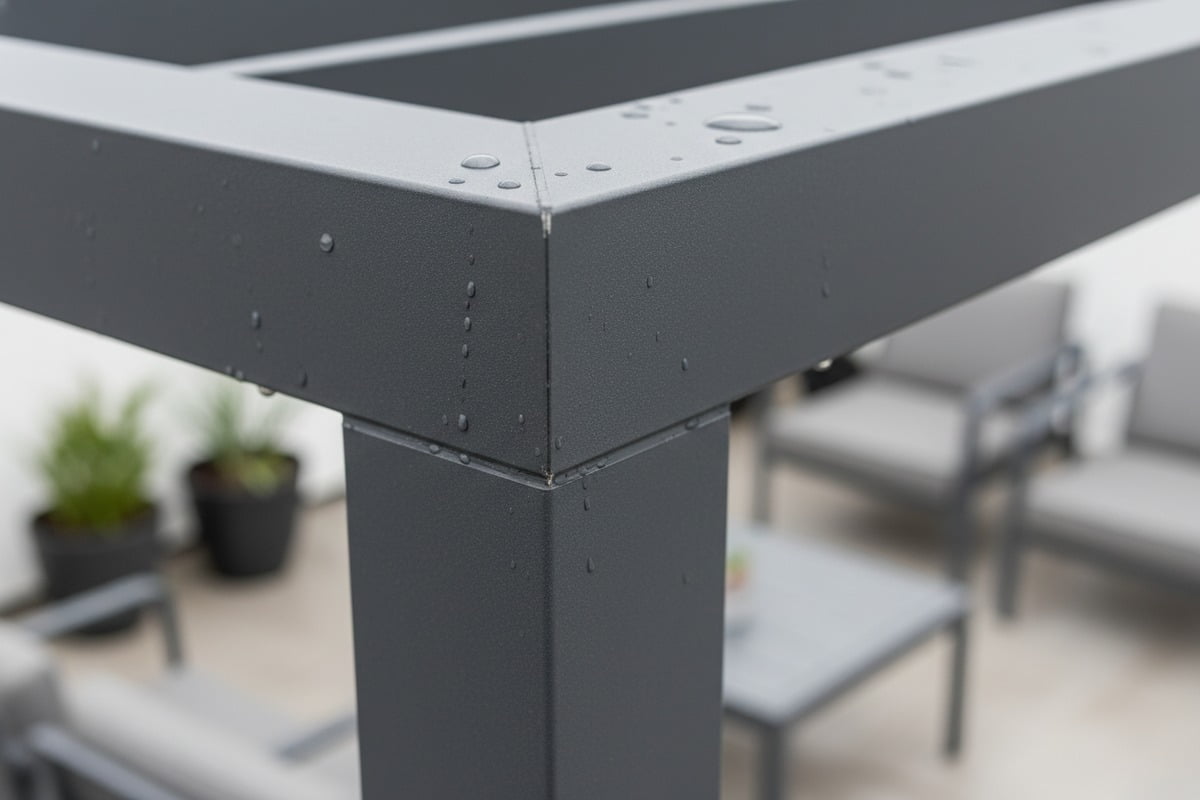
High-end buyers judge a pergola within seconds. A smooth, even, rich matte or textured powder coat communicates quality before anyone reads a spec sheet. Our finishing line applies electrostatic powder coating 6 at a minimum of 60 microns, followed by a 200°C curing cycle. We test every batch for adhesion (cross-hatch test), hardness (pencil hardness ≥ 2H), and salt spray resistance (≥ 1,000 hours).
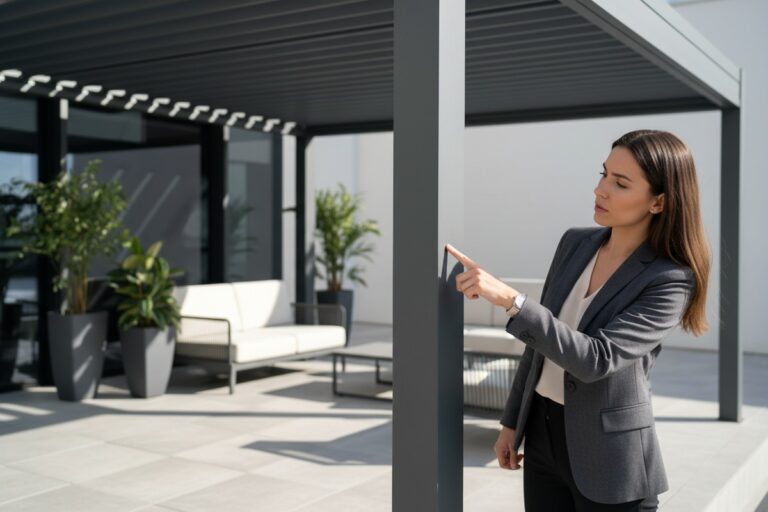
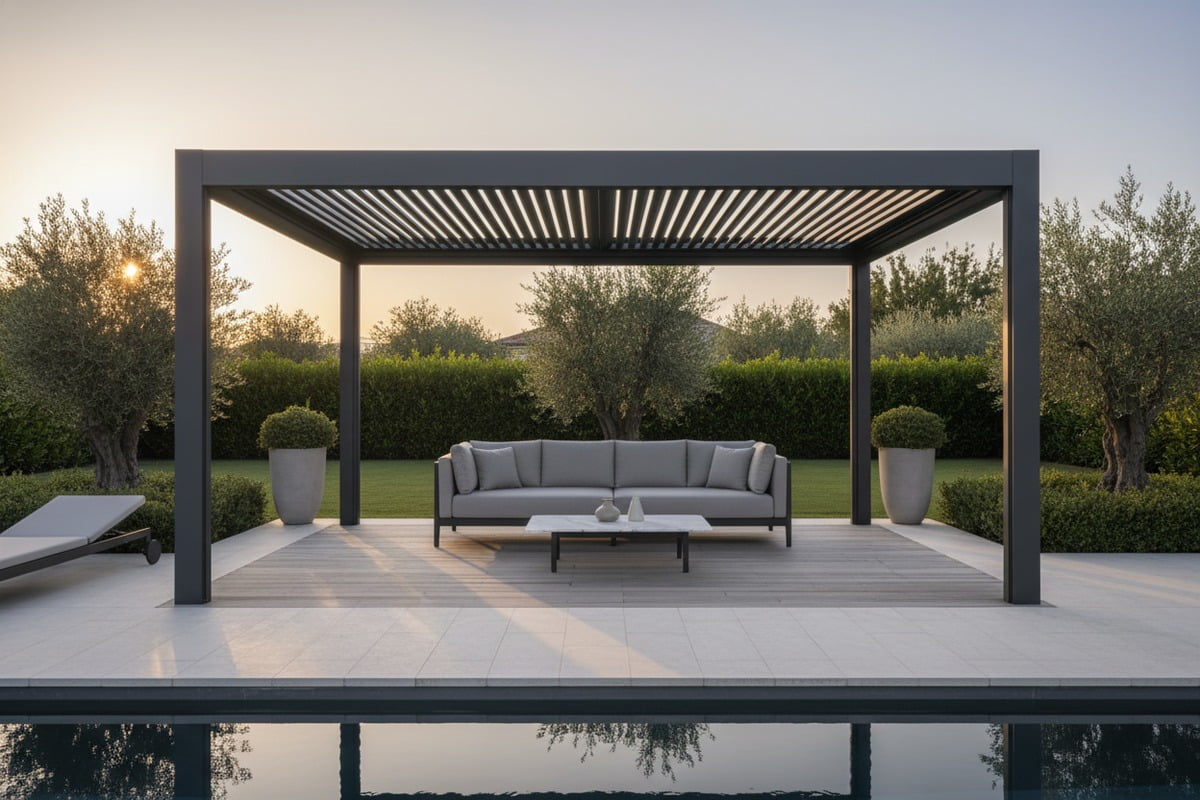
The charcoal grey finish shown in our latest louvered pergola line — a deep matte metallic tone — is a perfect example. It contrasts elegantly against light stone platforms and wood decking, giving the structure an industrial yet sophisticated presence. That finish quality is what separates a premium product from a painted metal frame.
Avoiding Common Pitfalls
Watch for orange-peel texture, uneven gloss, and visible weld marks. These defects are easy to miss in factory photos but obvious on a sunny patio. Always request a physical sample panel before committing to large orders. And if your factory cannot provide a QUALICOAT or GSB certification for their coating line, treat that as a red flag. QUALICOAT- or GSB-certified powder coating 7
In our experience exporting to European markets, the single fastest way a distributor gains shelf differentiation is through exclusive design details and signature color palettes that competitors simply cannot replicate off the shelf.
Set your brand apart by commissioning custom OEM pergola profiles, selecting unique RAL colors exclusive to your product line, incorporating branded hardware and packaging, and offering modular accessories like decorative screen panels, integrated LED channels, and motorized louver options that create a recognizable product identity.

The Power of Exclusive RAL Colors
Standard pergola catalogs often feature the same five or six colors: white, black, anthracite grey, bronze, and sometimes a wood-grain transfer. These are safe, but they do nothing to distinguish your brand.
When you specify a custom RAL color — say, RAL 7016 Anthracite Grey with a fine texture, or RAL 9001 Cream with a satin finish — you create a product that cannot be easily price-compared against generic competitors. Buyers see it as "your" color. Hotels and architects specify it by name.
Our powder coating line can match any RAL Classic or RAL Design color. Minimum order quantities for a custom color typically start at around 50 sets, which is well within reach for most wholesalers and project contractors.
OEM Design: Beyond Logo Stamping
True OEM customization goes deeper than printing a logo on the beam. It involves:
- Custom profile cross-sections — Unique column shapes or beam proportions that match your brand aesthetic.
- Proprietary connector systems — Hidden fasteners or snap-fit joints that simplify installation and look cleaner.
- Exclusive accessories — Side panels, privacy screens, gutter integrations, or lighting channels designed to fit only your product line.
- Branded installation hardware — Laser-engraved bolts, custom-color fasteners, and branded protective caps.
| OEM Customization Level | What It Includes | Typical MOQ | Brand Impact |
|---|---|---|---|
| Level 1: Basic branding | Logo on packaging, generic product | 20 sets | Low differentiation |
| Level 2: Color + finish exclusive | Custom RAL color, branded labels | 50 sets | Moderate differentiation |
| Level 3: Profile + accessory design | Custom extrusions, unique accessories | 100 sets | Strong differentiation |
| Level 4: Full system design | Proprietary structure, exclusive IP | 200+ sets | Maximum brand identity |
Modular Accessories as a Premium Lever
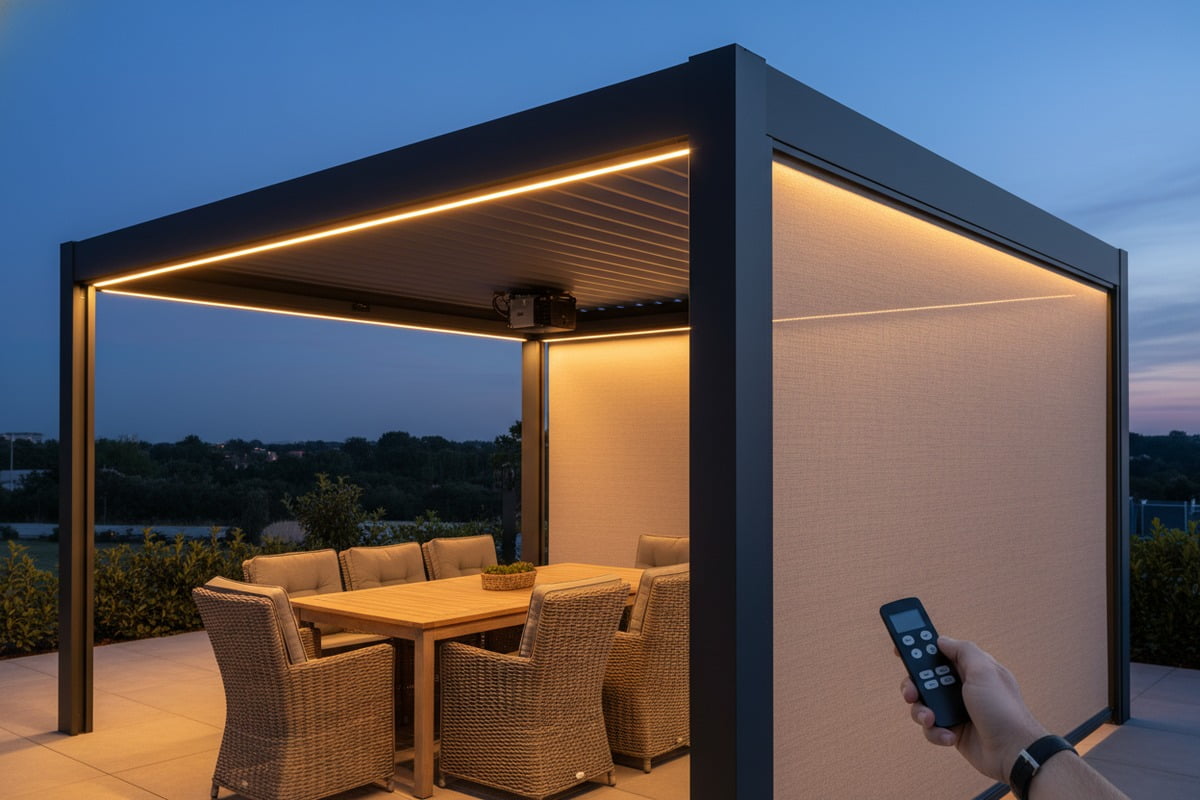
One of the clearest premium markers in our industry is a rich accessory ecosystem. When your client can add decorative screen panels for privacy, integrated LED strip channels for ambient lighting, motorized zip blinds for weather protection, and infrared heaters for cool evenings — all designed to click into your pergola frame — you have moved beyond selling a structure. You are selling a system.
This modular approach also increases average order value. A base pergola might sell for a certain price, but add louvers, side screens, lighting, and a motor kit, and the ticket doubles. More importantly, it locks the end user into your ecosystem for future upgrades.
Avoiding the "Generic Catalog" Trap
If you sell the same pergola that ten other importers source from the same factory, you compete on price alone. Price competition erodes margins and cheapens brand perception. The investment in OEM tooling and custom colors pays for itself within the first few container orders because you gain pricing power. When a product looks and feels unique, buyers accept a premium.
What technical certifications and load-bearing data should I present to justify a luxury price point to my buyers?
Our engineering team regularly fields questions from European clients who need hard numbers before they can approve a product for local building codes. Without proper certifications and transparent structural data, even the best-looking pergola will not pass muster.
Justify a luxury price point by presenting CE marking, EN 1090 structural certification, wind and snow load test reports conforming to Eurocode standards, motor CE and IP ratings, powder coat QUALICOAT certification, and clearly documented maximum span tables so buyers can verify performance against local building requirements.
Why Certifications Are Non-Negotiable for Premium
In the European market, certifications are not marketing decorations — they are legal requirements. A pergola sold in Italy, Germany, or France must meet structural safety standards. EN 1090 structural certification 9 If your product lacks the right paperwork, your buyer faces liability exposure. Premium buyers view certifications as proof of engineering integrity. They also use them to justify higher pricing to their own customers.
Key Certifications to Have Ready
Here is a practical reference table of the certifications that matter most for aluminum pergola exports to Europe:
| Certification | What It Covers | Why It Matters for Premium |
|---|---|---|
| CE Marking 10 | Product safety compliance for EU market | Legal market access; signals quality |
| EN 1090 | Execution of steel and aluminum structures | Proves structural fabrication quality |
| Eurocode EN 1991 Load Reports | Wind (EN 1991-1-4) and snow (EN 1991-1-3) loads | Verifies the product handles real weather |
| QUALICOAT / GSB | Powder coating quality | Guarantees long-term finish durability |
| Motor CE + IP Rating | Electrical safety and ingress protection | Required for motorized louver and blind systems |
| EN 13561 | External blinds and screens | Mandatory for zip blind accessories in EU |
Load-Bearing Data: Show the Numbers
Premium buyers — especially contractors and architects — want specific numbers. They need to know: What is the maximum wind speed this pergola withstands? What snow load can it carry? What is the maximum unsupported span?
On our production line, we test standard pergola configurations and publish load tables. For example, a 4 m × 4 m louvered pergola with 2.5 mm wall columns typically handles wind loads up to 120 km/h and snow loads of 50 kg/m². Larger spans or heavier load requirements call for reinforced beams or additional support columns.
Providing this data in a clean, professional format — not buried in a generic PDF — elevates the sales conversation. It shifts the discussion from "How cheap can you go?" to "How strong is this system?"
Conformità dei motori e dell'elettronica
Motorized louvered roofs and zip blinds involve electrical components. In Europe, these must carry CE marking and meet low-voltage directive requirements. Motors should have an IP44 rating minimum for outdoor use. Using uncertified motors is a legal risk and a reputation killer. One product recall or safety complaint can destroy years of brand building. We source motors from certified European or certified-equivalent suppliers, and every motor ships with its own declaration of conformity.
How to Present This Data to Buyers
Do not dump a stack of certificates on a buyer's desk. Instead, create a one-page technical summary for each product SKU. Include: alloy grade, wall thickness, maximum load ratings, coating certification, motor specifications, and a list of applicable EU standards. This document becomes a powerful sales tool that your buyer can hand to their architect or building inspector.
A few years ago, one of our Italian distribution partners received a container where three pergola sets arrived with scratched columns because the internal foam separators had shifted during rough seas. That single incident cost more in goodwill damage than the entire freight bill. It taught us that premium packaging is not an expense — it is brand insurance.
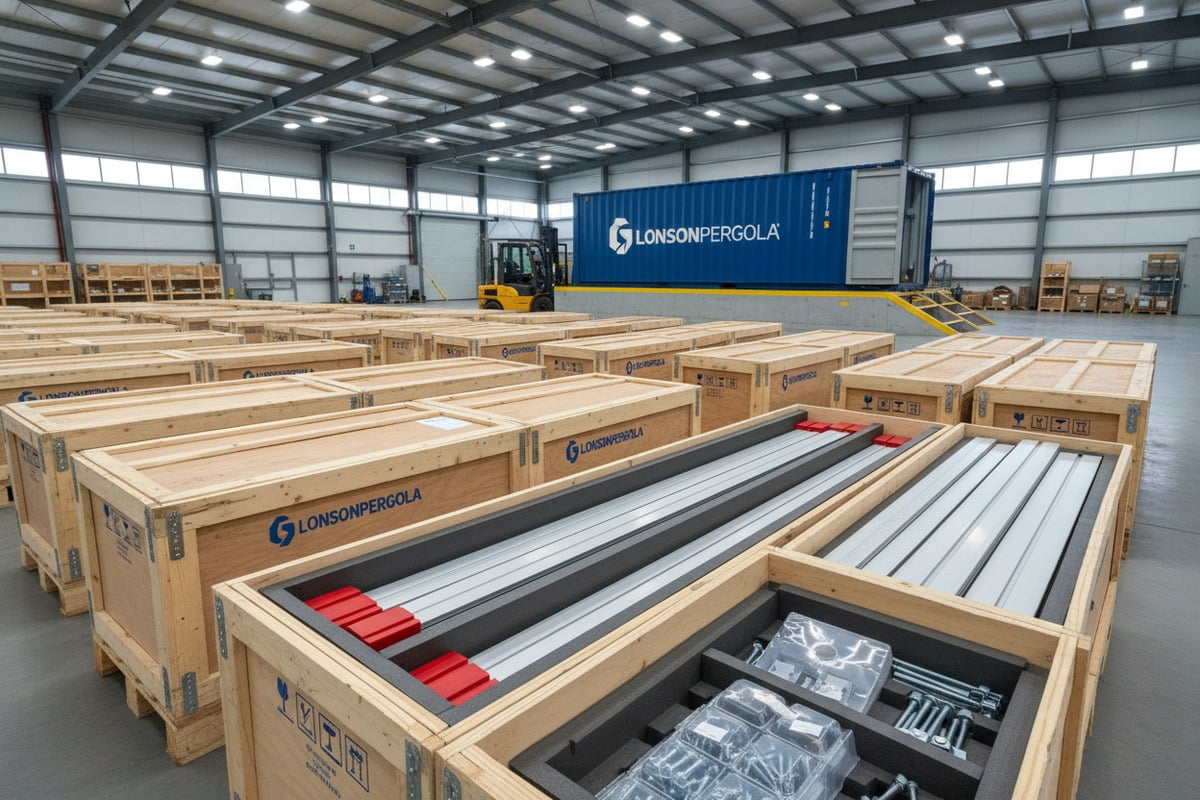
Improve packaging by using individual profile wrapping, foam-lined compartments, pre-sorted hardware kits with labeled bags, reinforced corner protectors, and custom crates. Strengthen installation support with multilingual 3D assembly videos, illustrated step-by-step manuals, QR-code-linked digital guides, and a dedicated after-sales technical team with guaranteed response times.
The True Cost of Poor Packaging
When a premium product arrives damaged, the financial loss goes beyond the replacement cost. Your buyer faces installation delays. Their client loses confidence. The contractor charges standby fees. And your brand takes a hit that no discount can repair.
For sea freight from China to Europe — a journey of 30 to 45 days — packaging must survive port handling, container stacking, moisture, and vibration. Standard cardboard wrap is not enough for premium aluminum profiles.
Our Packaging Protocol
Here is what we implement for every premium shipment:
- Individual PE film wrapping on every profile to prevent surface-to-surface contact scratches.
- Foam corner protectors on all columns and beams.
- Custom plywood crates for freestanding pergola sets, sized to prevent internal movement.
- Pre-sorted hardware kits — every bolt, screw, connector, and bracket is bagged, labeled, and grouped by installation step.
- Component checklist printed and placed inside the crate so the installer can verify completeness on arrival.
- Moisture-absorbing desiccant packs inside sealed packaging to prevent condensation damage during ocean transit.
Installation Support: Where Premium Brands Win or Lose
The pergola might arrive in perfect condition, but if the installer struggles with unclear instructions, the end result suffers. Premium positioning demands that installation feels effortless and precise.
We provide three layers of installation support:
Layer 1: Printed manual. A full-color, step-by-step illustrated guide in multiple languages (English, Italian, French, German, and Spanish are our standard set). Each step includes a clear diagram with numbered callouts.
Layer 2: Video guides. We produce 3D animated assembly videos for every pergola model. These are hosted online and accessible via a QR code printed on the manual cover and on the crate label. The installer scans, watches, and follows along.
Layer 3: Live technical support. Our after-sales team operates across European time zones. If a contractor hits a problem at 10 AM in Rome, they can reach a technician who speaks their language and knows the product inside out. Our target response time is under four hours.
What Happens When Parts Are Missing?
Even with careful packing, errors happen. The question is how fast you fix them. We maintain a European-side spare parts buffer with our key distribution partners. For standard fasteners and connectors, replacements ship from local stock within 48 hours. For non-standard components, we air-freight from our factory within five business days. This protocol exists because we learned the hard way that a single missing bracket can hold up a project worth tens of thousands of euros.
Professional Installation Versus DIY
Some pergola models are designed for experienced DIY installers. Others — especially motorized louvered systems with integrated wiring — benefit from professional installation. We clearly mark each product with an installation complexity rating so our distribution partners can advise their clients properly. This prevents frustration, callbacks, and negative reviews, all of which erode premium brand perception.
Conclusione
Premium positioning is not a single feature. It is the sum of material quality, custom design, certified performance, and flawless delivery. When every detail — from alloy grade to the last labeled bolt — reflects care and expertise, your aluminum pergola earns its place as a true architectural outdoor living product.
Note a piè di pagina
1. Explains Eurocodes as European standards for structural design in the EU. ︎
2. Replaced HTTP 404 link with an authoritative definition from Corrosionpedia, a specialized encyclopedia for corrosion. ︎
3. Provides information on 6063 aluminum alloy properties and common applications. ︎
4. Defines tensile strength as the maximum force a material withstands before breaking. ︎
5. Replaced HTTP unknown link with a comprehensive definition from Wikipedia, a highly authoritative source. ︎
6. Explains the process of electrostatic powder coating and its benefits for metal surfaces. ︎
7. Official website for QUALICOAT, a quality label for architectural aluminum coatings. ︎
8. Official website for RAL colors, a widely used standard for color communication. ︎
9. Explains EN 1090-1 standard for steel and aluminum structures, covering requirements and CE marking. ︎
10. Official EU information on CE marking, its meaning, and requirements for products in the EEA. ︎