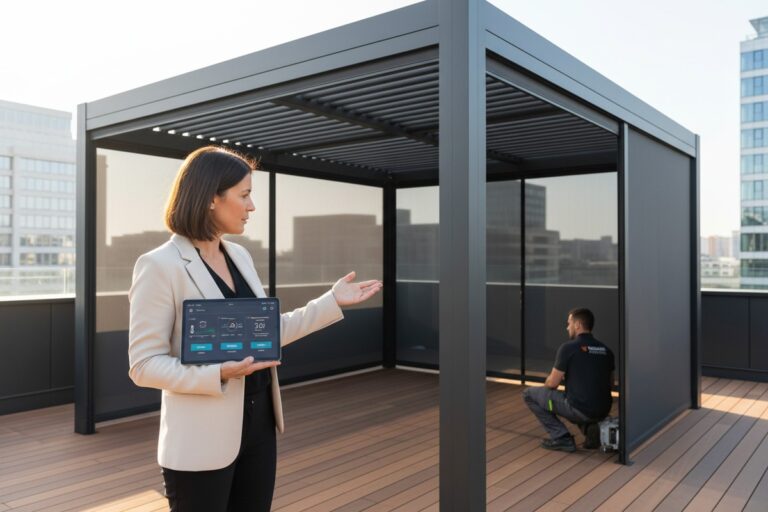

Every year, our engineering team reviews dozens of project failures traced back to one root cause: buyers who trusted a supplier's load ratings without verifying them against actual European standards 1. The consequences range from sagging beams after a single winter to complete structural collapse during a coastal storm. If you are sourcing aluminum pergolas for the European market, this gap between claimed performance and proven performance is the single biggest risk to your business reputation.
To verify European wind and snow load standards, request the supplier's Declaration of Performance (DoP) under EN 13561:2015, cross-reference their wind resistance class and snow load rating against Eurocode 1 (EN 1991) National Annex values for your specific region, and confirm all claims through independent, third-party test reports.
This guide breaks down the exact steps, documents, and red flags you need to know Eurocode 1 (EN 1991) 2. We will walk through aluminum wall thickness, test reports, Eurocode compliance, and how to spot suppliers who cut corners. Let's get into it.
How do I confirm that the aluminum wall thickness is sufficient for my local snow load?
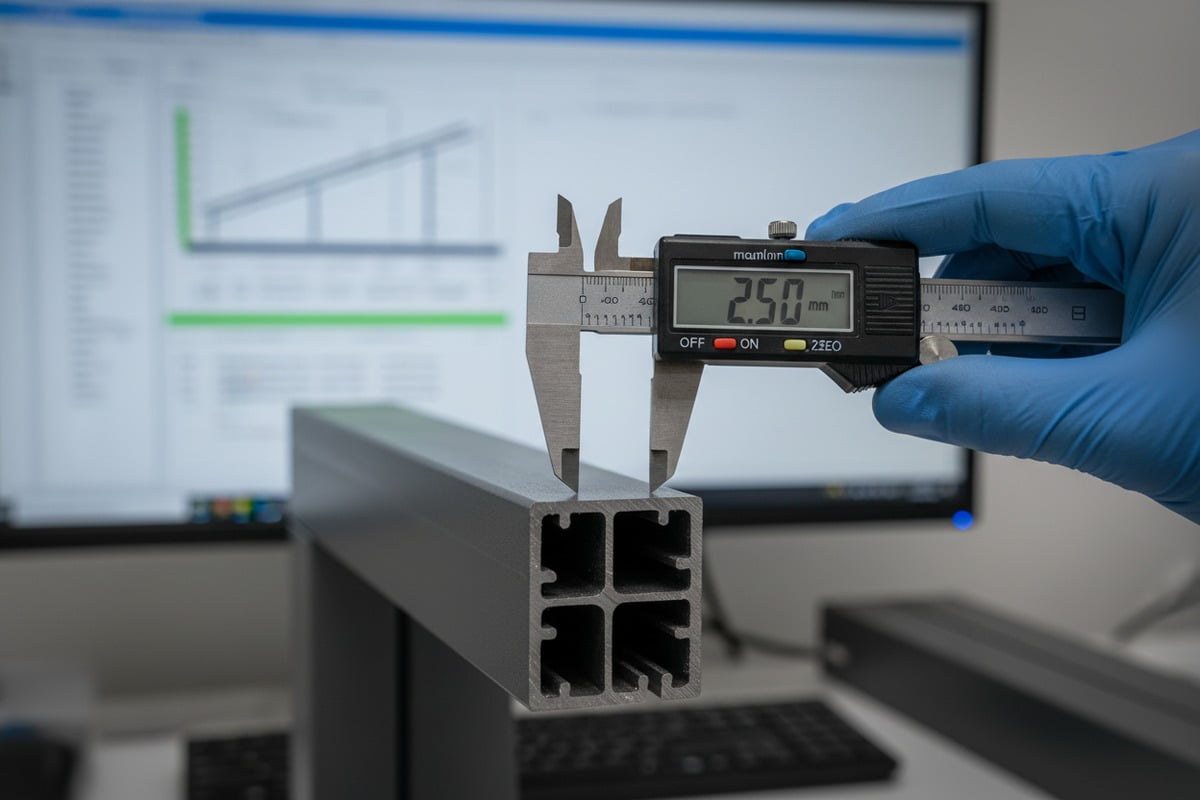
When we design pergola profiles at our facility, wall thickness is one of the very first parameters our structural engineers lock in. It directly determines whether a beam will hold up under 50 cm of wet snow or buckle quietly in the night. Too many buyers focus on surface finish and price, overlooking the millimeters that separate a safe pergola from a liability.
To confirm sufficient wall thickness for your local snow load, obtain the characteristic snow load value from your country's Eurocode 1 National Annex, then request the supplier's structural calculation report showing that their specific aluminum profile thickness and alloy grade meet or exceed that load at your site's altitude and exposure conditions.
Understanding Snow Load Values in Europe
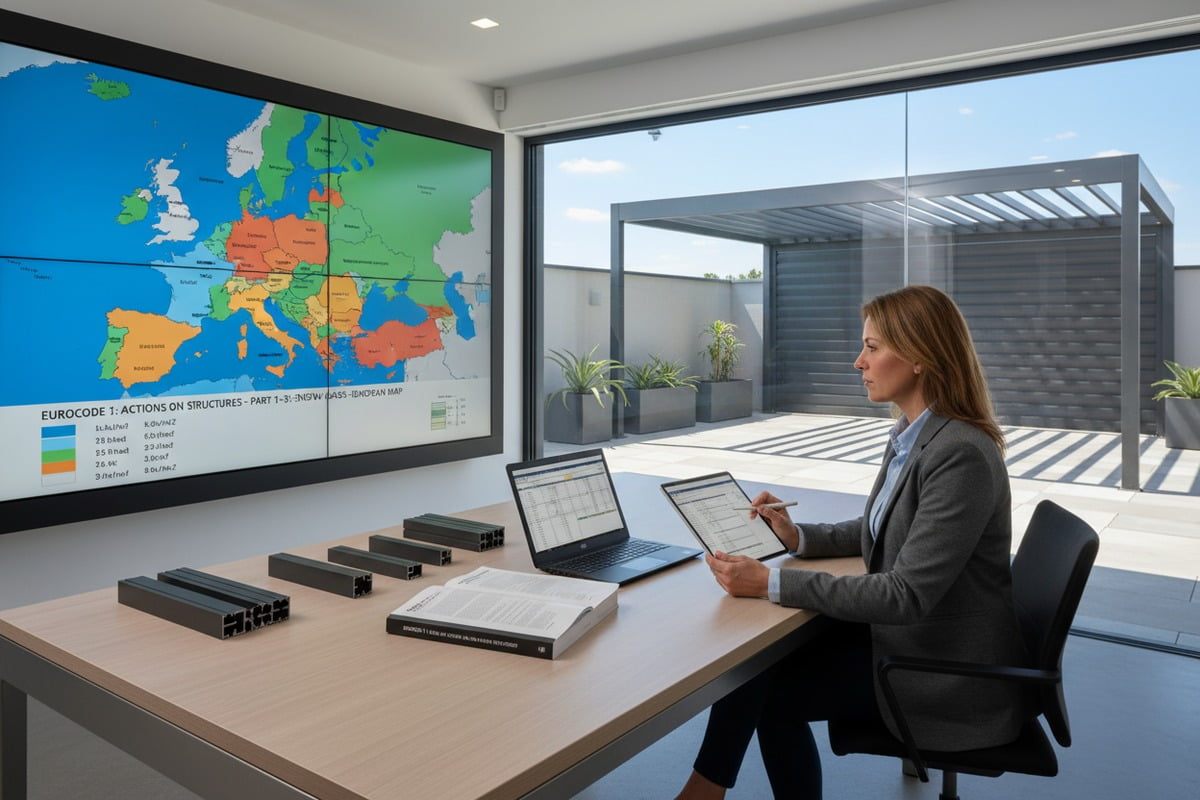
Snow load is not a single number. It varies dramatically across Europe. A pergola installed in coastal Barcelona faces a fraction of the snow load compared to one in the Austrian Alps. Eurocode 1 (EN 1991-1-3) 3 provides the calculation framework, but each country publishes its own National Annex with localized snow maps and ground snow load values. You must start there.
The characteristic snow load on the ground is expressed in kN/m² (kilonewtons per square meter) or kPa (kilopascals). The value depends on your site's altitude, latitude, and snow zone. A structural engineer then adjusts this figure using shape coefficients and exposure coefficients to get the actual snow load on the pergola roof.
Typical European Ground Snow Load Values by Region
| Region / Country | Typical Ground Snow Load Range (kN/m²) | Notes |
|---|---|---|
| Southern Spain, coastal Italy | 0.2 – 0.6 | Low snow risk, but still regulated |
| Central France, Netherlands | 0.5 – 1.0 | Moderate; check local annex |
| Northern Germany, Poland | 0.7 – 1.5 | Higher accumulation zones |
| Alpine regions (Austria, Switzerland) | 1.5 – 5.0+ | Altitude-dependent; can be extreme |
| Scandinavia (Norway, Sweden) | 1.5 – 4.5+ | Heavy snowfall zones |
How Wall Thickness Connects to Snow Load
Aluminum alloy 6063-T5 4 is the industry standard for pergola extrusions. But the same alloy can be extruded at 1.5 mm, 2.0 mm, 2.5 mm, or 3.0 mm wall thickness. Each step up significantly increases the section's moment of inertia 5, which is the beam's ability to resist bending under load.
In our production experience, a 2.0 mm wall thickness on a standard 100 mm x 200 mm beam profile is adequate for snow loads up to about 0.6 kN/m² over a 3-meter span. Push the snow load to 1.5 kN/m² or increase the span to 4 meters, and you need 2.5 mm or thicker walls—or internal reinforcement ribs.
What to Request from Your Supplier
Ask for these three things:
- The exact alloy grade and temper (e.g., 6063-T5 or 6061-T6).
- The wall thickness of each structural member — main beams, secondary rafters, and columns.
- A structural calculation report that references your site's snow load value from the relevant National Annex and shows the safety factor used.
If a supplier cannot provide a calculation report tied to a specific snow load value, they are guessing. That is not acceptable for any European project.
Minimum Recommended Wall Thickness by Snow Load
| Snow Load (kN/m²) | Minimum Wall Thickness (mm) for 3m Span | Minimum Wall Thickness (mm) for 4m Span |
|---|---|---|
| 0.3 – 0.6 | 1.8 - 2.0 | 2.0 – 2.2 |
| 0.6 – 1.0 | 2.0 – 2.3 | 2.3 – 2.5 |
| 1.0 – 1.5 | 2.3 – 2.5 | 2.5 - 3.0 |
| 1.5 – 3.0 | 2.5 – 3.0+ | 3.0+ or reinforced profiles |
These are general guidelines based on standard rectangular hollow sections. Your specific profile geometry matters. Always verify with engineering calculations.
What specific test reports should I request from my supplier to guarantee wind resistance?
Our quality assurance team has seen a troubling pattern over the past five years: suppliers claiming "Class 6 wind resistance" or "120 km/h rated" without a single page of independent testing to back it up. When the storm hits and the pergola fails, it is the buyer—not the supplier—who faces the liability claim.
Request a wind resistance test report conducted by an accredited third-party laboratory per EN 13561:2015, a Declaration of Performance (DoP) specifying the exact wind class achieved, and structural engineering calculations certified to Eurocode 1 (EN 1991-1-4) for your site-specific wind zone and terrain category.
The Difference Between Claimed and Certified Ratings
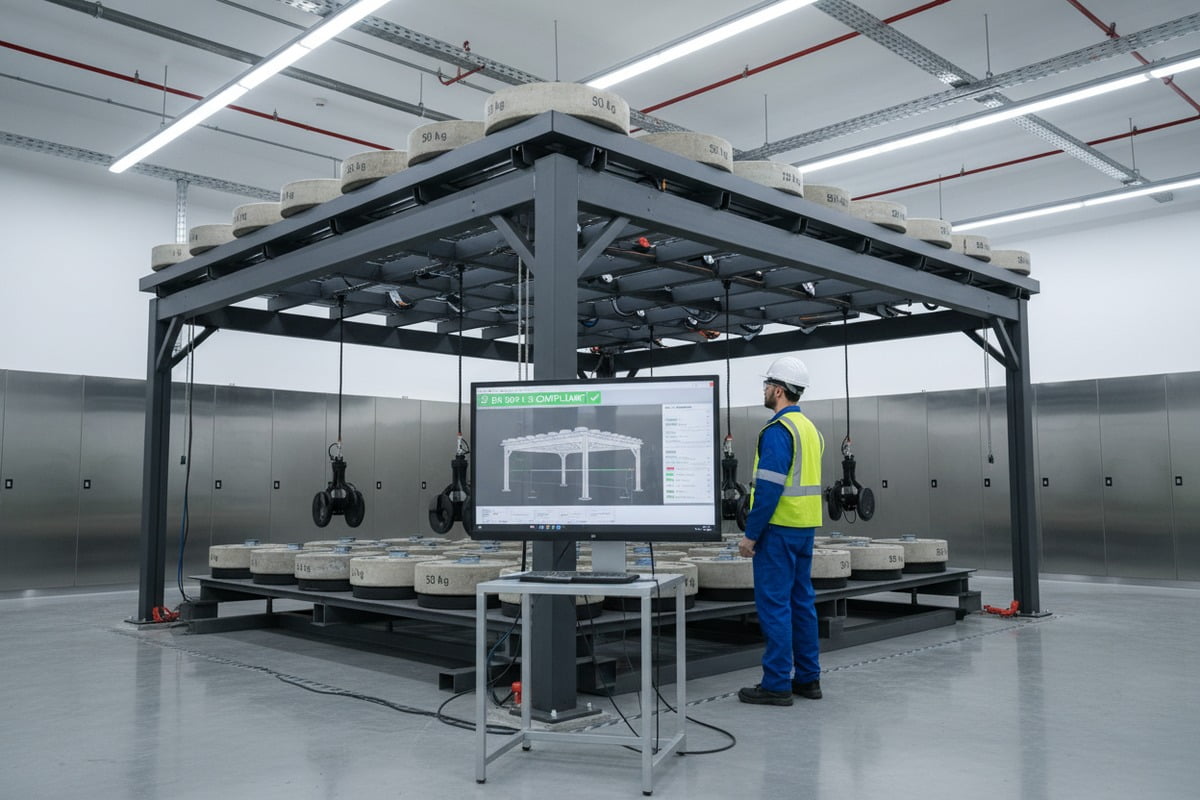
This is the most important distinction in pergola sourcing. A manufacturer can print "wind resistant to 120 km/h" on a brochure without any external validation. A certified rating, however, comes from a recognized testing laboratory that has physically subjected the pergola system—or a representative sample—to simulated wind loads following a defined protocol.
Certified ratings are what building authorities, insurance companies, and structural engineers accept. Claimed ratings are marketing. You need to know the difference before you sign a purchase order.
Documenti chiave da richiedere
Here is a clear checklist of what to ask for:
Declaration of Performance (DoP): This is legally required for products sold in the EU under the Construction Products Regulation 6. The DoP must reference the harmonized standard (EN 13561:2015 7 for pergola awnings) and declare the wind resistance class.
Third-Party Test Report: This is the actual laboratory document showing test methodology, equipment, sample details, and results. Look for the testing lab's accreditation number (ISO 17025 accreditation 8 is the gold standard). The report should specify the wind pressure applied, the deflection measured, and whether the sample passed or failed.
Structural Calculation Package: For fixed-roof or louvered pergolas that go beyond the scope of EN 13561, suppliers should provide structural calculations per Eurocode 1 (EN 1991-1-4) and Eurocode 9 (EN 1999 for aluminum structures). These calculations should be signed by a qualified structural engineer.
EN 13561:2015 Wind Resistance Classes
| Wind Class | Maximum Test Pressure (Pa) | Approximate Wind Speed (km/h) | Typical Application |
|---|---|---|---|
| Classe 1 | 40 | ~29 | Light awnings |
| Classe 2 | 70 | ~38 | Standard awnings |
| Class 3 | 110 | ~49 | Retractable awnings |
| Class 4 | 170 | ~59 | Guided pergola awnings |
| Class 5 | 250 | ~72 | Heavy-duty pergola systems |
| Class 6 | 350+ | ~85+ | Premium louvered pergolas |
Classes 4 through 6 are where most quality aluminum pergolas fall. Some manufacturers test beyond Class 6, achieving ratings of 100+ km/h or even 120+ km/h. These extended ratings are valid only if backed by independent test data.
Watch Out for These Gaps
Many suppliers provide an internal quality report instead of a third-party test report. These are not the same thing. An internal report means the supplier tested their own product in their own facility. There is no independent verification. Always ask: "Was this test conducted by an ISO 17025 accredited laboratory?" If the answer is no, or if the supplier hesitates, that is a red flag.
Also check whether the test report covers the exact configuration you are ordering. A test on a 3 m x 3 m pergola does not automatically validate a 4 m x 6 m custom design. Larger spans and different post spacings change the load distribution entirely. Our engineering team always runs site-specific calculations for custom orders because we know that a generic test result does not cover every configuration.
How can I verify that my custom pergola design complies with Eurocode structural standards?
Custom designs are where most compliance problems hide. When we develop bespoke pergola configurations for European distributors, every non-standard dimension, every extra-long span, and every unusual mounting condition requires a fresh round of structural analysis. Off-the-shelf certifications simply do not cover custom work.
Verify custom pergola compliance by requesting a project-specific structural calculation package prepared per Eurocode 0 (EN 1990), Eurocode 1 (EN 1991 for loads), and Eurocode 9 (EN 1999 for aluminum design), signed by a chartered structural engineer, and cross-checked against your country's National Annex parameters for the installation site.
Why Standard Certifications Fall Short for Custom Orders
A standard product certification—like a test report for a 3 m x 4 m pergola—proves that specific configuration works. Change the span to 5 meters, add a side-mounted zip blind that catches wind, or install on an elevated coastal terrace, and the original certification no longer applies.
Custom orders need custom engineering. This is non-negotiable in Europe, where building inspectors can and do request structural calculations for outdoor structures above certain size thresholds.
The Three Eurocodes You Must Reference
Eurocode 0 (EN 1990) sets the basis of structural design. It defines safety factors, load combinations, and reliability classes. For pergolas, Consequence Class CC1 or CC2 typically applies, depending on the structure's size and public access.
Eurocode 1 (EN 1991) defines the actions (loads) on the structure. Part 1-3 covers snow loads. Part 1-4 covers wind loads. The National Annex for your country provides the local values—basic wind velocity, snow zone maps, terrain categories, and altitude corrections.
Eurocode 9 (EN 1999) is specific to aluminum structural design. It provides rules for calculating the resistance of aluminum members and connections. It covers bending, shear, buckling, and fatigue. This is the standard that confirms your aluminum profiles are strong enough for the calculated loads.
Combined Load Scenarios Matter
One of the most overlooked aspects of Eurocode compliance is load combination. Structures must withstand not just wind alone or snow alone, but specific combinations defined in EN 1990. For example, a pergola in the Alps might need to resist full snow load plus a reduced wind load acting simultaneously. Or, in a coastal storm, wind uplift might act against the dead weight of the structure while some snow remains on the roof.
Our structural engineers routinely check at least three critical load combinations for every custom design:
- Maximum snow with moderate wind
- Maximum wind with no snow (uplift scenario)
- Combined wind and snow at reduced partial factors
Failing to check combined scenarios is a common shortcut that leads to real-world failures.
How to Cross-Check Your Supplier's Work
If your supplier provides a structural calculation package, here is how to verify it is legitimate:
- Check the engineer's credentials. The calculations should be signed by a qualified structural engineer with a license or charter recognized in a European country.
- Verify the input parameters. The basic wind velocity and ground snow load used in the calculations should match the values in the National Annex for your installation site. If they used a lower wind speed or snow load, the calculations are invalid for your location.
- Look for load combination tables. A proper Eurocode calculation will explicitly list the load combinations checked and the governing (worst-case) combination.
- Confirm the aluminum design code. The resistance checks should reference EN 1999, not just generic material properties.
- Hire a local engineer for a peer review. For high-value projects, spending a few hundred euros on a local structural engineer to review the supplier's calculations is the most reliable verification method.
National Annex Variations to Watch
The Eurocodes are harmonized across Europe, but National Annexes introduce country-specific parameters. A pergola designed for Italy's National Annex values 10 may not meet Germany's requirements, even if both reference the same Eurocode. Always confirm which National Annex was used in the structural calculations and ensure it matches your installation country.
What are the signs that a supplier is misrepresenting their product's load-bearing capacity?
Over our 25 years of manufacturing aluminum pergolas, we have competed against suppliers who undercut prices by quietly reducing material quality. The unfortunate reality is that some manufacturers misrepresent load-bearing capacity—either deliberately or through ignorance. Knowing the warning signs can save you from a costly mistake.
Signs of misrepresentation include vague or unsubstantiated load claims without test reports, refusal to disclose aluminum alloy grade and wall thickness, absence of a Declaration of Performance, inconsistent specifications across documents, and unwillingness to provide project-specific structural calculations for custom sizes.

Red Flag #1: Vague Performance Claims
Phrases like "heavy-duty," "storm-proof," or "engineered for European weather" mean nothing without numbers. A credible supplier states a specific wind class (e.g., Class 6 per EN 13561) or a specific snow load capacity (e.g., 1.2 kN/m²). If the supplier's marketing materials or datasheets use only qualitative descriptions, ask for quantitative data. If they cannot provide it, walk away.
Red Flag #2: No Third-Party Documentation
We covered this earlier, but it bears repeating. If a supplier has only internal test results or no test results at all, their load claims are unverified. Reputable manufacturers invest in third-party testing precisely because they know buyers and regulators require it. The absence of such documentation suggests the product has never been independently validated.
Ask for the aluminum alloy grade, temper designation, and wall thickness of every structural member. A transparent supplier provides this information readily, often in a technical datasheet. If a supplier dodges these questions, provides inconsistent answers, or says "it's proprietary," that is a serious warning. You cannot verify load-bearing capacity without knowing what the structure is made of.
Red Flag #4: One Rating Fits All Sizes
A supplier that claims the same wind and snow rating for a 3 m x 3 m pergola and a 6 m x 4 m pergola is almost certainly misrepresenting capacity. Larger spans experience greater bending moments under the same load. The physics are non-negotiable. If the rating does not change with size, the supplier is either over-rating the large model or under-rating the small one.
Red Flag #5: No Mention of Anchoring Requirements
A pergola's load-bearing capacity is meaningless without proper anchoring. Honest suppliers specify the required foundation type, anchor bolt sizes, and minimum concrete depth. If a supplier quotes impressive wind ratings but provides no anchoring guidelines, their number is theoretical at best. In our installation manuals, we always include detailed foundation specifications because we understand that the weakest link in any pergola system is usually the connection to the ground.
Red Flag #6: Price Too Good to Be True
This is the most practical indicator. If a supplier's price is 30–40% below comparable offerings, something has been cut. Usually, it is wall thickness. Reducing wall thickness from 2.5 mm to 1.5 mm saves substantial material cost per unit. The pergola looks the same in photos. It even feels solid when you handle a short sample. But under load, it fails.
Quick Reference: Credible vs. Suspicious Supplier Behavior
| Indicator | Credible Supplier | Suspicious Supplier |
|---|---|---|
| Load claims | Specific numbers with units (kN/m², km/h) | Vague terms ("heavy-duty," "strong") |
| Test reports | Third-party, ISO 17025 accredited lab | Internal only, or none provided |
| Material specs | Full alloy, temper, and wall thickness disclosed | Evasive or inconsistent answers |
| Size-specific ratings | Different ratings for different configurations | Same rating for all sizes |
| Anchoring guidance | Detailed foundation and bolt specifications | No mention of anchoring |
| Declaration of Performance | Provided with EN 13561 reference | Not available or "in progress" |
The Cost of Getting It Wrong
Misrepresented load capacity is not just an engineering problem. It is a business problem. If a pergola fails in a European country, the distributor or contractor who sold it faces product liability claims, insurance disputes, and potential criminal charges if negligence is proven. The reputational damage can end a business. Spending the time upfront to verify your supplier's claims is not paranoia—it is professional due diligence.
Conclusione
Verifying European wind and snow load standards is not optional—it is the foundation of safe, compliant pergola sourcing. Request Declarations of Performance, demand third-party test reports, cross-check structural calculations against your country's National Annex, and never trust vague claims without documentation.
Note a piè di pagina
1. Explains harmonized rules for construction products in the EU. ︎
2. Provides information on actions (loads) for structural design. ︎
3. Specifies principles and rules for determining snow loads. ︎
4. Describes properties and applications of Aluminum alloy 6063. ︎
5. Explains a fundamental engineering concept related to bending resistance. ︎
6. Lays down harmonized rules for marketing construction products in the EU. ︎
7. Specifies performance requirements for external blinds and awnings, including pergolas. ︎
8. Explains the international standard for the competence of testing and calibration laboratories. ︎
9. Defines the Declaration of Performance as a key part of CPR. ︎
10. Explains how National Annexes provide country-specific parameters for Eurocodes. ︎