

Over 25 years of shipping pergolas to Europe, our team has seen too many importers get burned by fake or incomplete CE paperwork. The consequences range from seized containers at customs to serious legal liability.
When sourcing aluminum pergolas from China, you should request the EU Declaration of Conformity, the full Technical File including design drawings and risk assessments, test reports from accredited laboratories, raw material certificates for aluminum alloys, user manuals in the target market's language, and separate compliance documents for any motorized or electrical components.
Each of these documents serves a different purpose in proving compliance. Let me walk you through what to look for, how to spot fakes, and where most importers make costly mistakes.
How can I verify if a Chinese pergola manufacturer's CE certificate is authentic?
We have shipped over 15,000 pergola sets to European distributors, and one pattern we keep seeing is buyers who accept a single-page CE certificate at face value. That is a risky shortcut.
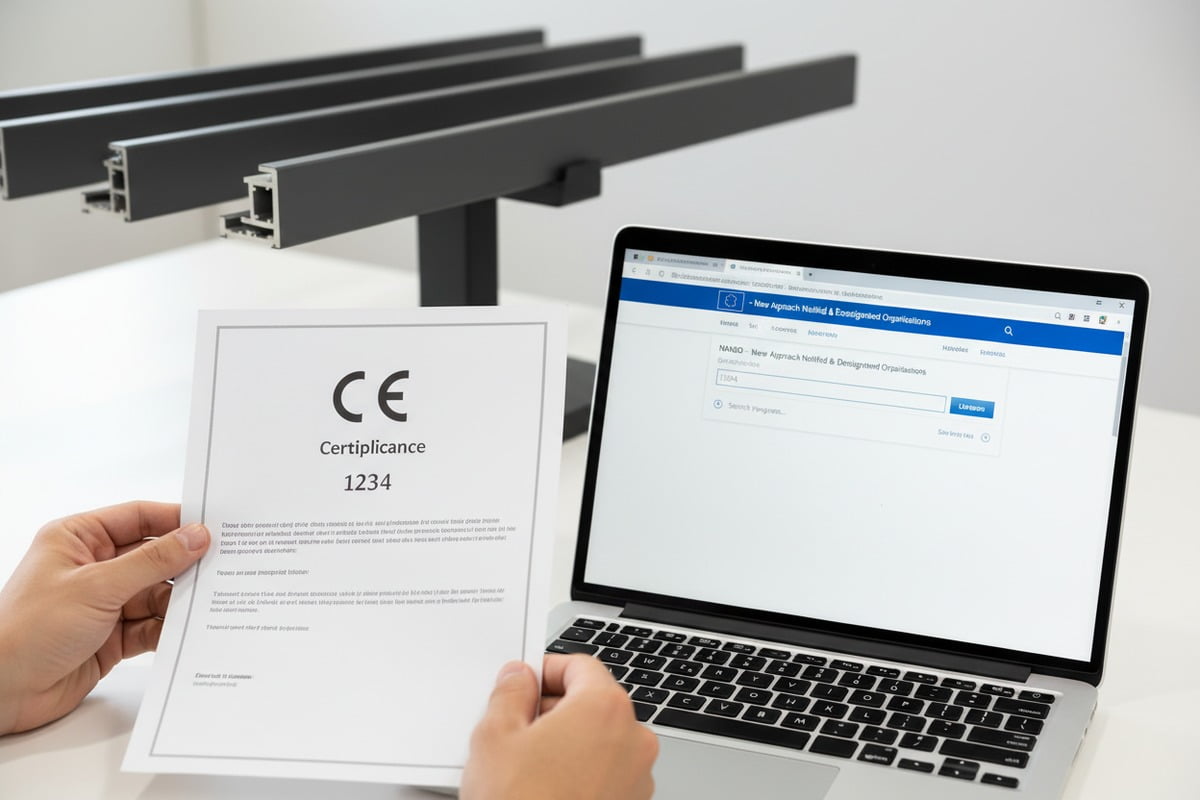
To verify a Chinese manufacturer's CE certificate, cross-reference the certificate number with the issuing Notified Body's online database, confirm the Notified Body's four-digit ID on the EU NANDO database, and check that the certificate specifically names the exact product model you are ordering.
Why a CE Certificate Alone Is Not Enough
A CE certificate is just one piece of the puzzle. The real proof of compliance lives in the technical documentation 1 behind it. Many trading companies in China will show you a generic certificate that covers a broad product category. But CE compliance is product-specific. If your pergola has a different profile thickness, a different span, or a different motor, the original certificate may not apply.
Passi per verificare l'autenticità
Here is a practical checklist you can follow right now:
-
Find the Notified Body number. Every legitimate CE certificate issued by a third party lists a four-digit Notified Body (NB) number. Go to the EU NANDO database 2 (ec.europa.eu/growth/tools-databases/nando) and search that number. The NB should appear as active and authorized for the relevant directive.
-
Contact the Notified Body directly. Send them the certificate number and ask if it is valid and current. This takes one email and usually gets a reply within a few business days.
-
Match the product details. The certificate must name the exact product model, not just "aluminum pergola" in general terms. If you are ordering a 4m × 6m motorized louvered pergola with integrated LED strips, the certificate should reflect that configuration or a family of configurations that clearly includes it.
-
Check the date. CE certificates have validity periods. An expired certificate means the product is not currently certified.
Common Red Flags
| Red Flag | What It Means | What to Do |
|---|---|---|
| No Notified Body number on the certificate | May be a self-declaration without third-party testing | Ask for full test reports and the DoC |
| Certificate lists a different company name | The manufacturer may be using someone else's certificate | Request a certificate in the actual manufacturer's name |
| Very broad product description | Certificate may not cover your specific model | Demand product-specific documentation |
| Certificate issued more than 5 years ago with no renewal | Compliance may have lapsed | Ask for current documentation |
| Manufacturer refuses to share the issuing body's contact | Likely a fraudulent document | Walk away |
Self-Declaration vs. Third-Party Certification
Not all CE marking requires a Notified Body. For some product categories, the manufacturer can self-declare compliance by issuing their own EU Declaration of Conformity 3 (DoC). In that case, there is no NB certificate to verify. However, the manufacturer must still hold a complete Technical File and be able to produce it on request. When our engineering team prepares a DoC for a standard non-motorized pergola, we still back it with third-party test reports because European customs authorities and market surveillance bodies can request proof at any time.
The key takeaway: never accept a certificate without checking the source. One email to the Notified Body can save you tens of thousands of euros in fines and seized goods.
Which specific technical files and test reports should I ask for besides the basic CE certificate?
During production audits at our Hainan facility, we regularly walk European buyers through our full Technical File. Most are surprised by how much documentation genuine compliance actually requires.
Beyond the CE certificate, request the full Technical File containing design drawings, risk assessments, a list of applied harmonized EN standards, structural load test reports, raw material certificates (EN 10204 Type 3.1), surface coating test reports, the EU Declaration of Conformity, and complete installation manuals in the target market's language.

The Technical File Explained
The Technical File is the backbone of CE compliance. It is not a single document but a collection of files that together prove the product meets all applicable EU directives. For aluminum pergolas destined for Europe, the Technical File typically includes the following:
- General product description and intended use
- Design and manufacturing drawings
- Bill of materials with supplier details
- Risk assessment following EN ISO 12100 methodology
- List of harmonized standards applied 4
- Test reports from accredited labs
- Calculations for structural performance
- Quality control procedures
- User manual and installation instructions
Critical Test Reports to Request
| Test / Report | Cosa dimostra | Standard applicabile |
|---|---|---|
| Structural load testing (wind) | Pergola can withstand specified wind loads | EN 1991-1-4 (wind actions) |
| Structural load testing (snow) | Pergola can withstand specified snow loads | EN 1991-1-3 (snow loads) |
| Aluminum alloy material certificate | Chemical composition and mechanical properties of the aluminum | EN 10204 Type 3.1 5 or 3.2 |
| Powder coating adhesion and durability | Coating resists peeling, fading, and corrosion | Qualicoat or GSB standards |
| Salt spray test | Corrosion resistance of frame and hardware | ISO 9227 |
| UV resistance test (for fabrics/screens) | Fabric withstands prolonged sun exposure | EN 13561 for awnings and blinds |
Raw Material Certificates
This is one area many importers overlook. Ask for EN 10204 Type 3.1 inspection certificates for the aluminum alloy. These certificates trace the material back to the smelter and confirm the alloy grade (typically 6063-T5 or 6061-T6 for pergola profiles). At our production facility, we source aluminum exclusively from certified mills and keep material certificates on file for every batch. If a manufacturer cannot produce these, you have no way to verify the actual wall thickness or alloy composition of the profiles.
Wind and Snow Load Calculations
European markets have region-specific requirements for structural loads. A pergola installed in northern Germany faces different snow loads than one in southern Italy. Request engineering calculations or Finite Element Analysis (FEA) reports that match the load zones of your target market. Generic "wind resistant" claims without supporting data are meaningless.
Installation Manuals and User Documentation
Under EU regulations, the importer is responsible for ensuring that user-facing documentation is available in the official language of the country where the product is sold. This includes assembly instructions, maintenance guides, and safety warnings. If you are distributing in Italy, France, and Germany, you need manuals in Italian, French, and German. Our team prepares multilingual documentation as part of every OEM order, but not all Chinese manufacturers do this. Ask upfront.
Quality Assurance Documentation
Request evidence of the manufacturer's quality management system. An ISO 9001 certificate 6 is a strong indicator. Also ask for inspection reports from pre-shipment quality checks. These should include dimensional verification, surface finish inspection, and functional testing of any moving parts.
Do I need separate CE documentation for the motorized components and zip blinds in my order?
When our engineers design a motorized louvered pergola with integrated zip blinds, they treat the structural frame, the motor system, and the screen as separate compliance streams. Many buyers do not realize this until customs flags the issue.
Yes, you need separate CE documentation for motorized components and zip blinds. The pergola structure falls under the Construction Products Regulation, while motors and electronics must comply with the Low Voltage Directive and EMC Directive. Zip blinds have their own product standard, EN 13561, requiring independent testing and documentation.

Why Separate Documentation Is Required
Different EU directives govern different product categories. A motorized aluminum pergola is not a single "product" from a regulatory standpoint. It is an assembly of components, each potentially falling under a different directive. Treating the entire system as one product and providing only one certificate is a common compliance gap.
Directive Mapping for a Typical Motorized Pergola Order
| Componente | Applicable EU Directive | Key Standard |
|---|---|---|
| Aluminum pergola structure | Construction Products Regulation 7 (CPR) 305/2011 | EN 1090 (structural components), EN 1991 (loads) |
| Tubular motor for louvers | Direttiva sulla bassa tensione 8 (LVD) 2014/35/EU | EN 60335-1, EN 60335-2-97 |
| Motor control electronics | EMC Directive 2014/30/EU | EN 55014, EN 61000 series |
| LED lighting (if integrated) | LVD + RoHS Directive 2011/65/EU | EN 60598 (luminaires) |
| Zip blind / screen system | Machinery Directive 2006/42/EC or CPR | EN 13561 (external blinds) |
| Remote control / RF transmitter | Radio Equipment Directive 9 (RED) 2014/53/EU | EN 300 220, EN 301 489 |
Conformità dei motori e dell'elettronica
The motors used in louvered pergolas and zip blinds must carry their own CE marking under the Low Voltage Directive. Request the motor manufacturer's DoC and test reports separately. Look for IP67 waterproof ratings for outdoor motors. At our facility, we use Somfy and compatible motors that already carry CE certification for the European market. If a supplier uses unbranded or generic motors, demand proof of LVD and EMC compliance for those specific motor units.
Zip Blind Documentation
Zip blinds are classified as external solar shading products under EN 13561. This standard covers wind resistance classes, operational endurance, and fabric performance. Request:
- Wind resistance class test report (Class 0 through Class 6)
- Fabric flame retardancy certificate (typically EN 13501-1)
- UV resistance and color fastness reports
- Operational cycle endurance test results (minimum 10,000 cycles is common)
What Happens If You Skip This Step
If market surveillance authorities inspect your product and find that the motor lacks its own CE documentation, they can order a recall of the entire product line. The structural pergola may be perfectly compliant, but a non-compliant motor makes the whole assembly illegal. We have seen European distributors lose entire shipments over missing EMC test reports for the control box.
Practical Advice
When placing an order, ask the manufacturer to provide a compliance matrix. This is a simple table listing every component, the applicable directive, and the corresponding certificate or test report reference number. If they cannot produce this, their compliance documentation is likely incomplete.
What are the legal risks for my business if I import aluminum pergolas without valid CE compliance?
Our European distribution partners sometimes share stories about competitors who tried to cut corners on compliance. The outcomes are consistently painful and expensive. This is not an area where you can afford to gamble.
Importing aluminum pergolas without valid CE compliance exposes your business to customs seizure and destruction of goods, fines up to €100,000 or more depending on the EU member state, product recall orders, civil liability for injuries or property damage, criminal prosecution in severe cases, and permanent reputational damage with your clients.
Who Bears the Legal Responsibility?
Under EU law, the importer bears the same legal obligations as the manufacturer when placing a product on the European market. If you import a pergola from China and sell it in Italy, you are legally responsible for ensuring it complies with all applicable directives. You cannot shift blame to the Chinese factory. This is clearly defined in Regulation (EC) No 765/2008 and the Market Surveillance Regulation (EU) 2019/1020 10.
Financial Consequences
The financial exposure goes far beyond the cost of the goods. Here is what can happen:
- Customs detention: Your container is held at port. You pay storage fees daily while authorities review documentation. If compliance cannot be proven, goods are destroyed at your expense.
- Fines: EU member states set their own penalty levels. In Germany, fines for placing non-compliant construction products on the market can reach six figures. In France, penalties can include both fines and imprisonment.
- Product recalls: If non-compliant products have already been distributed, you must organize and fund a recall. This includes notifying all downstream customers, retrieving products, and either bringing them into compliance or destroying them.
- Civil liability: If a pergola collapses due to inadequate structural design and injures someone, you face personal injury claims. Without valid CE documentation proving due diligence, your insurance may not cover the claim.
Real-World Scenario
Imagine you import 200 motorized pergolas and distribute them to contractors across northern Europe. A heavy snowfall causes three units to collapse because the aluminum profiles were thinner than specified. One collapse damages a hotel terrace and injures a guest. Without proper Technical Files, load test reports, and material certificates, you have no defense. The contractor sues you. The hotel sues the contractor. Your insurer reviews your compliance documentation and finds it lacking. You are exposed to the full liability chain.
The RAPEX System
The EU operates RAPEX (now called Safety Gate), a rapid alert system for dangerous non-food products. If your pergola is flagged, the alert is published publicly and shared across all EU member states. Every customs authority in Europe will then screen for your products. This effectively bans you from the entire EU market.
How to Protect Your Business
The best protection is thorough documentation before you place an order. Request and verify all CE documents during the quotation phase, not after production. Include compliance requirements in your purchase contract. Specify that the manufacturer must provide the full Technical File, DoC, and all test reports before shipment. At our company, we include compliance documentation as a standard deliverable in every European order. We also support buyers who need to register as the EU authorized representative or appoint one on their behalf.
Building a long-term relationship with a manufacturer who understands European regulations is far cheaper than dealing with a single compliance failure.
Conclusione
CE compliance is not optional paperwork. It is your legal shield and your business foundation in the European market. Request every document, verify every certificate, and build partnerships with manufacturers who treat compliance as seriously as you do.
Note a piè di pagina
- Replaced HTTP 404 with an official EU source on technical documentation for CE marking, and updated anchor text for clarity. ︎
- Official EU database for Notified Bodies. ︎
- Explains the purpose and requirements of the DoC. ︎
- Explains the role of harmonized standards in CE compliance. ︎
- Defines the requirements for inspection documents for metallic products. ︎
- Spiega lo standard internazionale per i sistemi di gestione della qualità. ︎
- Provides information on the EU regulation for construction products. ︎
- Explains the EU directive for electrical equipment. ︎
- Details the EU directive for radio equipment. ︎
- Outlines the EU regulation on market surveillance and product compliance. ︎