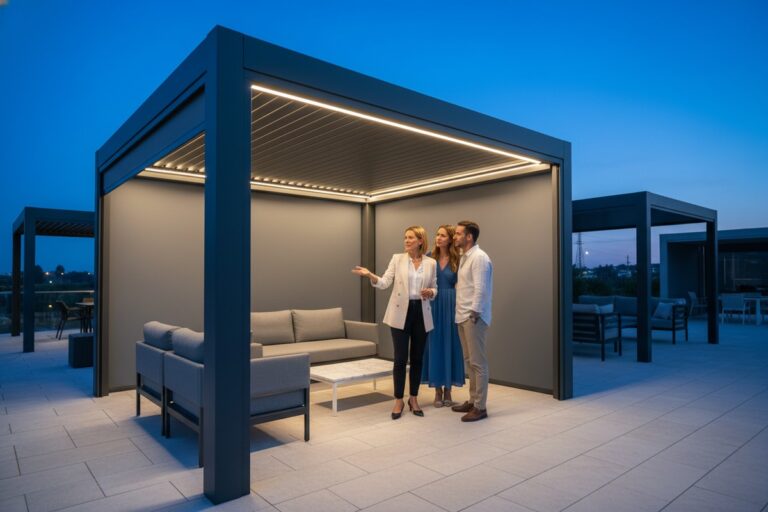

Every year, our sales team fields hundreds of inquiries from buyers drawn by competitive FOB prices 1—only to watch some walk away frustrated after the real costs surface.
When sourcing aluminum pergolas from China, expect hidden costs including import tariffs up to 145%, oversized shipping surcharges, quality rework expenses, certification compliance fees, installation labor overruns from poor manuals, and project delays from missed lead times. These extras can inflate your landed cost by 30% to over 100% beyond the quoted FOB price.
The sections below break down four major cost traps we see importers fall into repeatedly. Each one includes practical numbers, tables, and steps you can take right now to protect your margins. Let's dig in.
How can I avoid the high cost of replacing damaged profiles or missing components during my shipment?
Over the past 25 years of packing containers at our Hainan facility, we have learned that the cheapest quote often hides the most expensive packaging shortcuts.
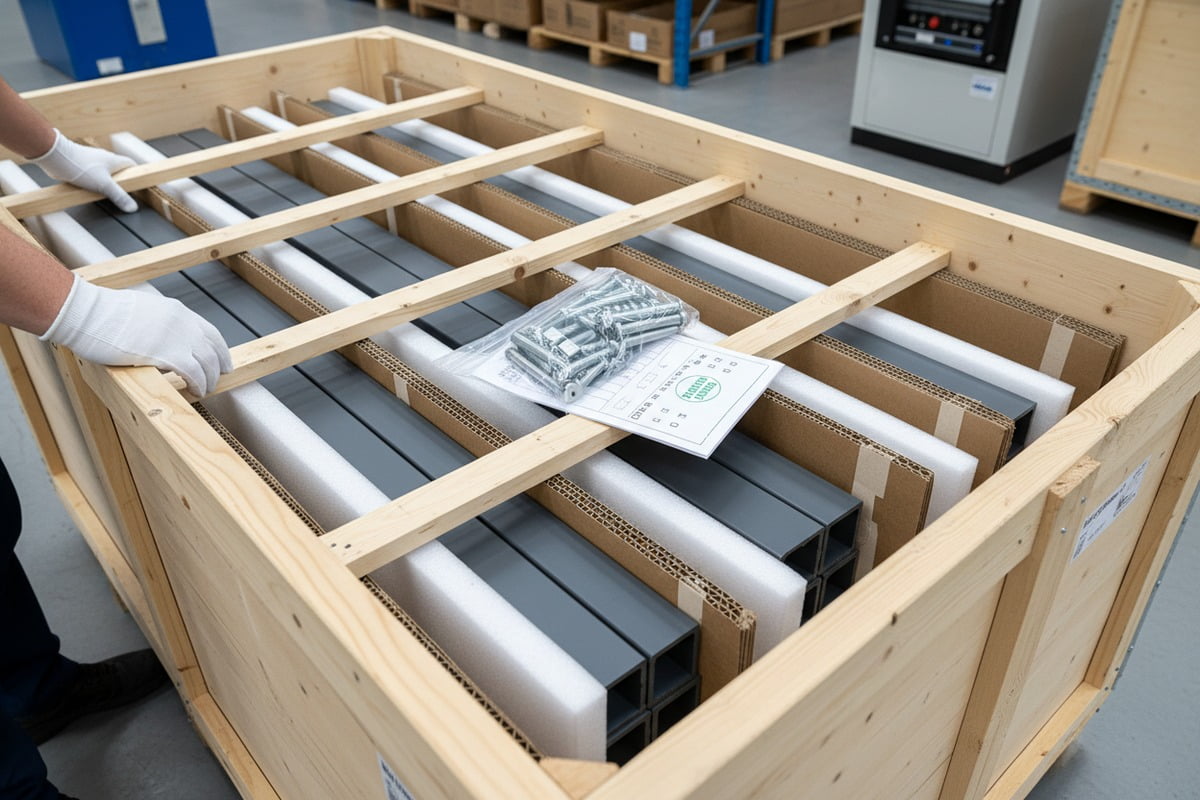
To avoid costly replacements, insist on reinforced packaging with foam-lined separators, complete hardware kits verified by a packing checklist, and a pre-shipment third-party inspection. Missing a single non-standard connector overseas can cost 10–50 times its factory price once you factor in air freight and project downtime.
Why Damaged Profiles Are So Expensive to Fix
Aluminum extrusions 2 are lightweight but soft. A scratch through the powder coating 3 triggers corrosion. A bent profile cannot be straightened without compromising structural integrity. When that profile is a custom RAL color with a 30-day replenishment lead time, your entire installation schedule collapses.
We once had a distributor in Italy order 120 pergola sets. The previous supplier packed posts with only thin plastic wrap. By the time the container arrived in Genoa, 18 sets had dented corner posts. The replacement cost was not just the profiles themselves—it was the express air freight at roughly €8 per kilogram, the customs re-clearance, and the two-week delay that triggered a penalty clause with the end client. Total damage exceeded €12,000 on profiles worth €900 at factory gate.
The Missing Component Problem
A missing screw sounds trivial. But when it is a proprietary M6 stainless steel self-tapping screw with a flanged head designed for a specific louver bracket, you cannot buy it at the local hardware store. You wait. Your installers wait. Your client calls every day.
Here is what a typical missing-component recovery costs:
| Cost Item | Estimate (Per Incident) |
|---|---|
| Emergency air freight for small parts | €150 – €500 |
| Installer idle time (2-person crew, 2 days) | €800 – €1,200 |
| Client penalty or goodwill discount | €500 – €3,000 |
| Internal admin and communication hours | €200 – €400 |
| Total per incident | €1,650 – €5,100 |
How to Protect Yourself
First, demand a detailed packing list that matches the bill of materials—every bolt, every bracket, every motor cable. At our factory, we photograph each hardware kit before sealing the carton and send the images to the buyer.
Second, use a third-party inspection company 4 like SGS or Bureau Veritas for a pre-shipment check. The cost is typically $250–$400 per inspection day. Compare that to the €5,000 recovery cost above.
Third, specify packaging standards in your purchase contract. Include requirements for corner protectors on all profiles, foam dividers between louver blades, and shrink-wrapped hardware bags labeled by assembly step. If the supplier pushes back on packaging upgrades, that tells you a lot about their export experience.
Finally, order a 3–5% spare parts buffer on your first shipment. The marginal cost at factory level is tiny. The insurance value is enormous.
Will I incur extra expenses if my supplier's motors lack the CE certifications required for my market?
When we design motorized louvered pergola systems, one of the first questions our engineers ask is which market the product will enter—because a motor that works perfectly in one country can be illegal in another.
Yes, you will incur significant extra expenses. Non-CE-certified motors require post-import testing, re-certification, or full replacement—each costing €500 to €5,000 per motor model. Selling non-compliant products in Europe also exposes you to product recalls, fines, and personal liability under the EU Machinery Directive.
What CE Certification Actually Covers
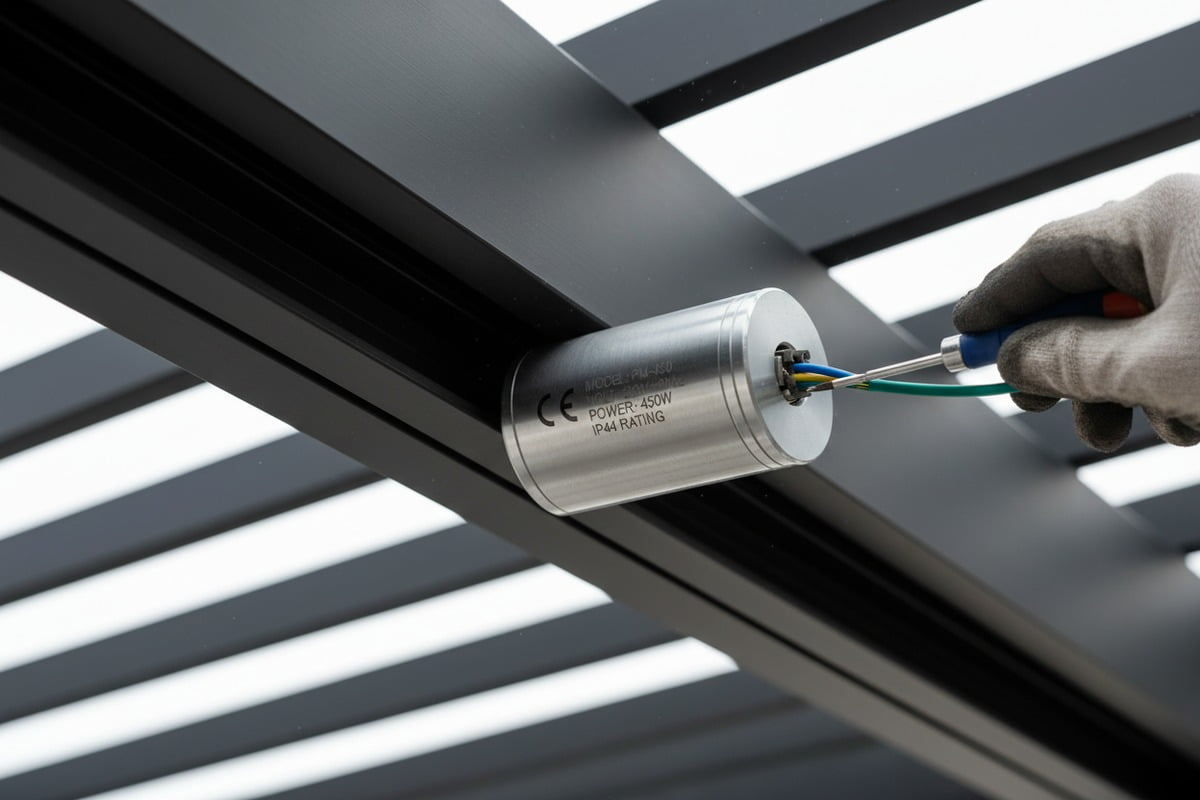
CE-Kennzeichnung 5 for pergola motors typically falls under the Low Voltage Directive (2014/35/EU) 6, the EMC Directive (2014/30/EU), and sometimes the Machinery Directive (2006/42/EC) depending on the system's automation level. The mark confirms that the product meets safety, electromagnetic compatibility, and performance standards recognized across the European Economic Area 7.
Many Chinese motor manufacturers produce excellent units—but only for their domestic market or for export regions without CE requirements. When a pergola factory sources the cheapest tubular motor available, it often lacks the test reports and declarations of conformity that European customs may request.
The Real Financial Impact
Here is a breakdown of what happens when non-compliant motors arrive at your warehouse:
| Scenario | Estimated Cost | Time Impact |
|---|---|---|
| Post-import CE testing and certification (per motor model) | €2,000 – €5,000 | 4–8 weeks |
| Full motor replacement with CE-compliant unit | €80 – €200 per motor + labor | 2–4 weeks |
| Product recall after market complaint | €10,000 – €50,000+ | 2–6 months |
| Customs hold and additional documentation | €500 – €2,000 per shipment | 1–3 weeks |
| Legal liability claim (worst case) | Uncapped | Months to years |
How We Handle This at Lonsonpergola
Our standard motorized pergola kits ship with Somfy or equivalent CE-marked motors. We include the Declaration of Conformity, test reports, and wiring diagrams in every shipment. When a buyer specifies a different motor brand, we verify certification status before production begins.
Steps You Should Take
Ask your supplier for three documents before placing any order: the CE Declaration of Conformity, the relevant test reports from a recognized lab (TÜV, SGS, Intertek), and the motor data sheet showing IP rating and voltage compatibility. If they cannot provide these within 48 hours, the motor is almost certainly not certified.
Also check the rain sensor, wind sensor, and any integrated LED controller. These electronic accessories each need their own CE compliance. A single uncertified component in the system can make the entire pergola non-compliant.
Budget an additional 5–8% of product cost for compliance verification on your first order with any new supplier. On repeat orders, this drops to nearly zero once you have validated the components.
Our after-sales team tracks support tickets by category, and "installation confusion" consistently ranks as the number one reason buyers contact us after delivery.
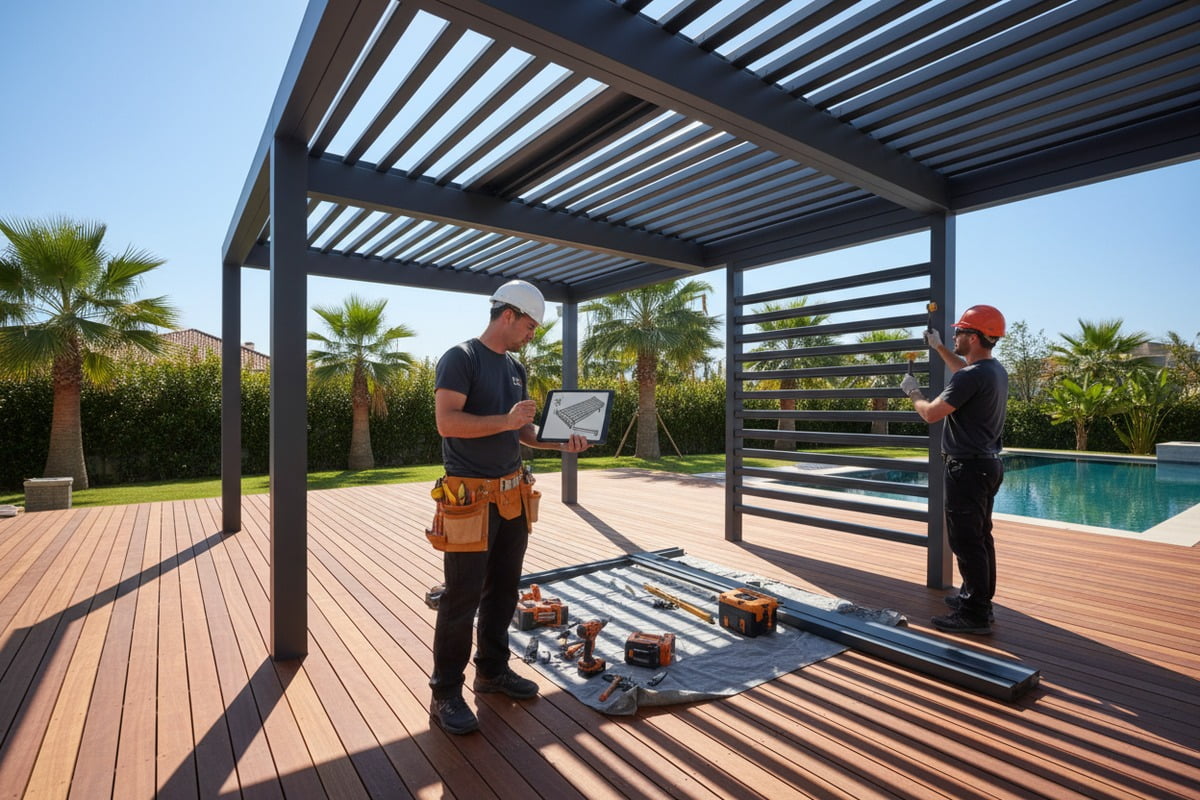
Budget 15–40% extra labor hours per installation when manuals are unclear or missing. Poor documentation forces crews to guess at assembly sequences, make errors, disassemble and redo work, and call the supplier across time zones for clarification. For a typical 4×6 m louvered pergola, this can add €300–€800 in wasted labor per unit.
Why This Cost Hides So Well
Installation labor is rarely included in supplier quotes. Buyers focus on FOB price, shipping, and duties. The assumption is that a pergola is a pergola—your team will figure it out. But a louvered system with motorized blades, integrated gutters, LED channels, and zip screens is not a flat-pack bookshelf. It has 200–400 individual components. Sequence matters. Tolerance matters. A blade installed upside down may not be obvious until the motor binds.
What Bad Documentation Looks Like
We have reviewed competitors' manuals that our clients shared with us during quoting. Common problems include:
- Illustrations rendered in low-resolution 2D with no perspective depth
- Steps numbered but not logically sequenced for a two-person crew
- Text machine-translated into English with grammatical errors that change meaning
- No indication of required tools or torque specifications
- Missing wiring diagrams for motor and sensor connections
The Downstream Labor Cost
| Installation Phase | Time with Clear Manual | Time with Poor Manual | Extra Cost (€40/hr crew) |
|---|---|---|---|
| Frame assembly | 2 hours | 3.5 hours | €60 |
| Louver blade installation | 1.5 hours | 3 hours | €60 |
| Motor and wiring | 1 hour | 2.5 hours | €60 |
| Gutter and drainage | 0.5 hours | 1.5 hours | €40 |
| Screen or blind attachment | 1 hour | 2 hours | €40 |
| Error correction and rework | 0 hours | 1.5 hours | €60 |
| Total | 6 hours | 14 hours | €320 |
Multiply that by 50 units in a hotel project and you are looking at €16,000 in unplanned labor—money that comes straight out of your profit margin.
What Good Documentation Looks Like
At our facility, we produce step-by-step 3D assembly animations, multilingual printed manuals with exploded-view diagrams, and QR codes on each carton linking to video walkthroughs. Every fastener is labeled with a part number that matches both the manual and the hardware bag.
What to Demand From Your Supplier
Request a sample manual before you place your order. Open it. Try to understand step 14 without reading steps 1–13. If you cannot, your installers will struggle too. Ask for video content. Ask for a dedicated WhatsApp or WeChat technical support contact who can respond within 4 hours during your business day. Write response-time requirements into your contract.
If your supplier treats documentation as an afterthought, they are transferring their cost savings onto your installation crew—and ultimately onto your client relationship.
What should I budget for the financial impact on my project if production lead times are delayed?
When we promise a 30-day delivery window, our production planning team works backward from the ship date with daily milestones—because we know exactly what a missed sailing costs the buyer on the other end.
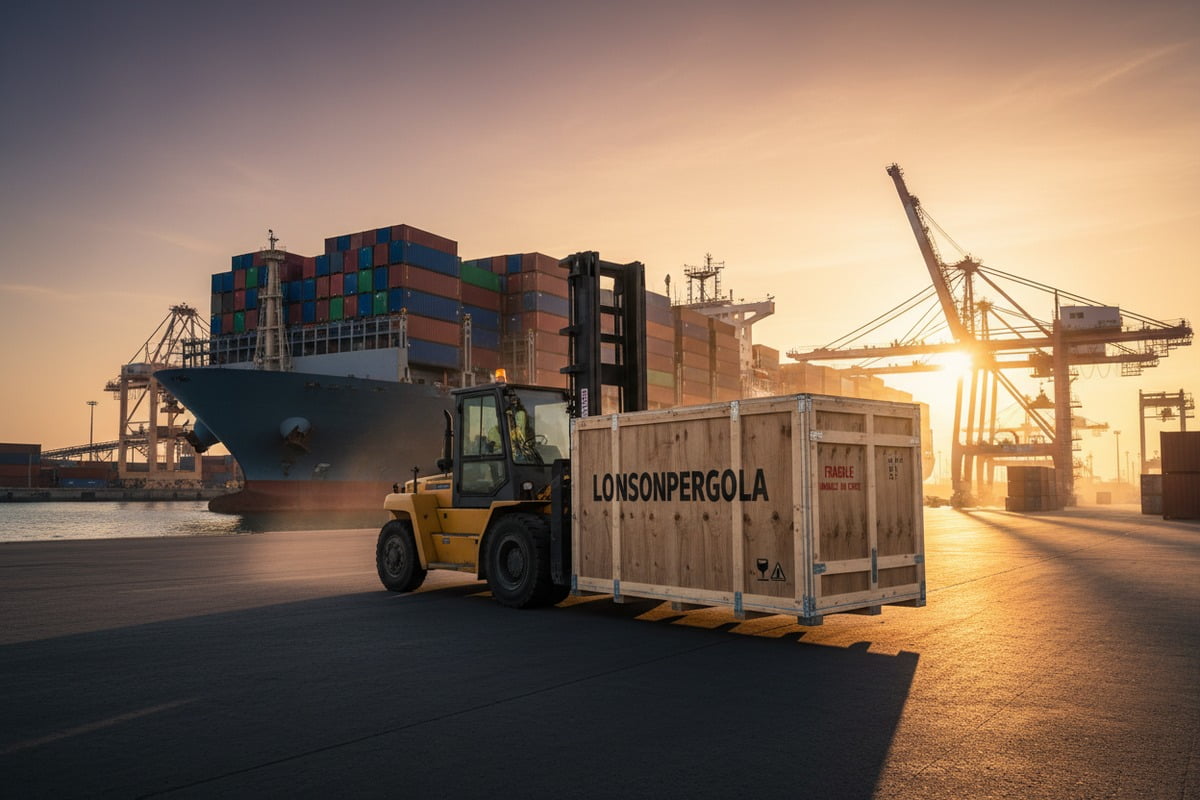
Budget a contingency of 5–15% of total project value for lead time delays. A two-week production slip can trigger container rebooking fees, peak-season surcharges, contractual penalties from your end client, idle crew costs, and lost sales during high-demand months. For a €100,000 order, this means €5,000–€15,000 at risk.
Why Delays Happen More Often Than Suppliers Admit
The most common causes of production delays from Chinese pergola factories include raw material shortages 8 (aluminum billet supply fluctuates with global commodity markets), color-matching failures on custom RAL powder coats, design revision loops when engineering drawings are not finalized before production starts, and simple capacity overload during peak export season from March to July.
A factory that quotes 25 days but runs at 95% capacity has no buffer. One quality rejection on a powder coating batch pushes everything back. And because many factories are actually trading companies 9 that subcontract production, they have even less control over scheduling.
The Cascade Effect of a Two-Week Delay
A delay does not just add two weeks to your timeline. It creates a cascade:
Your container misses its booked sailing. The next available slot may be one to two weeks later. If it is peak shipping season, the freight rate may be 20–40% higher. Your customs broker adjusts clearance scheduling. Your installation crew, already mobilized for the original date, either sits idle or moves to another job and cannot return for weeks. Your end client—perhaps a hotel opening for summer season—loses patience and invokes the penalty clause in your contract.
Quantifying the Impact
| Delay Consequence | Estimated Cost |
|---|---|
| Container rebooking fee | €300 – €800 |
| Peak-season freight surcharge | €1,000 – €4,000 per container |
| Installer idle time (1-week gap) | €2,000 – €4,000 |
| Client penalty clause (typical 0.5–1% per week) | €500 – €2,000 per week |
| Lost seasonal revenue (distributor) | Varies widely—potentially tens of thousands |
| Emergency airfreight for partial shipment | €5,000 – €15,000 |
How to Protect Your Timeline
Start by verifying whether your supplier is a factory or a trading company. Visit the facility—or at minimum, request a live video tour showing your product on the production line. A genuine factory with its own extrusion presses, powder coating line, and assembly hall has far more schedule control than a middleman.
Lock in material procurement early. Aluminum billet prices and availability shift. When we receive a confirmed order, we reserve billet stock within 48 hours. Ask your supplier to confirm raw material reservation in writing.
Build a two-week buffer into your project schedule. It costs you nothing upfront but absorbs the most common delay window without triggering downstream penalties.
Request milestone updates: drawing approval, extrusion completion, coating completion, assembly and QC, packing and loading. If any milestone slips by more than three days, escalate immediately. Early intervention prevents late surprises.
Finally, consider splitting large orders into two shipments. Ship the structural frames first, followed by screens and accessories. This way your crew can start foundation and frame work while the second shipment is in transit.
Schlussfolgerung
Hidden costs in China-sourced pergolas are real, but they are also predictable and manageable when you ask the right questions upfront and partner with a transparent, experienced manufacturer.
Fußnoten
- Explains the meaning and responsibilities of Free On Board (FOB) pricing in international trade. ︎
- Provides technical details about the manufacturing process and properties of aluminum extrusions. ︎
- Explains the electrostatic process and benefits of powder coating for durable metal protection. ︎
- Describes the role and importance of independent third-party inspections in ensuring product quality and compliance. ︎
- Provides official information about the purpose and requirements of CE marking for products in the EU. ︎
- Replaced with the official text of the Low Voltage Directive (2014/35/EU) on the EUR-Lex website, an authoritative EU source. ︎
- Defines the geographical scope and economic significance of the European Economic Area (EEA). ︎
- Discusses the causes, types, and impact of raw material supply chain disruptions on industries. ︎
- Explains the function, services, and role of trading companies in international import and export. ︎