
We often see buyers trust a TÜV logo too early, then panic when local checks, wind data, or missing reports delay the pergola project.
To find TÜV certification requirements for an aluminum pergola in Germany, identify the pergola's use, check the applicable DIN and EN standards, request the exact TÜV test report, and confirm that its scope matches your model, dimensions, wind zone, snow load, and local building rules.
The label matters, but the scope matters more. Once you know which documents to ask for, the process becomes much easier.
How can I verify if a supplier’s TÜV certificate is actually valid for the German market?
In our export work, the biggest risk is not a fake logo alone TÜV certification requirements 1. It is a real certificate that does not cover the pergola you plan to install.
You can verify a supplier's TÜV certificate for Germany by checking the issuing TÜV body, certificate number, covered product model, applied standards, validity dates, and surveillance status, then cross-checking the document with the TÜV database or the issuer and matching it to your exact pergola configuration.
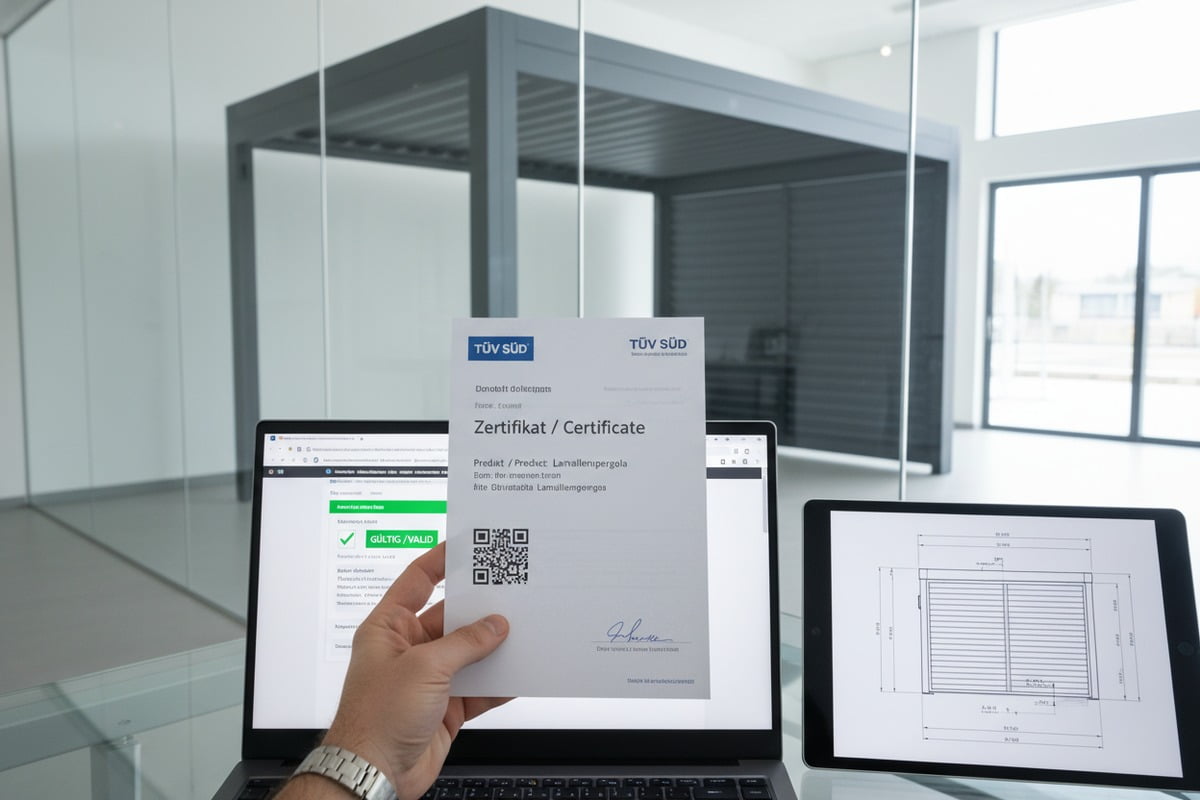
Start by separating product proof from company proof
When our team prepares technical files for Europe, we do not put every certificate into one pile DIN and EN standards 2. That is where confusion starts. A supplier may show ISO 9001 3, EN 1090, or a factory audit from a TÜV group, but that does not automatically mean the aluminum pergola itself has passed product testing for the German market.
The first question is simple: what exactly was certified EN 1090 4? A product certificate or type test is about the pergola system. A quality management certificate is about the factory process. Both can be useful, but they are not the same thing. If a supplier only sends a general management certificate, you still do not know whether the louvered roof, posts, beam size, anchoring method, or fabric roof version has been tested.
| Document type | What it can prove | What it cannot prove by itself |
|---|---|---|
| TÜV product certificate or test report | A specific pergola model or system was tested against named criteria | That every size or option in the catalog is covered |
| ISO 9001 or similar factory certificate | The factory follows a quality system | That the pergola meets German structural demands |
| CE declaration 5 | The supplier declares compliance where applicable | That an independent body tested the full pergola |
| Coating or material certificate | Material grade, finish, or corrosion data | Full structural safety of the installed pergola |
Check the scope, not just the logo
A valid certificate for Germany must fit the actual project. That means the model name, dimensions, roof type, and test basis should all line up. If you are buying a modern charcoal gray louvered pergola with integrated drainage and motorized blades, a certificate for a fixed canopy or a smaller manual model is not enough.
Ask for these details in one document set: certificate number, report number, issue date, expiry date if shown, tested product name, drawing or model reference, and the exact standards used. Look for standards such as EN 1991 for actions, DIN EN 1999-1-1 6 for aluminum design, and, where relevant, DIN EN 13561 for external blinds and awning-type systems. Some products also show fire test data for fabrics under EN 13501-1.
Confirm the issuer and German relevance
The issuing body matters. TÜV is a family of organizations, not one single global certificate. TÜV Rheinland 7, TÜV SÜD, TÜV Nord, and others each issue their own documents. A real certificate should clearly show which body issued it and how to verify it. Some certificates appear in public databases. Others need direct confirmation by email from the issuing office.
German-market validity also depends on use case. A document may be genuine and still be too weak for a restaurant terrace, hotel project, or public venue in Germany. For those projects, local authorities, insurers, or project engineers often want test reports from an accredited body plus load calculations tied to the site.
| Verification checkpoint | Green flag | Red flag |
|---|---|---|
| Issuing body named clearly | TÜV entity, contact details, certificate ID | Only a logo on a brochure |
| Product scope | Exact model, size range, roof type, options | Generic words like "pergola system" |
| Standards listed | DIN or EN standards are named | No standard or test basis shown |
| Traceability | Report number and linked drawings | No technical appendix |
| Current status | Validity or surveillance can be checked | Old undated scan with no status |
A good supplier will not resist these questions. In our experience, serious export projects move faster when the technical file is transparent from the start.
What are the specific wind and snow load requirements I need to follow for TÜV structural testing?
Our engineers spend more time on regional load assumptions than many buyers expect, because one wrong wind zone or roof option can ruin an otherwise sound design.
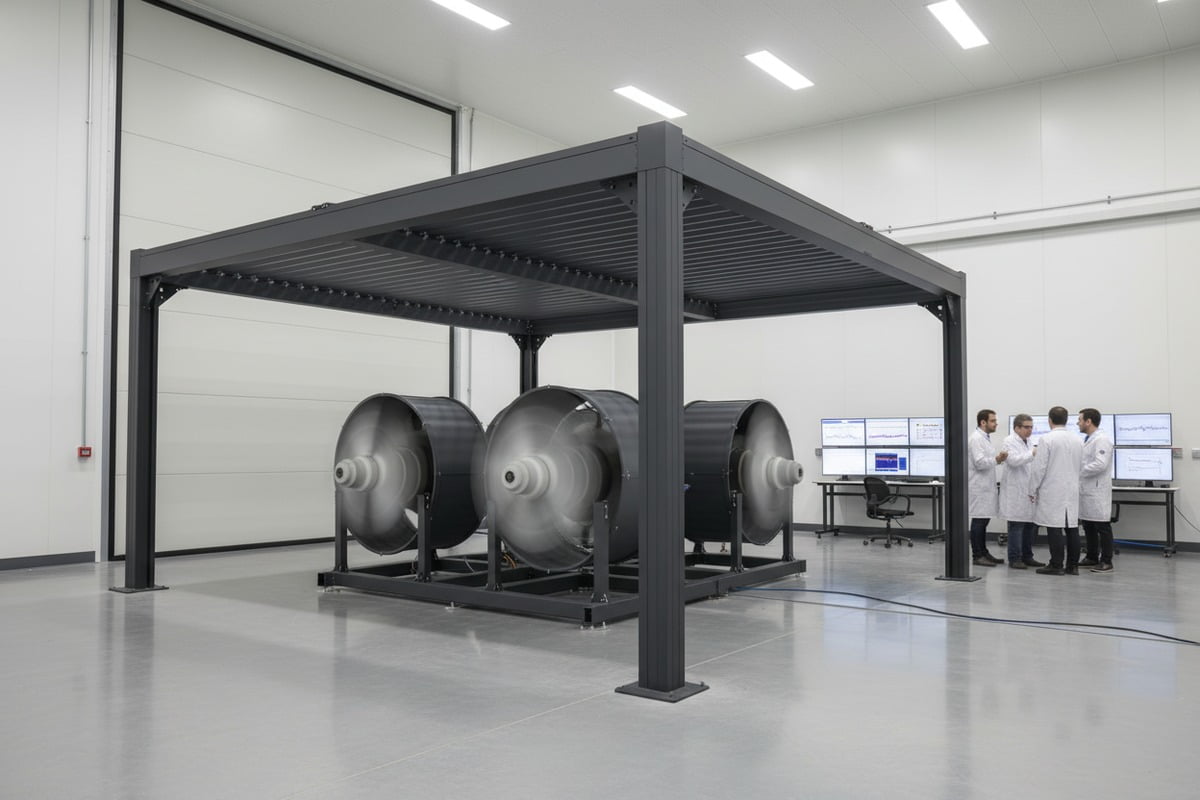
For TÜV structural testing, you usually need wind and snow loads calculated under EN 1991 with the German National Annex, then checked against the pergola system design, span, anchors, roof type, site altitude, exposure, and any local building authority requirements.
There is no single Germany-wide load number
This is where many buyers get stuck. They ask for "the German TÜV wind load" as if one number fits every site. It does not. Germany uses Eurocode action rules 8, mainly EN 1991, together with National Annexes and location-based maps. The result depends on where the pergola will stand, how exposed the site is, how high the structure is, and what kind of roof it has.
A freestanding aluminum pergola on a sheltered private terrace does not face the same conditions as a large terrace cover near open fields, a coastal area, or a mountain location. Snow is the same story. Roof geometry, drainage, altitude, and local accumulation risk all matter.
The standards usually seen in structural review
For aluminum member design, engineers commonly work with DIN EN 1999-1-1, which is Eurocode 9 for aluminum structures. For actions such as wind and snow, they use EN 1991 with the German National Annex. Some pergola or awning-related systems also refer to DIN EN 13561 9, especially when the product behaves like an external shading system. For temporary or semi-temporary structures, EN 13782 or older German references may appear in a test program. In some TÜV files, older references such as DIN 1055-3 or DIN 4113-1 still show up, especially in legacy programs or mixed technical dossiers.
That does not mean you should grab every standard on the list and assume all of them apply. The right set depends on the product category and installation use.
| Load input | Why it matters | Typical source |
|---|---|---|
| Wind zone | Changes design wind pressure | German wind maps and engineer review |
| Snow load zone | Changes roof load demand | German snow maps and engineer review |
| Site altitude | Can increase snow effects | Site data and local maps |
| Terrain exposure | Open land is harsher than sheltered yards | Site survey |
| Pergola dimensions | Larger spans raise member stress | Product drawings |
| Roof type | Louvers, fabric, or fixed panels behave differently | Product specification |
| Anchoring and foundation | Strong frame can still fail at the base | Structural detail and foundation design |
What TÜV reviewers and project engineers usually want
When we prepare export drawings for Europe, the load sheet is never just about beam thickness. Reviewers want to see the whole load path. That includes posts, beams, roof members, connectors, anchors, and the foundation interface. If the pergola has motorized louvers, screens, lighting, or a retractable roof, each option can change the test logic and the calculation package.
For practical project work, ask the supplier or engineer for the design loads in clear units, the allowable dimensions under those loads, and any assumptions about open or closed louvers during wind. Some systems are only safe up to a stated wind level when the roof is open. Others are tested in the closed position. That difference matters.
A simple buyer checklist for load review
Before you approve a pergola for Germany, confirm the installation city, altitude, exposure, boundary conditions, foundation type, and roof version. Then make sure the technical file states the tested or calculated maximum span and the matching wind and snow loads. This step protects homeowners, architects, and installers from a very common mistake: buying a pretty pergola first and asking about the site loads later.
| Question to ask | Why it matters |
|---|---|
| Which wind and snow loads was this exact model checked for? | It tells you whether the system matches the site |
| Does the report use EN 1991 and the German National Annex? | It shows German structural relevance |
| Are the loads valid for my dimensions and post layout? | Size changes performance |
| Do open and closed roof positions have different limits? | Moving roofs can have different wind behavior |
| Is the anchor and foundation design included? | Frame strength alone is not enough |
Where do I find the official TÜV SÜD or Rheinland documentation for outdoor shading systems?
We lose time fastest when a buyer asks for TÜV papers after pricing, because the hard part is finding the exact rule set behind a simple marketing claim.
You can find official TÜV SÜD or TÜV Rheinland documentation on their certification portals, testing service pages, certificate databases, and test regulation PDFs, but you still need the manufacturer's exact report because general service pages do not prove that a specific pergola model passed.
Start with official service pages, not reseller claims
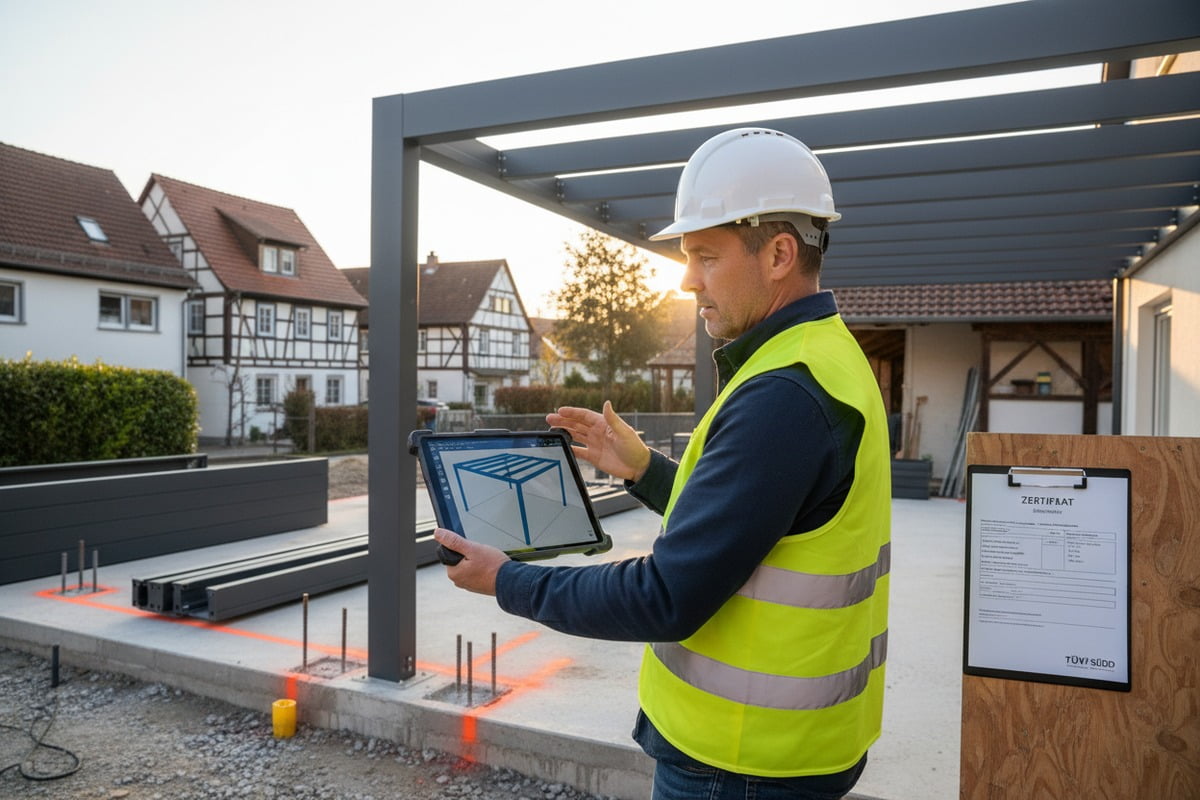
The safest starting point is the official website of the issuing TÜV body. Look for product certification services, test marks, certificate databases, and testing regulations. TÜV organizations explain their process in broad terms: application, document review, testing, certificate issue, and surveillance. That is useful because it tells you how the certification system works and what kind of evidence should exist for a real product.
For example, TÜV Rheinland publishes testing and certification regulations and also maintains public information around certification services and certificate or mark verification. TÜV SÜD 10 also publishes certification service pages and product testing information. These pages help you understand the framework, but they do not replace the actual report for your pergola.
What the official documentation can and cannot tell you
General TÜV pages usually explain the method, scope categories, and the role of ongoing surveillance. They may also show sample marks or searchable records. What they usually do not show is the full engineering content behind a private customer's pergola model. Many detailed reports remain with the manufacturer or applicant.
That is why the next step is to request the exact file from the supplier. In our projects to Europe, the useful documents are usually a mix of public and private material: a public certificate or verification page, plus the manufacturer-held report, drawings, and product specification sheet.
| Source | What you can get | What may still be missing |
|---|---|---|
| TÜV SÜD or TÜV Rheinland official service pages | Process description, service scope, certification categories | Proof for a specific pergola model |
| Public certificate database or mark directory | Certificate existence, status, issuing body | Full technical test content |
| Manufacturer technical file | Exact model scope, drawings, load data, options | Independent public verification unless linked |
| Local authority or project engineer | Acceptance expectations for your use case | The supplier's original report |
The fastest way to request the right file
Ask the supplier for one clean package. Request the certificate, test report reference, model drawing, applicable standards, and validity status in English or German. If the pergola includes retractable fabric, ask for fire classification. If it includes motors, lighting, or sensors, ask for CE-related electrical documents as well.
For outdoor shading systems, the phrase "official TÜV documentation" can mean different things. It may mean a public certificate entry. It may mean a test regulation PDF. Or it may mean the actual product report. For buying decisions, the third one matters most.
Watch out for broad marketing words
Words like "TÜV tested," "TÜV approved," or "German standard quality" are not enough. They are starting points, not proof. A serious supplier should be able to show which TÜV body was involved, what standard was used, and whether the result applies to the exact pergola you want.
| Request item | Why it matters |
|---|---|
| Certificate number | Lets you verify the document |
| Report number | Links the certificate to the test file |
| Product drawing or model code | Confirms scope |
| Applied DIN or EN standards | Shows technical basis |
| Validity or surveillance status | Shows whether certification is current |
How will choosing a TÜV-certified pergola manufacturer reduce my legal liability and insurance risks?
We have seen projects stall over one missing report, and the cost rarely comes from the frame itself. It comes from claims, delays, and insurance questions later.
Choosing a TÜV-certified pergola manufacturer can reduce legal and insurance risk because independent testing, traceable documents, and factory surveillance make it easier to prove due diligence, defend product suitability, satisfy project stakeholders, and handle claims after wind damage, fire concerns, or installation disputes.
Risk drops when the paper trail is strong
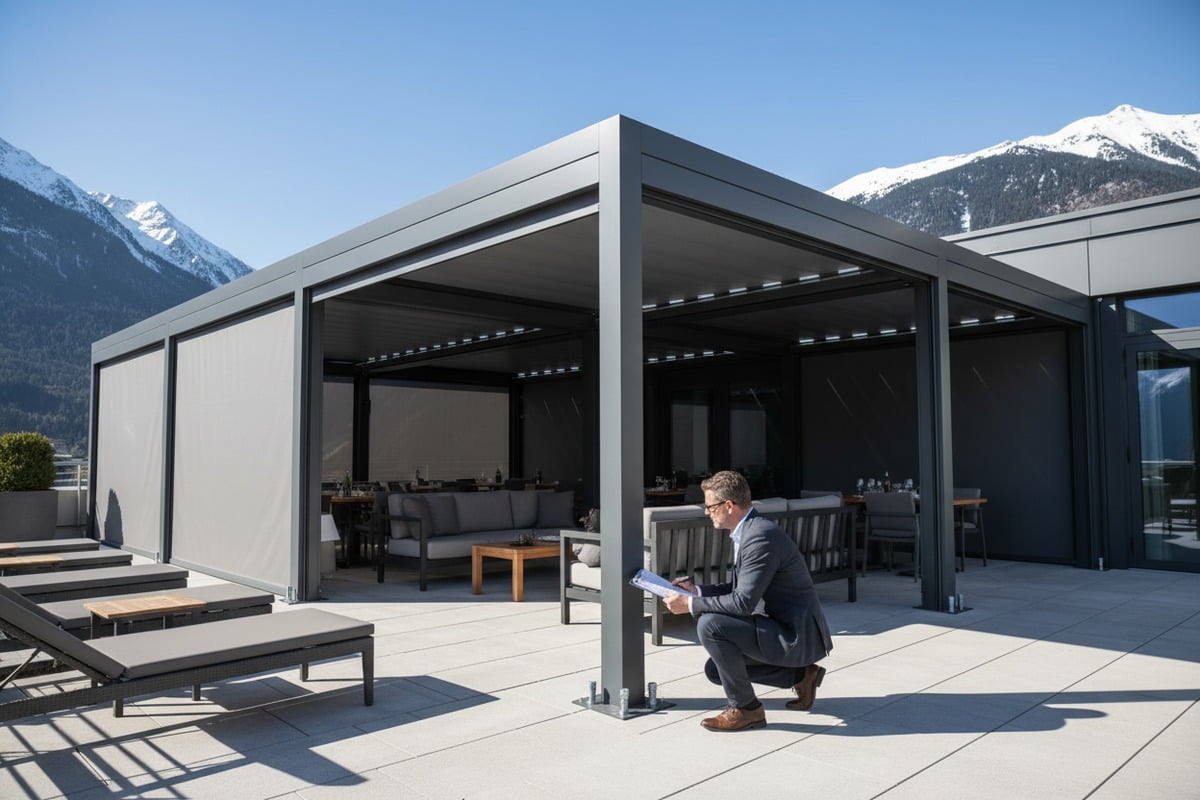
TÜV certification does not make a pergola legally untouchable. That is not how liability works. But it does make your position stronger when someone asks a hard question after a problem. If wind damage happens, if a hotel insurer requests proof, or if a contractor faces a dispute over specification, independent third-party documents can show that reasonable technical checks were done.
In our factory files, we track more than the frame. We track coatings, hardware sets, component lists, and model versions. That matters because liability often grows from small gaps. A missing anchor note, an unclear louver position limit, or a swapped motor can become a bigger issue than the main beam itself.
Why insurers and project stakeholders care
Insurers usually want evidence that the installed product was suitable for the site and used as intended. Architects and contractors want the same thing because they also carry risk. A TÜV-backed file helps them show due diligence. It can support tender review, design approval, and post-incident investigation.
This is especially valuable in commercial settings such as restaurants, resorts, and public terraces. Those sites often face stricter questions about wind resistance, fire behavior of fabrics, maintenance, and safe operation. For motorized systems, electrical compliance and CE documentation also matter. A TÜV document on the pergola frame does not replace those other obligations, but it strengthens the overall compliance package.
| Situation | Without strong third-party proof | With strong TÜV-backed documentation |
|---|---|---|
| Insurance review after storm damage | More doubt about suitability and site matching | Easier to show tested basis and design assumptions |
| Contractor dispute over supplied product | Harder to prove what was promised | Clearer scope, model traceability, and report references |
| Commercial project approval | More questions from stakeholders | Faster confidence in technical due diligence |
| Product change during production | Risk of undocumented substitution | Better traceability and control records |
It reduces risk, but it does not remove your own duties
Buyers still need to match the certificate to the project. Installers still need correct foundations and anchors. Importers still need the right declarations. Local building rules still apply, and Germany's state-level requirements can differ. A homeowner may face fewer formal checks than a public venue, but the structural and safety duties do not disappear.
That is why I see TÜV certification as risk reduction, not magic protection. It helps prove that the supplier did real work, that the product was reviewed by an independent body, and that the decision to buy it was not careless.
What to ask for before you sign
Ask for the tested scope, the surveillance status if applicable, the load assumptions, and the installation conditions. Then ask one more question that many buyers skip: what changes void the test basis? Enlarged span, different post spacing, new roof infill, different anchor method, or added side screens can all change the risk picture.
A reliable manufacturer should answer these points clearly. That is one reason many serious buyers prefer TÜV-supported suppliers for Germany even when the law does not explicitly require TÜV in every case.
Conclusion
In Germany, the safest path is simple: ask for the exact TÜV scope, match it to the site loads, and never buy a pergola on labels alone.
Notes de bas de page
1. Provides an overview of TÜV's testing, inspection, and certification services. ︎
2. Official source for German (DIN) and European (EN) standards. ︎
3. Replaced with the official ISO page for ISO 9001 Quality Management. ︎
4. TÜV SÜD provides testing and certification services for the EN 1090 standard. ︎
5. Replaced with the official Europa.eu page specifically detailing EU declarations of conformity for CE marking. ︎
6. Replaced with the official CEN (European Committee for Standardization) page for EN 1999-1-1. ︎
7. Official global website for TÜV Rheinland, a leading testing and certification service provider. ︎
8. Provides an overview of Eurocodes as European standards for structural design. ︎
9. Specifies performance and safety requirements for external blinds and awnings. ︎
10. Official global website for TÜV SÜD, detailing their mission and services. ︎