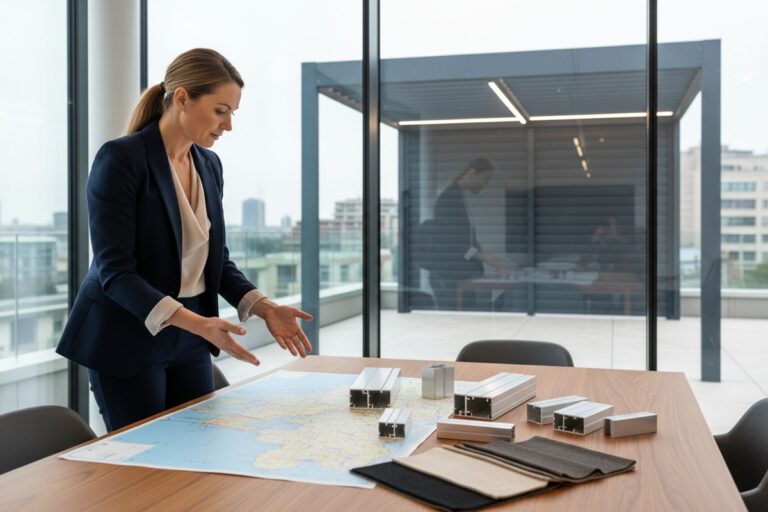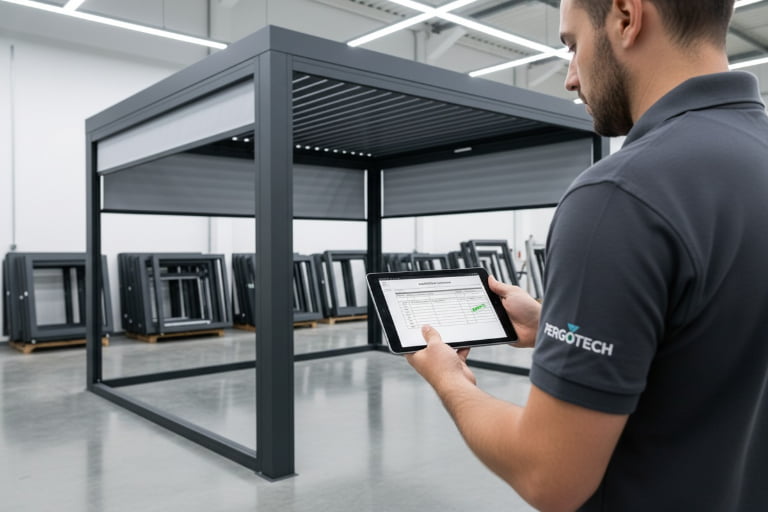

Every year, we ship thousands of custom aluminum pergolas from our production lines to distributors across Europe BOM (Bill of Materials) 1. Yet one question keeps coming back in emails, trade show conversations, and video calls: how do you actually start the OEM/ODM customization process with a Chinese factory without losing money, time, or brand reputation?
European distributors can request OEM/ODM aluminum pergola customization from China by submitting detailed technical specs and RAL color codes, negotiating MOQs and lead times, verifying CE compliance through third-party testing, and establishing quality control checkpoints from sampling to final container loading.
This guide walks through the exact steps our European partners follow when placing custom pergola orders EN 1991 standards 2. We cover everything from submitting your first drawing file to receiving scratch-free shipments at your warehouse door. Each section tackles a real pain point we see distributors face every week.
How do I submit my technical drawings and RAL color specs for a custom OEM pergola order?
Getting the specs right at the start saves weeks of back-and-forth later. Our engineering team reviews hundreds of drawing submissions each month, and the ones that go smoothly share a few common traits.
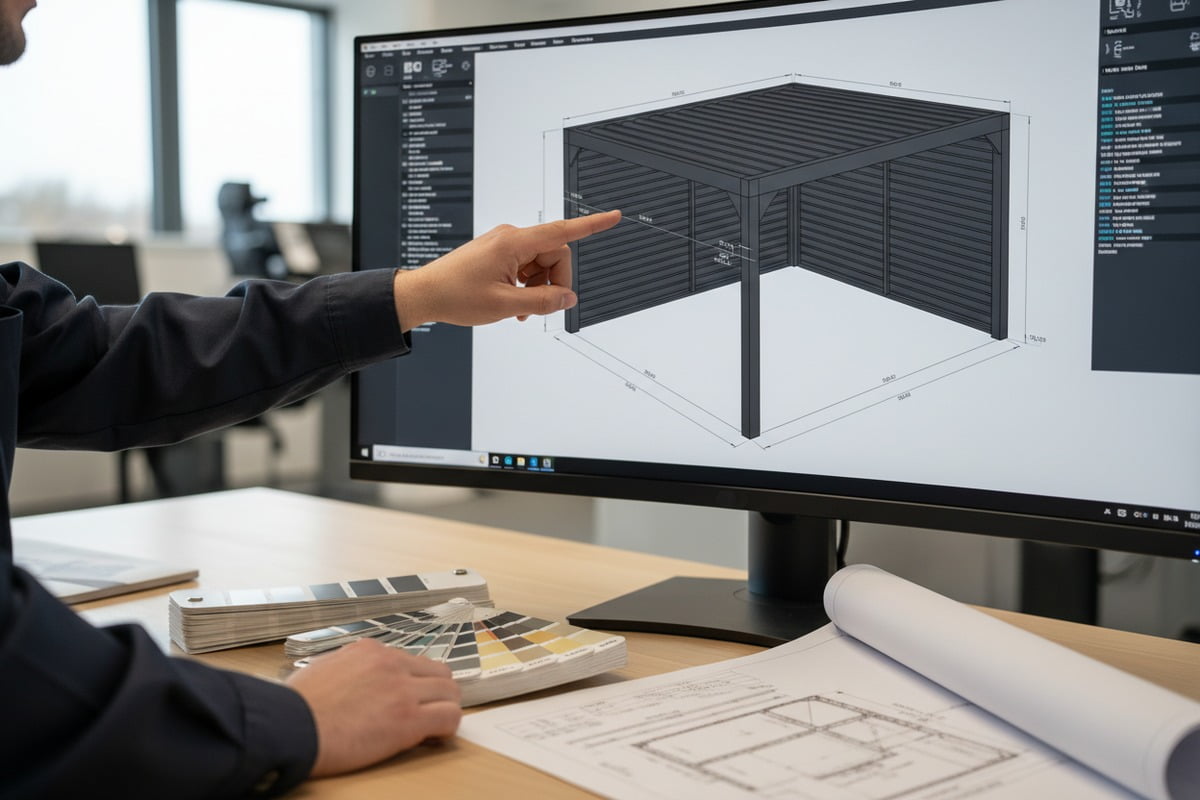
Submit technical drawings in DWG, DXF, or PDF format with exact dimensions, material grades, and RAL color codes. Share a complete BOM (Bill of Materials) and reference photos. A reliable Chinese manufacturer will return 3D renderings and a production-ready drawing within 3–5 business days for confirmation.
What File Formats Work Best?
Most factories, including ours, accept AutoCAD files (DWG/DXF), SolidWorks files, STEP files, and high-resolution PDFs. If you only have a sketch on paper, that works too — but expect an extra 2–3 days for our design team to convert it into a proper engineering drawing. The key is clarity. Every dimension should be labeled in millimeters. Do not assume the factory will guess your preferred tolerances.
How to Specify RAL Colors Correctly
RAL color codes 3 eliminate ambiguity. Instead of saying "dark grey," write "RAL 7016 Anthracite Grey." We use PVDF or polyester powder coating depending on your budget and durability needs. PVDF lasts longer under UV exposure, which matters for southern European climates. Always request a physical color swatch before mass production. Digital screens distort colors.
The Ideal Submission Checklist
| Item | Details | Why It Matters |
|---|---|---|
| Technical drawing | DWG/DXF/PDF with dimensions in mm | Prevents measurement errors |
| RAL color code | Exact code (e.g., RAL 9010, RAL 7016) | Ensures color match across batches |
| Material spec | Aluminum alloy grade (e.g., 6063-T5), wall thickness | Affects structural integrity |
| Hardware list | Motor brand, screw type, connector specs | Avoids missing parts on delivery |
| Reference photos | Real-world installation images or competitor samples | Aligns visual expectations |
| Quantity & timeline | MOQ and desired delivery date | Enables accurate production scheduling |
OEM vs. ODM: Which Path Fits Your Business?
If you already have your own proprietary design, you need OEM service 4. You send the drawings. We manufacture to your exact spec. Your brand goes on the product.
If you want a faster route to market, ODM makes more sense. You pick from our existing product range — say, a motorized louvered pergola with 0–120° adjustable blades — and we customize the color, size, and branding for your market. ODM orders typically ship 7–10 days faster because tooling is already done.
With 25 years of manufacturing experience and an annual capacity of 80,000 sets, our facility handles both paths simultaneously. We assign a dedicated project engineer to each European distributor so nothing gets lost in translation.
One tip: always ask for a 3D rendering before you approve the production drawing. It costs nothing extra and catches errors that flat drawings miss.
How can I verify that my customized aluminum pergolas comply with European CE and wind load standards?
Compliance is not optional in Europe. One distributor we work with in Italy nearly lost a €200,000 contract because their previous supplier's motor lacked proper CE documentation. That experience brought them to our factory.
Verify compliance by requesting CE certificates for both the structure and integrated electronics, asking for wind and snow load calculation reports per EN 1991 standards, and commissioning third-party lab tests (SGS, TÜV, or Bureau Veritas) before the first shipment leaves the port.
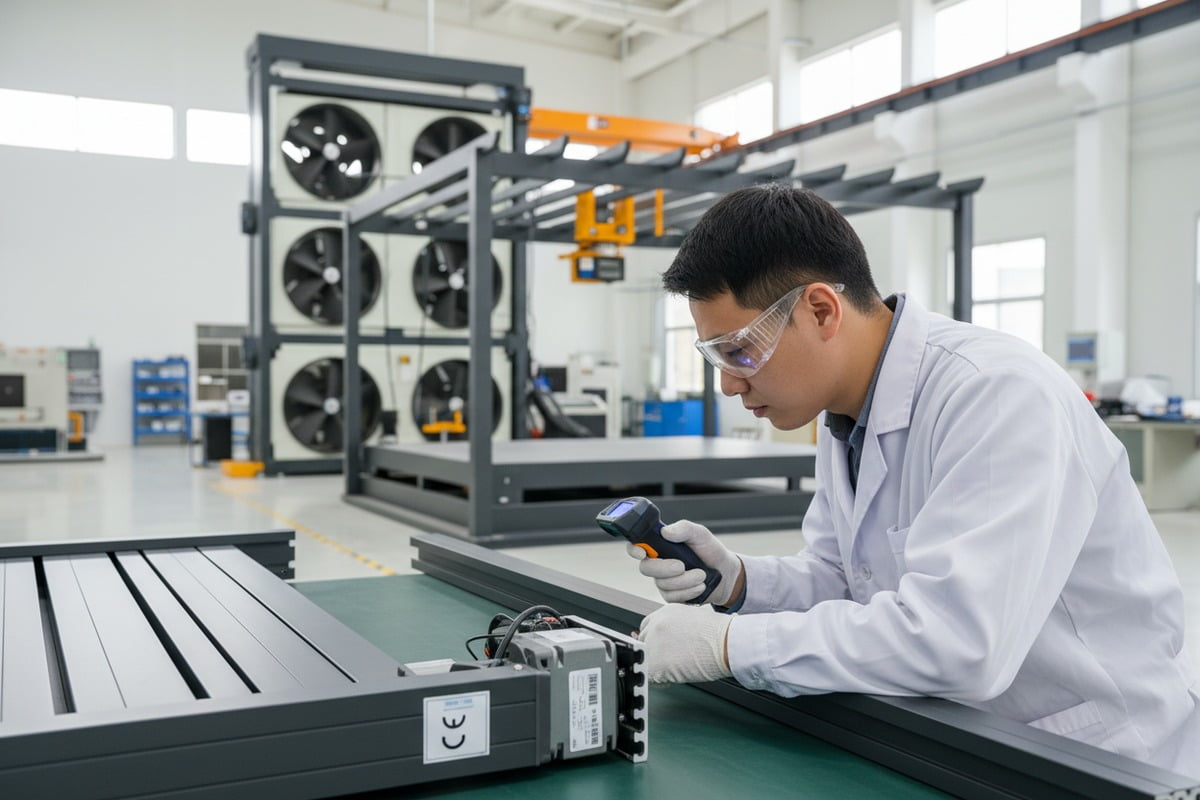
Understanding CE Marking for Pergolas
CE marking 5 for aluminum pergolas covers two main areas. First, the structural components must meet European construction product standards. Second, any electrical components — motorized louvers, LED lighting, rain sensors — must comply with the Low Voltage Directive (LVD 2014/35/EU) and the Electromagnetic Compatibility Directive (EMC 2014/30/EU).
Our factory holds ISO 9001 certification 6 and produces pergolas tested to CE requirements. But here is the critical point: do not rely solely on the factory's own certificates. Always request the test report number and verify it with the issuing lab.
Wind and Snow Load Calculations
European distributors operating in different climate zones need different load ratings. A pergola installed on the French Riviera faces different wind conditions than one in northern Germany.
| Standard | What It Covers | Typical Requirement |
|---|---|---|
| EN 1991-1-3 | Snow loads | 0.5–3.0 kN/m² depending on region |
| EN 1991-1-4 | Wind loads | Wind zones 1–4 (up to 130 km/h) |
| EN 1090 | Structural aluminum execution | Execution class EXC2 for most pergolas |
| EN 13561 | External blinds/screens | Performance and safety of awnings |
When you send us your project location, our structural engineer runs a load calculation specific to that region. We adjust post size (standard 150×150×3mm), beam thickness (200×165×2mm), and blade profile (210×40×1.8mm) accordingly. For high-wind coastal areas, we may recommend 200×200mm posts with 4mm wall thickness.
Third-Party Inspection: Worth Every Euro
We always recommend distributors hire a third-party inspector. SGS 7 and TÜV both have offices in Guangdong province, close to our factory. They can inspect at three stages: during production, before packing, and during container loading. The cost is typically €300–€800 per inspection. That is a fraction of the cost of a failed installation or a product recall.
Some distributors ask us about motor certifications specifically. We use Somfy-compatible tubular motors with CE and IP67 ratings as standard. If you need a specific motor brand for your market — say, Becker or Elero — we can integrate it. Just specify this in the BOM at the drawing stage.
How do I ensure my private-label pergola shipment arrives without scratches or missing hardware?
Packaging failures are the number one source of disputes in our industry. We learned this lesson early. A single scratched beam means the entire unit looks defective on a job site, and replacing it internationally costs ten times what proper packing would have cost.
Ensure damage-free delivery by requiring EPE foam wrapping on all aluminum profiles, individual hardware kits labeled per unit with QR-coded installation guides, pre-loading container inspections, and a detailed packing list with photos sent before the vessel departs.
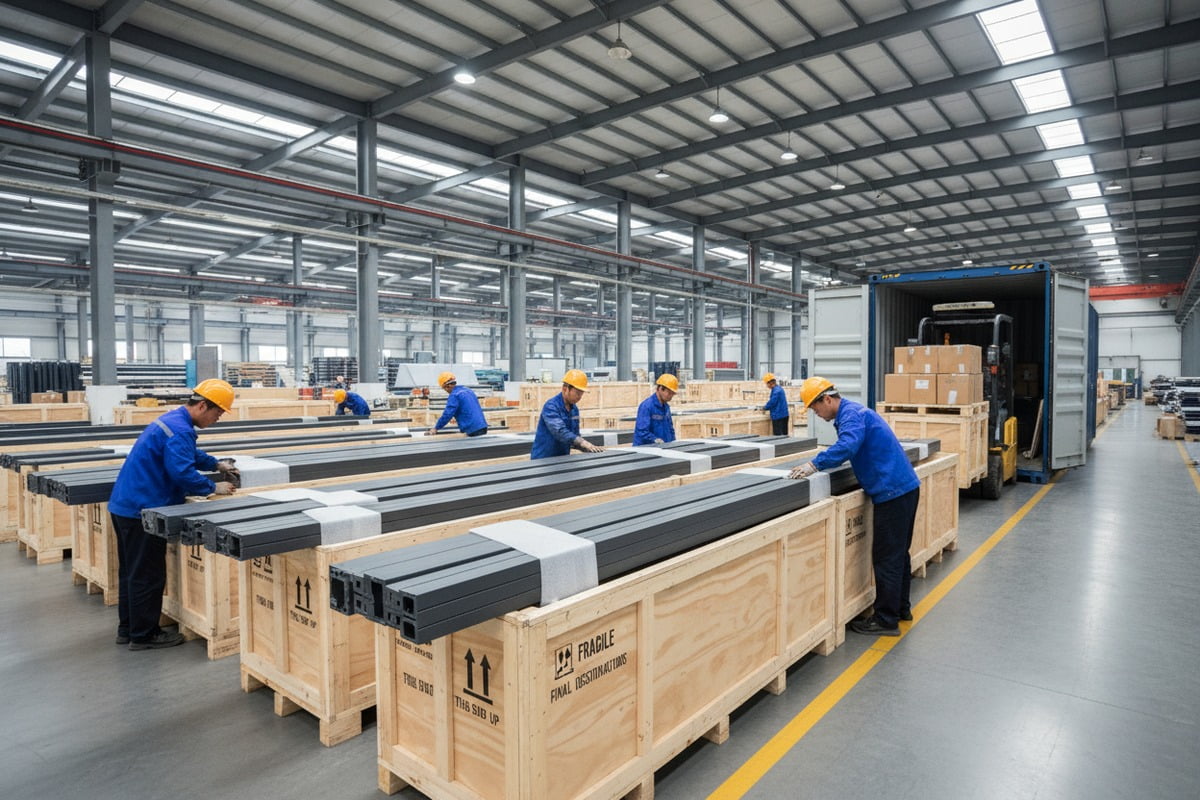
Our Packing Standard for European Orders
Every aluminum profile gets wrapped in EPE foam first, then protected with corner guards, and finally secured with stretch film. Louver blades — the most scratch-prone parts — are stacked in custom cardboard dividers inside wooden crates. Posts go into separate bundles, never mixed with smaller parts.
For private-label orders, we apply your brand stickers and labels before packing. Your customers never see our factory name.
The Hardware Kit Problem (And How We Solved It)
Missing a single non-standard screw can halt an installation. This is why we moved to a unit-based hardware kit system three years ago. Each pergola set gets its own sealed bag containing every bolt, screw, bracket, washer, and connector needed for that specific unit. The bag is labeled with the order number, unit number, and a QR code linking to the installation video.
| Packing Component | Method | Purpose |
|---|---|---|
| Aluminum profiles | EPE foam + corner guards + stretch film | Prevents scratches and dents |
| Louver blades | Cardboard dividers in wooden crate | Stops blade-to-blade contact |
| Motors & electronics | Individual foam-lined boxes | Shock absorption |
| Hardware kit | Sealed bag per unit, QR-coded | Eliminates missing parts |
| Installation guide | Multilingual PDF + video link | Reduces installation errors |
| Container loading | Photos sent to client before sealing | Final visual confirmation |
Container Loading Inspection
Before the container door closes, our QC team takes photos of every layer. These photos go to you via email or WeChat within hours. Some distributors also hire a third-party agent to be physically present during loading. We welcome this. Transparency builds trust.
We also include 2–3% spare parts in each shipment as standard practice. That means extra screws, extra brackets, and an extra set of rubber gaskets. If something goes missing during transit, your installer is not stuck waiting four weeks for a replacement part to arrive from China.
Shipping Route and Transit Time
Most of our European orders ship from Guangzhou port. Transit to major European ports like Rotterdam, Hamburg, or Genoa takes 25–35 days by sea. We provide full tracking numbers and work with freight forwarders experienced in DDP (Delivered Duty Paid) logistics 8 if you prefer door-to-door service.
How can I manage the communication with a Chinese factory to guarantee a 30-day lead time for my project?
Time zone differences and language barriers have killed more deals than price disagreements. One of our German distributors once told us: "I don't need the cheapest pergola. I need the one that arrives on time." That statement shaped how we run our project management.
Manage communication by appointing a single project manager on each side, using shared project trackers with milestone dates, confirming material procurement within 48 hours of order, and scheduling weekly video updates. A well-organized factory can consistently deliver custom orders within 30 days.
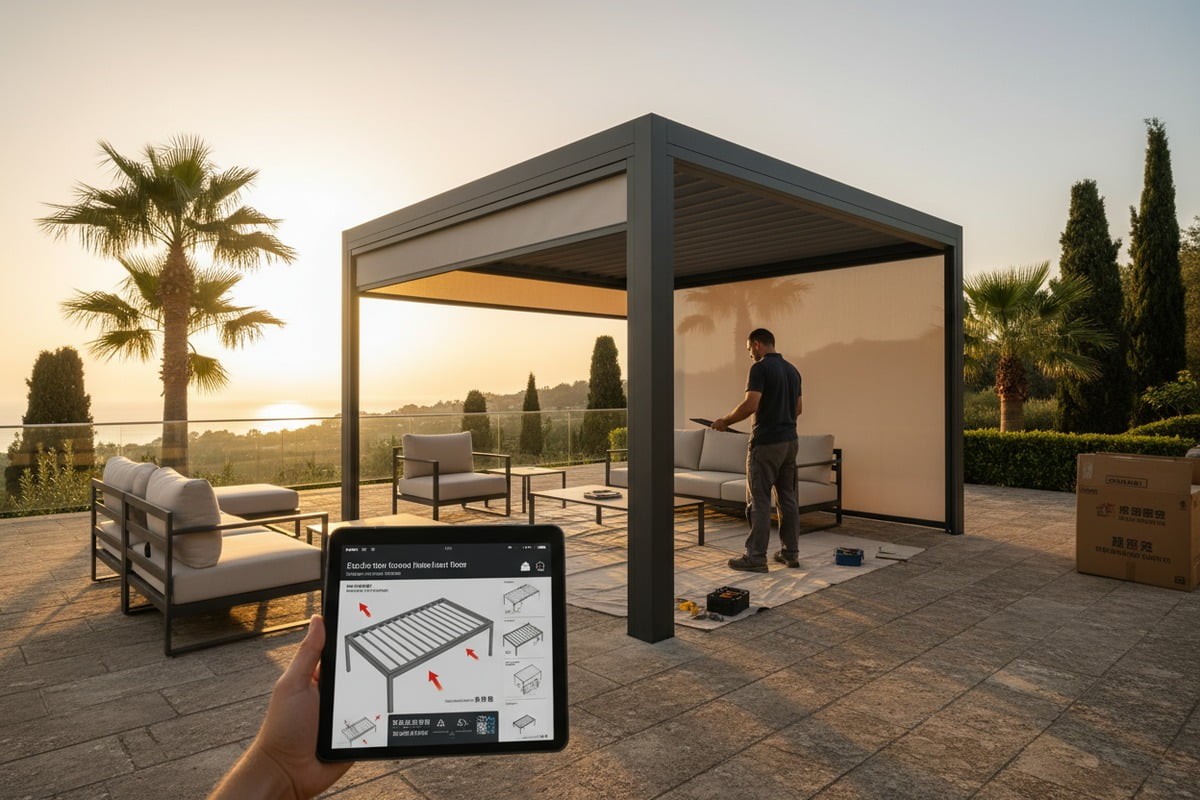
Why Lead Times Slip (And How to Prevent It)
Most lead time failures happen in the first week — not during production itself. The typical delays come from three sources: unclear specs requiring re-confirmation, late deposit payments, and unavailable raw materials (especially non-standard RAL colors that need custom powder mixing).
Here is how we structure the 30-day timeline at our facility with 100 team members:
- Day 1–3: Order confirmation, deposit received, BOM finalized.
- Day 4–7: Raw material procurement, aluminum extrusion 9 or stock allocation, powder coating color preparation.
- Day 8–20: Cutting, welding, assembly, motor integration, surface treatment.
- Day 21–25: Quality inspection, test operation of motorized parts, packing.
- Day 26–30: Container loading, shipping documents prepared, vessel booking confirmed.
Communication Tools That Actually Work
Forget relying on email alone. Our European clients use a combination of tools depending on their preference:
| Tool | Best For | Response Time |
|---|---|---|
| WhatsApp/WeChat | Quick questions, photos, voice messages | Under 2 hours during business |
| Formal confirmations, contracts, documents | Under 12 hours | |
| Video call (Zoom/Teams) | Drawing reviews, factory tours, problem-solving | Scheduled weekly |
| Shared Google Sheet | Order tracking, milestone status, packing updates | Updated daily |
The shared tracker is the most underrated tool. Both sides can see the current production stage in real time. If aluminum extrusion is delayed by one day, you know immediately — not two weeks later when you ask for a status update.
How Our 30-Day Guarantee Works
With an annual production capacity of 80,000 sets and extensive stock of standard aluminum profiles, we maintain buffer inventory specifically for European orders. Standard colors like RAL 7016, RAL 9010, and RAL 8014 are always in stock. Custom colors add 3–5 days for powder mixing and testing.
For complex OEM orders — say, a non-standard width of 5.2 meters with integrated frameless glass doors and RGB LED strips — the timeline may extend to 35–40 days. We communicate this before you pay the deposit, not after.
Dealing with the Time Zone Gap
China is 6–7 hours ahead of Central European Time. Our project managers overlap with European business hours from 2:00 PM to 6:00 PM China time (8:00 AM to 12:00 PM CET). Urgent issues get a response within two hours during this window. For after-hours emergencies, we have a dedicated WhatsApp line monitored until 10:00 PM China time.
The most successful partnerships we have are with distributors who treat the relationship like a joint venture, not a transaction. When both sides invest in clear communication, the 30-day lead time becomes routine rather than exceptional.
Conclusion
Requesting OEM/ODM aluminum pergola customization from China comes down to clear specs, verified compliance, protective packaging, and disciplined communication. Get these four pillars right, and your European distribution business gains a reliable, cost-effective supply chain built for long-term growth.
Footnotes
1. Defines a comprehensive list of items required for product manufacturing. ↩︎
2. Provides an overview of the Eurocodes, including standards for actions on structures. ↩︎
3. Replaced with Wikipedia for authoritative explanation of RAL color codes. ↩︎
4. Replaced with Wikipedia for a widely accepted and comprehensive definition of Original Equipment Manufacturer (OEM). ↩︎
5. Details the mandatory conformity mark for products sold within the European Economic Area. ↩︎
6. Describes the international standard for quality management systems and its benefits. ↩︎
7. Introduces a leading company for inspection, verification, testing, and certification services. ↩︎
8. Explains an Incoterm where the seller bears all costs and risks until goods are delivered. ↩︎
9. Describes the process of shaping aluminum into specific profiles. ↩︎