
On our production floor, we see buyers lose deals when carbon claims look vague; that risk grows fast in Europe, so we build proof into every pergola order.
European distributors evaluate aluminum pergola sustainability by combining product compliance, verified environmental management, EN 15804-style EPD data, recycled aluminum percentages, and carbon figures built on consistent LCA rules. They trust suppliers who show traceable documents, third-party checks, and durable low-maintenance designs.
The key is not collecting the most badges. It is knowing which proof European buyers treat as real risk control.
Which European eco-friendly certifications should I prioritize for my aluminum pergola imports?
In our EU orders, we often see good pergolas rejected because the wrong certificates create doubt; that doubt slows customs, sales, and tenders before price even matters.
For aluminum pergola imports, start with CE-related compliance under the Construction Products framework, ISO 14001, ISO 9001, and an EN 15804-compliant EPD. Then add ASI, recycled-content proof, and Cradle to Cradle when you target premium distributors, public projects, or green-building clients.
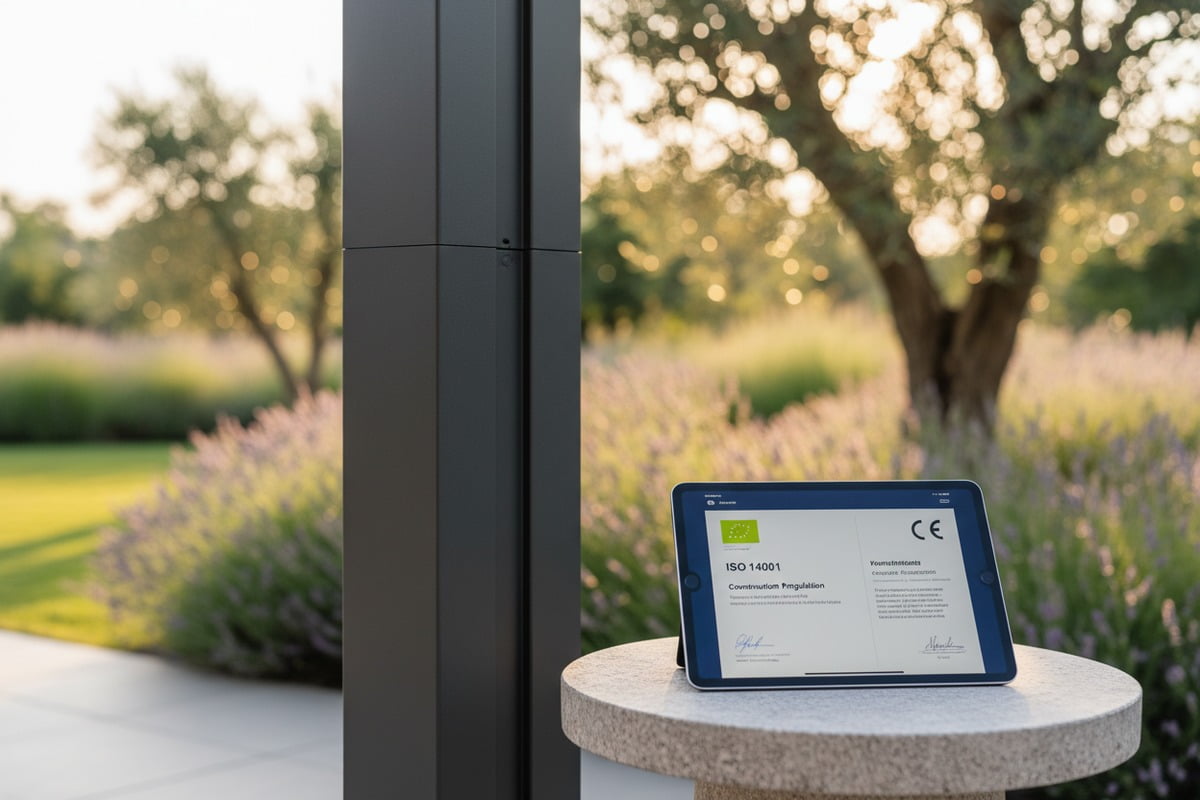
European buyers usually sort certifications into three groups EN 15804-style EPD data 1. First, they look for market-access and quality basi 2cs. Second, they check environmental management and product-level carbon evidence recycled aluminum percentages 3. Third, they look for premium signals that help them win projects in stricter markets like Germany, Switzerland, Norway, Sweden, and Denmark.
Start with the certificates that answer real buyer risk
When we prepare export files, I do not treat every certificate as equal LCA methodology 4. For aluminum pergolas, FSC is not the main issue unless the order includes wood inserts, composite-wood accessories, or timber packaging that must meet a buyer's sourcing policy. For the metal frame itself, distributors care much more about whether the factory runs a documented system and whether the product has traceable environmental data Construction Products framework 5.
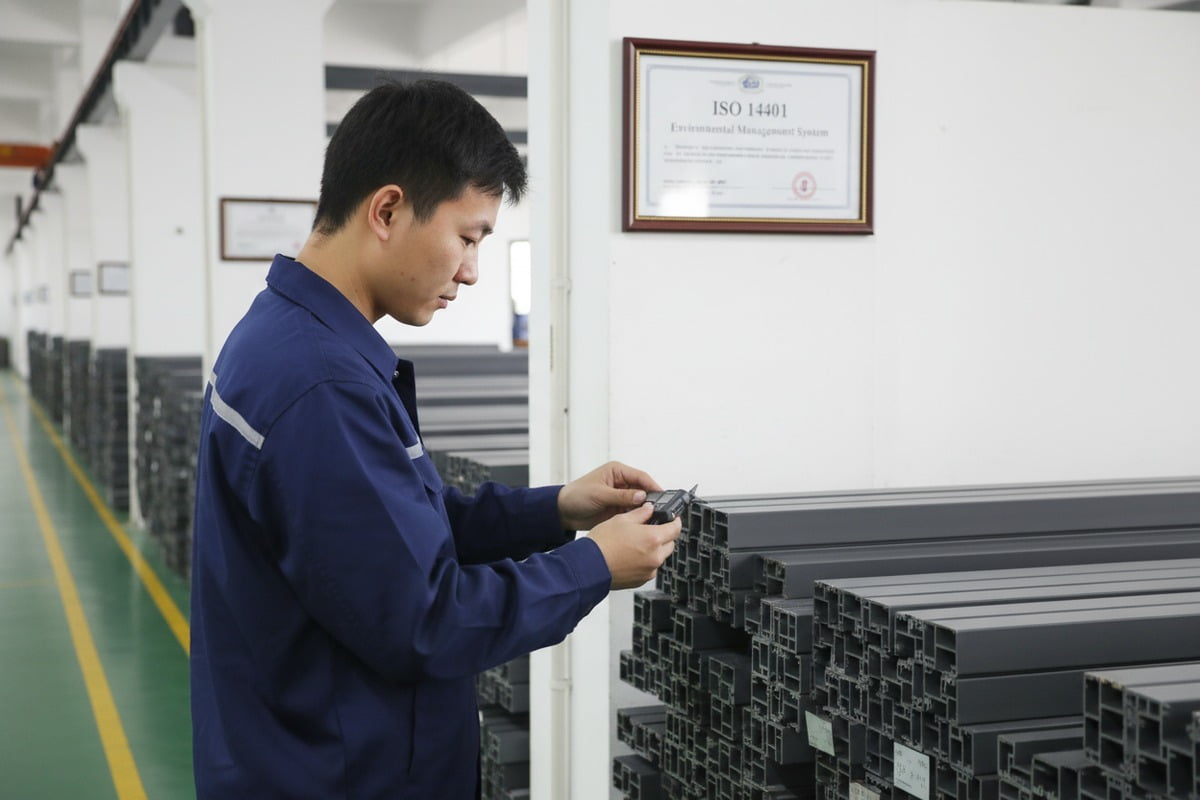
ISO 14001 matters because it shows the factory has an environmental management system. It does not prove one pergola is low carbon by itself, but it tells the buyer that waste, emissions, and compliance are managed in a disciplined way. ISO 9001 6 still matters too. European distributors often read quality control and environmental control together. If one is missing, confidence drops.
An EPD is often the strongest commercial document because it gives product-level data. Buyers can compare Global Warming Potential 7, raw material inputs, transport assumptions, and end-of-life scenarios in a structured format. For premium bids, an EPD aligned with EN 15804 is far more useful than a marketing brochure that only says "green aluminum."
| Certification or proof | Why distributors value it | Priority for aluminum pergolas | Best use case |
|---|---|---|---|
| ISO 14001 8 | Shows environmental management is controlled | Alto | Baseline supplier screening |
| ISO 9001 | Shows process stability and quality control | Alto | Core supplier approval |
| EPD aligned with EN 15804 | Gives comparable product-level environmental data | Alto | Public tenders, B2B projects, green building |
| CE-related compliance documents | Supports legal and technical acceptance where applicable | Alto | EU entry, project documentation |
| ASI chain or sourcing proof | Adds credibility for responsible aluminum sourcing | Medium to high | Premium distributors, brand-sensitive markets |
| Cradle to Cradle 9 | Supports circularity and material health positioning | Medio | High-end sustainability marketing |
| FSC or PEFC | Relevant mainly for wood parts or packaging | Conditional | Hybrid pergola systems |
Know what is basic and what is a differentiator
I have seen importers spend money on the wrong badge while skipping the document buyers actually ask for. That is why I separate "must-have" from "nice-to-have." ISO 14001 and EPD data solve common procurement questions. ASI and Cradle to Cradle become stronger when the distributor serves architects, hotels, public works, or customers chasing LEED or BREEAM points.
Regional habits also matter. Scandinavian buyers often push harder on embodied carbon and traceability. German-speaking markets often combine technical discipline with sustainability proof. Southern Europe can be more price-sensitive, but even there, serious distributors now ask for consistent product files because greenwashing is under more scrutiny.
Watch out for fake depth
Some suppliers list many logos, but the evidence behind them is thin. A distributor will notice fast if the certificate scope does not cover the actual factory, if the date is expired, or if the EPD belongs to a different alloy, profile, or coating system. On our side, we try to match the document to the exact pergola family, not just the company name. That small step prevents later disputes.
The short version is simple. Prioritize the certificates that answer buyer risk, prove factory discipline, and create comparable carbon data. Everything else should support that core stack, not distract from it.
How can I verify the carbon footprint data provided by my Chinese pergola manufacturer?
When our team reviews supplier files, vague carbon numbers create the fastest trust gap; one missing boundary note can turn a low-carbon claim into a procurement risk.
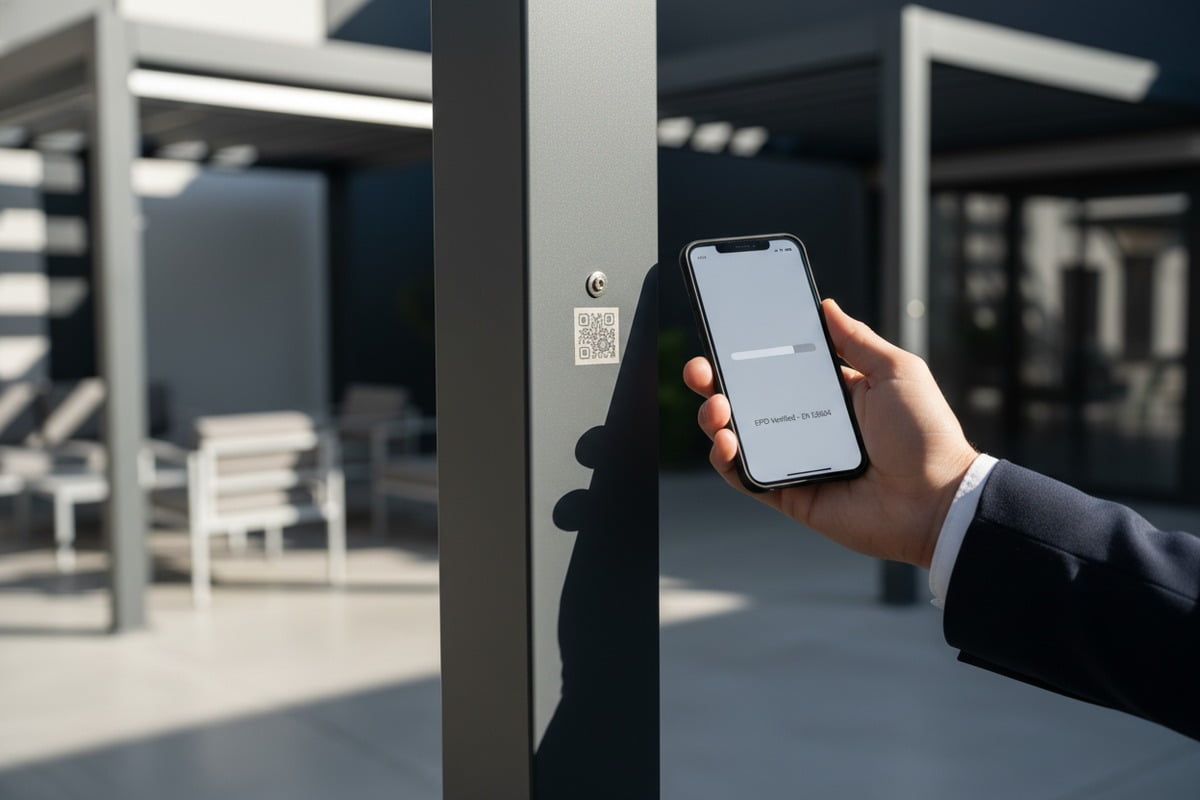
Verify carbon data by checking the LCA method first, not the headline number. Ask for ISO 14040/14044 alignment, EN 15804 structure where relevant, declared system boundaries, product weight, recycled content inputs, energy mix, transport assumptions, and third-party review or EPD registration.
The first rule is simple: never trust one carbon number without context. I have seen two suppliers quote very different footprints for similar pergolas because one used cradle-to-gate data and the other added shipping, installation, maintenance, and end-of-life. The number looked precise, but the comparison was not fair.
Check the functional unit and system boundary first
Ask what the carbon result refers to. Is it per pergola set, per square meter, per kilogram of aluminum profile, or per project? A result per kilogram can look low, but it may hide the total mass of a large pergola. European distributors want apples-to-apples comparison. That means the same unit, the same boundary, and the same product configuration.
For pergolas, many buyers focus on A1-A3 first because raw material extraction, alloy production, extrusion, and coating usually drive most embodied carbon. Still, advanced buyers now ask about transport, packaging, installation, use, repair, and end-of-life. Scope 3 attention is growing fast.
| What to verify | Why it matters | Common red flag |
|---|---|---|
| Functional unit | Makes product comparisons fair | No clear unit stated |
| System boundary | Shows what stages are included | Only one total number with no boundary |
| Product mass | Heavier systems may hide inside good ratios | Carbon result without weight |
| Recycled content basis | Major driver of aluminum footprint | No proof of virgin vs recycled share |
| Electricity mix | Strong impact on extrusion and coating emissions | Generic national average with no site data |
| Transport assumptions | Can change results for exports | Missing route, distance, or mode |
| Third-party review | Improves trust and reduces greenwashing risk | Self-declared spreadsheet only |
Ask for the data behind the carbon claim
When we build a carbon file, we do not start with a pretty PDF. We start with inputs. Buyers should ask for alloy type, billet source, extrusion weight, scrap recovery, powder coating consumption, packaging content, and factory electricity records. If the pergola is motorized, smart controls and accessories should be treated separately or clearly included.
A credible manufacturer should also explain where recycled content comes from. Pre-consumer and post-consumer scrap are both useful, but they are not always counted the same way in every study. If the supplier says "green aluminum" but cannot show the source or percentage, the claim is weak.
Prefer third-party structure over self-made claims
The strongest format is an EPD or an LCA reviewed by an independent party. A self-declared carbon letter can still be useful, but it should be treated as a first step, not the finish line. I usually tell buyers to test the consistency of the story. If recycled content is high, the carbon result should reflect that. If ocean transport is included, the route should make sense. If the powder-coated finish is premium and thick, there should be material use data to support it.
Verification is not about catching someone in a lie. It is about making sure the buyer can defend the number later in a tender, an audit, or a customer conversation.
What documentation do I need to prove my custom pergola orders meet EU sustainability standards?
When we prepare EU project files, the real headache is not the pergola itself; it is proving every claim in one clean pack before the buyer asks twice.
To prove custom pergola orders meet EU sustainability standards, you usually need CE-related compliance documents, a technical file, Declaration of Performance or Declaration of Conformity where applicable, EPD or LCA data, material traceability, coating and test reports, and supplier certificates such as ISO 14001.

For custom pergolas, the document pack matters almost as much as the product. European distributors do not just buy a frame and louver roof. They buy a file they can defend to customs, contractors, developers, and end customers. When one document is missing, the order can stall even if production is already finished.
Build one file that covers compliance, performance, and sustainability
I usually separate the file into three layers. The first layer is legal and technical compliance. This may include CE-related documents where applicable, declarations for motors or electrical parts, product drawings, installation manuals, and test results for wind load, snow load, drainage, and corrosion resistance. The second layer is sustainability proof, such as EPDs, LCAs, recycled-content declarations, and ISO 14001 certificates. The third layer is traceability, which includes raw material certificates, coating batch records, packing lists, and production references.
That structure helps because custom orders change often. A buyer may request a special RAL color, different louvers, zip blinds, screens, LED strips, or motor brands. Each change can affect the supporting file.
| Documento | What it proves | Who usually provides it |
|---|---|---|
| Technical drawings and bill of materials | Exact custom configuration | Manufacturer engineering team |
| Declaration of Performance or Declaration of Conformity where applicable | Product or component compliance status | Manufacturer or component supplier |
| CE-related records for motors, controls, or relevant systems | Market suitability and safety support | Component supplier and final assembler |
| EPD or project LCA data | Embodied carbon and environmental profile | EPD owner, consultant, or manufacturer |
| ISO 14001 and ISO 9001 certificates | Managed factory systems | Accredited certification body |
| Material certificates for aluminum and key parts | Alloy grade and sourcing traceability | Material mill or approved supplier |
| Powder coating and corrosion test reports | Durability and surface performance | Lab or coating supplier |
| Packaging and shipping records | Traceability across delivery chain | Manufacturer and logistics team |
Match the document to the exact order, not just the catalog
This is where many suppliers fail. They send a general certificate pack, but the order is non-standard. If the pergola size, snow load zone, anchoring method, or integrated electronics differ from the tested version, the buyer may ask for revised calculations or updated declarations. In our own export work, we try to link each document to the order code and drawing revision. That simple habit saves a lot of back-and-forth.
Prepare for stricter transparency rules
Another reason to stay organized is the direction of EU policy. Buyers are already talking about digital traceability, and Digital Product Passports 10 under the Ecodesign for Sustainable Products Regulation will push the market toward more granular data. That means material composition, repairability, replacement parts, and end-of-life pathways will become more visible over time.
A clean file also helps sales. Distributors selling to hotels, contractors, or public projects can move faster when every claim is supported in one folder. In practice, the supplier with the better document pack often feels lower risk than the supplier with the slightly lower price.
How does the use of recycled aluminum impact my brand's environmental compliance and market positioning?
On our shop floor, recycled content changes more than cost; it affects carbon math, tender access, and whether a distributor can tell a believable green story.
Recycled aluminum usually strengthens both compliance and market positioning because it cuts embodied carbon sharply, supports EPD results, fits circular-economy messaging, and helps distributors satisfy stricter buyer screening. The benefit is strongest when recycled content is verified, traceable, and tied to stable mechanical performance.
Recycled aluminum has become one of the clearest sustainability signals in the pergola market. The reason is practical, not cosmetic. Primary aluminum is energy intensive. Recycled aluminum can require about 95% less energy than producing new aluminum from bauxite, so even a partial shift in feedstock can change the embodied carbon result in a meaningful way.
Why buyers care so much about recycled content
In Europe, distributors increasingly need a simple story they can defend. "This pergola uses verified recycled aluminum" is easier to support than a vague promise about being eco-friendly. It connects directly to EPD results, procurement questionnaires, and green building conversations. It also helps when buyers compare similar dark charcoal powder-coated pergolas that look almost identical in photos. Carbon profile becomes a real sales point.
Still, the percentage alone is not enough. Buyers want to know whether the content is pre-consumer or post-consumer scrap, whether the alloy quality stays consistent, and whether structural performance remains stable. We have found that serious customers accept recycled content more readily when it comes with alloy certificates, test data, and consistent wall thickness.
| Recycled aluminum position | Likely compliance effect | Likely market effect |
|---|---|---|
| Low or undocumented | Weak support for carbon claims | Hard to stand out, higher greenwashing risk |
| Moderate and verified | Improves EPD and tender responses | Good fit for mainstream EU distributors |
| High and verified | Strong embodied carbon advantage | Better for premium, public, and sustainability-led projects |
| High but poorly documented | Limited real value | Buyers may reject the claim despite the number |
Compliance gains are real, but durability still matters
A lower-carbon material does not help much if the pergola fails early. European distributors still judge durability, corrosion resistance, powder coating quality, and maintenance needs. A pergola that lasts 25 to 30 years can outperform a weaker product with a good recycled story but poor service life. That is why I see the best suppliers combine recycled content with strong engineering, tested coating systems, and repairable components.
This is also where market positioning becomes more nuanced. In Scandinavia and parts of Germany, high recycled content can support premium pricing when the proof is solid. In cost-driven channels, it may not bring a direct price increase, but it can still protect your brand from being screened out. That matters. Staying on the approved supplier list is often more valuable than winning one order with a cheaper but weaker story.
Use recycled content as part of a bigger brand message
The strongest brand position does not rely on one claim. It links recycled aluminum to circular design, modular repair, durable finish, lower maintenance, and transparent documentation. That full package feels credible. It gives distributors language they can use in brochures, tenders, and sales meetings without sounding exaggerated.
In other words, recycled aluminum is powerful, but only when it is measured, documented, and supported by the real performance of the pergola.
Conclusione
European distributors trust pergola suppliers who combine the right certifications, consistent carbon methods, order-specific files, and verified recycled aluminum into one transparent package.
Note a piè di pagina
1. Explains the European standard for Environmental Product Declarations in construction. ︎
2. Official website of the Aluminium Stewardship Initiative, a global standard for responsible aluminum. ︎
3. Details the benefits and impact of recycled aluminum in terms of energy and emissions. ︎
4. The original URL was a 404. This replacement from BSI provides authoritative information on ISO 14040, which outlines the principles and framework for Life Cycle Assessments (LCAs), making it a suitable replacement for 'LCA rules'. ︎
5. Official EU source explaining the regulatory framework for construction products. ︎
6. Official ISO page explaining the standard for quality management systems. ︎
7. EPA explanation of Global Warming Potential as a measure of greenhouse gas impact. ︎
8. Official ISO page detailing the standard for environmental management systems. ︎
9. Official site for Cradle to Cradle Certified products, focusing on circularity and material health. ︎
10. European Commission information on Digital Product Passports for product sustainability. ︎