Every year, our production line ships thousands of aluminium pergolas to European markets, and the feature requests keep evolving.
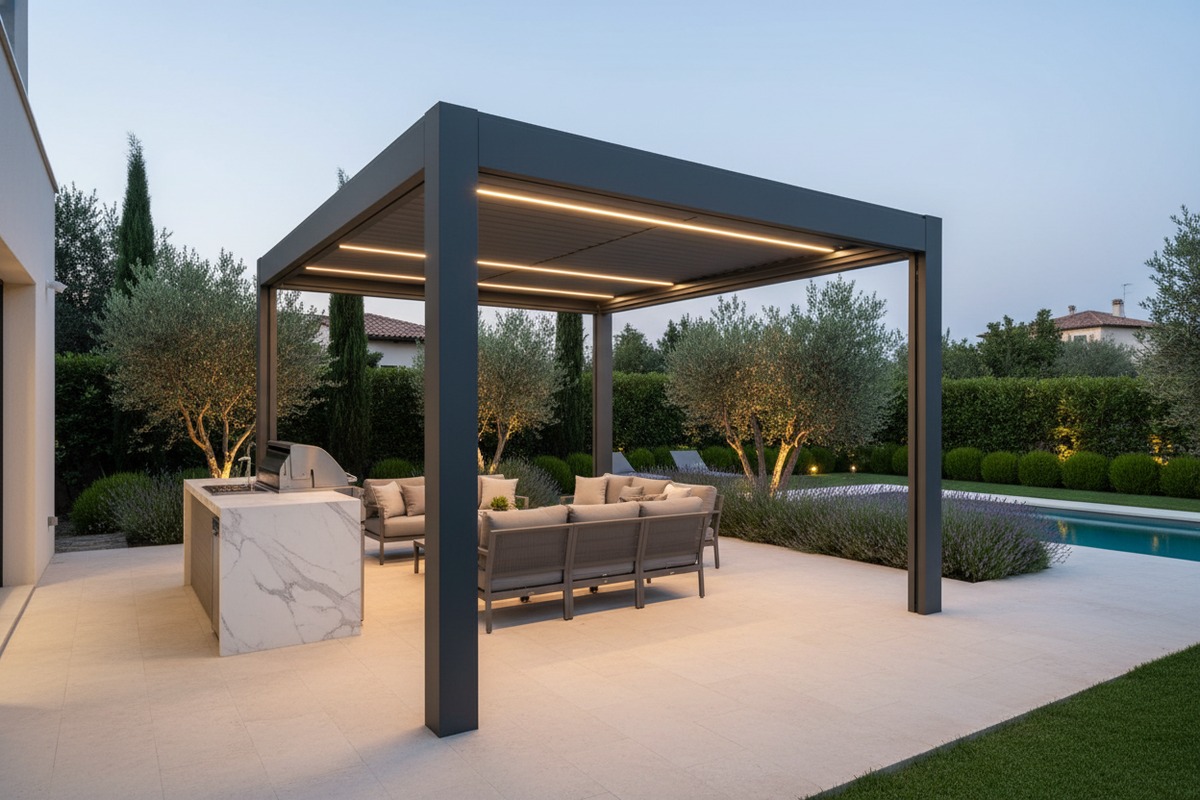
European homeowners love aluminium pergolas that combine motorized louvered roofs, slim minimalist framing, premium powder-coated finishes, integrated LED lighting, smart weather sensors, side privacy screens, outdoor kitchen integration, and durable low-maintenance construction — features that deliver year-round usability, architectural elegance, and weather resilience.
This guide breaks down each of those eight design features in detail Eurocode structural standards 1. You will learn what drives European buying decisions, how to evaluate structural performance, and which finish and technology options actually matter. Let us walk through it section by section.
How can I ensure the aluminum thickness provides enough wind and snow load resistance for my region?
When we test new pergola profiles at our factory, wall thickness is the single variable that separates a safe structure from a liability waiting to happen EN 1991-1-3 2.
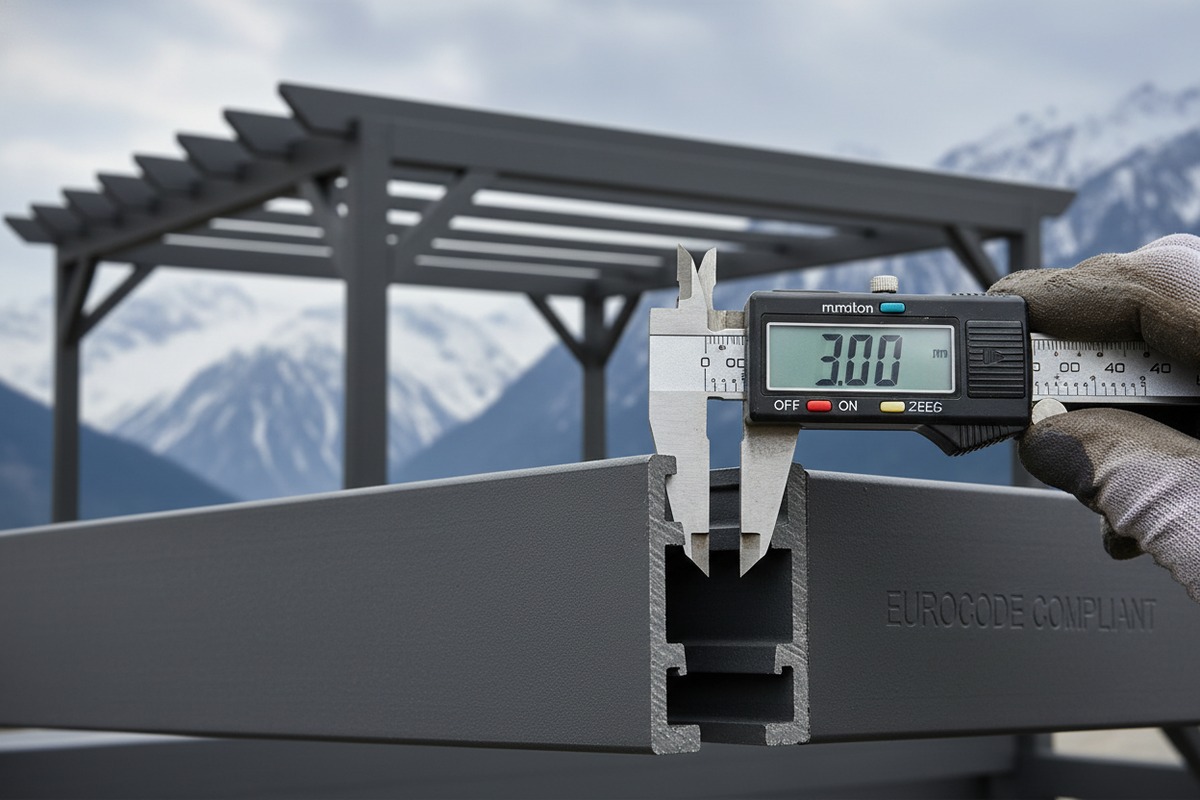
To ensure adequate wind and snow load resistance, verify that your aluminium pergola uses profiles with a minimum wall thickness of 2.0 mm for moderate climates and 2.5–3.0 mm or higher for regions with heavy snow or coastal wind exposure, and always confirm compliance with local Eurocode structural standards.
Why Wall Thickness Matters More Than You Think
Aluminium is lightweight, but that does not mean every aluminium pergola can handle a real European winter EN 1991-1-4 3. In northern France, southern Germany, or alpine Austria, snow loads can exceed 100 kg per square meter. Coastal areas in the Netherlands or Portugal face sustained wind gusts above 100 km/h CE compliance 4. If the profile walls are too thin, the structure flexes, joints loosen, and eventually something fails.
Our engineering team has seen competitors use 1.2 mm or 1.5 mm wall profiles to cut costs. These look identical to a thicker profile in a catalog photo Machinery Directive 2006/42/EC 5. But under load, the difference is dramatic. A 2.0 mm profile can handle roughly 40% more bending stress than a 1.5 mm profile of the same cross-section. For regions with significant snow or wind, 2.5 mm to 3.0 mm is the safer choice.
Eurocode Standards You Should Know
Europe uses the Eurocode system for structural design. The two most relevant codes for pergola buyers are:
- EN 1991-1-3 — Snow loads on structures
- EN 1991-1-4 — Wind actions on structures
These codes define the characteristic loads based on your geographic zone, altitude, and terrain category. A pergola installed in Milan faces different requirements than one in Stockholm. Always ask your supplier whether their structural calculations reference the correct Eurocode zone for your project location.
Regional Load Requirements at a Glance
| Region | Typical Snow Load | Typical Wind Speed | Recommended Min. Wall Thickness |
|---|---|---|---|
| Southern Mediterranean | 0–40 kg/m² | 80–110 km/h | 2.0 mm |
| Central Europe | 40–100 kg/m² | 90–120 km/h | 2.5 mm |
| Northern / Alpine Europe | 100–200+ kg/m² | 100–140 km/h | 3.0 mm or reinforced |
| Coastal Atlantic / North Sea | 20–60 kg/m² | 110–150 km/h | 2.5–3.0 mm |
How to Verify Before You Buy
Ask your supplier for a load test report or a structural calculation certificate. At our facility, we provide FEA (Finite Element Analysis) reports 6 for each pergola model, showing maximum deflection under rated snow and wind loads. If a supplier cannot provide this, treat it as a red flag.
Also check the connection hardware. Thick walls mean nothing if the bolts and brackets are undersized. A complete load path — from roof panel to beam to column to footing — must be verified. We recommend requesting a full installation drawing that shows anchor bolt sizing, base plate dimensions, and recommended foundation depth.
One more thing: if you are a distributor or contractor buying for multiple regions, do not assume one specification fits all. We regularly adjust wall thickness, beam depth, and column spacing for different European climate zones within the same product family. It costs a bit more upfront, but it avoids structural failures and warranty claims later.
Which RAL color customizations and surface finishes are currently trending among my European clients?
Our finishing line runs over 60 RAL colors 7 each quarter, and the patterns we see in European orders tell a clear story about what the market wants right now.
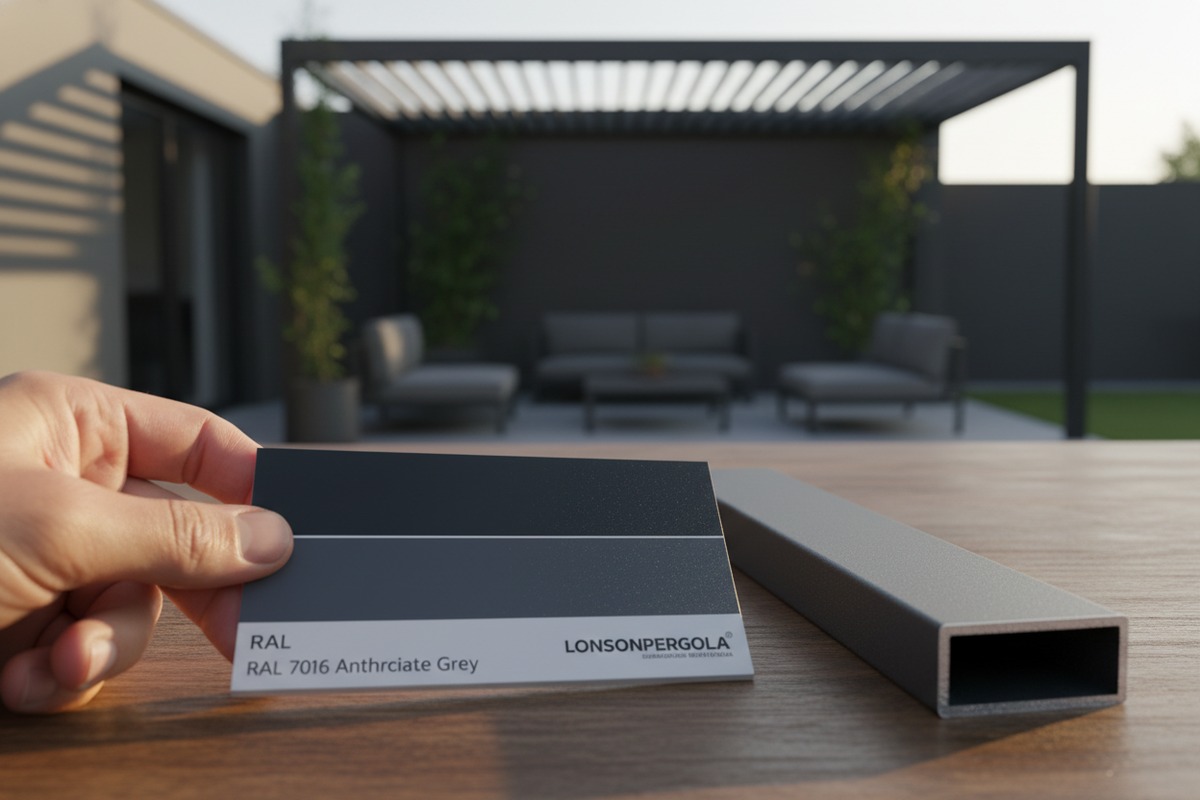
The most popular aluminium pergola finishes in Europe are matte RAL 7016 (anthracite grey), RAL 9005 (jet black), RAL 7021 (black grey), warm neutral tones like RAL 1015, and realistic wood-grain sublimation finishes — all applied as high-quality powder coatings that resist UV fading, chalking, and corrosion for 15 years or more.
The Dominant Color Families
Dark neutrals dominate. RAL 7016 anthracite grey is by far our most ordered color for European shipments. It matches modern window frames, blends with stone and concrete facades, and hides dirt well. RAL 9005 jet black follows closely, especially for contemporary and industrial-style homes. RAL 7021 black grey sits between the two and appeals to buyers who want depth without full black.
Warm neutrals are growing. We see increasing demand for RAL 1015 (light ivory), RAL 7032 (pebble grey), and RAL 9001 (cream white), particularly from southern European markets — Italy, Spain, and southern France — where lighter facades call for softer tones.
Wood-grain finishes are a distinct category. These use sublimation transfer technology to apply realistic timber textures over the powder-coated base. They give homeowners the look of wood without any of the maintenance. Oak, walnut, and teak effects are the most requested patterns.
Finish Types Compared
| Finish Type | Durability | UV Resistance | Cost Level | Il migliore per |
|---|---|---|---|---|
| Standard powder coat | 10–15 years | Good | Low–Mid | Inland, moderate UV areas |
| Super-durable polyester | 15–20 years | Eccellente | Mid | Coastal, high-UV areas |
| PVDF (Kynar) coating 8 | 20–30 years | Superior | Alto | Premium coastal installs |
| Wood-grain sublimation | 10–15 years | Good | Mid–High | Traditional or transitional homes |
| Anodized aluminium | 20+ years | Eccellente | Alto | Minimalist high-end projects |
Why Finish Quality Is Not Just Cosmetic
In coastal areas — the Netherlands, Portugal, western France, Scandinavia — salt spray and high UV exposure will destroy a cheap finish within two to three years. We use Qualicoat Class 2 certified powder coatings 9 as our standard for European orders. This certification means the coating has passed 1,000 hours of salt spray testing and 2,000 hours of accelerated UV aging.
For buyers in particularly harsh environments, we offer PVDF-based coatings, which hold color and gloss for 20 years or more. These cost about 15–20% more than standard powder coats but eliminate recoating costs entirely over the product's lifespan.
Matching the Home Architecture
European homeowners want their pergola to look like it belongs to the house. This means color matching is critical. We keep a library of common European facade and window-frame colors and can match any RAL code within a 3–5 day turnaround. If a client sends a physical sample, our color lab can scan it and produce a custom batch. This level of customization is a major reason contractors and distributors work with us rather than buying stock-color kits.
One practical tip: always request a physical color sample before confirming a large order. Screens and monitors display RAL colors inconsistently. A chip in hand avoids disputes at the job site.
Should I include integrated zip blinds and smart sensors to increase the marketability of my product line?
When we first added zip blinds and rain sensors to our pergola lineup five years ago, the uptake was slow. Now those options account for nearly half of every European order we process.
Yes — integrating zip blinds and smart weather sensors significantly increases the marketability and perceived value of aluminium pergolas in Europe, because they transform a simple shade structure into a fully enclosed, weather-responsive outdoor room that homeowners can use year-round with minimal manual intervention.
What Zip Blinds Add to the Package
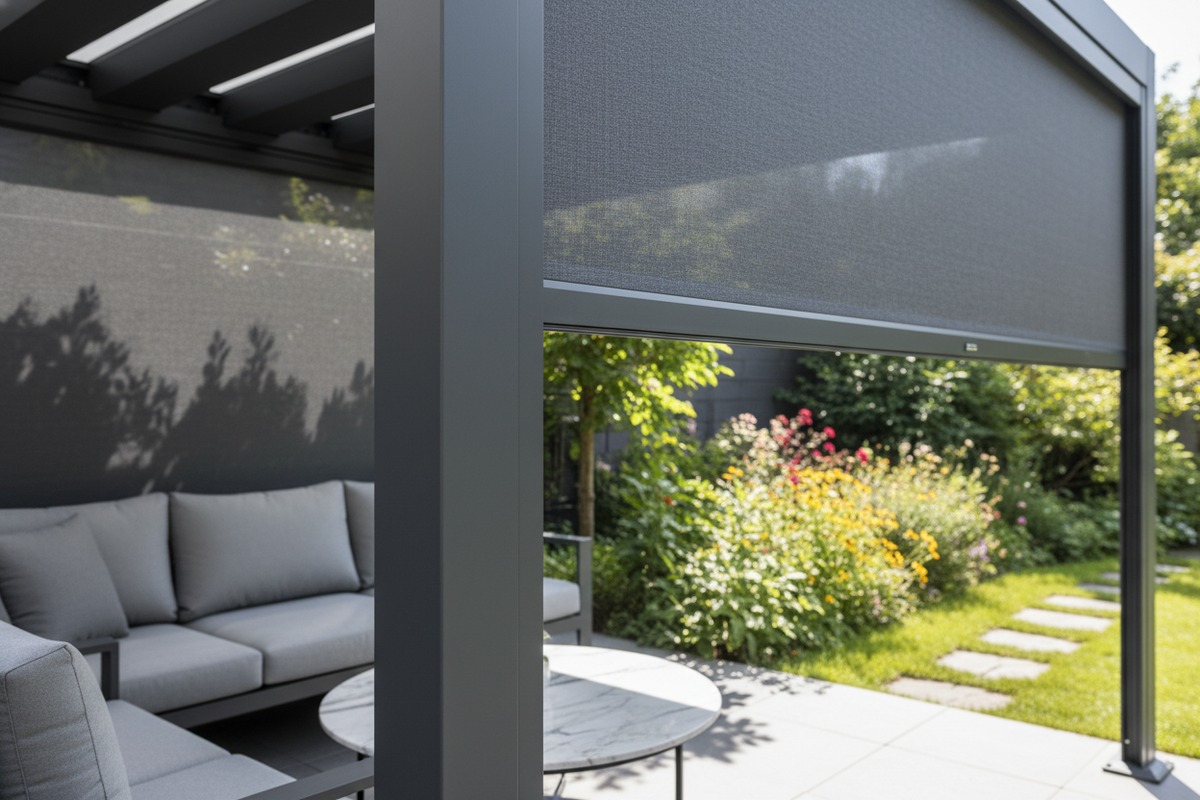
Zip blinds are vertical fabric screens that run in side-mounted aluminium channels with a zipper-like edge seal. When lowered, they block wind, rain spray, insects, and low-angle sun. When raised, the fabric retracts into a compact headbox that stays hidden inside the pergola beam.
The appeal for European homeowners is straightforward. Many gardens are compact. Neighbors are close. Wind is frequent. A pergola with zip blinds creates a private, sheltered zone without permanent walls. Homeowners can open or close each side independently based on conditions.
From a product-line perspective, zip blinds increase the average order value by 20–35%. They also create recurring accessory revenue — replacement fabrics, motor upgrades, and additional screens for future expansions.
Smart Sensors: Convenience That Sells
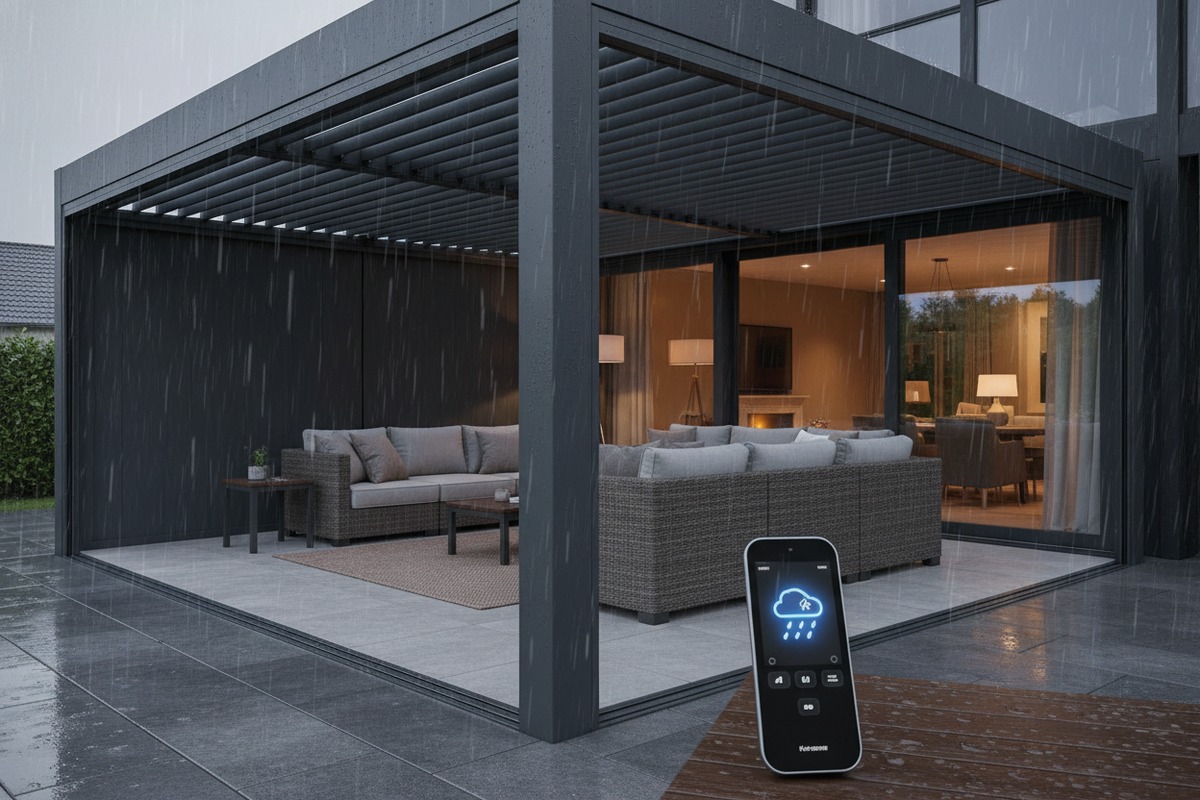
Weather sensors are small devices mounted on the pergola that detect rain, wind speed, sunlight intensity, and sometimes temperature. When conditions change, the system automatically adjusts the louvered roof angle, retracts or deploys zip blinds, and can trigger lighting presets.
Here is what the typical smart sensor package includes:
| Sensor Type | Function | Typical Trigger |
|---|---|---|
| Rain sensor | Closes louvers automatically | First droplets detected |
| Wind sensor | Retracts blinds above threshold | Wind speed > 35–50 km/h |
| Sun sensor | Adjusts louver angle for shade | Light intensity threshold |
| Temperature sensor | Activates heating or ventilation | Below or above set point |
The Balanced View
Not every buyer wants or needs full automation. Some homeowners — especially those on tighter budgets or in mild climates — prefer manual operation. Manual crank systems or basic remote-controlled motors cost significantly less and have fewer failure points.
Our approach is to offer tiered packages. The base package includes a manual or single-remote motor system. The mid-tier adds rain and wind sensors. The premium tier includes full app control, scene programming, and integration with smart home platforms like Google Home or Alexa.
This tiered approach lets distributors serve multiple price points without managing entirely separate product lines. It also reduces the risk of overselling technology to customers who do not need it.
Fabric Selection Matters
For zip blinds specifically, fabric quality is non-negotiable. We use solution-dyed acrylic and PVC-coated polyester fabrics rated for UV resistance (UPF 50+), flame retardancy (EN 13501-1 Class B-s1, d0), and colorfastness (Grade 7–8 on the blue wool scale). Cheap fabrics fray at the zip edge, jam in the channels, and fade within two seasons. That kind of failure damages the entire brand perception — not just the blind, but the pergola too.
How do I verify that the motors and electronic systems comply with mandatory European CE certifications?
Our quality team spends a significant part of every production cycle on motor and electronics compliance, because a single non-certified component can halt an entire shipment at a European port.
To verify CE compliance for pergola motors and electronics, request the manufacturer's EU Declaration of Conformity, check that products carry valid CE markings referencing the correct directives (Machinery Directive 2006/42/EC, Low Voltage Directive 2014/35/EU, and EMC Directive 2014/30/EU), and confirm testing by an accredited third-party laboratory.
Understanding What CE Actually Means
CE marking is not a quality seal. It is a legal declaration that a product meets all applicable EU safety, health, and environmental requirements. For pergola motors and electronic controls, three EU directives are most relevant:
- Machinery Directive 2006/42/EC — Covers motorized moving parts, including louvered roof actuators and blind drive motors.
- Direttiva sulla bassa tensione (LVD) 2014/35/UE — Covers electrical safety for equipment operating between 50 and 1000 V AC.
- EMC Directive 2014/30/EU — Ensures electronic systems do not emit excessive electromagnetic interference and can tolerate interference from other devices.
If your pergola includes radio-frequency remote controls or Wi-Fi-enabled smart controllers, the Radio Equipment Directive (RED) 2014/53/EU also applies.
Documents You Should Request
When evaluating a supplier's compliance claims, ask for these specific documents:
| Documento | Cosa dimostra | Who Issues It |
|---|---|---|
| EU Declaration of Conformity 10 (DoC) | Manufacturer legally declares compliance | The manufacturer |
| CE Test Report | Technical testing against directive requirements | Accredited lab (e.g., TÜV, SGS, Intertek) |
| IP Rating Certificate | Ingress protection level (dust and water) | Accredited lab |
| EN 60335-1 Test Report | General safety of household electrical appliances | Accredited lab |
| RoHS Declaration | Restriction of hazardous substances | Manufacturer or lab |
A genuine DoC will list the specific directives, the harmonized standards applied (such as EN 60335-1 or EN 55014-1), the product model numbers, and the name and address of the responsible person within the EU. If the document is vague, missing directive references, or unsigned, it is not valid.
Red Flags to Watch For
In our experience supplying the European market for over two decades, we have learned to spot the warning signs of non-compliant components:
- No third-party test report. A self-declared DoC without supporting lab evidence is technically legal but risky. Reputable suppliers back their declarations with independent test reports.
- Generic CE marks with no traceability. If the motor carries a CE sticker but the supplier cannot provide the DoC or name the testing lab, the mark may be fraudulent.
- Motors sourced from unverified sub-suppliers. Some pergola assemblers buy the cheapest tubular motors available and never verify their certification status. We audit every motor supplier in our chain annually.
- Missing IP ratings. Outdoor motors should carry at least IP44 for sheltered installations and IP65 for exposed positions. Without a certified IP rating, water ingress will cause premature failure.
Why This Matters for Your Business
If you import non-CE-compliant pergola systems into Europe, you are legally liable. Market surveillance authorities in countries like Germany, France, and the Netherlands conduct random inspections and can issue fines, product recalls, and import bans. Beyond the legal risk, a motor failure caused by a non-compliant component can result in injury claims that far exceed the cost of the pergola itself.
We include a complete compliance dossier — DoC, test reports, IP certificates, and wiring diagrams — with every shipment. This protects our partners and speeds up customs clearance. If your current supplier does not provide this documentation automatically, it is worth asking why.
Conclusione
European homeowners want aluminium pergolas that look refined, perform in tough weather, and adapt to how they actually live outdoors. Choosing the right thickness, finish, smart features, and certified components is what separates a premium product from a forgettable one.
Note a piè di pagina
1. Official EU site for structural design standards. ︎
2. Details the European standard for snow loads on structures. ︎
3. Details the European standard for wind actions on structures. ︎
4. Replaced with an official European Union website providing comprehensive guidance on CE marking. ︎
5. Replaced with the official text of the Machinery Directive 2006/42/EC from EUR-Lex, the European Union's legal database. ︎
6. Explains the use of FEA in structural analysis and design verification. ︎
7. Official site for the standardized color matching system used in Europe. ︎
8. Explains a highly durable coating type for extreme weather conditions. ︎
9. Official site for high-performance certification for powder coatings, ensuring durability. ︎
10. Explains the legal document required for CE marked products in the EU. ︎